
Table of Contents
As filed with the Securities and Exchange Commission on May 9, 2025
Registration No. 333-
UNITED STATES
SECURITIES AND EXCHANGE COMMISSION
Washington, D.C. 20549
FORM S-1
REGISTRATION STATEMENT
UNDER
THE SECURITIES ACT OF 1933
CapsoVision, Inc.
(Exact name of registrant as specified in its charter)
| Delaware | 3845 | 20-3369494 | ||
| (State or other jurisdiction of incorporation or organization) |
(Primary Standard Industrial Classification Code Number) |
(I.R.S. Employer Identification Number) |
18805 Cox Avenue, Suite 250
Saratoga, CA 95070
+1-408-624-1488
(Address, including zip code, and telephone number, including area code, of registrant’s principal executive offices)
Kang-Huai (Johnny) Wang
President and Chief Executive Officer
18805 Cox Avenue, Suite 250
Saratoga, CA 95070
+1-408-624-1488
(Name, address, including zip code, and telephone number, including area code, of agent for service)
Copies to:
| Portia Ku, Esq. O’Melveny & Myers LLP JC Plaza, 12th Floor 1225 Nanjing Road West Shanghai 200040 +86-21-2307-7000 |
Kurt Berney, Esq. O’Melveny & Myers LLP Two Embarcadero Center, 28th Floor San Francisco, California 94111 +1-415-984-8700 |
Richard I. Anslow Jonathan Deblinger Joseph A. Smith Ellenoff Grossman & Schole LLP 1345 Avenue of the Americas, 11th Floor New York, New York 10105 +1-212-370-1300 |
Approximate date of commencement of proposed sale to the public: As soon as practicable after the effective date of this registration statement.
If any of the securities being registered on this form are to be offered on a delayed or continuous basis pursuant to Rule 415 under the Securities Act of 1933, check the following box. ☒
If this form is filed to register additional securities for an offering pursuant to Rule 462(b) under the Securities Act, check the following box and list the Securities Act registration statement number of the earlier effective registration statement for the same offering. ☐
If this form is a post-effective amendment filed pursuant to Rule 462(c) under the Securities Act, check the following box and list the Securities Act registration statement number of the earlier effective registration statement for the same offering. ☐
If this form is a post-effective amendment filed pursuant to Rule 462(d) under the Securities Act, check the following box and list the Securities Act registration statement number of the earlier effective registration statement for the same offering. ☐
Indicate by check mark whether the registrant is a large accelerated filer, an accelerated filer, a non-accelerated filer, a smaller reporting company, or an emerging growth company. See the definitions of “large accelerated filer,” “accelerated filer,” “smaller reporting company” and “emerging growth company” in Rule 12b-2 of the Exchange Act:
| Large accelerated filer | ☐ | Accelerated filer | ☐ | |||
| Non-accelerated filer | ☒ | Smaller reporting company | ☒ | |||
| Emerging growth company | ☒ | |||||
If an emerging growth company, indicate by check mark if the registrant has elected not to use the extended transition period for complying with any new or revised financial accounting standards provided pursuant to Section 7(a)(2)(B) of the Securities Act. ☐
The registrant hereby amends this registration statement on such date or dates as may be necessary to delay its effective date until the registrant shall file a further amendment which specifically states that this registration statement shall thereafter become effective in accordance with Section 8(a) of the Securities Act of 1933 or until the registration statement shall become effective on such date as the Commission, acting pursuant to said Section 8(a), may determine.
Table of Contents
The information in this preliminary prospectus is not complete and may be changed. These securities may not be sold until the registration statement with the Securities and Exchange Commission is effective. This preliminary prospectus is not an offer to sell, nor does it seek an offer to buy these securities in any jurisdiction where the offer or sale is not permitted.
Subject to Completion Dated May 9, 2025
PRELIMINARY PROSPECTUS
Shares

CapsoVision, Inc.
Common Stock
This is the initial public offering of CapsoVision, Inc. We are offering shares of our common stock, par value $0.001 per share. Prior to this offering, there has been no public market for shares of our common stock. We anticipate the initial public offering price will be between $ and $ per share.
In connection with this offering, we have applied to have shares of our common stock listed on the Nasdaq Capital Market (“Nasdaq”) under the symbol “CV”. There can be no assurance that such application will be approved. If shares of our common stock are not approved for listing on Nasdaq, we will not consummate this offering.
We are an “emerging growth company” and a “smaller reporting company” as defined in the federal securities laws and will be subject to reduced public company reporting requirements. See “Prospectus Summary—Implications of Being an Emerging Growth Company” and “Prospectus Summary—Implications of Being a Smaller Reporting Company.”
An investment in shares of our common stock is highly speculative, involves a high degree of risk and should be considered only by persons who can afford the loss of their entire investment, see “Risk Factors” beginning on page 14 of this prospectus before you make your decision to invest in our common stock.
Neither the Securities and Exchange Commission nor any state securities commission has approved or disapproved of these securities or determined if this prospectus is truthful or complete. Any representation to the contrary is a criminal offense.
| Per Share | Total | |||||||
| Initial public offering price(1) |
$ | $ | ||||||
| Underwriting discounts and commissions(2) |
$ | $ | ||||||
| Proceeds to us, before expenses |
$ | $ | ||||||
| (1) | Assuming an initial public offering price is $ , the midpoint of the range set forth on the cover page of this prospectus. |
| (2) | See the section titled “Underwriting” beginning on page 162 for additional information regarding compensation payable to the underwriters. |
In addition to the underwriting discounts and commissions referred to in the table above, we have agreed to issue, upon closing of this offering, warrants to the representative of the underwriters to purchase 3% of the total number of shares of common stock sold in this offering at a per share price equal to 125% of the public offering price (the “Representative’s Warrants”). The registration statement of which this prospectus is a part also covers the Representative’s Warrants and the shares of common stock issuable upon the exercise thereof. See section entitled “Underwriting” on page 162 for more information.
We have granted to the underwriters an option exercisable for a period of 30 days from the closing of this offering to purchase up to additional shares of our common stock from us at the initial public offering price, less the underwriting discounts and commissions, solely to cover over-allotments, if any.
The underwriters expect to deliver the shares of common stock to investors on or about , 2025.
Joint Book-Running Managers
| The Benchmark Company | Roth Capital Partners |
The date of this prospectus is , 2025.
Table of Contents
| Page | ||||
| ii | ||||
| iii | ||||
| 1 | ||||
| 9 | ||||
| 11 | ||||
| 14 | ||||
| 60 | ||||
| 61 | ||||
| 62 | ||||
| 64 | ||||
| Management’s Discussion and Analysis of Financial Condition and Results of Operations |
65 | |||
| 83 | ||||
| 132 | ||||
| 139 | ||||
| 145 | ||||
| Security Ownership of Certain Beneficial Owners and Management |
147 | |||
| 150 | ||||
| 156 | ||||
| Material U.S. Federal Income Tax Consequences for Non-U.S. Holders |
158 | |||
| 162 | ||||
| 174 | ||||
| 175 | ||||
| 176 | ||||
| F-1 | ||||
Table of Contents
No dealer, salesperson or other person is authorized to give any information or to represent anything not contained in this prospectus. You must not rely on any unauthorized information or representations. This prospectus is an offer to sell only the shares offered hereby, but only under circumstances and in jurisdictions where it is lawful to do so. The information contained in this prospectus is current only as of its date.
This prospectus contains estimates, projections, and other information concerning our industry and our business, as well as data regarding market research, estimates, and forecasts prepared by our management or third parties. In particular, there is limited public available data as to the size and growth rates for the broader capsule endoscopy market (including for those medical indications that we seek to address); for the GI-tract medical indications that we and other capsule endoscopy providers seek to target, that portion for which capsule endoscopy is indicated as appropriate for diagnosis, surveillance and screening; assumptions as to Medicare and other third-party payor reimbursement rates; and the impact of various non-capsule competitive products. Information that is based on estimates, forecasts, projections, market research, or similar methodologies is inherently subject to uncertainties, and actual events or circumstances may differ materially from events and circumstances that are assumed in this information. While we believe the market and industry data included in this prospectus are reliable and are based on reasonable assumptions, these data and the industry in which we operate is subject to a high degree of uncertainty and risk due to a variety of factors, including those described in the section titled “Risk Factors.” These and other factors could cause results to differ materially from those expressed in these estimates, publications, and reports made by third parties or us.
Unless otherwise expressly stated, we obtained such industry, business, market, and other data from reports, research surveys, studies, and similar data prepared by market research firms and other third parties, industry and general publications, government data, and similar sources. In some cases, we do not expressly refer to the sources from which this data is derived. In that regard, when we refer to one or more sources of this type of data in any paragraph, you should assume that other data of this type appearing in the same paragraph is derived from the same sources, unless otherwise expressly stated or the context otherwise requires. References provided herein to third-party sources are for convenience and the content of these third-party sources, except to the extent specifically set forth in this prospectus, does not constitute a portion of this prospectus and is not incorporated herein.
Forecasts and other forward-looking information with respect to industry, business, market, and other data are subject to the same qualifications and additional uncertainties regarding the other forward-looking statements in this prospectus. See “Cautionary Note Regarding Forward-Looking Statements.”
ii
Table of Contents
CAUTIONARY NOTE REGARDING FORWARD-LOOKING STATEMENTS
This document contains forward-looking statements. In addition, from time to time, we or our representatives may make forward-looking statements orally or in writing. We base these forward-looking statements on our expectations and projections about future events, which we derive from the information currently available to us. Such forward-looking statements relate to future events or our future performance, including: our financial performance and projections; our growth in revenue and earnings; and our business prospects and opportunities. You can identify forward-looking statements by those that are not historical in nature, particularly those that use terminology such as “may,” “should,” “expects,” “anticipates,” “contemplates,” “estimates,” “believes,” “plans,” “projected,” “predicts,” “potential,” or “hopes” or the negative of these or similar terms. In evaluating these forward-looking statements, you should consider various factors, including: our ability to change the direction of the Company; our ability to keep pace with new technology and changing market needs; and the competitive environment of our business. These and other factors may cause our actual results to differ materially from any forward-looking statement. Forward-looking statements are only predictions. The forward-looking events discussed in this document and other statements made from time to time by us or our representatives, may not occur, and actual events and results may differ materially and are subject to risks, uncertainties and assumptions about us. We are not obligated to publicly update or revise any forward-looking statement, whether as a result of uncertainties and assumptions, the forward-looking events discussed in this document and other statements made from time to time by us or our representatives might not occur.
While we believe we have identified material risks, these risks and uncertainties are not exhaustive. Other sections of this prospectus describe additional factors that could adversely impact our business and financial performance. Moreover, we operate in a very competitive and rapidly changing environment. New risks and uncertainties emerge from time to time, and it is not possible to predict all risks and uncertainties, nor can we assess the impact of all factors on our business or the extent to which any factor, or combination of factors, may cause actual results to differ materially from those contained in any forward-looking statements.
Although we believe the expectations reflected in the forward-looking statements are reasonable, we cannot guarantee future results, level of activity, performance or achievements. Moreover, neither we nor any other person assumes responsibility for the accuracy or completeness of any of these forward-looking statements. You should not rely upon forward-looking statements as predictions of future events. We are under no duty to update any of these forward-looking statements after the date of this prospectus to conform our prior statements to actual results or revised expectations, and we do not intend to do so.
Forward-looking statements include, but are not limited to, statements about:
| • | our expectations regarding the acceptance of our products by patients and doctors; |
| • | our expectations regarding the potential market size for our current CapsoCam Plus capsule and CapsoCam Colon (once FDA cleared) and those markets that we may pursue; |
| • | our plans to increase small bowel capsule sales following recent 510(k) clearance for pediatric use and telehealth supervision and related products currently under development; |
| • | our expected receipt of and related timing for FDA 501(k) clearance of our CapsoCam Colon and related sales; |
| • | our plans and efforts to expand into new indications in terms of new GI pathologies and expanded patient populations; |
| • | our plans and efforts to introduce enhancements and improvements to our products and technologies, including the AI capabilities incorporated into our products; |
| • | our commercialization capabilities and strategies, including our plans to increase revenues and sales capabilities in and outside the United States (the “U.S.”); |
iii
Table of Contents
| • | the implementation of our strategic plan for our business and products and technology; |
| • | our relationships with, and capabilities of, our assembly manufacturers and component suppliers; |
| • | the protection of our intellectual property (including our AI capabilities) including through patents and trade secret protections; |
| • | the expected performance of our products; |
| • | our ability to manage our growth; |
| • | the anticipated use of proceeds from this offering; |
| • | our expectations regarding the time during which we will be an emerging growth company under the Jumpstart Our Business Startups Act of 2012 (the “JOBS Act”) or smaller reporting company under U.S. securities laws; |
| • | estimates of our expenses, future revenue, capital requirements, our needs for additional financing, and our ability to obtain additional capital; |
| • | our ability to continue as a going concern; and |
| • | our future financial performance. |
We caution you not to place undue reliance on the forward-looking statements, which speak only as of the date of this prospectus in the case of forward-looking statements contained in this prospectus.
iv
Table of Contents
This summary highlights information contained elsewhere in this prospectus. This summary does not contain all of the information that you should consider before deciding to invest in our common stock. You should read this entire prospectus carefully, including the “Risk Factors” section, our historical financial statements and the notes thereto, each included elsewhere in this prospectus. Unless otherwise indicated or the context requires otherwise, the words “we,” “us,” “our,” the “Company,” or “our Company,” and “CapsoVision” refer to CapsoVision, Inc., a Delaware corporation.
Overview
We are a commercial-stage medical technology company that develops advanced imaging and artificial intelligence (“AI”) technologies that are deployed in our capsule endoscopy solutions to identify abnormalities of the gastrointestinal (“GI”) tract for diagnostic and screening purposes.
We developed our first capsule endoscope system, currently comprising the CapsoCam Plus single-use capsule and the CapsoCloud and CapsoView software, to panoramically visualize the small-bowel mucosa to investigate abnormalities such as obscure GI bleeding and Crohn’s disease. The capsule acquires and stores video images in onboard memory while moving through the GI tract, and the software component allows healthcare providers to view the video retrieved from the capsule—either by streaming it from the cloud, where it is securely stored, to anywhere, at their convenience, using our CapsoCloud software, or downloading it from the capsule themselves and reviewing it in our CapsoView software. The CapsoCam is a wire-free capsule endoscopy solution, eliminating patient-worn data recorders and providing clinicians a zero-capex, maintenance-free, flexible, and scalable workflow. The CapsoCam Plus is classified as a Class II device and has received FDA marketing authorization through the 510(k) clearance process.
We are (i) in the process of updating CapsoCam Plus to add our self-developed AI assisted reading technology and (ii) targeting related FDA 510(k) clearance of the updated capsule for late 2025, with commercialization shortly thereafter. Our AI assisted reading tools detect and highlight suspected abnormalities for a clinician, reducing their time to review the video and making capsule endoscopy more financially attractive to their practice. Our 510(k) submission and FDA review thereof may be delayed and we may not receive 510(k) clearance from the FDA on a timely basis or at all.
We began sales of our small-bowel capsule system to our provider customers (i.e., primarily gastroenterologists practicing in clinics and/or hospitals) both internationally (in 2012) and in the U.S. (in 2017) through our global sales and marketing team. In the U.S., we sell to customers directly. Internationally, we sell both directly and through qualified exclusive distributors in specified regions. Our largest international markets (based on shipping destination) are France, Germany, and Canada. In 2023, we established a direct sales team in Germany to better serve our customers and strengthen our market presence in this key market. We plan to (i) further grow our existing sales and marketing team to increase small-bowel-related sales and (ii) leverage our existing sales and marketing team to sell future product additions to our GI-tract capsule endoscopy solution.
Our revenue has increased in each year since we began U.S. direct sales in 2020. Our revenues for the years ended December 31, 2023 and 2024 totaled approximately $9.8 million and $11.8 million, respectively, representing a year-over-year growth of approximately 21%. Our revenues for the three months ended March 31, 2024 and 2025 totaled approximately $2.5 million and $2.8 million, respectively, representing a year-over-year growth of approximately 12%. The primary driver for our revenue growth was an increase in the number of CapsoCam Plus capsules sold: an increase of 19% from 2023 to 2024 and 11% from the three month period ended March 31, 2024 to the three month period ended March 31, 2025, with an increase in unit sales of 26% in the U.S. and 4% internationally from 2023 to 2024 and 10% in the U.S. and 13% internationally from the three month period ended March 31, 2024 to the three month period ended March 31, 2025. In 2023 and 2024,
1
Table of Contents
international sales accounted for 26% and 23% of total revenue. In the three month periods ended March 31, 2024 and 2025, international sales accounted for 23% of total revenue. As of March 31, 2025, our small bowel capsule has been used in more than 135,000 patients worldwide and for 2024 our customer retention rate was approximately 90%. All of our revenues to date have been, and in the near-term will continue to be, generated from CapsoCam Plus related sales for the small bowel; and our ability to grow our small-bowel-related revenue is subject to our ability to successfully and timely execute related elements of our revenue growth strategy, including being able to compete effectively against our competitors (including those with an existing FDA-cleared product and that have established a market presence).
To expand beyond small-bowel-related sales, we are developing our next pipeline capsule endoscope product, CapsoCam Colon. Our CapsoCam Colon capsule (i) leverages CapsoCam Plus’s existing capsule design with its panoramic view and (ii) incorporates both our self-developed AI to automatically detect polyps in the video and our polyp-size measurement tool enabled by a 3D sensor in the capsule (polyp size being highly correlated with a polyp’s risk of becoming cancer). Based on our current regulatory development plan, we are targeting CapsoCam Colon revenues beginning in mid-2026 after receiving FDA 510(k) clearance of our second generation of CapsoCam Colon system, designed with a larger field of view and better image quality to improve accuracy, and which would be classified as a Class II device. Our 510(k) submission and FDA review thereof may be delayed and we may not receive 510(k) clearance from the FDA on a timely basis or at all.
Longer term, we believe our CapsoCam family of products, incorporating our panoramic imaging solution, can be adapted to address new GI medical indications. Potential new medical indications include esophageal medical conditions (such as esophageal varices and Barrett’s esophagus) and pancreatic cancer. We plan to commence feasibility studies of CapsoCam’s accuracy in (i) screening esophageal varices (i.e. enlarged blood veins in the esophagus) in cirrhotic patients with portal hypertension in the second half of 2025 and (ii) detecting abnormalities indicative of cancerous and precancerous pancreatic neoplasia (abnormal cell growth) in the first half of 2026, in each case, subject to timely availability of sufficient funding and liquidity and/or potential adjustment of our clinical development priorities.
Our ability to pursue our growth strategies (as described below) is subject to our ability to timely and successfully meet our cash and liquidity needs (through this offering, cash generated from operations and the issuance of additional equity securities or borrowings). These efforts may be adversely impacted by our history of operating losses, accumulated deficit and substantial doubt about our ability to continue as a going concern qualification as stated in the footnotes to our financial statements.
Market Overview
Overview and Challenges of Visualizing Small Bowel and Detecting Small Bowel Pathologies
Diseases of the small bowel include obscure GI bleeding, chronic iron-deficiency anemia, Crohn’s disease, tumors, and polyposis. Obscure GI bleeding is recurrent or persistent GI bleeding of uncertain origin. 5% of all GI bleeding is obscure GI bleeding. In approximately 80% of obscure GI bleeding cases, the origin is localized to the small bowel.1 Chronic iron-deficiency anemia is a condition in which blood lacks adequate healthy red blood cells. Crohn’s disease is a type of inflammatory bowel disease that causes swelling and irritation of the tissues, called inflammation, in the digestive tract.
Capsule endoscopy is the first-line modality for imaging the mucosa of the small bowel including the pathologies characterizing these diseases. Various methods of enteroscopy for reaching the entirety of the small bowel, which is approximately 20 feet long, are invasive, time consuming, and require a high level of skill from the operator of the endoscope. Enteroscopy is still required for biopsy or to provide certain therapies. For diagnostic visualization, however, capsule endoscopy is preferred given its simplicity, non-invasiveness, and relatively low cost.
| 1 | Lee, Bo-In (2022). Indications and Contraindications of Small-bowel Capsule Endoscopy. In: Chun, H.J., Seol, SY., Choi, MG., Cho, J.Y. (eds) Small Intestine Disease. Springer, Singapore. |
2
Table of Contents
Our Addressable Market Opportunity in Visualizing Small Bowel and Detecting Small Bowel Pathologies
The global capsule endoscopy market for the small bowel is estimated to be approximately $227 million in 2025 and is forecasted to reach approximately $335 million in 2030. The U.S. capsule endoscopy market for the small bowel is estimated to be approximately $87 million in 2025 and is forecasted to reach approximately $126 million in 2030.2
Overview and Challenges of Detecting Colon Polyps
A colon polyp is a clump of cells that forms on the lining of the colon. Most colon polyps are harmless, but, over time, some colon polyps develop into colorectal cancer (“CRC”). The size of a polyp is highly correlated with its risk of becoming cancerous.
Currently, optical colonoscopy, accompanied by polypectomy and biopsy, is considered the gold-standard for the detection of colorectal polyps and cancers. Each year in the U.S., there are approximately 153,000 new cases of CRC and approximately 53,000 deaths.3 It is widely accepted that CRC is among the most preventable, yet least-prevented cancers. CRC can take up to 10-15 years to progress from a pre-cancerous lesion to metastatic cancer and death. Patients who are diagnosed early in the progression of the disease—with pre-cancerous lesions or early-stage cancer—are more likely to have a complete recovery and to be treated less expensively.
Our Addressable Market Opportunity in Colon Capsule Endoscopy
The global colon capsule endoscopy market is estimated to be approximately $213 million in 2025 and is forecasted to reach approximately $311 million in 2030.4 These estimates only consider current products on the market and do not take into account advanced products currently in development and/or awaiting approval for introduction into the market. We believe that our CapsoCam Colon, once FDA cleared and commercialized, will be a superior capsule endoscopy system that will expand the market for colon capsule endoscopy.
Our Solutions
CapsoCam Plus
Our CapsoCam Plus capsule endoscopy system is intended for visualization of the small bowel mucosa, to detect abnormalities of the small bowel in adults and children aged 2 years and above. We believe that our CapsoCam Plus is a superior capsule endoscopy system compared to competitor systems, both in how it captures and presents images of the GI tract and the clinical workflow and patient experience that it enables.
CapsoCam Colon
We have developed our next pipeline product, CapsoCam Colon, for visualization of the colon and detection and measurement of polyps. We believe that our CapsoCam Colon, once FDA cleared, will be a superior capsule endoscopy system compared to competitor systems, both in how it captures and presents images of the GI tract and the clinical workflow and patient experience that it enables. As described below under “—Our Growth Strategies”, we are conducting relevant clinical development activities (including our recently concluded first
| 2 | Grand View Research, Inc., “Capsule Endoscopy Market Estimates & Trend Analysis From 2018 to 2030,” an independent report commissioned by CapsoVision, Inc. |
| 3 | https://www.cancer.org/cancer/types/colon-rectal-cancer/about/key-statistics.html |
| 4 | Grand View Research, Inc., “Capsule Endoscopy Market Estimates & Trend Analysis From 2018 to 2030,” an independent report commissioned by CapsoVision, Inc. |
3
Table of Contents
arm of our pivotal study involving 1,327 patients enrolled at 20 sites throughout the U.S.) and product enhancement activities to position us to commercialize CapsoCam Colon by mid-2026.
Our Strengths
We believe the continued growth of our Company will be driven by the following factors:
| • | Sole capsule endoscope with a 360° panoramic view available in the market. We believe only our CapsoCam Plus boasts a 360° panoramic lateral view. It houses four high-resolution cameras around its circumference, and the images from each are stitched into a single panoramic image. Compared to competitive end-view systems, a 360° panoramic lateral view provides a complete view of the GI mucosa—unobstructed by folds and with complete coverage of the bending intestine’s inner curvature, resulting in demonstrated superior diagnostic yield. |
| • | Telemedicine-enabled and zero-capex “wire-free” data collection and remote data analysis. Our CapsoCam is a zero-capex “wire-free” data collection solution for providers, as it stores the entire video in onboard memory. In December 2024, we received FDA 510(k) clearance for telemedicine supervision (i.e., remote ingestion) of our CapsoCam Plus, allowing patients to ingest our capsule in the comfort of their own homes, under the remote supervision of providers. The CapsoCam solution frees up exam-room schedules for providers and provides flexibility to administer capsules any day at any time. A provider’s practice can easily scale to multiple capsules per day with no added cost, and there is no equipment to recover from patients. Our CapsoCam Plus solution includes our cloud-based platform, CapsoCloud, which provides a flexible, trackable, streamlined, and capital-equipment-free workflow for providers in the U.S. It allows clinicians to track procedures and stream in vivo videos anywhere at their convenience, generate reports, store and manage patient data, and transfer data to third-party reading services. We believe at-home procedures and remote analysis via CapsoCloud will be attractive to providers and patients alike, particularly for future screening indications. |
| • | Automated pathology detection due to usage of AI. CapsoCam Colon (subject to FDA clearance) incorporates deep learning AI for automated pathology detection of polyps, a capability that competitive systems lack. In the second half of 2025, we also plan to file for FDA and EU clearance for the use of AI in our CapsoCam Plus capsule. Our AI assisted reading tools detect and highlight suspected abnormalities for a clinician, reducing their time to review the video and making capsule endoscopy more financially attractive to their practice. CapsoCloud continuously acquires consenting patients’ clinical data, enabling our in-house AI experts to develop ever-improving automated lesion detection and classification. Our 510(k) submission and FDA review thereof may be delayed and we may not receive 510(k) clearance from the FDA on a timely basis or at all. |
| • | 3D-sensing technology informs follow-on care decisions. Our CapsoCam Colon (subject to FDA clearance) incorporates our proprietary 3D-sensing technology to more accurately measure polyp sizes. Polyp size is highly correlated with its risk of becoming cancer. No other capsule endoscope currently in the market has 3D-enabled measurement capability. With automated pathology detection and the ability to manually review video frames adjacent to an identified polyp, physicians can more confidently decide that patients with small polyps (e.g., less than 6mm) may forgo a follow-on colonoscopy, increasing the utility of the procedure for healthcare providers and patients alike. |
| • | Experienced leadership team. Our senior management team consists of industry professionals with deep industry expertise across various disciplines, including medical technology, engineering, optics, sales and marketing, finance, operations, data science, AI, and clinical operations and research. |
4
Table of Contents
Our Growth Strategies
Our long-term, lifesaving vision is an ingestible capsule that, in a single convenient non-invasive procedure, screens for multiple cancers—esophageal, gastric, pancreatic, small-bowel, and colorectal—at early and precancerous stages, utilizing AI to analyze thousands of images captured in the GI tract. We are building towards this goal with a planned succession of FDA-cleared indications, targeting existing and nascent markets. Until then, key elements of our nearer-term growth strategy include:
| • | Obtain 510(k) clearance of CapsoCam Colon. We are developing CapsoCam Colon for visualization of the colon and detection and measurement of polyps. In addition to having a 360° panoramic lateral view, CapsoCam Colon incorporates deep learning AI for automated pathology detection of polyps and 3D-sensing technology to more accurately measure polyp sizes. We are currently actively analyzing the data collected from the first arm of our pivotal study to support 510(k) clearance of CapsoCam Colon for use by currently indicated patients who are a subset of the colorectal cancer screening and surveillance populations. The first arm of our pivotal study involved 1,327 patients enrolled at 20 sites throughout the U.S. Based on the clinical results from the pivotal study, and assuming results are favorable, we are planning to submit our 510(k) application, with two existing capsule endoscopies as predicate devices (one for the capsule and one for the incorporated AI), to the FDA in the first half of 2025 with a goal of obtaining 510(k) clearance in late 2025. To enhance the sensitivity and specificity of CapsoCam Colon for detecting and measuring polyps, we are developing our second-generation CapsoCam Colon capsule, which will include improvements such as a new lens and illumination optics with an increased field of view and improved image quality, and will extend our pivotal study to include a second arm, which is expected to involve approximately 200 patients enrolled at up to 10 sites in the U.S. We plan to use the clinical results of the second arm to support submission to the FDA of a 510(k) application in late 2025 with a goal of obtaining 510(k) clearance in the first half of 2026. There is no guarantee that the clinical results of any of our clinical trials will demonstrate the requisite performance needed to meet applicable regulatory requirements in order to obtain FDA clearance. Current indications for colon capsule endoscopy are limited to patients with evidence of lower-GI bleeding (such as a positive stool test) for whom the risk of colonoscopy or moderate sedation is significant and for patients who have had an incomplete colonoscopy, with adequate preparation. As a part of this second 510(k) application to increase the population of indicated patients, we intend to seek FDA clearance of expanded indications that remove the requirement for evidence of GI bleeding of lower GI origin for patients with major risks for colonoscopy or moderate sedation. Our 510(k) submission and FDA review thereof may be delayed and we may not receive 510(k) clearance from the FDA on a timely basis or at all. |
| • | Expand clinical use cases and accessories for CapsoCam Plus. In December 2024, we received 510(k) clearance of our CapsoCam Plus for pediatric use in children aged 2 years and above and telemedicine supervision (i.e., remote ingestion). Also, we are currently developing a capsule delivery device (availability expected in 2025) for patients who are unable to swallow the capsule, many of whom are children. The capsule delivery device should enable faster penetration of the newly indicated pediatric market. We are also currently developing a patency capsule (tentative FDA 510(k) submission planned by mid-2025), which is used primarily with Crohn’s disease patients to verify that a capsule endoscope can pass through the GI tract without retention at a stricture, a narrowing of the small bowel which can result from inflammation and scarring associated with Crohn’s disease. |
| • | Continue to improve and innovate our GI-tract capsule endoscopy solution. Our research and development initiatives are focused on introducing enhancements and improvements aimed at increasing the value provided by our GI-tract capsule endoscopy solution. In particular, we are working on improvements to our CapsoCam, including a new lens and illumination optics with an increased field of view, improved image quality and higher peak frame rate. For our AI assisted reading technology, we plan to continue investing to (i) improve the pathology-detection and classification accuracy and the |
5
Table of Contents
| scope of our AI algorithms and (ii) apply AI, including large language models, to streamline the diagnostic and medical-report-generation processes, which in turn improves the efficiency and effectiveness of our healthcare provider customers. We also plan to continue making improvements to our CapsoCloud and CapsoView software. |
| • | Expand into new indications and clinical use cases beyond small bowel and colon. In the second half of 2025, we plan to commence feasibility studies of our CapsoCam’s accuracy in screening esophageal varices in cirrhotic patients with portal hypertension, subject to timely availability of sufficient funding and liquidity and/or potential adjustment of our clinical development priorities. Patients with cirrhosis who develop portal hypertension are at risk for complications, including bleeding from esophageal varices. Portal hypertension is the result of resistance to portal blood flow, which most often occurs in the liver and with increases in portal blood flow. When esophageal varices rupture, bleeding may be severe and life- threatening. There are approximately 5.5 million people in the U.S. with Cirrhosis.5 Up to 85% of cirrhotic patients at some point develop esophageal varices6, a significant clinical stage.7 Esophageal varices is one of the most common causes of acute upper gastrointestinal bleeding. Acute variceal bleeding is a potentially fatal complication of liver cirrhosis and represents an important economic and population health issue.8 We believe that our CapsoCam’s panoramic imaging is particularly well suited to visualizing the esophagus and measuring the size of varices, which may translate to significant improvement in sensitivity and staging accuracy. In the first half of 2026, we plan to commence feasibility studies of our CapsoCam’s accuracy in detecting abnormalities indicative of cancerous and precancerous pancreatic neoplasia (abnormal cell growth) by visualizing abnormalities of the duodenal papilla, subject to timely availability of sufficient funding and liquidity and/or potential adjustment of our clinical development priorities. A dilated, or unnaturally opened, duodenal papilla is correlated with GI tract content reflux into the pancreas duct and pancreatic neoplasia and may indicate the presence of, or elevated risk of developing, serious abnormalities like pancreatitis or a tumor of the pancreas. The CapsoCam has detected the duodenal papilla (Ampulla of Vater) at a higher rate than non-panoramic systems in prior studies. For example, a 2024 retrospective study was conducted at a single Japanese center with 33 patients ingesting the CapsoCam Plus and another random sample of propensity-score-matched patients ingesting the Medtronic PillCam SB3. Physician video readers observed the duodenal papilla at a significantly higher rate using the CapsoCam Plus (82% vs. 15%, p < 0.001).9 There is currently no effective screening for pancreatic cancer. |
Risks Relating to Our Business
Our business and ability to execute our business strategy are subject to a number of risks of which you should be aware before you decide to buy our securities. In particular, you should consider the following risks, which are discussed more fully in the section entitled “Risk Factors”:
| • | We have a history of net losses and expect to incur additional losses in the foreseeable future. |
| • | Our 2024 audited financial statements include a footnote raising substantial doubt about our ability to continue as a “going concern” and, even if this offering is successful, we will likely need to raise additional financing to fund our business and revenue growth plans. |
| • | All of our revenues to date have been, and in the near-term will continue to be, generated from CapsoCam Plus small bowel related sales; and growing our small-bowel-related revenue is subject to our ability to successfully and timely execute related elements of our revenue growth strategy. |
| 5 | https://gi.org/topics/liver-cirrhosis/ |
| 6 | Socrate Pallio, et al. Diagnosis and Management of Esophagogastric Varices. Diagnostics 2023, 13, 1031. |
| 7 | D’Amico G, Pasta L, Morabito A, et al. Competing risks and prognostic stages of cirrhosis: a 25-year inception cohort study of 494 patients. Aliment Pharmacol Ther. 2014; 39:1180–1193. |
| 8 | Socrate Pallio, et al. Diagnosis and Management of Esophagogastric Varices. Diagnostics 2023, 13, 1031 |
| 9 | Hirata, Issei; Tsuboi, Akiyoshi; Matsubara, Yuka; Sumioka, Akihiko; Takasago, Takeshi; Tanaka, Hidenori; Yamashita, Ken; Takigawa, Hidehiko; Urabe, Yuji; Oka, Shiro. Clinical usefulness and acceptability of small-bowel capsule endoscopy with panoramic imaging compared with axial imaging in Japanese patients. DEN Open. 2024 Jun 6 |
6
Table of Contents
| • | Currently we do not expect CapsoCam Colon-related revenues until mid-2026 given the anticipated timing of FDA clearance of our second generation CapsoCam Colon solution. |
| • | Broad adoption of our CapsoCam Colon solution (once cleared) and growing related revenues depend on, among other things, expanding beyond CapsoCam Colon’s initial indicated patient population and a successful completion rate for our capsule colonoscopy, increasing the accuracy of our initial CapsoCam Colon solution; and we may fail to successfully and timely execute related elements of our CapsoCam Colon adoption and revenue growth strategy. |
| • | Longer term efforts to expand our GI-tract capsule endoscopy solutions beyond small bowel and colon pathologies and medical conditions may not succeed. |
| • | We may not obtain or may experience delays in obtaining 510(k) clearance for our initial or planned second generation of our CapsoCam Colon capsule endoscopy solution (with improved optics and other components), which would adversely impact our ability to commercialize this product. |
| • | We may face regulatory challenges and delays in obtaining 510(k) clearance for marketing of those CapsoCam capsules incorporating our self-developed AI assisted reading technology. |
| • | Any failure or defect in our GI-tract capsule endoscopy solution could harm our reputation, expose us to liability, and reduce our sales. |
| • | We rely on various suppliers to assist us in the assembly and manufacture of our GI-tract capsule endoscopy solution and sourcing of critical and other components and many of these suppliers are single-source suppliers located in Asia (particularly Taiwan and Japan); any disruption in our supply chain could adversely affect our ability to meet the demand for our products and fulfil our orders. |
| • | We face substantial geopolitical and trade risks (including a possible trade war and imposition of tariffs and supply chain interruptions) and natural disaster risks associated with our business operations in Asia (particularly Taiwan and Japan). |
| • | If Medicare and other third-party payors do not approve reimbursement for our products at adequate reimbursement rates, we may be unable to successfully commercialize our products. |
| • | If we or our distributors fail to comply with regulatory requirements, we may be subject to stringent penalties and our business may be materially adversely affected. |
| • | Our success will depend on our ability to obtain, maintain, enforce, and protect our intellectual property rights. |
| • | If we fail to identify our patentable inventions or adequately protect our patent rights, the commercial value of our products, services or technologies may be adversely affected and our competitive position may be harmed. |
Implications of Being an Emerging Growth Company
We qualify as an “emerging growth company” under the federal securities laws and, therefore, we may take advantage of certain exemptions from various public company reporting requirements, including:
| • | a requirement to only have two years of audited financial statements and only two years of related selected financial data and management’s discussion and analysis; |
| • | exemption from the auditor attestation requirement on the effectiveness of our internal control over financial reporting; |
| • | election not to adopt new or revised accounting standards until they become effective for private companies; |
| • | reduced disclosure obligations regarding executive compensation; and |
7
Table of Contents
| • | exemptions from the requirements of holding a non-binding advisory stockholder vote on executive compensation and any golden parachute payments. |
We may take advantage of these provisions for up to five years or such earlier time that we are no longer an emerging growth company. We would cease to be an emerging growth company if we have more than $1.235 billion in total annual growth revenues, have issued more than $1 billion of non-convertible debt in the past three years, or if we are deemed to be a large accelerated filer under the rules of the Securities and Exchange Commission (the “SEC”). We may choose to take advantage of some, but not all, of the available benefits available to emerging growth companies. We have taken advantage of some of the reduced reporting requirements in this prospectus. Accordingly, the information contained herein may be different than the information you receive from other public companies in which you hold stock. In addition, an emerging growth company may delay adopting new or revised accounting standards until such time as those standards apply to private companies. We have elected to avail ourselves of this exemption from new or revised accounting standards and, therefore, we will not be subject to the same new or revised accounting standards as other public companies that are not emerging growth companies.
Implications of Being a Smaller Reporting Company
We are a smaller reporting company as defined in the Securities Exchange Act of 1934, as amended (the “Exchange Act”). We may take advantage of certain of the scaled disclosures available to smaller reporting companies and will be able to take advantage of these scaled disclosures for so long as (i) the market value of our voting and non-voting common stock held by non-affiliates is less than $250 million measured on the last business day of our second fiscal quarter or (ii) our annual revenue is less than $100 million during the most recently completed fiscal year and the market value of our voting and non-voting common stock held by non-affiliates is less than $700 million measured on the last business day of our second fiscal quarter. If we are a smaller reporting company at the time we cease to be an emerging growth company, we may continue to rely on exemptions from certain disclosure requirements that are available to smaller reporting companies. Specifically, as a smaller reporting company, we may choose to present only the two most recent fiscal years of audited financial statements in our Annual Report on Form 10-K and we are not required to comply with the auditor attestation requirements of Section 404(b) of the Sarbanes-Oxley Act of 2002, as amended (the “Sarbanes-Oxley Act”), and, similar to emerging growth companies, smaller reporting companies have reduced disclosure obligations regarding executive compensation.
Company Information
We were incorporated under the laws of the State of Delaware on August 1, 2005, under the name “Capso Vision, Inc.” and changed our name to CapsoVision, Inc. on May 31, 2016. Our principal executive office is located at 18805 Cox Ave, Suite 250, Saratoga, CA 95070. Our website address is CapsoVision.com. The information on or accessible through our website is not part of this prospectus.
8
Table of Contents
| Securities we are offering |
shares of common stock. |
| Initial public offering price |
We anticipate the initial public offering price will be between $ and $ per share. |
| Shares of common stock outstanding immediately before this offering |
shares. |
| Shares of common stock outstanding immediately after this offering |
shares. |
| Over-allotment option |
We have granted the underwriters an option, exercisable for 30 days from the closing of this offering, to purchase up to an additional shares of our common stock at the initial public offering price less underwriting discounts and commissions, solely to cover over-allotments, if any. |
| Use of proceeds |
We intend to use the net proceeds of this offering for general corporate purposes. See “Use of Proceeds”. |
| Risk Factors |
See section titled “Risk Factors” and other information appearing elsewhere in this prospectus for a discussion of factors you should carefully consider before deciding whether to invest in our securities. |
| Lock-up |
We, our directors, executive officers, and holders (but limited to such holders that hold an aggregate of not more than 95%) of the outstanding shares of our common stock have agreed not to offer, issue, sell, contract to sell, encumber, grant any option for the sale of or otherwise dispose of any of our securities for a period of 6 months after the date of closing of this offering. See “Underwriting.” |
| Representative’s Warrants |
We have agreed to issue to the representative of the underwriters or its designees at the closing of this offering, warrants to purchase the number of shares of our common stock equal to 3% of the aggregate number of shares sold in this offering (the “Representative’s Warrants”). The Representative’s Warrants will be exercisable at any time and from time to time, in whole or in part, during the five (5) year period commencing six (6) months after the closing of this offering and may be exercised on a cashless basis. The exercise price of the Representative’s Warrants will equal 125% of the initial public offering price per share, subject to adjustments. See “Underwriting.” |
| Nasdaq listing and symbol |
In connection with this offering, we have applied to have shares of our common stock listed on Nasdaq under the symbol “CV”. No assurance can be given that our application for listing will be approved by Nasdaq or that a trading market will develop for our common stock. We will not proceed with this offering in the event shares of our common stock are not approved for listing on Nasdaq. |
9
Table of Contents
The number of shares of common stock to be outstanding after this offering is based on shares outstanding as of March 31, 2025 and reflects the Preferred Stock Conversion, as defined and described below.
The number of shares of our common stock to be outstanding after this offering does not include:
| • | shares of our common stock issuable upon the exercise of outstanding warrants as of March 31, 2025 with a weighted-average exercise price of $1.45 per share; |
| • | shares of our common stock issuable upon the exercise of outstanding stock options as of March 31, 2025, with a weighted-average exercise price of $ per share; |
| • | shares of our common stock issuable upon the exercise of outstanding stock options granted subsequent to March 31, 2025, with a weighted-average exercise price of $ per share; and |
| • | shares of our common stock reserved for future issuance under our 2025 Equity Incentive Plan (the “2025 Plan”), which will become effective as of the date immediately prior to the date our registration statement relating to this offering becomes effective, as well as any future increases in the number of shares of common stock reserved for issuance under the 2025 Plan. |
Unless otherwise indicated, all information contained in this prospectus, including the number of shares of common stock that will be outstanding after this offering, assumes or gives effect to:
| • | the adoption, filing, and effectiveness of our amended and restated certificate of incorporation, to be in effect immediately prior to the completion of this offering, and the adoption of our amended and restated bylaws, to be in effect upon the effectiveness of the registration statement of which this prospectus forms a part; |
| • | the conversion of all the outstanding shares of our Series A, Series B, Series C, Series C-1, Series D, Series D-1, Series D-2, Series E, Series F-1, Series F-2, Series G, Series G-1 and Series H preferred stock into an aggregate of shares of our common stock, the conversion of which will occur immediately prior to the completion of this offering (the “Preferred Stock Conversion”); |
| • | no exercise of outstanding warrants or options subsequent to March 31, 2025; |
| • | a -for- reverse stock split of our common stock, which we effected on , 2025 and a corresponding adjustment to the ratio of the Preferred Stock Conversion and adjustment to our outstanding warrants; and |
| • | no exercise by the underwriters of their option to purchase up to additional shares of our common stock and the Representative’s Warrants. |
10
Table of Contents
The following tables sets forth our summary financial data for the periods and as of the dates indicated. The following summary statements of operations data for the years ended December 31, 2023 and 2024 have been derived from our audited financial statements included elsewhere in this prospectus. The following summary interim condensed statements of operations data for the three months ended March 31, 2024 and 2025, and the summary interim condensed balance sheet data as of March 31, 2025, have been derived from our unaudited interim condensed financial statements included elsewhere in this prospectus. Our audited financial statements and unaudited interim financial statements included elsewhere in this prospectus have been prepared in accordance with U.S. generally accepted accounting principles (“GAAP”). Our unaudited interim condensed financial statements were prepared on a basis consistent with our audited financial statements and include, in our opinion, all adjustments of a normal and recurring nature that are necessary for the fair statement of the financial information set forth in those statements included elsewhere in this prospectus. Our historical results are not necessarily indicative of the results that may be expected for any period in the future and results for the three months ended March 31, 2025 are not necessarily indicative of results to be expected for the year ending December 31, 2025. You should read the following summary financial data together with our audited financial statements and unaudited interim financial statements and the related notes included elsewhere in this prospectus and the section titled “Management’s Discussion and Analysis of Financial Condition and Results of Operations.” The summary financial data included in this section are not intended to replace the financial statements and the related notes included elsewhere in this prospectus.
Statement of Operations data:
| For the Year Ended December 31 |
For the three months Ended March 31 |
|||||||||||||||
| 2023 | 2024 | 2024 | 2025 | |||||||||||||
| (in thousands, except share amounts and net loss per share) | ||||||||||||||||
| Revenue |
$ | 9,753 | $ | 11,756 | $ | 2,495 | $ | 2,783 | ||||||||
| Costs of revenue |
(4,262 | ) | (5,379 | ) | (1,101 | ) | (1,289 | ) | ||||||||
|
|
|
|
|
|
|
|
|
|||||||||
| Gross profit |
5,491 | 6,377 | 1,394 | 1,494 | ||||||||||||
| Operating expenses: |
||||||||||||||||
| Selling and marketing |
(5,533 | ) | (6,967 | ) | (1,639 | ) | (1,961 | ) | ||||||||
| Research and development |
(9,333 | ) | (15,120 | ) | (3,260 | ) | (3,107 | ) | ||||||||
| General and Administrative |
(1,972 | ) | (4,207 | ) | (705 | ) | (1,808 | ) | ||||||||
| Total operating expenses |
(16,838 | ) | (26,294 | ) | (5,604 | ) | (6,876 | ) | ||||||||
| Operating loss |
(11,347 | ) | (19,917 | ) | (4,210 | ) | (5,382 | ) | ||||||||
|
|
|
|
|
|
|
|
|
|||||||||
| Non-operating income |
||||||||||||||||
| Interest income |
49 | 26 | 9 | 6 | ||||||||||||
| Other non-operating income, net |
4 | 4 | 1 | 1 | ||||||||||||
|
|
|
|
|
|
|
|
|
|||||||||
| Total non-operating income, net |
53 | 30 | 10 | 7 | ||||||||||||
| Loss before provision for income tax |
(11,294 | ) | (19,887 | ) | (4,200 | ) | (5,375 | ) | ||||||||
| Provision for income taxes |
11 | 11 | — | — | ||||||||||||
|
|
|
|
|
|
|
|
|
|||||||||
| Net loss |
$ | (11,305 | ) | (19,898 | ) | (4,200 | ) | (5,375 | ) | |||||||
|
|
|
|
|
|
|
|
|
|||||||||
| Net loss per share—basic and diluted1 |
$ | (1.93 | ) | (2.96 | ) | (0.67 | ) | (0.75 | ) | |||||||
|
|
|
|
|
|
|
|
|
|||||||||
| Weighted average shares—basic and diluted1 |
5,862,935 | 6,726,856 | 6,225,547 | 7,184,899 | ||||||||||||
|
|
|
|
|
|
|
|
|
|||||||||
| Pro forma net loss per share, basic and diluted2 |
||||||||||||||||
|
|
|
|
|
|
|
|
|
|||||||||
| Weighted-average shares used in computing pro forma net loss per share, basic and diluted |
||||||||||||||||
11
Table of Contents
| 1 | See Notes 3 and 13 to our audited financial statements and our unaudited interim condensed financial statements included elsewhere in this prospectus for an explanation of the calculation of our basic and diluted net loss per share and the weighted-average number of shares used in the computation of the per share amounts. |
| 2 | Unaudited pro forma net loss per share, basic and diluted, for the year ended December 31, 2024 and for the three months ended March 31, 2025 is calculated giving effect to the convertible preferred stock conversion, as if the shares resulting from the convertible preferred stock conversion were outstanding as of the beginning of the period presented. The following table summarizes our unaudited pro forma net loss per share for the year ended December 31, 2024 and the three months ended March 31, 2025. |
The following table sets forth the computation of unaudited pro forma basic and diluted net loss per share attributable to common stockholders for the periods presented:
| Year Ended December 31, 2024 |
Three Months Ended March 31, 2025 |
|||||||
| (in thousands, except share and per share amounts) |
||||||||
| Numerator |
||||||||
| Net loss, basic and diluted |
$ | (19,898 | ) | $ | (5,375 | ) | ||
|
|
|
|
|
|||||
| Pro forma net loss |
$ | (19,898 | ) | $ | (5,375 | ) | ||
|
|
|
|
|
|||||
| Denominator |
||||||||
| Weighted average shares—basic and diluted |
6,726,856 | 7,184,899 | ||||||
|
|
|
|
|
|||||
| Pro forma adjustment to reflect the Convertible Preferred Stock Conversion |
||||||||
|
|
|
|
|
|||||
| Weighted-average shares used in computing pro forma net loss per share, basic and diluted |
||||||||
|
|
|
|
|
|||||
| Pro forma net loss per share, basic and diluted3 |
$ | $ | ||||||
Balance Sheet data:
| As of March 31, 2025 |
|
|||||||||||
| Actual | Pro Forma4 | Pro Forma as Adjusted56 |
||||||||||
| (in thousands) |
||||||||||||
| Cash |
$ | 4,398 | $ | 4,398 | ||||||||
|
|
|
|
|
|
|
|||||||
| Total assets |
12,448 | 12,448 | ||||||||||
|
|
|
|
|
|
|
|||||||
| Operating lease liabilities—current and non-current |
1,153 | 1,153 | ||||||||||
|
|
|
|
|
|
|
|||||||
| Total convertible preferred stock |
143,625 | — | ||||||||||
| Accumulated deficit |
(135,725 | ) | (135,725 | ) | ||||||||
|
|
|
|
|
|
|
|||||||
| Total stockholders’ equity (deficit) |
$ | (134,699 | ) | $ | 8,926 | |||||||
|
|
|
|
|
|
|
|||||||
| 3 | Basic and diluted pro-forma net loss per share for the year ended December 31, 2024 and three months ended March 31, 2025, gives effect to the Convertible Preferred Stock Conversion as though the conversion had occurred as of the beginning of the period. |
| 4 | The pro forma column above reflects (a) the Convertible Preferred Stock Conversion, and (b) the filing and effectiveness of our amended and restated certificate of incorporation, which will become effective immediately prior to the completion of this offering. |
12
Table of Contents
| 5 | The pro forma as adjusted column gives effect to (a) the pro forma adjustments set forth in (1) above and (b) our receipt of estimated net proceeds from the sale of shares of common stock that we are offering at an assumed initial offering price of $ per share, which is the midpoint of the estimated price range set forth on the cover page of this prospectus, after deducting estimated underwriting discounts and commissions and estimated offering expenses payable by us. |
| 6 | The pro forma as adjusted information above is illustrative only and will depend on the actual initial public offering price and other terms of this offering determined at pricing. Each $1.00 increase or decrease in the assumed initial public offering price of $ per share of our common stock, which is the midpoint of the estimated price range set forth on the cover page of this prospectus, would increase or decrease, as applicable, each of our pro forma as adjusted cash and cash equivalents, working capital, total assets, and total stockholders’ equity (deficit) by approximately $ million, assuming the number of shares offered by us, as set forth on the cover page of this prospectus, remains the same, and after deducting estimated underwriting discounts and commissions and estimated offering expenses payable by us. Similarly, each increase or decrease of 1.0 million shares in the number of shares of common stock offered by us would increase or decrease, as applicable, each of our pro forma as adjusted cash and cash equivalents, working capital, total assets, and total stockholders’ equity (deficit) by approximately $ million, assuming the assumed initial public offering price of $ per share of our common stock, which is the midpoint of the estimated price range set forth on the cover page of this prospectus, remains the same, and after deducting estimated underwriting discounts and commissions and estimated offering expenses payable by us. |
13
Table of Contents
Investing in our common stock involves a high degree of risk. You should carefully consider the risks described below, as well as the other information in this prospectus, including our financial statements and the related notes and “Management’s Discussion and Analysis of Financial Condition and Results of Operations,” before deciding whether to invest in our common stock. The occurrence of any of the events or developments described below could have a material adverse effect on our business, financial condition, results of operations, and prospects. In such an event, the market price of our common stock could decline, and you may lose all or part of your investment. Additional risks and uncertainties not presently known to us or that we currently believe are not material may also impair our business, financial condition, results of operations, and prospects.
Risks Relating to Our Business and Industry
We have a history of net losses, and we expect to incur additional losses in the foreseeable future.
We have incurred net losses since inception, and we expect to incur additional losses in the foreseeable future. For the years ended December 31, 2023 and 2024 and the three months ended March 31, 2025, we incurred net losses of $11.3 million, $19.9 million and $5.4 million, respectively. As of December 31, 2023 and 2024 and March 31, 2025 we had an accumulated deficit of $110.5 million, $130.4 million and $135.7 million, respectively. Our accumulated deficit reflects significant front-end spending and investment related to both completed and ongoing key operational milestones, including: (i) the initial and continued development of CapsoCam Plus and CapsoCloud, our cloud-based platform; (ii) development of our next pipeline capsule endoscope, CapsoCam Colon; (iii) initial development and ongoing improvements to our AI assisted reading tools and technologies; and (iv) funding of completed and ongoing related clinical and other studies.
As we execute on our business strategy to grow our business and revenues (including seeking FDA 510(k) clearance for CapsoCam Colon), we will continue to incur development costs and clinical study expenses and will make additional investments. Additionally, as a public company, we will incur significant legal, accounting and other expenses that we did not incur as a private company. Accordingly, we expect to continue to incur losses for at least the near-term and we may never achieve profitability or, if we do achieve profitability, sustain profitability. Our failure to achieve and sustain profitability in the future would make it more difficult to finance our business and accomplish our strategic objectives, which would have a material adverse effect on our business, financial condition and results of operations.
Our audited financial statements for the year ended December 31, 2024 include a footnote raising substantial doubt about our ability to continue as a “going concern” and, even if this offering is successful, we will likely need to raise additional financing to fund our business and revenue growth plans.
Our 2024 audited financial statements include a footnote raising substantial doubt about our ability to continue as a going concern. We have funded our historical net losses and negative cash flows through the issuance of convertible preferred stock and common stock. As of December 31, 2024, we had cash of approximately $9 million, including $20.4 million raised in 2023 and $15.0 million raised in 2024 through the issuance of preferred stock to our investors. As of March 31, 2025, we had cash of approximately $4.4 million.
Our ability to continue as a going concern depends on a number of factors including the success of this offering, whether we can successfully implement our business and revenue growth plans to generate sufficient cash flow from operating activities, and our ability to raise as needed other equity financing or loan facilities.
Even if this offering is successful, we will likely need to undertake additional capital-raising activities sufficient to fund our operations and investments to grow our revenues as contemplated by our growth strategy. However, there is no certainty regarding the occurrence, magnitude, or timing of these capital-raising activities. If we raise additional
14
Table of Contents
funds through the sale of equity, convertible debt, or other equity-linked securities, our stockholders’ ownership will be diluted. The inability to secure adequate financing on favorable terms, or at all, could have a material adverse effect on our financial position, results of operations, cash flows, and ability to achieve our intended business objectives. See the risk factor titled “We may require additional capital to support business growth, and this capital might not be available on terms favorable to us, or at all, and may dilute existing stockholders’ ownership of our common stock” below.
Given the substantial doubt about our ability to continue as a going concern, potential investors must exercise caution when evaluating our financial condition, results of operations, and business prospects. Our inability to raise sufficient financing or meet our strategic plans could result in a material adverse effect on our financial position, results of operations, cash flows, and ability to achieve our intended business objectives.
All of our revenues to date have been, and in the near-term will continue to be, generated from CapsoCam Plus related sales for the small bowel; and our ability to grow our small-bowel-related revenue is subject to our ability to successfully and timely execute related elements of our revenue growth strategy.
Near term actions to grow our CapsoCam Plus small-bowel-related revenues include those set forth below. We may be unable to timely and effectively execute these or other activities designed to increase our small-bowel-related revenues.
| • | Leveraging the patient and provider benefits of CapsoCam Plus capsule endoscopy solution (which includes the associated software products, CapsoCloud and CapsoView) to effectively compete against competitors, such as (i) Medtronic, with its comparatively greater overall brand recognition, financial resources and other competitive advantages; and (ii) the U.S. subsidiary of a non-U.S. (Chinese) competitor who was the first to use AI-driven lesion detection software to support its small bowel capsule endoscopy system. |
| • | Further penetrating the small bowel market in the U.S. and internationally, including by (i) increasing the size and effectiveness of our U.S. and international sales teams; (ii) pursuing the pediatric market (with children comprising a significant portion of the Crohn’s disease patient population) following FDA clearance in December 2024 for this newly indicated patient population; (iii) introducing complementary products such as our (a) capsule delivery device (availability expected in 2025) and (b) patency capsule (for verifying a capsule endoscope can pass through the bowel without retention prior to an exam) (tentative FDA 510(k) submission planned by mid-2025); and (iv) facilitating increased telemedicine adoption following FDA clearance in December 2024 of remote ingestion of our CapsoCam Plus, allowing patients to ingest our capsules in the comfort of their own homes with remote provider supervision. |
| • | Incorporating our AI assisted reading technology into our CapsoCam Plus capsule. We are currently (i) conducting related clinical studies to demonstrate the benefits of our AI technology as incorporated into CapsoCam Plus; (ii) planning to submit the related 510(k) application to the FDA in the second half of 2025; and (iii) targeting late 2025 for FDA clearance with commercialization planned to begin shortly thereafter. |
Each of these activities is subject to numerous risks. For example, (i) we may be unable to compete effectively against our competitors; (ii) the introduction of our capsule delivery device and patency capsule may be delayed or these products may not be sufficiently adopted by providers and patients initially or in the longer term; and (iii) we may fail to obtain all required FDA and EU approvals for incorporating our AI assisted reading technology into our CapsoCam Plus solution.
For additional information, see the other risks set forth under this “Risk Factors” section including “We operate in a highly competitive industry, and competitive pressures could have a material adverse effect on our business, financial condition, results of operations, and prospects,” “Our longer term efforts to expand our GI-tract capsule endoscopy solution beyond small bowel and colon pathologies and medical conditions may not
15
Table of Contents
succeed,” and “We may face regulatory challenges and delays in obtaining 510(k) clearance for marketing of those CapsoCam capsules incorporating our self-developed AI technology, including our CapsoCam Colon capsule endoscopy solution and CapsoCam Plus capsule endoscopy solution (small bowel).”
CapsoCam Colon is our initial strategic effort to expand revenues for our GI-tract capsule endoscopy solution beyond small-bowel-related sales; we do not currently expect to generate CapsoCam Colon-related revenues until mid-2026 based on the anticipated timing of FDA clearance for the second generation of our CapsoCam Colon solution.
Our CapsoCam Colon capsule endoscopy solution (which includes associated software products, CapsoCloud and CapsoView) is our initial strategic effort to grow our revenues beyond small-bowel-related sales. We do not expect to generate CapsoCam Colon related sales in the U.S. or internationally until after (i) obtaining initial FDA 510(k) or EU clearance, as applicable, for both our first and second generation of our CapsoCam Colon capsule for use by the indicated patients (who are a subset of the colorectal cancer screening and surveillance population) and (ii) satisfying the related conditions for obtaining these clearances.
Both generations of our CapsoCam Colon solution incorporate our AI assisted reading technology. Notably, the planned second-generation product will incorporate improvements—such as a new lens and illumination optics with an increased field of view and improved image quality—designed to increase the accuracy (measured in terms of polyp-detection sensitivity and specificity) and benefits of using our CapsoCam Colon solution to visualize the colon and detect and measure polyps. We plan to focus our regulatory efforts on first obtaining U.S. FDA clearance followed by obtaining EU clearance. We plan to use the clinical results of the second arm of our pivotal study to support submission to the FDA of a 510(k) application in late 2025 with a goal of obtaining FDA 510(k) clearance for the second-generation product in the first half of 2026. Our 510(k) submission and FDA review thereof may be delayed and we may not receive 510(k) clearance from the FDA on a timely basis or at all. Staff reductions in the FDA office charged with regulating devices may cause delay. Related risks with respect to, among other things, receiving requisite regulatory clearances and the timing thereof and commercializing our CapsoCam Colon capsule endoscopy solution are described further below in these “Risk Factors.”
Broad adoption of our CapsoCam Colon solution (once cleared) and growing related revenues depend on, among other things, expanding beyond CapsoCam Colon’s initial indicated patient population, increasing the accuracy of our initial CapsoCam Colon solution, and achieving and maintaining a satisfactory successful completion rate for capsule endoscopies using our CapsoCam Colon solution; and we may fail to successfully and timely execute related elements of our CapsoCam Colon adoption and revenue growth strategy.
Broader adoption of our CapsoCam Colon capsule endoscopy solution by providers and patients (once cleared) and growing related revenues would involve, among other things:
| • | increasing the indicated patient population for our CapsoCam Colon solution. The initial indicated patient population is a subset of the colorectal cancer screening and surveillance populations. More specifically, GI patients with (i) major risks for colonoscopy or moderate sedation coupled with evidence of GI bleeding of lower GI origin and (ii) an incomplete colonoscopy with adequate bowel preparation. As part of seeking FDA clearance for the planned second generation of our CapsoCam Colon solution, we plan to seek FDA clearance to remove the GI bleeding requirement. Successful removal of the GI bleeding requirement would significantly increase CapsoCam Colon’s addressable market. There is no assurance that the FDA will permit this request or any future request to expand the indicated patient population for our CapsoCam Colon solution on a timely basis or at all. Any such request would involve significant effort and require, among other things, related regulatory submissions and our conducting non-clinical and clinical studies to generate data and evidence to support the request; |
| • | continued enhancements and improvements to our CapsoCam Colon solution to increase its accuracy (measured in terms of polyp-detection sensitivity and specificity) and benefits of using CapsoCam Colon to visualize the colon and detect and measure polyps. Our success in implementing these enhancements |
16
Table of Contents
| and improvements (including obtaining related FDA 510(k) and EU clearances) is critical to (i) our initial and ongoing commercialization efforts (including efforts to increase provider and patient acceptance of our solution); (ii) our ability to increase CapsoCam Colon’s indicated patient populations; and (iii) consequently, increasing that portion of the colorectal cancer screening, surveillance, and diagnostic patient populations for which our CapsoCam Colon may be used. We may be unable to successfully make continued enhancements and improvements to sufficiently increase the accuracy and benefits of using our CapsoCam Colon system on a timely basis or at all; and |
| • | achieving and maintaining a satisfactory and successful examination completion rate for capsule endoscopy using CapsoCam Colon. A successful completion rate for CapsoCam Colon endoscopies much lower than that for traditional colonoscopies may (i) limit the patient population for whom CapsoCam Colon is deemed appropriate; (ii) limit its acceptance by providers and patients; and (iii) result in an unacceptable number of patients requiring a follow-on colonoscopy or other diagnostic test to confirm that they lack significant colon polyps or do not have cancer. A successful colon capsule endoscopy involves successful imaging of either (i) a patient’s entire colon without detecting significant polyps or (ii) a sufficient portion of the patient’s colon to identify the presence of one or more significant polyps (i.e., indicating preventative or treatment driven colonoscopy is recommended). Capsule colonoscopy procedures are unsuccessful most often due to inadequate bowel preparation and/or slow capsule transit through the colon. CapsoCam Colon’s successful completion rate (as demonstrated in our pivotal study) is supported by a physical design that encourages timely transit the GI-tract and a battery lifetime that is currently twice the competition’s. However, the bowel preparation, which is similar to that used for colonoscopy, produces a level of cleansing that is patient specific, and capsule endoscopy does not afford an opportunity, as colonoscopy does, for targeted additional cleansing by the physician during the exam. Although we are positioned to benefit from improvements in bowel preparation medications on the market, these developments are outside our business and difficult to predict. |
We may be unable to timely and effectively drive broad provider and patient adoption of our CapsoCam Colon solution (once cleared) and grow related revenue. Each of the above activities is subject to numerous risks described above or elsewhere in these “Risk Factors.”
Our longer term efforts to expand our GI-tract capsule endoscopy solutions beyond small bowel and colon pathologies and medical conditions may not succeed.
We believe our CapsoCam Plus (small bowel) and CapsoCam Colon solutions, incorporating our panoramic imaging solution, can be adapted to address new GI medical indications. Potential new medical indications include esophageal medical conditions (such as esophageal varices and Barrett’s esophagus) and pancreatic cancer with sales to our customers supported through our existing sales and marketing organization. We plan to commence feasibility studies of our CapsoCam’s accuracy in (i) screening esophageal varices (i.e. enlarged blood veins in the esophagus) in cirrhotic patients with portal hypertension in the second half of 2025 and (ii) detecting abnormalities indicative of cancerous and precancerous pancreatic neoplasia (abnormal cell growth) in the first half of 2026, in each case, subject to timely availability of sufficient funding and liquidity and/or potential adjustment of our clinical development priorities. These expansions require substantial investment in research and development, rigorous clinical studies or trials, and regulatory clearance, any of which may delay or impede the planned indication expansion for our capsule endoscopy solution. In connection with our efforts to address pancreatic cancer, we may seek an FDA “Breakthrough Device Designation” for our capsule endoscopy solution. A Breakthrough Device Designation prioritizes a device in the FDA’s review queue for all future regulatory submissions and accelerates communications (i.e., negotiations and feedback) with the FDA, thereby expediting the marketing application process. However, our proposed capsule endoscopy solution may not meet the eligibility requirements for this designation and, even if a Breakthough Device Designation is received, it may not receive the FDA authorization required to market the proposed capsule endoscopy solution.
We face significant competition in the capsule endoscopy market for our current and planned medical conditions. Our success in expanding our capsule endoscopy solution is contingent upon our ability to execute on
17
Table of Contents
our related strategies, differentiate our technology with initial or improved product accuracy (such as sensitivity and specificity) and features, and secure acceptance in the GI medical community. Any failure in these areas could significantly impede our growth prospects and adversely affect our financial performance. There is no assurance that our efforts will yield successful outcomes in addressing pancreatic cancer, esophageal medical conditions or other targeted medical conditions.
We may not obtain or may experience delays in obtaining 510(k) clearance for our initial CapsoCam Colon capsule endoscopy solution or our planned second generation of our CapsoCam Colon solution (with improved optics and other components), which would adversely impact our ability to commercialize this product and generate related revenue.
The 510(k) application process can be lengthy. There is no guarantee that the FDA will grant 510(k) clearance for our initial or planned second generation CapsoCam Colon capsule endoscopy solution, and their timeline for doing so may not align with our planned commercialization schedule. Staff reductions in the FDA office charged with regulating devices may also cause delay.
Although our CapsoCam Plus solution, which visualizes the small bowel, has been cleared by the FDA, the CapsoCam Colon capsule endoscopy solution will require a distinct, unrelated regulatory submission, as it is subject to different statutory requirements. This is due to its use in the colon (part of the lower GI-tract) and incorporation of new capabilities (including AI assisted reading technology) to facilitate visualization of the colon and to identify and measure polyps, each of which introduces different safety and effectiveness considerations. As a part of the marketing submission review, the FDA may require additional analysis, data, studies, or modifications to our products or labeling, which could increase our costs, delay our launch, or limit our market opportunity. The FDA may also require other conditions on our products to achieve initial clearance, such as additional studies or clinical trials, labeling restrictions, or post-market surveillance commitments, which could increase our regulatory burden and liability. Risks related to the separate FDA clearance of the AI assisted reading technology incorporated in our CapsoCam Colon capsule endoscopy solution and CapsoCam Plus capsule endoscopy solution are discussed in the risk factor titled “We may face regulatory challenges and delays in obtaining 510(k) clearance for marketing of those CapsoCam capsules incorporating our self-developed AI technology, including our CapsoCam Colon capsule endoscopy solution and CapsoCam Plus capsule endoscopy solution (small bowel)” below.
The FDA is required by statute to review 510(k) applications within defined timelines. For most 510(k) submissions, a 90-day maximum review period is mandated. While this requirement provides predictability for the review process, it also places constraints on available opportunities to address any questions posed by FDA. Factors critical to a timely review and clearance of our 510(k) applications include (i) the quality of our regulatory submission (including both in terms of clarity in presentation and the supportiveness of data) and (ii) the availability of qualified FDA review resources (i.e., individuals possessing relevant technical understanding and requiring a minimal “learning curve”). Although we have (x) engaged with the FDA in early communications (including several pre-submission meetings) regarding our CapsoCam Colon solution and (y) considered FDA feedback during product development, there is no guarantee that the FDA staff members involved in those discussions and/or who are familiar with the CapsoCam technology will be available to participate in the post-submission review of our 510(k) application. The involvement of less experienced FDA staff members may result in a “learning curve” potentially reducing the effective time available to the FDA to critically review our submissions. Likewise, changes in review staff levels or workload—possibly due to changes in FDA funding or operations or the emergence of competing public health priorities (e.g., addressing a device shortage)--may lead to review delay and an inability to complete the FDA review process within the statutorily mandated period, potentially leading to a longer review process for our applications.
Failure to obtain or delays in obtaining 510(k) clearance for our CapsoCam Colon capsule endoscopy solution could result in additional costs or liabilities and adversely impact our reputation, ability to sell our CapsoCam Plus capsule endoscopy solution, and our ability to compete effectively in this or other markets. Any of these outcomes could have a material adverse effect on our business, financial condition, and results of operations.
18
Table of Contents
Our revenue and business growth depends on the success of our CapsoCam capsule endoscopy solution (including our CapsoCam Colon capsule once cleared).
Our ability to capture the market opportunity for our GI-tract capsule endoscopy solution depends on several factors, including the following:
| • | acceptance in the GI medical community; |
| • | the number of patients screened or tested for specific pathology or medical indication and the number of patients who use our CapsoCam capsules for that purpose; |
| • | our ability to introduce enhancements and improvements aimed at increasing the value provided by our GI-tract capsule endoscopy solution; |
| • | our ability to develop and commercialize our CapsoCam capsule endoscopy solution for new indications, patient populations and clinical use cases; |
| • | our ability to successfully complete any required clinical or other studies and obtain and maintain any required regulatory approval or clearances; |
| • | insurer and third-party reimbursement of the costs associated with our GI-tract capsule endoscopy solution (which may be adversely impacted by U.S. governmental budgetary and cost-cutting activity); |
| • | successful management of our global supply chain including our component suppliers and assembly manufacturers for our CapsoCam solution, many of which are located in Asia (particularly Taiwan and Japan) and some of which are currently single-source suppliers; |
| • | successful growth and leveraging of our global sales team (including, where appropriate, distributors) and marketing team to sell and market our GI-tract capsule endoscopy solution; and |
| • | the amount and nature of competition from other GI-tract diagnostic products or procedures. |
Our failure to effectively manage our business through the various challenges we face, may result in an inability to execute on our business plan and revenue growth strategies, respond to competitive pressures, take advantage of market opportunities, satisfy customer requirements, or maintain high-quality products, which could have a material adverse effect on our business, financial condition, results of operations, and prospects.
We may face regulatory challenges and delays in obtaining 510(k) clearance for marketing of those CapsoCam capsules incorporating our self-developed AI technology, including our CapsoCam Colon capsule endoscopy solution and CapsoCam Plus capsule endoscopy solution (small bowel).
We plan to submit to the FDA the clinical results of the first arm of our CapsoCam Colon pivotal study in a 510(k) submission in the first half of 2025 (assuming such results are favorable). This submission will seek FDA clearance of our initial CapsoCam Colon capsule endoscopy solution which incorporates our self-developed AI technology. In the second half of 2025, we plan to seek FDA 510(k) clearance for the use of AI in our small bowel capsule, CapsoCam Plus.
The incorporation of AI technology into our GI-tract capsule endoscopy solution (including the associated software products, CapsoCloud and CapsoView) requires appropriate FDA regulatory authorization, supported by requisite clinical and other studies, prior to its commercialization in the U.S. Under the FDA’s current regulatory framework, our capsule endoscopy solution and the AI technology are assessed separately, with each component falling under a different regulatory classification and subject to distinct regulatory requirements. This bifurcated approach, set by precedent, ensures that each component meets the necessary safety, effectiveness, and performance expectations.
In the case of CapsoCam Colon, as of the date of this prospectus, the FDA has only authorized one colon capsule imaging system, the Medtronic PillCam COLON 2, introduced in 2014, which does not include any
19
Table of Contents
AI-driven analytics; and one AI-driven capsule endoscopy analysis software, the AnX Robotics NaviCam ProScan, introduced in 2023, which exclusively supports AnX Robotics’ small bowel capsule system. These devices will respectively serve as predicate devices for our CapsoCam Colon 510(k) submission. In particular, to receive initial FDA clearance for our first generation CapsoCam Colon, the clinical results must demonstrate that:
| • | CapsoCam Colon, considered without the integration of AI, demonstrates a polyp-detection accuracy that is, at a minimum, comparable to the performance of the predicate device (i.e., Medtronic PillCam COLON 2); and |
| • | our AI technology can (i) reliably and accurately identify and analyze images and video of the colon to detect abnormalities as quantified by diagnostic accuracy measures such as sensitivity and specificity, and, in doing so, (ii) aid qualified physicians in achieving improved diagnostic performance relative to not using AI. |
Clearance of the incorporated AI technology is unlikely to occur if the CapsoCam Colon solution, absent AI, fails to meet the applicable regulatory requirements. In connection with FDA clearance of our planned second generation of CapsoCam Colon, which will incorporate various hardware and image processing improvements, we will need to demonstrate that the incorporated AI technology is not compromised by these modifications.
The FDA may not agree that our AI technology meets these evidentiary requirements, or it may require us to submit additional data or information over the course of regulatory review to support the safety and effectiveness of CapsoCam Colon (including the incorporated AI technology). Also, the FDA may determine that CapsoCam Colon (including the incorporated AI technology) is not eligible for the 510(k) pathway and that we must utilize a different, more rigorous and costly regulatory pathway, such as a PMA or a De Novo request, which could significantly delay our ability to market CapsoCam Colon (including the incorporated AI technology), increase our development costs and reduce our competitive advantage. The FDA recognizes that there are challenges within the current regulatory framework for medical devices incorporating artificial intelligence and is actively pursuing regulatory reforms to better foster innovation while maintaining patient safety. We proactively monitor new FDA policies and programs and will update our regulatory strategy to reduce regulatory uncertainty and burden where applicable.
In seeking 510(k) clearance for our AI technology as incorporated into CapsoCam Plus we are (i) utilizing the NaviCam ProScan as the predicate device (confirmed with the FDA) and (ii) currently conducting a retrospective clinical study of the CapsoCam Plus solution with the AI technology incorporated to analyze in vivo videos from completed, real-world clinical cases, to assess the performance of the AI technology for small bowel. Similar to the first arm of our CapsoCam Colon pivotal study, the study seeks to demonstrate that the AI technology can (i) reliably and accurately identify and analyze images and video of the small bowel to detect abnormalities as quantified by diagnostic accuracy measures such as sensitivity and specificity, and, in doing so, (ii) aid qualified physicians in achieving improved diagnostic performance relative to not using AI.
These regulatory considerations may apply to updates or improvements to previously cleared AI technology, such as major changes in algorithm design, significant changes in clinical performance, or the addition of new functions (e.g., detection of new types of abnormalities). In these scenarios, we will be expected to demonstrate the safety and performance of the updated technology through the appropriate studies and pursue regulatory clearance through additional FDA filings prior to commercial distribution. Also, changes to the device hardware or imaging processing methods contained in CapsoCam capsules incorporating our AI technology may affect the performance of the incorporated AI technology, even if the related algorithm is not directly changed. As a result, we may be required to demonstrate that performance of the incorporated AI technology is not degraded by those critical capsule component changes and obtain regulatory clearance prior to distribution.
20
Table of Contents
Any failure or defect in our GI-tract capsule endoscopy solution could harm our reputation, expose us to liability, and reduce our sales.
Our GI-tract capsule endoscopy solution comprises our CapsoCam capsules and the associated software (CapsoCloud and CapsoView), including their related components. We may encounter technical, operational, or regulatory challenges or limitations in developing, testing, validating, or implementing improvements to our GI-tract capsule endoscopy solution, which could delay or prevent us from achieving our desired outcomes. Moreover, related components (including the lens module, image senser, processor and storage module) and incorporated AI technology may fail or malfunction due to defects, errors, bugs, viruses, cyberattacks, or other causes, which could compromise the quality, accuracy, or reliability of our products and the images and analyses they produce. Any failure or defect in our GI-tract capsule endoscopy solution (including capsule components and the associated software, CapsoCloud and CapsoView) could harm our reputation, expose us to liability, and reduce our sales. Any of these outcomes could have a material adverse effect on our business, financial condition, and results of operations.
We rely on various suppliers to assist us in the assembly and manufacture of our GI-tract capsule endoscopy solution and sourcing of critical and other components and many of these suppliers are single source suppliers located in Asia (particularly Taiwan and Japan); any disruption in our supply chain could adversely affect our ability to meet the demand for our products and fulfil our orders.
To assist us in manufacturing our GI-tract capsule endoscopy products we rely on component suppliers and assembly manufacturers based in Asia (particularly Taiwan and Japan). Critical components found in our CapsoCam capsules include lens modules from Largan, complementary metal oxide semiconductor (“CMOS”) image sensors from Toshiba Corporation (“Toshiba”), and application-specific integrated circuits (“ASICs”) from Moai Electronics Corporation (“Moai”) / Speedbridge Technology Co. (“Speedbridge”). Many of our suppliers/manufacturers are single source and located in Asia. For example, the single source suppliers of our lens modules and ASICs are located in Taiwan and the single source supplier of our CMOS image sensors is located in Japan. Currently, assembled CapsoCam capsules are shipped by Largan from Taiwan to our U.S. facility where we complete the manufacturing process before distributing the capsules to our distribution network. Any disruption to our supply chain could significantly harm our ability to effectively manufacture and deliver our CapsoCam capsules and, in turn materially harm, our financial results.
The numerous supply chain related risks we face that could adversely impact our ability to manufacture and sell our CapsoCam capsules include:
| • | our supplier may be unable to meet our demand requirements, including demands for desired improvements or upgrades, or may prioritize the orders of its other customers; |
| • | our supplier may be unable to meet our quality standards, specifications, or requirements for critical components, or may experience defects, errors, or failures in these components, which could compromise the quality, performance, or safety of our CapsoCam capsules and the images and analyses they produce; |
| • | our supplier may increase or seek to increase prices, or impose unfavorable purchase terms or conditions, which could increase our costs and reduce our margins; |
| • | our supplier may discontinue the production of critical components, or cease to do business with us, for any reason; |
| • | it may be difficult for us to find an alternative or second supply source, which may not be available, affordable, or compatible with our CapsoCam capsules and, for commercial reasons, we may prefer or be required to work on an exclusive basis with our supplier; and |
| • | supplier concentration in Asia (particularly Taiwan and Japan) subjects us to heightened risks related to geopolitical tensions (particularly between China and Taiwan), potential trade disputes and imposition of tariffs or threats of tariffs, transportation interruptions, natural disasters, and manufacturing constraints, any of which can affect the manufacture and delivery of our CapsoCam capsules and lead to delays, |
21
Table of Contents
| increased costs, and potential shortages of our CapsoCam capsules and critical components. For additional information, see the risk factor titled “We face substantial geopolitical and trade risks (including a possible trade war and imposition of tariffs and supply chain interruptions) and natural disaster risks associated with our business operations in Asia (particularly Taiwan and Japan)” below. |
Although we are in the process of planning or implementing various mitigation measures to address supply chain risks (including qualifying a backup supplier for certain critical components and looking to build reserve supplies of capsules and critical components to address unanticipated delays), these efforts may not be successful. For example, implementation of mitigation measures to address the supply chain disruption of CMOS image sensors would be complicated, and resolving an industry-wide issue relating to CMOS image sensors would require a significant amount of time and coordinated efforts across multiple industry participants.
In addition, our operations depend heavily on expedited and reliable shipping services to ensure the secure and timely delivery of our products to customers. Any delivery performance issues, such as loss, damage, or destruction of our CapsoCam capsules or the components thereof, would incur substantial costs for timely replacement and could tarnish our reputation, leading to decreased demand for our products and increased operational expenses. Additionally, significant increases in shipping rates could negatively affect our operating margins and overall financial performance. Service interruptions caused by strikes, severe weather, natural disasters, or other disruptions could further impede our ability to process orders promptly. These factors collectively pose a risk to our business, financial condition, and operational results, and can potentially damage our reputation.
We face substantial geopolitical and trade risks (including a possible trade war and imposition of tariffs and supply chain interruptions) and natural disaster risks associated with our business operations in Asia (particularly Taiwan and Japan).
We face substantial geopolitical risks due to our business operations in Asia (particularly Taiwan and Japan). Our major assembly manufacturers are located in Taiwan. Most of our single-source suppliers of critical components of our products are located primarily in Taiwan and Japan. Political events, trade and other international disputes, geopolitical tensions, conflict, terrorism, public health issues, industrial accidents and other business interruptions in these areas can have a material adverse effect on our business operations. Restrictions on international trade, such as tariffs and other controls on imports or exports of goods, technology or data, can materially adversely affect our business and supply chain. Restrictive measures can increase the cost of our products, and can require us to take various actions, including changing suppliers and restructuring our supply chain, business relationships and operations. Changing our business and supply chain in accordance with new or changed restrictions on international trade can be expensive, time-consuming and disruptive to our operations. Such restrictions can be announced with little or no advance notice, which can create uncertainty, and we may not be able to effectively mitigate all adverse impacts from such measures. For example, an increase in the recent tensions between mainland China and Taiwan and the possibility of instability and uncertainty caused by prolonged or regular military drills in the Taiwan Strait may result in disruptions in the overall trading environment, and in turn result in higher transportation cost and interruption in delivery of our products or its critical components from our single-source suppliers in Taiwan, adversely affecting our business and financial condition.
In addition to political risks, Taiwan and Japan are susceptible to natural disasters, such as earthquakes and typhoons, that could disrupt the normal operations of our business and adversely affect earnings. There can be no assurance that future natural disasters will not occur and result in major damages to our component suppliers and assembly manufacturers (many of whom are single-source and located in Taiwan and Japan), which could have a material adverse effect on our business, financial condition and results of operations.
22
Table of Contents
If Medicare and other third-party payors, including managed care organizations, do not approve reimbursement for our products at adequate reimbursement rates, we may be unable to successfully commercialize our products which would likely have a material adverse effect on our business.
Our ability to increase sales of our products depends, in significant part, on the availability of adequate coverage and reimbursement from third-party payers, including governmental payers, managed care organizations, and private health insurers. If Medicare and other third-party payors do not approve reimbursement for our CapsoCam capsules at adequate reimbursement rates, we may be unable to successfully commercialize our products which would have a material adverse effect on our business.
In particular, we believe that obtaining a positive national coverage decision and favorable reimbursement rate from the Centers for Medicare and Medicaid Services (“CMS”) for our CapsoCam capsules will be a necessary element in achieving material commercial success. These third-party payors are increasingly attempting to contain healthcare costs by limiting both coverage and the level of reimbursement for new healthcare products approved for marketing by the FDA. As a result, there is significant uncertainty surrounding whether the use of capsules will be eligible for coverage by third-party payors or, if eligible for coverage, what the reimbursement rates will be for those products.
CMS currently reimburses properly submitted reimbursement claims for most capsule endoscopies utilizing our small bowel CapsoCam Plus capsule. For CapsoCam Colon, we expect to qualify for CMS reimbursement for our initial indicated patient population. CMS currently provides reimbursement for capsule endoscopy procedures for patients with major risks for colonoscopy or moderate sedation with evidence of GI bleeding of lower GI origin and patients who have had an incomplete colonoscopy with adequate preparation. As a part of our 510(k) FDA application for our second generation CapsoCam Colon capsule and to increase the population of indicated patients, we intend to seek FDA clearance of expanded indications that remove the requirement for evidence of GI bleeding of lower GI origin for patients with major risks for colonoscopy or moderate sedation. Successfully growing our CapsoCam Colon revenues will depend on our success in timely securing CMS reimbursement for this and any newly indicated patient population.
Reimbursement of capsule endoscopy by a third-party payor may depend on a number of factors, including a payor’s determination that products using our technologies are: effective for detecting or diagnosing gastrointestinal disorders; not experimental or investigational; approved by the major guidelines organizations; reliable, safe and minimally invasive; medically necessary; appropriate for the specific patient; and cost-effective.
If we are unable to obtain positive policy decisions from third-party payors, including Medicare and managed care organizations, approving reimbursement for our CapsoCam capsules, including our CapsoCam Colon, at adequate levels, the commercial success of these products would be compromised and our revenues would be significantly limited. Moreover, coverage policies and reimbursement rates are subject to change and we cannot guarantee that even if we initially achieve adequate coverage and reimbursement rates that they will be applicable to our products in the future. Any failure to obtain or maintain favorable reimbursement could have a material adverse effect on our business, financial condition, results of operations, and prospects.
We may face expansion risks when expanding in existing and entering into new foreign markets.
Our growth strategy includes increasing our international revenues and potential entry into new international markets (including through qualified exclusive distributors in targeted regions). In 2023 and 2024, international sales accounted for approximately 26% and 23% of our revenues, respectively. In three months ended March 31, 2024 and 2025, international sales accounted for approximately 23% of our revenue. Our largest international shipping destinations include France, Germany and Canada. Some of our existing and new international markets may be highly regulated and competitive. However, we may face significant challenges and risks in expanding in
23
Table of Contents
existing and entering into new international markets (including risks related to expanding our market share and customer base), such as the following:
| • | The need to grow our sales and marketing team (including potentially through qualified distributors) in these markets. |
| • | The need to comply with complex and evolving regulatory requirements, quality standards, and post-market surveillance obligations, which may entail significant time, cost, and resources, and may subject us to regulatory actions, penalties, or product recalls if we fail to meet them. |
| • | The need to compete with established and emerging players in the capsule endoscopy market, which may have greater financial capabilities, brand recognition, market access, distribution networks, or technological capabilities, and which may offer lower prices, superior features, or better customer service. |
| • | The need to secure adequate reimbursement and coverage policies from public and private payers, which may affect the affordability, accessibility, and adoption of our CapsoCam capsule endoscopy solution, and which may be subject to changes, limitations, or uncertainties due to budget constraints, policy reforms, or competitive pressures. |
We may fail to successfully execute on our growth strategy, overcome these challenges and risks, or achieve our expected returns on our investments in these foreign markets. In addition, we may encounter unforeseen difficulties or liabilities related to our operations, supply chain, intellectual property, or litigation in these foreign markets. Any of these factors could negatively impact our sales, margins, reputation, or market position in new foreign markets, and as a result, our business, results of operations and financial condition.
The clinical results of our various clinical studies (including those for our CapsoCam Colon capsule) may not be released in any peer-reviewed publications.
We are currently evaluating the results of the first arm of our pivotal study for CapsoCam Colon and plan to submit these results to the FDA as part of an initial 510(k) clearance submission for our “first generation” product. We will do the same with the clinical results of the second arm of the pivotal study to evaluate our second generation CapsoCam Colon capsule (incorporating improvements such as a new lens and illumination optics with an increased field of view and improved image quality).
From time to time, we may publicly disclose interim, top-line or preliminary data from our pivotal studies (including those related to our CapsoCam Colon pivotal study included in this prospectus), which are based on a preliminary analysis of then-available data, and the results and related findings and conclusions are subject to change following a more comprehensive review of the data related to the pivotal study or additional data collected at a later time. We also make assumptions, estimations, calculations, and conclusions as part of our analyses of data, and we may not have received or had the opportunity to fully and carefully evaluate all data. The data from a study may not be released in any peer-reviewed publication, either initially or in the future. As a result, the interim, top-line, or preliminary results that we report may differ from future results of the same trial, or different conclusions or considerations may qualify such results, once additional data have been received and fully evaluated. The FDA may not accept or agree with our assumptions, estimates, calculations, conclusions, or analyses or may interpret or weigh the importance of data differently, which could impact the value of our study (including our CapsoCam Colon pivotal study), or the approvability or potential for commercialization.
We do not plan to release the clinical results from our various clinical studies (including the first arm or second arm of our CapsoCam Colon clinical study and our planned CapsoCam Plus clinical study (AI)) before submitting, as applicable, the related 510(k) clearance submission to the FDA. Typically, the submission of study results for publication in a peer-reviewed journal occurs after its use for an FDA submission. The initial or future absence of peer-reviewed research could hinder the acceptance of our GI-tract capsule endoscopy solution products within the medical community, potentially affecting its credibility and market adoption.
24
Table of Contents
Furthermore, the results of the utilization of our GI-tract capsule endoscopy solution (including CapsoCam Colon) may not be accepted or replicated by the scientific or medical community, or may be challenged or disputed by our competitors or other third parties. Physicians and third-party payors may be skeptical of new technologies and may require substantial evidence of clinical efficacy and cost-effectiveness before adopting new products. If the results of our research and clinical studies and our sales and marketing activities relating to communication of these results do not convince thought-leading gastroenterologists, guidelines organizations, primary care physicians, third-party payors, and patients that our GI-tract capsule endoscopy solution (including CapsoCam Colon) is reliable, effective, and superior to existing screening methods, we may not achieve the necessary market acceptance. The publication of negative or inconclusive results, or the emergence of new or conflicting data, could undermine the validity or reliability of our study and our GI-tract capsule endoscopy solution, and could reduce the demand for or acceptance of our CapsoCam capsules by physicians, patients, payors, or other stakeholders. Any of these outcomes could have a material adverse effect on our business, financial condition, and results of operations.
We may face risks associated with our use and development of artificial intelligence, including our AI technology.
Clinicians are subject to fatigue and distraction and have varying degrees of expertise in identifying GI-tract abnormalities. Our AI assisted reading tool is designed to (i) reduce viewing times for clinicians by highlighting the areas of interest (via a bonding box placed around suspected abnormalities) and (ii) improve diagnostic yield and provide more consistent accuracy by providing suggestions or recommendations. However, risks related to the use of our AI technology include:
| • | our AI assisted reading technology may fail to accurately identify all or a sufficient portion of the patient’s GI-tract abnormalities (measured in terms of sensitivity and specificity); |
| • | a clinician may (i) place undue reliance on our AI assisted reading technology to identify GI-tract abnormalities (e.g., polyps in colon) or (ii) fail to fully utilize product features designed to supplement a clinician’s review (such as the ability to review frames adjacent to an AI bonded frame identifying a suspected GI-tract abnormality or view the video in non-AI mode); |
| • | our AI technology may not prevent or reduce the occurrence or impact of clinician alertness fatigue; and |
| • | product enhancements and improvements (including improvements to our AI algorithms) may fail to deliver improved viewing, accuracy improvements (including as measured in terms of sensitivity and specificity) and other expected benefits. |
We plan to further invest in AI to improve our products. However, we may not achieve the expected benefits from our AI investments, or we may face technical, regulatory, ethical or legal challenges that could limit or delay the development, deployment or adoption of our AI technology. Additionally, we may encounter difficulties in integrating our AI technology with our existing or future products, software or platforms, or in ensuring the compatibility, interoperability or reliability of our AI technology.
Our AI technology may introduce errors or biases that could compromise the quality or validity of the clinician’s viewing. In particular, for data collected by CapsoCloud to serve as the clinically derived reference standard (“ground truth”) for enhancing AI capabilities, it is imperative that the collected data be meticulously labeled. This labeling process is resource-intensive and necessitates the involvement of qualified gastroenterologists who meticulously review and annotate the images. The accuracy of these labels is crucial, as it directly impacts the AI’s ability to make precise and reliable predictions based on the data. If the models underlying our AI technologies are incorrectly designed or implemented; trained or reliant on incomplete, inadequate, inaccurate, biased, or otherwise poor quality data (including as a result of the labeling process described above), or on data to which we do not have sufficient rights or in relation to which we and/or the providers of such data have not implemented sufficient legal compliance measures; used without sufficient oversight and governance to ensure their responsible use; misused or used outside of scope of applicable
25
Table of Contents
regulatory authorizations; and/or adversely impacted by unforeseen defects, technical challenges, cybersecurity threats, or material performance issues, the performance of our products, as well as our reputation, could suffer or we could incur liability resulting from the violation of laws or contracts to which we are a party, regulatory enforcement actions, or civil claims.
The performance of any algorithm incorporated in our AI technology will generally be assessed by comparing the output of the algorithm against a ground truth for a specified dataset. This applies to internal evaluation of an algorithm’s performance, supporting external presentations and publications, and testing to support regulatory submissions. Our algorithm output will not always agree with the opinion of a qualified gastroenterologist, and in some cases multiple qualified gastroenterologists may not agree with each other. While we constantly work to improve our GI-tract capsule endoscopy solution, our AI technology is novel and complex, and our AI technology may not perform as intended under all circumstances.
CapsoCloud is designed to automatically accumulate patient data critical to develop and train AI-based GI-tract abnormality detection and classification capabilities. If we are unable to obtain sufficient rights to use such data under applicable regulatory frameworks or our patients were to withdraw or withhold their consent, our ability to continue to develop new or improved CapsoCam capsule endoscopy products, and our revenue prospects, could be materially adversely impacted.
The regulatory landscape for AI technologies is rapidly changing as various federal, state, and international government bodies introduce or consider new laws and regulations. The FDA has issued guidance on incorporating AI into medical devices, and existing laws may be interpreted in ways that impact AI operations or could be rescinded or amended as new administrations take differing approaches to evolving AI technologies. This creates uncertainty around implementation standards and enforcement practices, making it difficult to predict the future impact on businesses. In the U.S., the Trump administration rescinded an executive order relating to AI technologies that was previously implemented by the Biden administration. The Trump administration may continue to rescind other existing federal orders and/or administrative policies relating to AI technologies, or may implement new executive orders and/or other rule-making relating to AI technologies in the future. Any such changes at the federal level could require us to expend significant resources to modify our products, services, or operations to ensure compliance or remain competitive. U.S. legislation related to AI technologies has also been introduced at the federal level and is advancing at the state level. Such additional regulations may impact our ability to develop, use, and commercialize AI technologies in the future.
It is possible that further new laws and regulations will be adopted in the U.S. and other jurisdictions, potentially limiting the use of AI technologies or requiring changes that could negatively affect business performance. Compliance with these laws may necessitate significant resource expenditure, especially if regulations vary across jurisdictions. The cost of compliance could increase operating expenses due to additional reporting obligations. Any failure, actual or perceived, to comply with these laws and regulations could materially and adversely impact our business operations, financial condition, and future prospects.
Actual or perceived failures to comply with applicable data privacy and security laws, regulations, standards and other requirements could adversely affect our business, financial condition, results of operations, and prospects.
We collect, store, process and analyze large amounts of data for GI tract from our products, customers, patients, hospitals and other sources, to support our AI technology. With CapsoCloud, we have access to a rich and growing source of clinical data from patients, which enables us to develop ever-improving automated detection and classification of GI-tract abnormalities. However, the collection and use of such data involves significant risks and challenges, such as data breaches, cyberattacks, unauthorized access, theft, loss, corruption, misuse, manipulation, infringement, disclosure or destruction. Any of these events could compromise the security, privacy, integrity, availability or accuracy of our data, and expose us to legal, regulatory, reputational or financial liabilities, as well as potential claims, fines, penalties, sanctions, litigation or investigations.
26
Table of Contents
We must comply with various U.S. laws and regulations that protect personal information, especially health-related information, such as the Health Insurance Portability and Accountability Act (HIPAA), which imposes privacy, security, and breach notification obligations and penalties on entities that handle such information. Some states, such as California, have also enacted their own privacy and security laws, which may differ from or conflict with federal laws and require additional disclosures, responses, and contracts. These laws and regulations are subject to interpretation and change, and may increase our compliance costs and risks.
We may also face data protection laws and regulations in foreign jurisdictions, such as the General Data Protection Regulation, which applies to personal data of individuals in the European Economic Area and imposes stringent requirements and fines on data processors and controllers, including for transfers of such data to third countries like the U.S. These laws and regulations may affect how we conduct business, transfer data, and provide services, and may expose us to additional costs, complaints, investigations, or fines. The Federal Trade Commission may also take action against us for misleading, deceptive, or unfair practices related to privacy and data security.
Although we work to comply with applicable laws, regulations and standards, our contractual obligations, research protocols, and other obligations, any actual or perceived failure by us or our employees, representatives, contractors, consultants, or other third parties to comply with such requirements or adequately address data privacy and security concerns, even if unfounded, could result in, among other adverse impacts, damage to our reputation, loss of customer confidence in our security measures, withdrawal or withholding of customer consent for using patient data, government investigations, and enforcement actions and litigation and claims by third parties, any of which could have a material adverse effect on our business, financial condition, results of operations, and prospects.
We operate in a highly competitive industry, and competitive pressures could have a material adverse effect on our business, financial condition, results of operations, and prospects.
We operate in a highly competitive industry, and competitive pressures could have a material adverse effect on our business, financial condition, results of operations, and prospects. The medical device market, particularly in the area of diagnostic imaging and endoscopic procedures, is characterized by rapid technological advancements and the continuous introduction of new products.
The competition that we face for our small bowel CapsoCam Plus is primarily from traditional enteroscopy procedures performed by trained physicians in hospital or clinical settings and other capsule-based imaging solutions manufactured by companies such as Medtronic, IntroMedic, JinShan and Ankon. Those competitors include well-established companies with significant resources and brand recognition such as Medtronic, that are constantly developing and marketing innovative products that may offer superior features or lower costs. With respect to Medtronic, it also enjoys other competitive advantages including (i) a “first mover advantage” as the first manufacturer of a small bowel capsule endoscopy and a colon capsule endoscopy (as described below); (ii) exclusive supply arrangements (sometimes up to three years) with some of the larger GI practices and hospitals (particularly in the Northeast region of the U.S.) which our sales team also targets; and (iii) greater brand recognition and financial resources.
Notably, one competitor, Ankon (through its affiliate AnX Robotics), has already established a market presence with their FDA-cleared AI product for the small bowel in the U.S. and various other markets outside the U.S. This puts us at a market disadvantage until we can launch our own AI product for the small bowel, which is anticipated to occur in late 2025, subject to FDA clearance. The delay in our product launch could result in a loss of market share and reduced revenue opportunities, as potential customers may opt for the already available and proven solutions from our competitors. Additionally, the competitive landscape is further impacted by the pricing strategies of Asia-based capsule endoscopy companies, such as Ankon (China), Jinshan (China) and IntroMedic (South Korea), who are offering their products at lower than average prices. This aggressive pricing approach could pressure us to lower our prices to remain competitive, potentially impacting our profit margins.
The competition that we face for CapsoCam Colon is primarily from (i) procedure-based detection technologies such as optical colonoscopy, flexible sigmoidoscopy and CTC (or “virtual” colonoscopy); (ii) stool-
27
Table of Contents
based DNA tests such as Cologuard (initial FDA clearance in 2014); and (iii) other capsule-based imaging solutions like PillCam COLON 2 (initial FDA clearance in 2014). Other sources of competition include (a) common CRC screening tests, such as the fecal occult blood test (“FOBT”) and the fecal immunochemical test (“FIT”), and (b) screening technologies including liquid biopsy tests, such as Epi proColon (FDA approval in 2016) and C-Scan (CE Mark obtained in 2019). Those competitors include well-established companies with significant resources and brand recognition such as Medtronic, that are constantly developing and marketing innovative products that may offer superior features or lower costs. For instance, the Medtronic PillCam COLON 2 is the only U.S. FDA approved colon capsule endoscopy and is prominent in the market outside the U.S.
The combination of these factors could significantly affect our ability to attract and retain customers, thereby adversely impacting our overall business performance and future growth prospects.
Cost-containment efforts of our customers and purchasing groups could have a material adverse effect on our sales and results of operations. Consolidation in the healthcare industry or group purchasing organizations could lead to demands for price concessions, which may affect our ability to sell our products at prices necessary to support our current business strategies.
The cost-containment efforts of our customers and integrated group purchasing organizations (“GPOs”) have a material adverse effect on our sales and results of operations. In the United States, many clinics and hospitals, including some of our customers, are members of the GPOs, which are organizations that leverage the collective purchasing power of their members, such as hospitals, clinics, and other healthcare providers, to negotiate favorable pricing and terms for medical products and services. These entities negotiate pricing arrangements with medical device companies and distributors, offering these negotiated prices to affiliated hospitals and other members. GPOs typically award contracts on a category-by-category basis through a competitive bidding process, soliciting bids from multiple providers to drive down pricing or reduce the number of vendors. Due to the highly competitive nature of these contracting processes, we may face challenges in obtaining new or maintaining existing contract positions with major GPOs. The increasing leverage of the GPOs may reduce market prices for our products, thereby impacting our revenue and margins.
While securing a contract with a GPO can facilitate sales to their members and enhance our ability to meet the stringent requirements set by their members, it does not guarantee any level of sales, as purchases are typically made through individual purchase orders. Even as a sole contracted supplier for a certain product category, members of the GPO are generally free to purchase from other suppliers. Consequently, members of the GPOs may opt for alternative products based on price or quality offered by other companies, potentially leading to a decline in our sales volumes and revenue.
The rising healthcare costs over the past decade have led to numerous cost reform initiatives by legislators, regulators, and third-party payors, triggering a consolidation trend in the healthcare industry to aggregate purchasing power. This trend may result in more requests for pricing concessions in the future. We anticipate that market demand, government regulation, third-party coverage and reimbursement policies, and societal pressures will continue to evolve the healthcare industry, leading to further business consolidations and alliances among our customers. These changes may exert additional downward pressure on the prices of our products, affecting our results of operations and our ability to support our current business strategies.
The effectiveness of our CapsoCam capsules heavily relies on patients adhering to our use protocols. Other companies or institutions may develop and market novel or improved methods that may make our technologies less competitive or obsolete.
The effectiveness of our CapsoCam capsule endoscopy relies on patients adhering to proper dietary restriction and bowel cleansing protocols prior to the screening procedure. Inadequate preparation can result in suboptimal imaging, which may lead to missed screenings and diagnoses or the need for repeat procedures or alternative procedure such as colonoscopy. This dependence on patient compliance introduces a variable that is
28
Table of Contents
beyond our direct control, potentially impacting the reliability and accuracy of our diagnostic results. If patients do not follow the prescribed fasting and cleansing regimen, the performance of our CapsoCam capsules may be compromised, leading to decreased diagnostic accuracy and patient dissatisfaction.
The use of our CapsoCam capsule also requires manual retrieval of the capsule by the patient, who must send it back to our download center for data collection and analysis. This manual retrieval process, while designed to be as convenient as possible, may not meet the expectations of all patients and could lead to potential errors as patients are required to diligently monitor their bowel movements to ensure the capsule is retrieved, which may be inconvenient and burdensome for them. The capsules are transported by shipping companies. There have been instances where the shipping company has either lost or damaged the capsules, leading to the loss of critical patient data. This compromises the integrity of the patient data and disrupts the entire procedure.
If other companies or institutions develop or market methods that do not require fasting or bowel cleansing or require less stringent preparation, our products may become less attractive to patients. For example, non-invasive stool-based DNA tests generally requires no specific dietary restrictions or bowel preparation and enables patients to collect a stool sample at home using the provided kit and send it to the lab for analysis. Such test may be more attractive to low-risk or average-risk patients who require more convenient options for GI-tract screening. Also, recent advancements in medical research have opened up new possibilities for early detection and screening of colorectal cancer by leveraging key metabolites and early diagnostic biomarkers. Advances in technology or alternative screening methods that eliminate or reduce the need for fasting or bowel cleansing could provide a more convenient and patient-friendly option, potentially making our CapsoCam capsules less competitive. Should such alternatives gain acceptance in the market, we may experience a decline in demand for our products, which could materially and adversely affect our business, financial condition, and results of operations. Additionally, our ability to compete effectively may be further challenged if these new methods are protected by patents or other intellectual property rights that we cannot circumvent.
There are risks associated with use of our CapsoCam capsules, including capsule retention, component failures and aspiration.
Our CapsoCam capsule endoscopy is generally a safe procedure providing non-invasive visualization of the entire small bowel and colon (once cleared). However, there are risks associated with this procedure, including capsule retention, component failures and, in rare cases, aspiration.
For 2024, we recorded a provider complaint rate of approximately 2.4% (based on number of capsules sold in 2024). The bulk of recorded complaints related to patient failure to (i) timely retrieve the capsule following completion of the procedure and (ii) enter the correct serial number or use the correct shipping label when returning the capsule for download. In addition, a small number of the recorded complaints related to defective battery packs. Although small, these failures indicate potential issues with the usability or clarity of instructions provided to patients by providers or us and shipment and inventory management issues. These issues, in turn, can significantly impact customer and patient satisfaction and our reputation and potential sales.
Capsule retention by a patient refers to the capsule getting stuck in the GI tract, which can occur due to various reasons such as strictures, tumors, or inflammatory bowel diseases. We believe the industry retention rate may be as high as 2%. Based on (i) incidences reported to us for all CapsoCam capsule patients in 2024 and (ii) total CapsoCam capsules sold by us in 2024, our 2024 retention rate was less than 1/10 of 1%. However, we believe our retention rate is understated due to (i) underreporting by providers and patients and, relatedly, (ii) the fact that most retained capsules are eventually excreted without the need for invasive intervention and medication may be used to encourage this process. In some instances, endoscopic retrieval or surgical intervention may be necessary to remove the retained capsule. Aspiration is rare but potentially fatal where the capsule is accidentally inhaled into the respiratory tract instead of being swallowed into the esophagus. As of the date of this prospectus, there have been no complaints regarding any aspiration incident involving a CapsoCam capsule.
29
Table of Contents
While we strive to ensure the highest safety standards and patient experience for our CapsoCam capsule, we cannot guarantee that it is entirely free of safety issues, component failures or errors. Despite rigorous testing and quality control measures, unforeseen complications may arise during the use of our GI-tract capsule endoscopy solution. These could include, but are not limited to, adverse reactions, product malfunction, or unforeseen interactions with the patient’s medical condition.
We may need additional capital to execute our business plan, and we may be unable to raise additional capital on acceptable terms.
Executing our business plan will require additional capital. We may need to raise funds to support research and development, and expand our sales and marketing efforts. If we are unable to raise additional capital on acceptable terms, we may not be able to implement our business plan effectively, which could adversely affect our growth prospects and financial condition. Furthermore, market conditions and other factors outside our control could make it difficult to raise capital when needed. If we are unable to secure additional financing, we may have to delay, reduce, or eliminate certain aspects of our business plan, which could have a material adverse effect on our business, financial condition, results of operations, and prospects.
Our existing sales and marketing team may face challenges in selling additional products and features added to our GI-tract capsule endoscopy solution.
We may face unique challenges in leveraging our existing sales channels to sell and market product and service additions to our GI-tract capsule endoscopy solution (including CapsoCam Colon once cleared). For example, the primary difference between small-bowel and colon diagnostic visualization lies in their distinct medical purposes, preparation requirements, and market dynamics. A small bowel capsule endoscopy is typically conducted to diagnose conditions such as OGIB, Crohn’s disease, or small bowel tumors and a different cleansing preparation compared to a colon capsule endoscopy which requires more rigorous bowel preparation. Additionally, the market for colorectal cancer screening is highly competitive, with established products such as traditional colonoscopies, other imaging technologies (mainly CT colonography and to a decreasing extent sigmoidoscopy) and stool-based screening products already in widespread use. These and other procedure and market differences and dynamics will require additional salesforce training and may necessitate tailored marketing strategies and sales approaches, which could complicate our efforts to utilize our current sales teams for products beyond small bowel.
If we or our distributors fail to comply with regulatory requirements, we may be subject to stringent penalties and our business may be materially adversely affected.
The marketing and sale of our CapsoCam capsules are subject to various state, federal, and foreign regulations. Compliance with these regulatory requirements is essential to avoid significant penalties and ensure the continued commercialization of our products. However, the regulatory landscape is complex and constantly evolving, making it challenging to stay compliant. Any failure by us or our distributors to adhere to applicable regulations could result in substantial fines, sanctions, or other enforcement actions and damage to our reputation.
Healthcare policy changes and increased scrutiny of marketing practices in the medical device industry add another layer of risk. New regulations or changes to existing laws could impose additional burdens on our business, affecting our ability to operate effectively. Ensuring ongoing compliance with regulatory requirements is critical to maintaining our market position and avoiding adverse impacts on our business.
The success of our business is substantially dependent upon the efforts of our senior management team and certain other key personnel and our ability to retain these individuals and to attract additional key personnel.
Our success depends in large part on our ability to attract and retain managerial and key personnel, including our senior executive officers and various highly skilled employees. If we were to lose any of our senior
30
Table of Contents
management team or these key personnel, we may experience difficulties in competing effectively, developing our technologies, and implementing our business strategies. Competition for desirable personnel is intense, and there can be no assurance that we will be able to attract and retain the necessary staff. The failure to maintain management or to attract sales and key personnel as we move towards the commercialization of our CapsoCam capsules could materially adversely affect our business, financial condition, and results of operations.
Product and professional liability suits against us could result in expensive and time-consuming litigation, payment of substantial damages and increases in our insurance rates.
Our CapsoCam capsules are cleared or authorized by the FDA for specific intended uses. However, if physicians elect to use our products in manners outside of these intended uses, such use may result in adverse outcomes and may pose significant risks, especially for individuals with known or suspected gastrointestinal obstructions, strictures, or fistulas, as the capsule may become lodged, potentially leading to an obstruction that requires urgent medical or surgical intervention. We cannot prevent physicians from using our products off-label or from using non-our products in conjunction with our products. The risk of injury to patients may increase if physicians attempt off-label use. Additionally, we cannot guarantee that physicians are adequately trained by us or their peers before using our products. Complications from off-label use or use by untrained physicians may not effectively treat conditions and may expose us to product liability claims or litigation, harming our reputation.
The sale and use of our CapsoCam capsules could lead to product or professional liability claims based on allegations that one of our CapsoCam capsules contained a design or manufacturing defect, which resulted in the failure to detect the disease for which it was designed. A product or professional liability claim could result in substantial damages and be costly and time-consuming to defend, either of which could materially harm our business or financial condition. We cannot assure you that our liability insurance would protect our assets from the financial impact of defending a liability claim.
Any claim brought against us, with or without merit, could increase our liability insurance rates or prevent us from securing insurance coverage in the future. Furthermore, product liability claims could result in negative publicity, injury to our reputation, and loss of revenue. Even successful defense would require significant financial and management resources, which could adversely affect our business, financial condition, results of operations, and prospects.
We may engage in acquisitions that could disrupt our business, cause dilution to our stockholders and reduce our financial resources.
In the future, we may enter into transactions to acquire other businesses, products, or technologies. Because we have not made any acquisitions to date, our ability to do so successfully is unproven. If we do identify suitable candidates, we may not be able to make such acquisitions on favorable terms or at all. Any acquisitions we make may not strengthen our competitive position, and these transactions may be viewed negatively by customers or investors.
We may decide to incur debt in connection with an acquisition or issue our common stock or other securities to the stockholders of the acquired company, which would reduce the percentage ownership of our existing stockholders. We could incur losses resulting from undiscovered liabilities of the acquired business that are not covered by the indemnification we may obtain from the seller. In addition, we may not be able to successfully integrate the acquired personnel, technologies, and operations into our existing business in an effective, timely, and non-disruptive manner.
Macroeconomic conditions could materially adversely affect our business, financial condition, results of operations, and prospects.
Macroeconomic conditions, such as high inflationary pressure, potential military conflicts, possible trade wars, introduction of or changes in tariffs or trade barriers, changes to monetary policy, high interest rates,
31
Table of Contents
volatile currency exchange rates, credit and debt concerns, decreasing consumer confidence and spending, including capital spending, concerns about the stability and liquidity of certain financial institutions, and global recessions can adversely impact demand for our products, which could negatively impact our business, financial condition, results of operations, and prospects. Recent macroeconomic conditions have been adversely impacted by geopolitical instability and military hostilities in multiple geographies and monetary and financial uncertainties.
The impacts of these macroeconomic conditions, and the actions taken by governments, central banks, companies, and consumers in response, have resulted in, and may continue to result in, higher inflation in the United States and globally, which is likely, in turn, to lead to an increase in costs and may cause changes in fiscal and monetary policy, including additional increases in interest rates. Other adverse impacts of recent macroeconomic conditions have been, and may continue to be, supply chain constraints, logistics challenges, liquidity concerns in the broader financial services industry, and fluctuations in labor availability. In a higher inflationary environment, we may be unable to raise the prices of our products sufficiently to keep up with the rate of inflation.
Healthcare policy and funding/budgetary changes could have a material adverse effect on our business, financial condition, results of operations, and prospects.
In recent years, the healthcare industry in the United States has experienced significant legislative and regulatory changes aimed at reducing costs, increasing access to health insurance, and improving the overall efficiency of healthcare delivery. The Affordable Care Act (the “ACA”) has been a cornerstone of these efforts, expanding health insurance coverage through public program expansion and private sector reforms. Additionally, the American Rescue Plan Act and the Inflation Reduction Act have introduced enhanced subsidies to make health insurance more affordable. However, these changes bring uncertainty regarding the number of individuals who will obtain public or private health insurance and the scope of such coverage. This uncertainty can impact our business by potentially reducing the number of insured individuals or altering the scope of insurance coverage, which may affect our revenue streams and financial stability.
The ACA has been subject to continuous legislative, regulatory, and judicial challenges, creating an unpredictable environment for healthcare providers. Changes in the interpretation or implementation of the ACA could eliminate or modify provisions that are beneficial to our business while maintaining or introducing provisions that reduce our reimbursement rates or otherwise negatively impact our operations. For instance, if certain beneficial provisions are repealed or altered, we may face increased financial pressure due to reduced reimbursement rates or additional regulatory compliance costs. This uncertainty makes it challenging to plan for the future and could lead to financial instability if adverse changes are implemented.
Moreover, other health reform initiatives at both federal and state levels add another layer of complexity. These initiatives could result in funding and coverage reductions or decreased enrollment in Medicaid, further impacting our revenue. Additionally, recent reforms focused on price transparency and out-of-network charges, such as the No Surprises Act, may limit our ability to set and negotiate prices, affecting our relationships with insurers and patients. Further, the Trump administration has enacted several executive actions and the U.S. Congress is considering budget cuts that would adversely impact the U.S. federal government’s budget and potential changes in budgetary priorities and spending levels (including those related to Medicare and Medicaid). Such pressures and uncertainty could (i) result in a reduction in the market opportunity and demand for our current or future pipeline products and (ii) adversely affect staffing levels and the funding for the FDA and as a result, prevent or delay marketing approval of our current or future pipeline products, restrict or regulate post-approval activities and affect our ability to profitably sell any product for which we obtain marketing approval, each of which may negatively impact our business. These factors collectively create a challenging environment that could adversely affect our financial condition, results of operations, and cash flows.
32
Table of Contents
Adverse developments affecting the financial services industry could adversely affect our current and projected business operations, financial condition and results of operations.
Adverse developments that affect financial institutions, such as events involving liquidity that are rumored or actual, have in the past and may in the future lead to bank failures and market-wide liquidity problems. We are exposed to concentrations of credit risk through our financial instruments, which primarily include demand deposits held at reputable financial institutions and accounts receivable. These financial instruments are subject to potential credit risk, as we rely on the financial stability and creditworthiness of these institutions and its customers. While we take measures to mitigate these risks, such as conducting thorough credit evaluations and maintaining relationships with well-established financial institutions, there remains an inherent risk of financial loss if these counterparties fail to meet their obligations.
Additionally, our cash deposits may occasionally exceed the limits insured by the U.S. Federal Deposit Insurance Corporation. This situation can arise during periods of high cash flow or when large payments are received. When cash deposits exceed FDIC insurance limits, we are exposed to the risk of loss in the event of a bank failure. Although we strive to manage this risk by spreading out our cash deposits in accounts with multiple reputable and financially stable banks, the potential for uninsured losses remains a significant risk factor that could adversely impact our financial position and operational stability.
Changes to U.S. tariff measures and other potential changes in international trade relations implemented by the U.S. could have a material adverse effect on our business, financial condition, cash flows and results of operations.
Our supply chain is heavily reliant on products and components manufactured and assembled in various Asian countries (particularly Taiwan and Japan). These import operations are subject to tariff and other international trade regulations. When imported into the U.S., such products and components are subject to applicable rates of duty. The U.S. government has recently made statements and taken certain actions that have created significant uncertainty about the future relationship between the U.S. and various other countries with respect to trade policies, treaties, government regulations and tariffs, including implementing tariffs on certain countries and implementing and subsequently pausing such implementation of tariffs on certain other countries. As a result of these statements and actions, we are exposed to the possibility of product supply disruption and increased costs and expenses. There continues to exist significant uncertainty about the future relationship between the U.S. and other countries with respect to such trade policies, treaties and tariffs. We cannot predict with certainty the future trade policy of the U.S. or other countries. We are currently evaluating the potential impact of the imposition of tariffs on our business and financial condition and measures that we might implement to address or mitigate the potential impact on our business. We cannot predict the likelihood, nature or extent of the potential impact or our ability to avoid the related adverse effects. Relevant factors include whether such tariffs are ultimately implemented, the timing and duration of implementation and the amount, scope and nature of such tariffs and potential exclusions from the application of those tariffs. These tariffs and other unfavorable government policies on international trade (such as export controls) may increase the cost of manufacturing our commercialized products or developing our pipeline products, affect the demand for our products (if and once approved), or restrict our access to raw materials and components used in the manufacture of our current products and the development of our future products, each of which could negatively impact our financial condition and results of operations. Further, such developments, or the perception that any such developments could occur, may have a material adverse effect on global economic conditions and the stability of global financial markets, and may significantly reduce global trade and, in particular, trade between the impacted nations and the U.S. Any of these factors could depress economic activity and adversely impact the price and demand for our products, increase our costs, and affect our customers and suppliers and have a material adverse effect on our business, financial condition and results of operations.
33
Table of Contents
We leverage cloud-based CapsoCloud for easy access to patients’ in vivo videos, however use of CapsoCloud faces complicated compliance requirements.
Utilizing our cloud-based platform, CapsoCloud, physicians can remotely access and analyze their patients’ in vivo videos and other exam data. However, the regulatory environment for cloud-based platforms is complex and varies across different jurisdictions, and as described below, some states or countries may impose restrictions or prohibitions on the use of cloud-based platforms or the transmission of patient data across borders. Initially, following the commercial launch of our CapsoCam Colon solution, providers will utilize CapsoCloud to download in vivo videos for remote review. Within one year of commercial launch, we plan to introduce user-friendly streaming functions to facilitate via CapsoCloud remote in vivo video review, procedure report generation and image annotation.
Outside the U.S., CapsoCloud also faces significant operational and compliance issues due to stringent data privacy and security regulations in various countries. This necessitates the development of country-specific cloud infrastructures for CapsoCloud, which can lead to increased costs, complexity, and potential delays in service delivery. Additionally, for certain U.S. government-related customers, such as the U.S. Department of Defense and Veterans Administration associated hospitals, CapsoCloud must implement additional layers of IT security to meet their stringent security requirements before these customers can utilize CapsoCloud. This could further complicate our cloud infrastructure, increase the risk of security breaches if not properly managed, and require substantial investment in specialized security measures and compliance protocols.
If we are unable to comply with these regulations or obtain the necessary approvals or licenses, we may face legal actions, fines, penalties, or loss of business, which could adversely affect our reputation, operations, and financial results. Additionally, we may incur significant costs and resources to adapt CapsoCloud to meet the changing regulatory requirements or customer preferences in different markets and countries.
We depend on our authorized agent and importer for a significant portion of our revenue.
We depend on Aureliance, our authorized agent and importer in the EU and EEA for a significant portion of our revenue. It has historically contributed a significant percentage of our revenue generated from EU countries, such that if it were to materially reduce or terminate its business with us, our revenue generated from such countries would suffer. For the years ended, and as of December 31, 2023 and 2024, it represented approximately 12% and 10% of our revenue and 28% and 21% of our accounts receivable, respectively. For the three month periods ended March 31, 2024 and 2025, Aureliance represented approximately 5% and 9% of our revenue and 22% of our accounts receivable balance as of March 31, 2025. The loss of it or a significant reduction in its business with us could have a material adverse effect on our financial condition and results of operations.
Our ability to utilize our net operating loss carryforwards and research and development tax credits may be limited.
We have experienced net operating losses (“NOLs”) for tax purposes since our inception. As of December 31, 2023, we have total available gross (pre-tax) Federal and U.S. state NOL carryforwards of $91 million and $69 million, respectively. As of December 31, 2024, total available gross (pre-tax) Federal and U.S. state NOL carryforwards were $100 million and $79 million, respectively. Under the Federal Tax Cuts and Jobs Act of 2017, NOLs incurred in tax years beginning on or after January 1, 2018, are carried forward indefinitely and are subject to a usage limitation of 80% of taxable income. NOLs incurred in tax years prior to January 1, 2018, are subject to a twenty-year carryforward period before expiring but are not subject to a usage limitation based on taxable income.
Utilization of NOL carryforwards and research and development tax credit carryforwards may be subject to substantial annual limitations under Section 382 of the Internal Revenue Code of 1986, as amended (“Section 382”), or, for states, under state laws, due to ownership changes that have occurred previously or that
34
Table of Contents
could occur in the future. These ownership changes may limit the amount of carryforwards that can be utilized annually to offset future taxable income. In general, an ownership change, as defined by Section 382, results from transactions increasing the ownership of certain stockholders or public groups in the stock of a corporation by more than 50% over a three-year period. We have not conducted a study to assess whether an ownership change has occurred or whether there have been multiple ownership changes since inception. If we have experienced an ownership change, as defined by Section 382, at any time since inception, utilization of the NOL carryforwards or research and development tax credit carryforwards would be subject to an annual limitation under Section 382. Any limitation may result in the expiration of a portion of the NOL carryforwards or research and development tax credit carryforwards before utilization.
The inability to fully utilize the NOL carryforwards and research and development tax credits could adversely affect our financial position and results of operations. If we are unable to generate sufficient taxable income in future periods to utilize the NOL carryforwards and research and development tax credit carryforwards before they expire, we may incur higher tax liabilities, which could have a material adverse effect on our business, financial condition, and results of operations.
Our relationships with board-certified physicians are subject to various state laws and there is no assurance that our current practices will remain compliant.
We provide remote capsule endoscopy reading services through board-certified physicians to our customers with our related revenues totaling $232 thousand in 2024 and $85 thousand in three months ended March 31, 2025. Our relationships with board-certified physicians are subject to various state laws including those with respect to physician licensing requirements. The interpretation and enforcement of these laws vary significantly across states, and there is no assurance that our current practices will remain compliant. If regulatory authorities determine that our arrangements with physicians violate these laws, we may be forced to restructure or terminate these relationships, leading to potential disciplinary actions, penalties, and a loss of revenue.
Our products must be manufactured in accordance with applicable laws and regulations, and we could be forced to recall our products or terminate production if we fail to comply with these regulations.
Our CapsoCam capsules are regulated as medical devices in the United States and must be manufactured in compliance with the FDA’s current good manufacturing practices (cGMPs) for medical devices, known as the Quality System Regulation (“QSR”). The FDA enforces the QSR through periodic announced or unannounced inspections of medical device manufacturing facilities, which may include the facilities of subcontractors. Failure to comply with applicable FDA requirements or later discovery of previously unknown problems with our products or manufacturing processes could result in, among other things, warning letters, fines, injunctions, civil penalties, suspension or withdrawal of marketing authorizations, product recalls, and total or partial suspension of production or distribution.
In addition, our products are subject to similar state regulations governing manufacturing. Our third-party manufacturers may not take the necessary steps to comply with applicable regulations, which could cause delays in the delivery of our medical devices. If we or our third-party manufacturers fail to comply with applicable laws and regulations, we could be forced to recall our products or terminate production, which could have a material adverse effect on our business, financial condition, results of operations, and prospects.
Some of our activities may subject us to risks under federal and state laws prohibiting “kickbacks” and false or fraudulent claims.
Our business practices and relationships with healthcare providers are subject to scrutiny under various federal and state laws designed to prevent fraud and abuse, including the federal Physician Payments Sunshine Act, Anti-Kickback Statute and the False Claims Act. The Physician Payments Sunshine Act increases the transparency of financial relationships between medical device manufacturers (etc.) and healthcare providers in order to uncover
35
Table of Contents
potential conflicts of interest that could compromise treatment decisions and medical research, or that could increase the cost of healthcare services billed to federal health programs. The Anti-Kickback Statute prohibits the exchange of remuneration to induce or reward the referral of business reimbursable under federal healthcare programs. The False Claims Act imposes liability on individuals and companies who submit false claims under federal health care programs. Violations of these laws can result in severe penalties, including criminal and civil fines, exclusion from participation in federal healthcare programs, and significant reputational harm.
Additionally, state laws often mirror or expand upon federal prohibitions, applying to all payers, not just federal programs. Compliance with these laws requires substantial resources and ongoing monitoring of our business practices. Any failure to comply with these laws, whether intentional or inadvertent, could lead to investigations, legal actions, and significant financial penalties, which could materially and adversely affect our business, financial condition, results of operations, and prospects.
Our independent sales representatives earn commissions for capsule sales in their territories, with potential additional commissions for reorders from new accounts and quarterly bonuses. Despite our efforts to provide compliance training and integrate some of them into our direct sales team to improve regulatory oversight, there remains a risk that they might inadvertently breach laws or ethical guidelines in their pursuit of higher earnings, which is not entirely within our control. Independent sales representatives, motivated by commissions and bonuses, might engage in practices that could be construed as kickbacks. If our independent sales representatives engage in unethical or illegal practices to boost sales, it could lead to the submission of false or fraudulent claims for payment submitted to the government. Their malfeasance may expose us to legal and financial liabilities under the federal and state laws.
Failure to comply with the Foreign Corrupt Practices Act (the “FCPA”), economic and trade sanctions regulations, and similar laws could subject us to penalties and other adverse consequences.
We are subject to the FCPA and other laws that prohibit improper payments or offers of payments to foreign governments and their officials for the purpose of obtaining or retaining business. Our operations in countries with a high risk of corruption expose us to the risk that our employees, contractors, or agents may engage in activities that violate the FCPA or similar laws, despite our policies and procedures designed to prevent such conduct. Violations of these laws can result in severe penalties, including substantial fines, criminal sanctions, and reputational damage.
Additionally, we are subject to economic and trade sanctions regulations administered by the U.S. Department of the Treasury’s Office of Foreign Assets Control (OFAC), which restrict our ability to engage in transactions with certain countries, entities, and individuals. Non-compliance with these regulations can lead to significant financial penalties, restrictions on our business operations, and adverse effects on our reputation. Ensuring compliance with these complex and evolving regulations requires significant resources and ongoing vigilance.
We sell our GI-tract capsule endoscopy products in the international market through a combination of our direct sales team and third-party distributors. Additionally, the bulk of our component suppliers and assembly manufacturers are currently located outside the U.S., and we anticipate increasing our international activities in the future. Despite our implementation of policies, internal controls, and other measures designed to ensure compliance with applicable anti-corruption and anti-bribery laws and regulations, as well as U.S. trade sanctions laws, there remains a risk that our employees or agents may engage in improper conduct for which we could be held accountable. Any violations, or even allegations of violations, of these laws can result in investigations and enforcement actions that may disrupt our operations, divert significant management attention, and incur substantial costs and expenses, including legal fees. If we, our sales representatives or distributors are found to have violated these laws, we could face severe penalties, including fines, profit disgorgement, injunctions, securities litigation, bans on government business transactions, delisting from securities exchanges, and other consequences that could materially and adversely affect our business, financial condition, and results of operations. Furthermore, our reputation, net sales, or stock price could suffer if we become the subject of negative publicity related to actual or potential violations of anti-corruption, anti-bribery, or trade sanctions laws and regulations.
36
Table of Contents
Our business and operations may suffer in the event of information technology system failures, cyberattacks, or deficiencies in our cybersecurity.
We rely heavily on information technology systems and infrastructure to operate our business, including the collection, storage, and transmission of sensitive patient exam data. Our systems, including CapsoCloud, and those of our third-party service providers, are vulnerable to cyberattacks, data breaches, and other security incidents that could compromise the confidentiality, integrity, and availability of our data. Such incidents could result in significant disruptions to our operations, financial losses, and damage to our reputation.
We seek to protect against cybersecurity threats. Among other measures, our CapsoCloud systems are HIPAA-compliant and operate in an ISO 27001 certified cloud-computing environment, we have adopted various cybersecurity controls and procedures and we conduct cybersecurity related trainings. However, there is no guarantee that our systems will be immune to cyberthreats. For example, in October 2019, we observed and investigated a cyberattack that breached our Amazon Web Services (AWS) account hosting the CapsoCloud service. In connection with this investigation, we determined no data was compromised during this incident and, in addition to related employee trainings, we adopted additional procedures and controls designed to protect against these types of incidents. Any failure to adequately protect our IT systems and sensitive patient exam data collected, stored and transmitted on or through our systems could lead to regulatory investigations, legal actions, and substantial costs associated with remediation and notification efforts, which could materially and adversely affect our business, financial condition, results of operations, and prospects.
We have identified two material weaknesses in our internal control over financial reporting. These material weaknesses could adversely affect our ability to report our results of operations and financial condition accurately and in a timely manner.
Our management is responsible for establishing and maintaining adequate internal control over financial reporting designed to provide reasonable assurance regarding the reliability of financial reporting and the preparation of financial statements for external purposes in accordance with U.S. GAAP. Our management is likewise required, on a quarterly basis, to evaluate the effectiveness of our internal controls and to disclose any changes and material weaknesses identified through such evaluation in those internal controls. A material weakness is a deficiency, or a combination of deficiencies, in internal control over financial reporting, such that there is a reasonable possibility that a material misstatement of our annual or interim financial statements will not be prevented or detected on a timely basis.
We identified two material weaknesses in our internal control over financial reporting.
The first material weakness relates to our failure to design or maintain sufficient controls over implementation of information technology general controls or complementary user entity controls for applications (such as our enterprise resource planning (“ERP”), payroll and stock option management IT systems) used in the preparation of our financial statements. More specifically, we did not design or maintain sufficient controls related to user access provisioning and monitoring, change management, program development and data management.
The second material weakness relates to a lack of segregation of duties in the financial reporting function due to a limited number of staff performing the financial reporting function. More specifically, there is a limited level of multiple reviews among those tasked with preparing our financial records and with respect to our existing ERP system proper segregation of duties was not enforced (i.e., for journal entries we did not always different individuals responsible for the entry process and another approving the journal entry).
To respond to these material weaknesses, we have devoted, and plan to continue to devote, significant effort and resources to the remediation and improvement of our internal control over financial reporting. For example, in addition to hiring a Corporate Controller in Q1 2025, we are also evaluating the current and future headcount
37
Table of Contents
and other needs of the accounting department to ensure proper segregation of duties. We are also evaluating an upgrade to or replacement of our existing ERP system which would help address many of the control issues contributing to these material weaknesses.
Any failure to remediate these material weaknesses could adversely impact our ability to report our financial position and results from operations on a timely and accurate basis. If our financial statements are not accurate, investors may not have a complete understanding of our operations. Likewise, if our financial statements are not filed on a timely basis, we could be subject to sanctions or investigations by the stock exchange on which our common stock is listed, the SEC or other regulatory authorities. Either of the foregoing could have a material adverse effect on our business. Ineffective internal controls could also cause investors to lose confidence in our reported financial information, which could have a negative effect on the trading price of our securities.
We can give no assurance that the measures we have taken and plan to take in the future will remediate the material weaknesses identified or that any additional material weaknesses or restatements of financial results will not arise in the future due to a failure to implement and maintain adequate internal control over financial reporting or circumvention of these controls. In addition, even if we are successful in strengthening our controls and procedures, in the future those controls and procedures may not be adequate to prevent or identify irregularities or errors or to facilitate the fair presentation of our financial statements.
We may face litigation and other risks as a result of the material weaknesses in our internal control over financial reporting.
As a result of such material weaknesses and other matters raised or that may in the future be raised by the SEC, we face potential for litigation or other disputes which may include, among others, claims invoking the federal and state securities laws, contractual claims or other claims arising from the restatement and material weaknesses in our internal control over financial reporting and the preparation of our financial statements. Any such litigation or dispute, whether successful or not, could have a material adverse effect on our business, results of operations and financial condition.
Risks Relating to Our Intellectual Property
Our success will depend on our ability to obtain, maintain, enforce, and protect our intellectual property rights.
Our success and ability to compete depends in part on our ability to obtain, maintain, enforce, and protect issued patents, trademarks, trade secret, and other intellectual property rights and proprietary technology in the U.S. and elsewhere. If we cannot adequately obtain, maintain, and enforce our intellectual property rights and proprietary technology, competitors may be able to use our technologies or the goodwill we have acquired in the marketplace and erode or negate any competitive advantage we may have and our ability to compete, which could harm our business and ability to achieve profitability and/or cause us to incur significant expenses. We generally seek to protect our proprietary position by filing patent applications that are important to our business. We also seek to protect our proprietary position by acquiring or in-licensing relevant issued patents or pending patent applications or other intellectual property or proprietary rights from third parties. If we are unable to obtain or maintain patent protection with respect to any proprietary technology, our business, financial condition, results of operations, and prospects could be materially harmed.
We rely on a combination of contractual provisions, confidentiality procedures, and patent, trademark, copyright, trade secret and other intellectual property laws to protect the proprietary aspects of our brands, technologies, trade secrets, know-how, and data. These legal measures afford only limited protection, and competitors or others may gain access to or use our intellectual property rights and proprietary information. In addition, patents have a limited lifespan. In the U.S., for example, the natural expiration of a utility patent is generally 20 years from the earliest effective non-provisional filing date. Our success will depend, in part, on preserving our trade secrets, maintaining the security of our data and know-how, and obtaining, maintaining, and
38
Table of Contents
enforcing other intellectual property rights. We may not be able to obtain, maintain, and/or enforce our intellectual property or other proprietary rights necessary to our business or in a form that provides us with a competitive advantage.
The patent prosecution process and enforcement of any resulting patents are expensive, time-consuming, and complex, and we may not be able to file, prosecute, maintain, enforce, defend, or license all necessary or desirable patents or patent applications at a reasonable cost or in a timely manner, or in all jurisdictions. Moreover, pending patent applications cannot be enforced against third parties practicing the technology claimed in such applications unless, and until, patents issue from such applications, and then only to the extent the issued claims cover relevant product, service, or the technology. There can be no assurance that our current or future patent applications will result in patents being issued or that our issued patents will afford sufficient protection against competitors or other third parties with similar products, services or technologies competitive with ours, nor can there be any assurance that the patents issued will not be infringed, designed around, or invalidated by third parties.
Even our issued patents may later be found invalid or may be modified or revoked in proceedings instituted by third parties before various patent offices or in courts. In addition, our issued patents may later be found to be unenforceable for a number of possible reasons, such as for a failure to properly identify material prior art or other references to the U.S. Patent and Trademark Office (the “USPTO”). The degree of future protection for our intellectual property or other proprietary rights is uncertain. Only limited protection may be available and may not adequately protect our rights or permit us to gain or keep any competitive advantage. These uncertainties and/or limitations in our ability to properly protect or be able to enforce the intellectual property or other proprietary rights relating to our products, services and technologies could have a material adverse effect on our business, financial condition, results of operations, and prospects.
We cannot be certain that the claims in our U.S. pending patent applications, corresponding international patent applications and patent applications in certain foreign territories will be considered patentable by the USPTO, courts in the U.S., or by the patent offices and courts in foreign countries, nor can we be certain that the claims in our future issued patents will not be found invalid or unenforceable if challenged. Our ability to obtain and maintain valid and enforceable patents depends in part on whether the differences between our inventions and the prior art allow our inventions to be patentable over the prior art. Additionally, regardless of when filed, we may fail to identify relevant third-party patents or patent applications, or we may incorrectly conclude that a third-party patent is invalid or not infringed by our products, services, technologies, or activities. Therefore, we cannot be certain that we were the first to make the inventions claimed in any of our patents or pending patent applications, or that we were the first to file for patent protection of such inventions.
Failure to obtain, maintain, and/or enforce intellectual property rights necessary to our business and failure to protect, monitor and control the use of our intellectual property rights could negatively impact our ability to compete and cause us to incur significant expenses. The intellectual property laws and other statutory and contractual arrangements in the U.S. and other jurisdictions we depend upon may not provide sufficient protection in the future to prevent the infringement, use, violation or misappropriation of our patents, trademarks, data, technology, and other intellectual property rights by others, and may not provide an adequate remedy if our intellectual property rights are infringed, misappropriated, or otherwise violated by others.
The degree of future protection for our intellectual property rights is uncertain. Therefore, we cannot ensure that others will not develop, manufacture and/or commercialize similar or alternative products, services, or technologies that do not infringe, misappropriate, or violate any patents or other intellectual property rights that we own or have rights to. We cannot ensure that any patents issued to us will provide a basis for an exclusive market for our products, services, or technologies, will provide us with any competitive advantages or will not be challenged, invalidated, modified, revoked, or circumvented by third parties. We cannot ensure that any of our challenged patents will be found to ultimately be valid and enforceable. We cannot ensure that any of our patents, or any of our pending patent applications, if issued, will include claims having a scope sufficient to protect our products, services, or technologies. We cannot ensure that any of our pending patent applications will issue as
39
Table of Contents
patents, or even if issued, will include claims with a scope sufficient to protect our products, services, or technologies. We cannot ensure that we will be able to successfully develop, manufacture, and commercialize our products, services, or technologies on a substantial scale before relevant patents we may have expire. We cannot ensure that we were the first to make the inventions covered by each of our patents and pending patent applications or we were the first to file patent applications for such inventions. We cannot ensure that we will develop additional proprietary inventions, products, services, or technologies that are separately patentable. In addition, we cannot ensure that our commercial activities, products, services, or technologies will not infringe upon the patents of others. Defending against any such infringement claims is also expensive, time-consuming, complex, and can distract us from pursuing commercial activities.
If we fail to identify our patentable inventions or adequately protect our patent rights, the commercial value of our products, services or technologies may be adversely affected and our competitive position may be harmed.
We rely in part on our portfolio of issued patents and pending patent applications in the U.S. and other countries to protect our intellectual property and competitive position. However, it is also possible that we may fail to identify patentable aspects of inventions made in the course of the development, manufacture, and commercial activities conducted by or on behalf of us before it is too late to obtain patent protection on such inventions. If we fail to timely file for patent protection in any jurisdiction, we may be precluded from doing so at a later date. Although we enter into non-disclosure and confidentiality agreements with parties who have access to patentable aspects of our research and development output, such as our employees, outside scientific collaborators, suppliers, consultants, advisors, and other third parties, any of these parties may breach the agreements and disclose such output before a patent application is filed, thereby jeopardizing our ability to seek patent protection, and any of these parties may decide to independently file for intellectual property without naming us as owners, inventors, or co-owners for the intellectual property. Furthermore, publications of discoveries in the scientific literature often lag behind the actual discoveries, and patent applications in the U.S. and other jurisdictions are typically not published until 18 months after filing, or in some cases not at all. Therefore, we cannot be certain that we were the first to make the inventions claimed in any of our patents or pending patent applications, or that we were the first to file for patent protection of such inventions. Moreover, should we become a licensee or co-owner of a third party’s patents or patent applications, depending on the terms of any future in-licenses or co-ownership agreement to which we may become a party, we may not have the right to control the preparation, filing, and prosecution of patent applications, or to maintain or enforce the patents, covering technology in-licensed from third parties. Therefore, these patents and patent applications may not be prosecuted, maintained, and/or enforced in a manner consistent with the best interests of our business. While we may apply for patents in some countries outside of the U.S., we may not accurately predict all of the countries where patent protection will ultimately be desirable. Furthermore, the issuance of a patent does not give us the right to practice the patented invention. Third parties may have blocking patents that could prevent us from importing, using, manufacturing, and/or commercializing our own products or services, or otherwise practicing our own technology. Any of these outcomes could impair our ability to prevent competition from third parties, which may have an adverse impact on our business.
The patent positions of companies, including our patent position, may involve complex legal and factual questions that have been the subject of much litigation in recent years, and, therefore, the scope of any patent claims that we have or may obtain cannot be predicted with certainty. Accordingly, we cannot provide any assurances about which of our patent applications will issue, the breadth of any resulting patent, whether any of the issued patents will be found to be infringed, invalid, or unenforceable or will be threatened or challenged by third parties, that any of our issued patents have, or that any of our currently pending or future patent applications that mature into issued patents will include claims with a scope sufficient to protect our products, services, or technology. Our pending and future patent applications may not result in the issuance of patents or, if issued, may not issue in a form that will be advantageous to us.
The coverage claimed in a patent application can be significantly reduced before the patent is issued, and its scope can be reinterpreted after issuance. We cannot offer any assurances that the breadth of our issued patents will be sufficient to stop a competitor from developing, manufacturing, and commercializing one or more products, services,
40
Table of Contents
or technologies in a non-infringing manner that would be competitive with one or more of our products, services, or technologies, or otherwise provide us with any competitive advantage. Furthermore, any successful challenge to these patents or any other patents owned by us after patent issuance could deprive us of rights necessary for our commercial success. Further, there can be no assurance that we will have adequate resources to enforce our patents.
Though an issued patent is presumed valid and enforceable, its issuance is not conclusive as to its validity or its enforceability and it may not provide us with adequate proprietary protection or competitive advantages against competitors with similar products or services. Patents, if issued, may be challenged, deemed unenforceable, invalidated, narrowed, or circumvented. Proceedings challenging our patents or patent applications could result in either loss of the patent, or denial of the patent application or loss or reduction in the scope of one or more of the claims of the patent or patent application. Any successful challenge to our patents and patent applications could deprive us of exclusive rights necessary for our commercial success. In addition, defending such challenges in such proceedings may be costly. Thus, any patents that we own may not provide the anticipated level of, or any, protection against competitors. Furthermore, an adverse decision may result in a third party receiving a patent right sought by us, which in turn could affect our ability to develop, manufacture, commercialize, import, or otherwise use our products, services, or technologies.
Some of our patents and patent applications are or may in the future be co-owned with third parties. If we are unable to obtain an exclusive license to any such third- party co-owners’ interest in such patents or patent applications, such co-owners may be able to license their rights to other third parties, including our competitors, and our competitors could market competing products, services, or technologies. In addition, we may need the cooperation of any such co-owners of our patents to enforce such patents against third parties, and such cooperation may not be provided to us.
Obtaining and maintaining patent protection depends on compliance with various procedural, document submission, fee payment, and other requirements imposed by governmental patent agencies, and our patent protection could be reduced or eliminated for non-compliance with these requirements.
The USPTO, and various foreign governmental patent agencies require compliance with a number of procedural, documentary, fee payment, and other similar provisions during the patent application process. In addition, periodic maintenance fees, renewal fees, annuity fees, and various other government fees on issued patents often must be paid to the USPTO and foreign patent agencies over the lifetime of the patent and/or applications and any patent rights we may obtain in the future. While an unintentional lapse of a patent or patent application can in many cases be cured by payment of a late fee or by other means in accordance with the applicable rules, there are situations in which non-compliance can result in abandonment or lapse of the patent or patent application, resulting in partial or complete loss of patent rights in the relevant jurisdiction. Non-compliance events that could result in abandonment or lapse of a patent or patent application include, but are not limited to, failure to respond to official actions within prescribed time limits, non-payment of fees, and failure to properly legalize and submit formal documents. If we fail to maintain our patents and patent applications, we may not be able to stop a competitor from marketing products, services, or technologies that are the same as or similar to our products, services, or technologies, which would have a material adverse effect on our business, financial condition, results of operations, and prospects.
Our patents will eventually expire, and our patent protection will be reduced or eliminated by expiration of patents in our patent portfolio.
We have prosecuted and obtained a variety of patents to protect the intellectual property rights to our products and services. These patents protect our inventions relating to camera, image sensor, display and imaging system, capsule detection, power source control, and other key and ancillary components of our products. We rely on these patents to prevent others from using, developing, manufacturing and selling competing products or solutions or infringing on our proprietary rights.
41
Table of Contents
However, patents have a limited lifespan, with the term of individual patents depends upon the date of filing of the patent application, the date of patent issuance and the legal term of patents in jurisdictions in which they are obtained. In most countries, including the U.S., issued patents are granted a term of 20 years from the earliest effective non-provisional filing date. We have patents that are anticipated to expire as indicated in “Business—Intellectual Property.” After patents in our portfolio begin to expire, we cannot guarantee that our remaining patents will be sufficient to maintain our competitive advantage or prevent competitors from developing similar or superior products. Once our patents expire, we may lose the exclusive right to prevent others from using, developing, manufacturing or selling products that incorporate our patented technology that are claimed in the expired patents. If third parties use our technology within the scope of such expired patents, we may not be able to sue them for infringement or recover any damages. This could result in increased competition, reduced market share, lower revenues and margins, and harm to our reputation and brand.
In certain instances, a patent term of a U.S. patent may be adjusted to recapture a portion of delay by the USPTO in examining the patent application or extended to account for term effectively lost as a result of the FDA regulatory review period, or both. While the adjustment of the patent term based upon delay by the USPTO is automatically calculated by the USPTO, it is possible that this patent term adjustment is improperly calculated by the USPTO and thus does not accurately reflect the true amount of adjustment that is entitled to a patent holder. Indeed, the USPTO has publicly acknowledged in 2024 that numerous errors have possibly occurred for patent term adjustments that have been calculated by the USPTO for previously issued patents. Moreover, it is possible that actions we have taken to prosecute a patent application will be considered applicant delay and will reduce the amount of patent term adjustment that is granted to a patent. For a patent term extension based upon the FDA regulatory review period, the period of extension may be up to five years, but cannot extend the remaining term of a patent beyond a total of 14 years from the date of approval. Only one patent among those eligible for an extension may be extended. However, there is no guarantee that the applicable authorities, including the FDA, will agree with our assessment of whether such extensions should be granted, and even if granted, the length of such extensions may be less than the maximum extension available. In addition, this type of patent term extension will only be granted if requested within a designated timeframe after FDA approval. If the applicable authorities do not approve the extension or if we do not make a timely application for extension, then it is possible that a term extension will not be granted for a given patent in our patent portfolio, thereby reducing the amount of enforceable term for the patent.
Changes in U.S. or foreign patent laws or their interpretations could diminish the value of our patents in general, thereby impairing our ability to protect our current and future products, services, or technologies, and could increase the uncertainties and costs surrounding the prosecution of our patent applications and the enforcement or defense of our current or future patents.
Our ability to obtain patents and the breadth of any patents obtained is uncertain in part because, to date, some legal principles remain unresolved, and there has not been a consistent policy regarding the breadth or interpretation of claims allowed in patents in the U.S. and other countries. Changes in either patent laws or in interpretations of patent laws in the U.S. and other countries may diminish the value of our intellectual property rights or narrow the scope of our patent protection, which in turn could diminish the commercial value of our products, services, and technologies.
Patent reform legislation may pass in the future that could lead to additional uncertainties and increased costs surrounding the prosecution, enforcement, and defense of our patents and applications. Furthermore, the U.S. Supreme Court and the U.S. Court of Appeals for the Federal Circuit have made, and will likely continue to make, changes in how the patent laws of the U.S. are interpreted. The U.S. Supreme Court has ruled on several patent cases in recent years, either narrowing the scope of patent protection available in certain circumstances or weakening the rights of patent owners in certain situations.
In addition to increasing uncertainty with regard to our ability to obtain patents in the future, this combination of events has created uncertainty with respect to the value of patents, once obtained. Depending on actions by the U.S. Congress, the federal courts and the USPTO, the laws and regulations governing patents
42
Table of Contents
could change in unpredictable ways that would weaken our ability to obtain new patents or to enforce patents that we own or that we might obtain or license in the future. An inability to obtain, enforce, and defend patents covering our proprietary technologies would materially and adversely affect our business, financial condition, results of operations, and prospects.
Similarly, foreign courts have made, and will likely continue to make, changes in how the patent laws in their respective jurisdictions are interpreted. Changes in patent laws and regulations in other countries or jurisdictions, changes in the governmental bodies that enforce them, or changes in how the relevant governmental authority enforces patent laws or regulations may weaken our ability to obtain new patents or to enforce patents that we own or may obtain in the future. Further, the laws of some foreign countries do not protect proprietary rights to the same extent or in the same manner as the laws of the U.S. In addition, any protection afforded by foreign patents may be more limited than that provided under U.S. patent and intellectual property laws. We may encounter significant problems in enforcing and defending our intellectual property both in the U.S. and abroad. For example, if the issuance in a given country of a patent covering an invention is not followed by the issuance in other countries of patents covering the same invention, or if any judicial interpretation of the validity, enforceability or scope of the claims or the written description or enablement in a patent issued in one country is not similar to the interpretation given to the corresponding patent issued in other countries, our ability to protect our intellectual property rights in those countries may be limited. We cannot predict future changes in the interpretation of patent laws in the U.S. and other countries or changes to patent laws that might be enacted into law by U.S. and foreign legislative bodies. Those changes may materially affect our patents or patent applications and our ability to obtain additional patent protection in the future. Any of the foregoing could have a material adverse effect on our competitive position, business, financial condition, results of operations, and prospects.
In June 2023, the European Unitary Patent system and the European Unified Patent Court (“UPC”) were launched. European patent applications now have the option, upon grant of a patent, of becoming a Unitary Patent which is subject to the jurisdiction of the UPC. In addition, conventional European patents, both already granted at the time the new system began and granted thereafter, are subject to the jurisdiction of the UPC, unless actively opted out. This was a significant change in European patent practice, and deciding whether to opt-in or opt-out of Unitary Patent practice entail strategic and cost considerations. The UPC provides third parties with a new forum to centrally revoke our European patents and makes it possible for a third party to obtain pan-European injunctions against us. It will be several years before we will understand the scope of patent rights that will be recognized and the strength of patent remedies that will be provided by the UPC. While we have the right to opt our patents out of the UPC over the first seven years of the court’s existence, doing so may preclude us from realizing the benefits of the UPC. Moreover, the decision whether to opt-in or opt-out of Unitary Patent status will require coordinating with co-applicants, if any, adding complexity to any such decision.
The legal systems in certain countries may also favor state-sponsored or companies headquartered in particular jurisdictions over our first-in-time patents and other intellectual property protection. We are aware of incidents where such entities have stolen the intellectual property of other companies in order to create competing products. For example, through its “Annual Special 301 Report on Intellectual Property,” the Office of the United States Trade Representative has been reporting on the adequacy and effectiveness of intellectual property protection in a number of foreign countries that are U.S. trading partners and their protection and enforcement of intellectual property rights. Placement of a country on the Priority Watch List indicates that particular problems exist in that country with respect to intellectual property protection, enforcement, or market access for persons relying on intellectual property rights. Countries placed on the Priority Watch List are the focus of increased bilateral attention concerning the specific problem areas. It is possible that we will not be able to enforce our intellectual property rights against third parties that misappropriate our proprietary technology in those countries.
43
Table of Contents
We may not be able to protect our intellectual property rights throughout the world.
Filing, prosecuting, and defending patents on our products, services, and technologies in all countries throughout the world would be prohibitively expensive, and the laws of foreign countries may not protect our rights to the same extent as the laws of the U.S. The requirements for patentability may differ in certain countries, particularly in developing countries. In addition, the laws of some foreign countries do not protect intellectual property rights to the same extent as federal and state laws in the U.S. Consequently, we may not be able to prevent third-parties from practicing our inventions in all countries outside the U.S. or from selling or importing products made using our inventions in and into the U.S. or other jurisdictions. Competitors may use our technologies in jurisdictions where we have not obtained patent protection to develop their own products, services, or technologies and, further, may export otherwise infringing products, services, or technologies to territories where we have patent protection, but enforcement is not as strong as that in the U.S. These products, services, or technologies may compete with our products, services, or technologies, and our patents or other intellectual property rights may not be effective or sufficient to prevent such competition.
Various companies have encountered significant problems in protecting and defending intellectual property rights in certain foreign jurisdictions. The legal systems of certain countries may not favor the enforcement of patents and other intellectual property protection, particularly those relating to medical devices and related services and technologies, which could make it difficult for us to stop the infringement of our patents or marketing of competing products, services, and technologies in violation of our intellectual property and proprietary rights. In addition, some jurisdictions, such as Europe, Japan, and China, may have a higher standard for patentability than in the U.S., including, for example, imposing a high standard for making claim amendments and for the submission of supplemental experimental data during patent examination. Under those heightened patentability requirements, we may not be able to obtain sufficient patent protection in certain jurisdictions even though the same or similar patent protection can be secured in the U.S. and other jurisdictions.
Proceedings to enforce our intellectual property and proprietary rights in foreign jurisdictions could result in substantial costs and divert our efforts and attention from other aspects of our business, could put our patent rights at risk of being invalidated or interpreted narrowly, could put our owned patent applications at risk of not issuing and could provoke third parties to assert claims against us. We may not prevail in any lawsuits that we initiate, and the damages or other remedies awarded, if any, may not be commercially meaningful. Accordingly, our efforts to enforce our intellectual property and proprietary rights around the world may be inadequate to obtain a significant commercial advantage from the intellectual property that we develop, own or license. Various countries outside the U.S., including certain countries in Europe, India, and China, have compulsory licensing laws under which a patent owner may be compelled to grant licenses to third parties. If we are forced to grant a license to third parties with respect to any patents relevant to our business, our competitive position may be impaired, and our business, financial condition, results of operations, and prospects may be adversely affected. In addition, many countries limit the enforceability of patents against government agencies or government contractors. As a result, a patent owner in such countries may have limited remedies in certain circumstances, which could materially diminish the value of such patent. Accordingly, our efforts to enforce our intellectual property rights around the world may be inadequate to obtain a significant commercial advantage from our intellectual property.
Further, the standards applied by the USPTO and foreign patent offices in granting patents are not always applied predictably. As such, we do not know the degree of world-wide uniform protection that we will have on our technologies and products in the future.
If we cannot successfully enforce our intellectual property rights, the commercial value of our products, services, or technologies may be adversely affected and our competitive position may be harmed.
Third parties, including our competitors, may currently, or in the future, infringe, misappropriate, or otherwise violate our issued patents or other intellectual property rights, and we may file lawsuits or initiate other proceedings to protect or enforce our patents or other intellectual property rights, which could be expensive, time-consuming, and unsuccessful. We regularly monitor for unauthorized use of our intellectual property rights
44
Table of Contents
and, from time to time, analyze whether to seek to enforce our rights against potential infringement, misappropriation, or violation of our intellectual property rights. However, the steps we have taken, and are taking, to protect our proprietary rights may not be adequate to enforce our rights as against such infringement, misappropriation, or violation of our intellectual property rights. In certain circumstances it may not be practicable or cost-effective for us to enforce our intellectual property rights fully, particularly in certain developing countries or where the initiation of a claim might harm our business relationships. We may also be hindered or prevented from enforcing our rights with respect to a government entity or instrumentality because of the doctrine of sovereign immunity. Our ability to enforce our patent or other intellectual property rights depends on our ability to detect infringement. It may be difficult to detect infringers who do not advertise the components or methods that are used in connection with their products, services, or technologies. Moreover, it may be difficult or impossible to obtain evidence of infringement in a competitor’s or potential competitor’s product, services, or technologies. Thus, we may not be able to detect unauthorized use of, or take appropriate steps to enforce, our intellectual property rights. Any inability to meaningfully enforce our intellectual property rights could harm our ability to compete and reduce demand for our products, services, and technologies. We may in the future become involved in lawsuits to protect or enforce our intellectual property rights. An adverse result in any litigation proceeding could harm our business. In any lawsuit we bring to enforce our intellectual property rights, a court may refuse to stop the other party from manufacturing, commercializing, using or importing the product, service, offering or technology at issue on grounds that our intellectual property rights do not cover, and the other party is not infringing, violating or otherwise misappropriating our intellectual property, through the manufacture, commercialization, use or importation of the product, service, offering or technology in question. Any claims we assert against perceived infringers could also provoke these parties to assert counterclaims against us alleging that we infringe, misappropriate, or otherwise violate their intellectual property rights. If we initiate legal proceedings against a third party to enforce a patent covering a product, service, offering or technology, the defendant could counterclaim that such patent is invalid or unenforceable. In patent litigation in the U.S., defendant counterclaims alleging invalidity or unenforceability are common, and there are numerous grounds upon which a third party can assert invalidity or unenforceability of a patent. Grounds for a validity challenge could be an alleged failure to meet any of several statutory requirements, including lack of patentable subject matter, novelty, obviousness, or non-enablement. Grounds for an unenforceability assertion could be an allegation that someone connected with prosecution of the patent withheld relevant information from USPTO, or made a misleading statement, during prosecution. Mechanisms for such challenges include re-examination, post-grant review, inter partes review, interference proceedings, derivation proceedings, and equivalent proceedings in foreign jurisdictions (e.g., opposition proceedings). In a patent or other intellectual property proceeding, a court may decide that a patent or other intellectual property right of ours is invalid or unenforceable, in whole or in part, construe the patent’s claims or other intellectual property narrowly or refuse to stop the other party from manufacturing, commercializing, using or importing the product, service, offering, or technology at issue on the grounds that our patents or other intellectual property do not cover the manufacture, commercialization, use, or importation of the product, service, offering, or technology in question. Furthermore, even if our patents or other intellectual property rights are found to be valid and infringed, a court may refuse to grant injunctive relief against the infringer and instead grant us monetary damages and/or ongoing royalties. Such monetary compensation may be insufficient to adequately offset the damage to our business caused by the infringer’s competition in the market. An adverse result in any litigation or administrative proceeding could put one or more of our patents or other intellectual property rights at risk of being invalidated or interpreted narrowly, which could adversely affect our competitive business, financial condition, results of operations and prospects. Moreover, even if we are successful in any litigation, we may incur significant expense in connection with such proceedings, and the amount of any monetary damages may be inadequate to compensate us for damage as a result of the infringement and the proceedings.
We may become a party to intellectual property litigation or administrative proceedings that could be expensive, time-consuming, and unsuccessful, and could interfere with our ability to develop, manufacture, commercialize, import, or otherwise use our products, services, or technologies.
Our commercial success depends, in part, on our ability to develop, manufacture, commercialize, import, or use our products, services, and technologies without infringing, misappropriating, or otherwise violating the
45
Table of Contents
intellectual property rights of third parties. Our industry has been characterized by extensive litigation regarding patents, trademarks, trade secrets, and other intellectual property rights, and companies in the industry have used intellectual property litigation to gain a competitive advantage. While we do not intend to infringe upon, misappropriate, or otherwise violate the intellectual property rights of others, there may be pertinent rights of which we are presently unaware.
Third parties may initiate legal proceedings alleging that we are infringing, misappropriating, or otherwise violating their intellectual property rights. The outcomes of such proceedings are uncertain and could have a negative impact on the success of our business. It is possible that U.S. and foreign patents and pending patent applications controlled by third parties may be alleged to cover our products, services, and technologies, or that we may be accused of misappropriating third parties’ trade secrets or infringing third parties’ trademarks. We may in the future become party to, or be threatened with, adversarial proceedings or litigation regarding intellectual property rights with respect to our products, services, or technologies, including interference proceedings, post grant review, and inter partes review before the USPTO or equivalent foreign regulatory authority. Furthermore, we may also become involved in other proceedings, such as reexamination, derivation, or opposition proceedings before the USPTO or other jurisdictional body relating to our intellectual property rights or the intellectual property rights of others. Third parties may assert infringement claims against us based on existing patents or patents that may be granted in the future, regardless of their merit. Because patent applications can take many years to issue and because publication schedules for pending applications vary by jurisdiction, there may be applications now pending of which we are unaware and which may result in issued patents, which our current or future products, services, or technologies infringe. Also, because the claims of published patent applications can change between publication and patent grant, there may be published patent applications that may ultimately issue with claims that we infringe. There is a risk that third parties may choose to engage in litigation with us to enforce or to otherwise assert their patent rights against us. Even if we believe such claims are without merit, a court of competent jurisdiction could hold that these third-party patents are valid and enforceable, and infringed by the use of our products, services, or technologies, which could have a negative impact on the commercial success of our current and any future products, services, or technologies. If we were to challenge the validity of any such third-party U.S. patent in federal court, we would need to overcome a presumption of validity. As this burden is a high one requiring us to present clear and convincing evidence as to the invalidity of any such U.S. patent claim, there is no assurance that a court of competent jurisdiction would invalidate the claims of any such U.S. patent. We will have similar burdens to overcome in foreign courts in order to successfully challenge a third-party claim of patent infringement.
Our defense of any litigation or interference proceedings may fail and, even if successful, defending such claims brought against us would cause us to incur substantial expenses and distract our management and other employees. If such claims are successfully asserted against us, we could be forced to pay substantial damages. Further, if a patent infringement or other intellectual property rights-related lawsuit were brought against us, we could be forced, including by court order, to cease developing, manufacturing, commercializing, importing, or using the infringing product, service, or technology. In addition, we could be found liable for monetary damages, including treble damages and attorneys’ fees, if we are found to have willfully infringed a patent or other intellectual property right. Although patent, trademark, trade secret, and other intellectual property disputes have often been settled through licensing or similar arrangements, costs associated with such arrangements may be substantial and could include ongoing royalties. We may not be able to obtain licenses on commercially reasonable terms or at all, in which event our business would be materially and adversely affected. Even if we were able to obtain a license, the rights may be non-exclusive, which could result in our competitors and other third parties gaining access to the same intellectual property. Ultimately, if we are unable to obtain such licenses or make any necessary changes to our products, services, or technologies, we could be forced to cease some aspect of our business operations, which could harm our business significantly.
A finding of infringement or an unfavorable interference or derivation proceedings outcome could prevent us from developing, manufacturing, commercializing, importing, or using our products, services, or technologies, or force us to cease some or all of our business operations, which could materially harm our business. Claims that
46
Table of Contents
we have misappropriated the confidential information or trade secrets of third parties could have a similar negative impact on our business, financial condition, results of operations, and prospects. We may not have sufficient financial or other resources to conduct such litigation or proceedings adequately. Some of our competitors may be able to sustain the costs of litigation or administrative proceedings more effectively than we can because of greater financial resources and more mature and developed intellectual property portfolios. We could encounter delays in product introductions while we attempt to develop alternative products or technologies.
If third parties assert infringement, misappropriation, or other claims against our customers, these claims may require us to initiate or defend protracted and costly litigation on behalf of our customers, regardless of the merits of these claims. If any of these claims succeed or settle, we may be forced to pay damages or settlement payments on behalf of our customers or may be required to obtain licenses for the products, services, or technologies they use. If we cannot obtain all necessary licenses on commercially reasonable terms, our customers may be forced to stop using our products, services, or technologies.
Our competitors may have substantially greater resources and have made substantial investments in patent portfolios, trade secrets, trademarks, and competing technologies, and may have applied for or obtained, or may in the future apply for or obtain, patents or trademarks that will prevent, limit, or otherwise interfere with our ability to make, use, sell, import, and/or export our products, services, or technologies. As the number of competitors in our market grows and the number of patents issued in this area increases, the possibility of patent infringement claims against us may increase. Moreover, individuals and groups that are non-practicing entities, commonly referred to as “patent trolls,” purchase patents, and other intellectual property assets for the purpose of making claims of infringement in order to extract settlements. From time to time, we may receive threatening letters, notices or “invitations to license,” or may be the subject of claims that our products, services, or technologies and business operations infringe, misappropriate, or otherwise violate the intellectual property rights of others. These matters can be time-consuming, costly to defend in litigation, divert management’s attention and resources, damage our reputation and brand, and cause us to incur significant expenses or make substantial payments. In addition, we purchase product components, including hardware and software, from suppliers, and the design of these components may be outside of our direct control. These suppliers may not indemnify us in the event that a third party alleges the use of such components infringes its intellectual property rights.
Any lawsuits relating to intellectual property rights could subject us to significant liability for damages and invalidate our intellectual property. Any potential intellectual property litigation also could force us to do one or more of the following: (a) stop developing, making, selling, importing, or using products, services, or technologies that allegedly infringe, misappropriate, or otherwise violate the asserted intellectual property right; (b) pay substantial damages or royalties to the party whose intellectual property rights we may be found to be infringing, misappropriating, or otherwise violating; (c) redesign those products, services, or technologies that contain the allegedly infringing intellectual property, which could be costly, disruptive, and infeasible; and attempt to obtain a license to the relevant intellectual property rights from third parties, which may not be available on commercially reasonable terms or at all, or from third parties who may attempt to license rights that they do not have; (d) lose the opportunity to license our intellectual property rights to others or to collect royalty payments based upon successful protection and assertion of our intellectual property rights against others; (e) incur significant legal expenses; or (f) pay the attorney’s fees and costs of litigation to the party whose intellectual property rights we may be found to be infringing, misappropriating, or otherwise violating.
Third parties may also raise similar claims before administrative bodies in the U.S. or abroad, even outside the context of litigation. Such mechanisms include re-examination, post grant review, inter partes review, and equivalent proceedings in foreign jurisdictions (for example, opposition proceedings). Such proceedings could result in revocation of or amendment to our patents in such a way that they no longer cover our products, services, or technologies. With respect to the validity question, for example, we cannot be certain that there is no invalidating prior art, of which we, our patent counsel, and the patent examiner were unaware during prosecution. If a third party were to prevail on a legal assertion of invalidity and/or unenforceability, we may lose at least part, and perhaps all, of the patent protection on our products, services, or technologies. Such a loss of patent protection would have a material adverse impact on our business, financial condition, results of operations, and prospects.
47
Table of Contents
Because of the substantial amount of discovery required in connection with intellectual property litigation, there is a risk that some of our confidential information could be compromised by disclosure during litigation. There could also be public announcements of the results of hearing, motions, or other interim developments. If securities analysts or investors perceive these results to be negative, it could have a material adverse effect on the price of shares of our common stock. Even if we ultimately prevail, a court may decide not to grant an injunction against further infringing activity and instead award only monetary damages, which may not be an adequate remedy. Furthermore, even if resolved in our favor, the monetary cost of such litigation and the diversion of the attention of our management could outweigh any benefit we receive as a result of the proceedings. Uncertainties resulting from the initiation and continuation of patent litigation or other proceedings could have a material adverse effect on our business. Any of the foregoing may cause us to incur substantial costs and could place a significant strain on our financial resources, divert the attention of management from our core business, and harm our reputation.
We may be subject to claims challenging the inventorship or ownership of our patents and other intellectual property rights.
We may also be subject to claims that our current or former employees, contractors, partners, vendors or other third parties have an ownership interest in our current or future patents, patent applications, or other intellectual property rights, including as an inventor, co-inventor, or co-owner. We may be subject to ownership or inventorship disputes in the future arising, for example, from conflicting obligations of employees, consultants, partners, vendors, or others who were or are involved in developing our products, services, or technologies. Although it is our policy to require those who may be involved in the conception or development of inventions to execute agreements assigning such inventions and intellectual property rights therein to us, we may be unsuccessful in executing such an agreement with each party who, in fact, conceives or develops inventions that we regard as our own, and we cannot be certain that our agreements with such parties will be upheld in the face of a potential challenge, or that they will not be breached, for which we may not have an adequate remedy. The assignment of inventions may not be self-executing, or the assignment agreements may be breached, and litigation may be necessary to defend against these and other claims challenging inventorship or ownership of inventorship. If we fail in defending any such claims, in addition to paying monetary damages, we may lose valuable intellectual property rights, such as exclusive ownership of, or the right to use, valuable intellectual property rights, and other owners may be able to license their interest in such intellectual property rights to other third parties, including our competitors. Such an outcome could have a material adverse effect on our business. Even if we are successful in defending against such claims, litigation could result in substantial costs and be a distraction to management and other employees.
In addition, we may be subject to claims from third parties challenging inventorship or ownership of intellectual property rights we regard as our own, based on claims that our agreements with employees, consultants, partners, vendors, or others who were or are involved in developing our products, services, or technologies obligating them to assign their inventions and intellectual property rights therein to us are ineffective or in conflict with prior or competing contractual obligations to assign inventions and intellectual property rights therein to another employer, to a former employer, or to another person or entity. Many of our current and former employees and consultants were previously employed at or engaged by other medical device companies, including our competitors or potential competitors. Some of these employees and consultants have executed with such previous employment or engagements confidential information non-disclosure and non-use agreements and inventions assignment agreements, which may have included non-competition provisions. Although we try to ensure that such employees and consultants do not use or otherwise disclose confidential information or intellectual property rights of others in their work for us without such other person’s consent, we may be subject to claims that we or our current or former employees or consultants have, inadvertently or otherwise, infringed, violated, or otherwise misappropriated the confidential information or the intellectual property rights of these former employers, clients, or other third parties. To the extent that our current or former employees or consultants disclose or use confidential information or intellectual property rights owned by others in their work for us, disputes may arise as to the rights in any related or resulting inventions and litigation may be
48
Table of Contents
necessary to defend against these claims. It may also be necessary or we may desire to obtain a license to such third party’s intellectual property rights to settle any such claim; however, there can be no assurance that we would be able to obtain such license on commercially reasonable terms, if at all. If our defense to those claims fails, in addition to paying monetary damages or a settlement payment, a court could prohibit us from manufacturing, commercializing, using or importing the product, service, or technology features or practicing other intellectual property rights that are essential to our business, which could have a material adverse effect on our competitive position as well as our business, financial condition, results of operations, and prospects. In addition, we may lose valuable intellectual property rights or personnel. Even if we are successful in defending against these claims, litigation could result in substantial costs and could be a distraction to management and our employees. Any litigation or the threat thereof may adversely affect our ability to hire employees or contract with collaborators, partners, services provides, or contractors. A loss of key personnel or their work product could hamper or prevent our ability to develop, manufacture, commercialize, import, or use our products, services, or technologies, which could materially and adversely affect our business, financial condition, results of operations, and prospects.
If we are unable to protect the disclosure and use of our confidential information and trade secrets, the value of our products, services, and technologies and our business and competitive position could be harmed.
In addition to patent protection, we also rely on other intellectual property rights, including trade secrets, know-how, and/or other proprietary information that is not patentable or that we elect not to patent. However, trade secrets can be difficult to protect, and some courts are less willing or unwilling to protect trade secrets. To protect and maintain the confidentiality of our trade secrets and other proprietary information, we rely heavily on confidentiality provisions that we have in contracts with our employees, consultants, collaborators, and other third parties. We generally enter into confidentiality and inventions assignment agreements with our employees, consultants, and applicable third parties upon their commencement of a relationship with us. However, we cannot guarantee that we have entered into such agreements with each party that may have or have had access to our trade secrets or proprietary technology and processes, and we may not enter into such agreements with all employees, consultants, and third parties who have been involved in the development of our inventions. Although we generally require all of our employees, consultants, advisors, and any third parties who have access to our proprietary know-how, information, or technology to enter into confidentiality agreements, we cannot provide any assurances that all such agreements have been duly executed, and any of these parties may breach the agreements and disclose our proprietary information, including our trade secrets.
In addition, despite the protections we place on our intellectual property and our other proprietary rights, monitoring unauthorized use and disclosure by employees, consultants, and other third parties who have access to such intellectual property or other proprietary rights is difficult, and we do not know whether the steps we have taken to protect our intellectual property or other proprietary rights will be adequate. Therefore, we may not be able to prevent the unauthorized disclosure or use of our technical knowledge or other trade secrets by such employees, consultants, advisors, or third parties, despite the existence of our protections, including non-disclosure and use restrictions. These agreements may not provide meaningful protection against the unauthorized disclosure or use or of our trade secrets, know-how, or other proprietary information in the event the unwanted use is outside the scope of the provisions of the contracts or in the event of any unauthorized use, misappropriation, or disclosure of such trade secrets, know-how or other proprietary information that we fail to detect. There can be no assurances that such employees, consultants, advisors, or third parties will not intentionally or unintentionally breach their agreements with us, that we will have adequate remedies for any breach, or that our trade secrets will not otherwise become known or independently developed by third parties, including our competitors. If any of our trade secrets were to be lawfully obtained or independently developed by a competitor, we would have no right to prevent them, or those to whom they communicate it, from using that information to compete with us. In addition to contractual measures, we try to protect the confidential nature of our proprietary information by maintaining physical security of our premises and electronic security of our information technology systems. Such security measures may not, for example, in the case of misappropriation of a trade secret by an employee, consultant or other third party with authorized access, provide adequate protection
49
Table of Contents
for our proprietary information. Our security measures may not prevent an employee, consultant, or other third party from misappropriating our trade secrets and providing them to a competitor, and recourse we take against such misconduct may not provide an adequate remedy to protect our interests fully.
If any of our trade secrets were to be disclosed to or independently developed by a competitor, our competitive position would be harmed. The exposure of our trade secrets and other proprietary information would impair our competitive advantages and could have a material adverse effect on our business, financial condition, results of operations, and prospects. In particular, a failure to protect our proprietary rights may allow competitors to copy our products, services, or technologies, which could adversely affect our pricing and market share. Unauthorized parties may also attempt to copy or reverse engineer certain aspects of our products, services, or technologies that we consider proprietary. Costly and time-consuming litigation could be necessary to enforce and determine the scope of our trade secret rights and related confidentiality, non-disclosure, and non-use provisions, and outcomes of such litigation are unpredictable. Enforcing a claim that a party illegally disclosed, used or misappropriated a trade secret can be difficult, expensive, and time-consuming, and the outcome is unpredictable. While we use commonly accepted security measures, trade secret violations are often a combination of federal and state law in the U.S., and the criteria for protection of trade secrets can vary among different jurisdictions. If the steps we have taken to maintain our trade secrets are deemed inadequate, we may have insufficient recourse against third parties for misappropriating the trade secret. In addition, some courts are less willing or unwilling to protect trade secrets and agreement terms that address non-competition are difficult to enforce in many jurisdictions and might not be enforceable in certain cases. Finally, even if we were to be successful on the enforcement of our claims, we may not be able to obtain adequate remedies.
It is also possible that others may independently develop information or technologies that are the same as or similar to our trade secrets or other proprietary technologies and develop products, services, or technologies without obtaining access to our trade secrets or other proprietary information in which case we could not assert any intellectual property rights, including trade secret rights, against such parties in a manner that could prevent legal recourse by us. If we fail to obtain or maintain trade secret protection, or if any of our confidential or proprietary information, such as our trade secrets, were to be disclosed or used by others without our consent or otherwise misappropriated, or if any such information was independently developed by a competitor, or if our competitors obtain our trade secrets or independently develop products, services, or technologies that are the same as or similar to ours, our competitive market position could be materially and adversely harmed.
If our trademarks and trade names are not adequately protected, we may not be able to build brand name recognition in our markets of interest and our competitive position may be harmed.
Our trademarks could be challenged, opposed, invalidated, infringed, and circumvented by third parties, and our trademarks could also be diluted, declared generic or descriptive, or found to be infringing on other marks. If any of the foregoing occurs, we could be forced to re-brand our Company, products, services, or technologies, resulting in loss of brand recognition and requiring us to devote resources to advertising and marketing new brands, and suffer other competitive harm. Third parties may also adopt trademarks similar to ours, which could harm our brand identity and lead to market confusion. Further, there can be no assurance that competitors will not infringe our trademarks or that we will have adequate resources to enforce our trademarks. At times, competitors may adopt trade names or trademarks similar to ours, thereby impeding our ability to build brand identity and possibly leading to market confusion. Certain of our current or future trademarks may become so well known by the public that their use becomes generic and they lose trademark protection. Over the long term, if we are unable to establish name recognition based on our trademarks and trade names, then we may not be able to compete effectively. Any of the foregoing could have a material adverse effect on our competitive position, business, financial condition, results of operations, and prospects.
We rely on our trademarks, trade names, and brand names to distinguish our products, services, and technologies from the products, services, and technologies of our competitors, and have registered or applied to register many of these trademarks in the U.S. and certain countries outside the U.S.; however, we have not yet registered all of our trademarks in all of our current and potential markets. There can be no assurance that all of
50
Table of Contents
our trademark applications will be approved for registration. During trademark registration proceedings, we may receive rejections. Although we are given an opportunity to respond to those rejections, we may be unable to overcome such rejections. In addition, in proceedings before the USPTO and comparable agencies in many foreign jurisdictions, third parties have opposed and may oppose in the future further our trademark applications and may seek to cancel trademark registrations or otherwise challenge our use of the trademarks. Opposition or cancellation proceedings may be filed against our trademark filings in these agencies, and such filings may not survive such proceedings. While we may be able to continue the use of our trademarks in the event registration is not available, particularly in the U.S., where trademark rights are acquired based on use and not registration, third parties may be able to enjoin the continued use of our trademarks if such parties are able to successfully claim infringement in court. In addition, opposition or cancellation proceedings may be filed against our trademark applications and registrations and our trademarks may not survive such proceedings. If we do not secure registrations for our trademarks, we may encounter more difficulty in enforcing them against third parties than we otherwise would. Our trademarks or trade names may be infringed, circumvented, declared generic, or determined to be violating or infringing on other marks.
Our products contain third-party open source software components and failure to comply with the terms of the underlying open source software licenses could restrict our ability to sell our products, affect our ability to protect our proprietary information, and subject us to possible litigation.
Our products contain software tools licensed by third parties under open source software licenses. Use and distribution of open source software may entail greater risks than use of third-party commercial software, as open source software licensors generally do not provide warranties or other contractual protections regarding infringement claims or the quality of the code. Some open source software licenses contain requirements that the licensee make its source code publicly available if the licensee creates modifications or derivative works using such open source software, depending on the type of open source software the licensee uses and how the licensee uses it. If we combine our proprietary software with open source software in a certain manner, we could, under certain open source software licenses, be required to make available the source code of certain of our proprietary software to the public for free. This could allow our competitors to create similar products with less development effort and time and ultimately could result in a loss of product sales and revenue. In addition, some companies that use third-party open source software have faced claims challenging their use of such open source software and their compliance with the terms of the applicable open source license. We may be subject to suits by third parties claiming ownership of what we believe to be open source software or claiming non-compliance with the applicable open source licensing terms. Use of open source software may also present additional security risks because the public availability of such software may make it easier for hackers and other third parties to compromise or attempt to compromise our technology platform and systems.
Although we typically review our use of open source software to avoid subjecting our products, services or technology to conditions we do not intend, the terms of many open source software licenses have not been interpreted by U.S. courts, and there is a risk that these licenses could be construed in a way that could impose unanticipated conditions or restrictions on our ability to commercialize our products, services or technology. Moreover, our processes for monitoring and controlling our use of open source software in our products, services or technology may not be effective. If we are held to have breached the terms of an open source software license, we could be required to seek licenses from third parties to continue offering our solutions on terms that are not economically feasible, to re-engineer our products, services, or technology, to discontinue the sale of our products, services, or technology if re-engineering could not be accomplished on a timely basis, to pay statutory or other damages to the license holder, or to make generally available, in source code form, our proprietary code, any of which could materially adversely affect our business, financial condition, results of operations, and prospects.
51
Table of Contents
Risks Relating to Our Common Stock and this Offering
There may not be an active trading market for our common stock, which may cause shares of our common stock to trade at a discount from the initial public offering price and make it difficult to sell the shares of common stock you purchase.
Prior to this offering, there has been no public market for our common stock. It is possible that after this offering, an active trading market will not develop or, if developed, that any market will not be sustained, which would make it difficult for you to sell your shares of common stock at an attractive price or at all. The initial public offering price per share of common stock will be determined by agreement among us and the representative of the underwriters and may not be indicative of the price at which shares of our common stock will trade in the public market, if any, after this offering. The market value of our common stock may decrease from the initial public offering price. Furthermore, an inactive market may also impair our ability to raise capital in the future by selling shares of our common stock.
We are an emerging growth company and a smaller reporting company, and we cannot be certain if the reduced reporting requirements applicable to emerging growth companies and smaller reporting companies will make our common stock less attractive to investors.
We are an “emerging growth company,” as defined in the JOBS Act. We will remain an “emerging growth company” until the earliest to occur of:
| • | the last day of the fiscal year during which our total annual revenue equals or exceeds $1.235 billion (subject to adjustment for inflation); |
| • | the last day of the fiscal year following the fifth anniversary of this offering; |
| • | the date on which we have, during the previous three-year period, issued more than $1 billion in non-convertible debt; or |
| • | the date on which we are deemed to be a “large accelerated filer” under the Exchange Act. |
As a result of our “emerging growth company” status, we may take advantage of exemptions from various reporting requirements that would otherwise be applicable to public companies including, but not limited to, reduced disclosure obligations regarding executive compensation in our periodic reports and proxy statements and exemptions from the requirements of holding a nonbinding advisory vote on executive compensation and stockholder approval of any golden parachute payments not previously approved.
We are also a “smaller reporting company,” meaning that the market value of our stock held by non-affiliates plus the proposed aggregate amount of gross proceeds to us as a result of this offering is less than $700.0 million and our annual revenue is less than $100.0 million during the most recently completed fiscal year. We may continue to be a smaller reporting company after this offering if either (i) the market value of our stock held by non-affiliates is less than $250.0 million or (ii) our annual revenue is less than $100.0 million during the most recently completed fiscal year and the market value of our stock held by non-affiliates is less than $700.0 million.
If we are a smaller reporting company at the time we cease to be an emerging growth company, we may continue to rely on exemptions from certain disclosure requirements that are available to smaller reporting companies. Specifically, as a smaller reporting company we may choose to present only the two most recent fiscal years of audited financial statements in our annual report on Form 10-K and, similar to emerging growth companies, smaller reporting companies have reduced disclosure obligations regarding executive compensation. Investors may find our common stock less attractive because we may rely on these exemptions. If some investors find our common stock less attractive as a result, there may be a less active trading market for our common stock and the market price of our common stock may be adversely affected and more volatile.
52
Table of Contents
We will incur increased costs and become subject to additional regulations and requirements as a result of becoming a public company, which could lower our profits or make it more difficult to run our business.
As a public company, we will incur significant legal, accounting, and other expenses that we have not incurred as a private company, including costs associated with public company reporting requirements. We will also incur costs associated with the Sarbanes-Oxley Act and related rules implemented by the SEC and the exchange on which our securities are listed. The expenses generally incurred by public companies for reporting and corporate governance purposes have been increasing. We expect these rules and regulations to increase our legal and financial compliance costs and to make some activities more time-consuming and costly, although we are currently unable to estimate these costs with any degree of certainty. These laws and regulations also could make it more difficult or costly for us to obtain certain types of insurance, including director and officer liability insurance, and we may be forced to accept reduced policy limits and coverage or incur substantially higher costs to obtain the same or similar coverage.
These laws and regulations could also make it more difficult for us to attract and retain qualified persons to serve on our board of directors, on our board committees or as our executive officers. Furthermore, if we are unable to satisfy our obligations as a public company, we could be subject to delisting of our common stock, fines, sanctions, other regulatory action, and potentially civil litigation.
If we are unable to design, implement, and maintain effective internal control over financial reporting in the future, investors may lose confidence in the accuracy and completeness of our financial reports and the market price of our common stock may decline.
As a public company, we will be required to maintain internal control over financial reporting and to report any material weaknesses in such internal controls. In addition, beginning with our second annual report on Form 10-K, we will be required to furnish a report by management on the effectiveness of our internal control over financial reporting, pursuant to the rules and regulations of the SEC regarding compliance with Section 404 of the Sarbanes-Oxley Act. The process of designing, implementing and testing the internal control over financial reporting required to comply with this obligation is time consuming, costly and complicated. See the risk factor titled “We have identified two material weaknesses in our internal control over financial reporting. These material weaknesses could adversely affect our ability to report our results of operations and financial condition accurately and in a timely manner.” Any failure to maintain internal control over financial reporting could severely inhibit our ability to accurately report our financial condition, results of operations, or cash flows.
Further, if we are unable to comply with the requirements of Section 404 of the Sarbanes-Oxley Act in a timely manner, or if we or, if required, our auditors, are unable to assert that our internal control over financial reporting is effective, investors may lose confidence in the accuracy and completeness of our financial reports and the market price of our common stock could decline, and we could also become subject to investigations by the stock exchange on which our common stock is listed, the SEC or other regulatory authorities, which could require additional financial and management resources. Failure to remedy any material weakness in our internal control over financial reporting, or to implement or maintain other effective control systems required of public companies, could also restrict our future access to the capital markets.
In addition, as we continue to scale and improve our operations, including our internal systems and processes, we are currently evaluating the implementation of a variety of critical systems, such as supply chain management, customer relationship management, billing, human resource information systems and accounting systems. We cannot assure you that new systems, including any increases in scale or related improvements, will be successfully implemented or that appropriate personnel will be available to facilitate and manage these processes. Failure to implement necessary systems and procedures, transition to new systems and processes or hire the necessary personnel could result in higher costs, compromised internal reporting and processes and system errors or failures. For example, we are evaluating an upgrade to or replacement of our existing ERP system that facilitates orderly maintenance of books and records and the preparation of financial statements. ERP system implementations are complex projects that require significant investment of capital and human resources,
53
Table of Contents
the reengineering of many business processes and the attention of many employees who would otherwise be focused on other aspects of our business. The implementation and transition to any new critical system, including a new ERP system, may be disruptive to our business if they do not work as planned or if we experience issues related to such implementation or transition, which could have a material adverse effect on our operations.
We do not intend to pay dividends in the foreseeable future. As a result, your ability to achieve a return on your investment will depend on appreciation in the market price of our common stock.
We have never declared or paid cash dividends on our capital stock, and we do not currently intend to pay any cash dividends on our capital stock in the foreseeable future. We currently intend to retain all available funds and any future earnings to fund the development and expansion of our business. Any future determination related to dividend policy will be made at the discretion of our board of directors, subject to applicable laws, and will depend upon, among other factors, our results of operations, prospects, financial condition, contractual restrictions and capital requirements. In addition, our ability to pay cash dividends on our capital stock may be limited by the terms of any future debt or preferred securities we issue or any future credit facilities we enter into.
Accordingly, investors must for the foreseeable future rely on sales of their common stock after price appreciation, which may never occur, as the only way to realize any future gains on their investments.
If our operating and financial performance in any given period does not meet any guidance that we provide to the public, the market price of our common stock may decline.
We may, but are not obligated to, provide public guidance on our expected operating and financial results for future periods. Any such guidance will be comprised of forward-looking statements subject to the risks and uncertainties described in this prospectus and in our other public filings and public statements. Our actual results may not always be in line with or exceed any guidance we have provided, especially in times of economic uncertainty. If actual circumstances differ from those in our assumptions, our operating and financial results could fall below our publicly announced guidance or the expectations of investors. If, in the future, our operating or financial results for a particular period do not meet any guidance we provide or the expectations of investment analysts or investors generally, or if we reduce our guidance for future periods, the market price of our common stock may decline. Even if we do issue public guidance, there can be no assurance that we will continue to do so in the future.
We will have broad discretion in the use of net proceeds to us from this offering and may not use them effectively.
We will have broad discretion in the application of the net proceeds to us from this offering, including for any of the purposes described in “Use of Proceeds,” and you will not have the opportunity as part of your investment decision to assess whether the net proceeds are being used appropriately. Because of the number and variability of factors that will determine our use of the net proceeds from this offering, their ultimate use may vary substantially from their currently intended use. We intend to use a portion of the net proceeds to fund research and product development activities, including clinical studies and research and development to advance our GI-tract CapsoCam endoscopic capsules and CapsoCloud. If we do not use the net proceeds that we receive in this offering effectively, our business, financial condition, results of operations, and prospects could be harmed, and the market price of our common stock could decline. Pending their use, we may invest the net proceeds from this offering in short-term, investment-grade, interest-bearing securities such as money market accounts, certificates of deposit, commercial paper, and guaranteed obligations of the U.S. government that may not generate a high yield for our stockholders. These investments may not yield a favorable return to our investors.
54
Table of Contents
Investors in this offering will experience immediate and substantial dilution.
The initial public offering price of our common stock is expected to be substantially higher than the pro forma as adjusted net tangible book value per share of our common stock. Therefore, if you purchase shares of our common stock in this offering, you will pay a price per share that substantially exceeds our pro forma as adjusted net tangible book value per share after this offering. Based on the initial public offering price of $ per share, the midpoint of the price range set forth on the cover page of this prospectus, you will experience immediate dilution of $ per share, representing the difference between our pro forma as adjusted net tangible book value per share after giving effect to this offering and the initial public offering price. Furthermore, if the underwriters exercise their option to purchase additional shares, or outstanding options and warrants are exercised, you could experience further dilution. For a further description of the dilution that you will experience immediately after this offering, see the section titled “Dilution.”
We may require additional capital to support business growth, and this capital might not be available on terms favorable to us, or at all, and may dilute existing stockholders’ ownership of our common stock.
We intend to continue to make investments to support our business growth and may require additional funds to respond to business challenges and opportunities, including the need to develop new products, enhance our existing products, enhance our operating infrastructure, potentially expand internationally, and potentially acquire complementary businesses and technologies. In order to achieve these objectives, we may make future commitments of capital resources. Accordingly, we may need to engage in equity or debt financings to secure additional funds. If we raise additional funds through further issuances of equity or convertible debt securities, our existing stockholders could suffer significant dilution, and any new equity securities we issue could have rights, preferences, and privileges superior to those of holders of our common stock. In addition, the incurrence of indebtedness would increase our fixed obligations and include covenants or other restrictions that would impede our ability to manage our operations. Further, if additional financing is needed, we may not be able to obtain additional financing on terms favorable to us or at all. Our inability to obtain adequate financing or financing on terms satisfactory to us, when we require it, could significantly limit our ability to continue supporting our business growth and responding to business challenges and opportunities.
Sales of a substantial number of shares of our common stock in the public market could cause our stock price to fall.
If our existing stockholders sell, or indicate an intention to sell, substantial amounts of our common stock in the public market after the lock-up, market standoff, and other legal restrictions on resale discussed in this prospectus lapse, the trading price of our common stock could decline. Based upon the number of shares outstanding as of , 2025 and assuming (i) the conversion of our outstanding convertible preferred stock as of , 2025 into an aggregate of shares of our common stock immediately prior to the completion of this offering, (ii) no exercise of the underwriters’ option to purchase additional shares of common stock, (iii) no exercise of outstanding options or warrants subsequent to , 2025, and (iv) a -for- reverse stock split of our common stock, which we effected on , 2025 and a corresponding adjustment to the ratio of the Preferred Stock Conversion and adjustment to our outstanding warrants, upon the closing of this offering, we will have outstanding a total of shares of common stock. Of these shares, all of the shares of our common stock sold in this offering, plus any shares sold upon exercise of the underwriters’ option to purchase additional shares, will be freely tradable, without restriction, in the public market immediately following this offering, other than shares purchased by our “affiliates” (as such term is defined in Rule 144 under the Securities Act of 1933). See the section titled “Shares Eligible for Future Sale” in this prospectus for restrictions applicable to our affiliates. We anticipate that we, our directors, executive officers, and the holders of the outstanding shares of our common stock (but limited to such holders that hold an aggregate of not more than 95% of our outstanding common shares on an as converted to common basis) have entered or will enter into lock-up agreements with the underwriters prior to the commencement of this offering. The lock-up agreements pertaining to this offering will expire 6 months after the date of closing of this offering (the “Lock-Up Period”). After the expiration of the lock-up agreements and the market standoff restrictions described below, as
55
Table of Contents
of , 2025, up to approximately additional shares of common stock will be eligible for sale in the public market, approximately % of which shares are owned by directors, executive officers, and other owners of more than 5% of our outstanding common stock, stock options, warrants and securities convertible into our common stock and will be subject to Rule 144 under the Securities Act of 1933, as amended (the “Securities Act”). The representative of the underwriters may, however, in its sole discretion, permit our officers, directors, and other stockholders who are subject to these lock-up agreements to sell shares prior to the expiration of the lock-up agreements. Furthermore, our outstanding common stock, stock options, warrants, and other securities convertible into or exercisable or exchangeable for our common stock are subject to market standoff restrictions with us that include restrictions on the sale, transfer, or other disposition of shares during the Lock-Up Period. As a result of the foregoing, substantially all of our outstanding common stock, stock options, warrants, and other securities convertible into or exercisable or exchangeable for our common stock are subject to a lock-up agreement or market standoff provisions during the Lock-Up Period. We have agreed to enforce all such market standoff restrictions on behalf of the underwriters and not to release, amend, or waive any such market standoff provisions during the Lock-Up Period without the prior consent of the Representative (as defined below), on behalf of the underwriters, provided that we may release shares from such restrictions to the extent that it would be permissible to release such shares under the form of lock-up agreement with the underwriters signed by or that will be signed by certain record holders of our securities as described herein. In addition, as of , 2025, shares of common stock that are subject to outstanding options or subject to outstanding warrants will become eligible for sale in the public market to the extent permitted by the provisions of various vesting schedules, lock-up agreements, market standoff restrictions, and Rule 144 and Rule 701 under the Securities Act. If these additional shares of common stock are sold, or if it is perceived that they will be sold, in the public market, the market price of our common stock could decline. After this offering, based upon the number of shares outstanding as of , 2025, the holders of approximately shares of our common stock, or approximately % of our total outstanding common stock, will be entitled to rights with respect to the registration of their shares under the Securities Act, subject to the lock-up agreements and market standoff restrictions described above. Registration of these shares under the Securities Act would result in the shares becoming freely tradable without restriction under the Securities Act, except for shares purchased by affiliates. Any sales of securities by these stockholders could have a material adverse effect on the trading price of our common stock. Record holders of our securities are typically the parties to the lock-up agreements with the underwriters and the market standoff restrictions referred to above, while holders of beneficial interests in our shares who are not also record holders in respect of such shares are not typically subject to any such agreements or other similar restrictions. Accordingly, we believe that holders of beneficial interests who are not record holders and are not bound by market standoff restrictions or lock-up agreements could enter into transactions with respect to those beneficial interests that negatively impact our stock price. In addition, a security holder who is neither subject to market standoff restrictions with us nor a lock-up agreement with the underwriters may be able to sell, short sell, transfer, pledge, or otherwise dispose of or attempt to sell, short sell, transfer, hedge, pledge, or otherwise dispose of their equity interests at any time.
Provisions in our charter documents and under Delaware law could discourage a takeover that stockholders may consider favorable and may lead to entrenchment of management.
Our amended and restated certificate of incorporation and amended and restated bylaws that will be in effect immediately prior to the consummation of this offering will contain provisions that could delay or prevent changes in control or changes in our management without the consent of our board of directors. These provisions will include the following:
| • | A classified board of directors with three-year staggered terms, which may delay the ability of stockholders to change the membership of a majority of our board of directors; |
| • | No cumulative voting in the election of directors, which limits the ability of minority stockholders to elect director candidates; |
| • | The exclusive right of our board of directors to elect a director to fill a vacancy created by the expansion of the board of directors or the resignation, death, or removal of a director, which prevents stockholders from being able to fill vacancies on our board of directors; |
56
Table of Contents
| • | The ability of our board of directors to authorize the issuance of shares of preferred stock and to determine the price and other terms of those shares, including preferences and voting rights, without stockholder approval, which could be used to significantly dilute the ownership of a hostile acquiror; |
| • | The ability of our board of directors to alter our amended and restated bylaws without obtaining stockholder approval; |
| • | The required approval of at least % of the shares entitled to vote at an election of directors to adopt, amend or repeal our amended and restated bylaws or to repeal certain provisions of our amended and restated certificate of incorporation; |
| • | A prohibition on stockholder action by written consent, which forces stockholder action to be taken at an annual or special meeting of our stockholders; |
| • | The requirement that a special meeting of stockholders may be called only by our board of directors, which may delay the ability of our stockholders to force consideration of a proposal or to take action, including the removal of directors; and |
| • | Advance notice procedures that stockholders must comply with in order to nominate candidates to our board of directors or to propose matters to be acted upon at a stockholders’ meeting, which may discourage or deter a potential acquiror from conducting a solicitation of proxies to elect the acquiror’s own slate of directors or otherwise attempting to obtain control of us. |
We are also subject to the anti-takeover provisions contained in Section 203 of the General Corporation Law of the State of Delaware (the “Delaware General Corporation Law”). Under Section 203, a corporation may not, in general, engage in a business combination with any holder of 15% or more of its capital stock unless the holder has held the stock for three years or, among other exceptions, the board of directors has approved the transaction. For a description of our capital stock, see the section titled “Description of Capital Stock.”
Claims for indemnification by our directors, officers, and other employees or agents may reduce our available funds to satisfy successful third-party claims against us and may reduce the amount of money available to us.
Our amended and restated certificate of incorporation and amended and restated bylaws will provide that we will indemnify our directors and officers, in each case to the fullest extent permitted by Delaware law. In addition, as permitted by Section 145 of the Delaware General Corporation Law, our amended and restated bylaws to be effective immediately prior to the completion of this offering and our indemnification agreements that we have entered into with our directors, officers and certain other employees will provide that:
| • | We will indemnify our directors and officers for serving us in those capacities or for serving other business enterprises at our request, to the fullest extent permitted by Delaware law. Delaware law provides that a corporation may indemnify such person if such person acted in good faith and in a manner such person reasonably believed to be in or not opposed to the best interests of the registrant and, with respect to any criminal proceeding, had no reasonable cause to believe such person’s conduct was unlawful. |
| • | We may, in our discretion, indemnify employees and agents in those circumstances where indemnification is permitted by applicable law. |
| • | We are required to advance expenses, as incurred, to our directors and officers in connection with defending a proceeding, except that such directors or officers shall undertake to repay such advances if it is ultimately determined that such person is not entitled to indemnification. |
| • | We will not be obligated pursuant to our amended and restated bylaws to indemnify a person with respect to proceedings initiated by that person against us or our other indemnitees, except with respect to proceedings authorized by our board of directors or brought to enforce a right to indemnification. |
| • | The rights conferred in our amended and restated bylaws are not exclusive, and we are authorized to enter into indemnification agreements with our directors, officers, employees, and agents and to obtain insurance to indemnify such persons. |
57
Table of Contents
| • | We may not retroactively amend our amended and restated bylaws provisions to reduce our indemnification obligations to directors, officers, employees, and agents. |
Our amended and restated certificate of incorporation will provide that the Court of Chancery of the State of Delaware will be the exclusive forum for certain disputes between us and our stockholders, which could limit our stockholders’ ability to obtain a favorable judicial forum for disputes with us or our directors, officers, or employees.
Our amended and restated certificate of incorporation will provide that, unless we consent in writing to the selection of an alternative forum, the Court of Chancery of the State of Delaware (or, in the event that the Court of Chancery does not have jurisdiction, the federal district court for the District of Delaware or other state courts of the State of Delaware) is the exclusive forum for any derivative action or proceeding brought on our behalf, any action asserting a claim of breach of fiduciary duty owed by any of our directors, officers, or stockholders to us or to our stockholders, any action asserting a claim against us arising pursuant to the Delaware General Corporation Law, our amended and restated certificate of incorporation, or our amended and restated bylaws (as either may be amended from time to time), or any action asserting a claim against us that is governed by the internal affairs doctrine; provided that, the exclusive forum provision will not apply to suits brought to enforce any liability or duty created by the Exchange Act or any other claim for which the federal courts have exclusive jurisdiction; and provided further that, if and only if the Court of Chancery of the State of Delaware dismisses any such action for lack of subject matter jurisdiction, such action may be brought in another state or federal court sitting in the State of Delaware. Our amended and restated certificate of incorporation will also provide that the federal district courts of the United States of America will be the exclusive forum for the resolution of any complaint asserting a cause of action against us or any of our directors, officers, employees, or agents and arising under the Securities Act. Nothing in our amended and restated certificate of incorporation or amended and restated bylaws precludes stockholders that assert claims under the Exchange Act from bringing such claims in state or federal court, subject to applicable law.
If any action the subject matter of which is within the scope described above is filed in a court other than a court located within the State of Delaware (a “Foreign Action”), in the name of any stockholder, such stockholder shall be deemed to have consented to the personal jurisdiction of the state and federal courts located within the State of Delaware in connection with any action brought in any such court to enforce the applicable provisions of our amended and restated certificate of incorporation and having service of process made upon such stockholder in any such action by service upon such stockholder’s counsel in the Foreign Action as agent for such stockholder. Although our amended and restated certificate of incorporation will contain the choice of forum provision described above, it is possible that a court could find that such a provision is inapplicable for a particular claim or action or that such provision is unenforceable.
We believe these provisions may benefit us by providing increased consistency in the application of Delaware law and federal securities laws by chancellors and judges, as applicable, particularly experienced in resolving corporate disputes, efficient administration of cases on a more expedited schedule relative to other forums, and protection against the burdens of multi-forum litigation. However, this choice of forum provision may limit a stockholder’s ability to bring a claim in a judicial forum that it finds favorable for disputes with us or any of our directors, officers, other employees, or stockholders, which may discourage lawsuits with respect to such claims, although our stockholders will not be deemed to have waived our compliance with federal securities laws and the rules and regulations thereunder. In addition, this choice of forum provision may result in increased costs for stockholders to bring a claim. Furthermore, the enforceability of similar choice of forum provisions in other companies’ certificates of incorporation has been challenged in legal proceedings, and it is possible that a court could find these types of provisions to be inapplicable or unenforceable.
58
Table of Contents
The market price of our common stock may be volatile, which could cause the value of your investment to decline.
Even if an active trading market develops, the market price of our common stock may be highly volatile and could be subject to wide fluctuations. Securities markets worldwide experience significant price and volume fluctuations. This market volatility, as well as general economic, market, or political conditions, could reduce the market price of our common stock regardless of our operating performance. In addition, our results of operations could be below the expectations of public market analysts and investors due to a number of potential factors, including variations in our quarterly results of operations, additions or departures of key management personnel, failure to meet analysts’ earnings estimates, publication of research reports about our industry, litigation and government investigations, data privacy and security-related events, changes or proposed changes in laws or regulations or differing interpretations or enforcement thereof affecting our business, adverse market reaction to any indebtedness we may incur or securities we may issue in the future, changes in market valuations of similar companies or speculation in the press or investment community, announcements by our competitors, adverse publicity about the medical device industry, or individual scandals, and, in response, the market price of our common stock could decrease significantly.
You may be unable to resell your shares of common stock at or above the initial public offering price. Stock markets experience extreme price and volume fluctuations. In the past, following periods of volatility in the overall market and the market price of a company’s securities, securities class action litigation has often been instituted against these companies. Such litigation, if instituted against us, could result in substantial costs and a diversion of our management’s attention and resources.
If securities or industry analysts do not publish research or reports about our business, or if they issue an adverse or misleading opinion regarding our stock, our stock price and trading volume could decline.
The trading market for our common stock will be influenced by the research and reports that industry or securities analysts publish about us or our business. We do not currently have and may never obtain research coverage by securities and industry analysts. If no or few securities or industry analysts commence coverage of us, the market price for our stock would be negatively impacted. In the event we obtain securities or industry analyst coverage, if any of the analysts who cover us issue an adverse or misleading opinion regarding us, our business model, our intellectual property or our stock performance, or if our results of operations fail to meet the expectations of analysts, our stock price would likely decline. If one or more of these analysts cease coverage of us or fail to publish reports on us regularly, we could lose visibility in the financial markets, which in turn could cause our stock price or trading volume to decline.
59
Table of Contents
We estimate that we will receive net proceeds from the sale of shares of common stock in this offering of approximately $ million (or approximately $ million if the underwriters’ option to purchase additional shares of common stock from us is exercised in full), based upon an assumed initial public offering price of $ per share, the midpoint of the range set forth on the cover page of this prospectus, and after deducting underwriting discounts and commissions and estimated offering expenses payable by us.
We intend to use the net proceeds from this offering as follows:
(i) approximately $8 million to fund research and development activities related to CapsoCam Plus AI, CapsoCam Colon as well as clinical investigation of our CapsoCam’s accuracy in screening esophageal varices in cirrhotic patients with portal hypertension and detecting cancerous and precancerous pancreatic neoplasia by visualizing abnormalities of the duodenal papilla; and
(ii) the remainder for general corporate purposes, including working capital, operating expenses and capital expenditures.
The expected use of net proceeds from this offering represents our intentions based upon our present plans and business conditions. We cannot predict with certainty all of the particular uses for the proceeds of this offering or the amounts that we will actually spend on the uses set forth above. Accordingly, our management will have broad discretion in applying the net proceeds from this offering. The timing and amount of our actual expenditures will be based on many factors, including cash flows from operations and the anticipated growth of our business. Pending their use, we intend to invest the net proceeds from this offering in a variety of capital-preservation investments, including government securities and money market funds.
60
Table of Contents
We have never declared or paid any cash or other dividends or distributions on our capital stock. We currently intend to retain earnings, if any, to finance the growth and development of our business. We do not expect to pay any cash dividends on our common stock in the foreseeable future. Payment of future dividends, if any, will be at the discretion of our board of directors and will depend on our financial condition, results of operations, capital requirements, restrictions contained in any financing instruments, provisions of applicable law and other factors the board of directors deems relevant.
61
Table of Contents
The following table sets forth our cash and capitalization as of March 31, 2025:
| • | on an actual basis; |
| • | on a pro forma basis, to reflect (i) the Preferred Stock Conversion and (ii) the adoption, filing, and effectiveness of our amended and restated certificate of incorporation, to be in effect immediately prior to the completion of this offering; and |
| • | on a pro forma as adjusted basis, after giving effect to the pro forma adjustments set forth above, the sale of shares of our common stock in this offering at an assumed initial public offering price of $ (the midpoint of the range set forth on the cover page of this prospectus), and our receipt of the estimated $ in net proceeds from this offering, after deducting underwriting commissions and estimated offering expenses payable by us. |
You should read this capitalization table together with “Use of Proceeds,” “Summary Financial Data,” “Management’s Discussion and Analysis of Financial Condition and Results of Operations” and our financial statements and the related notes appearing elsewhere in this prospectus. The pro forma as adjusted information below is illustrative only and our capitalization following the completion of this offering will depend on the actual initial public offering price and other terms of this offering determined at pricing.
| As of March 31, 2025 | ||||||||||||
| Actual | Pro Forma | Pro Forma as Adjusted |
||||||||||
| (in thousands, except share and per share amounts) |
||||||||||||
| Cash |
$ | 4,398 | $ | $ | ||||||||
|
|
|
|
|
|
|
|||||||
| Convertible preferred stock, par value $0.001 per share; 153,682,280 shares authorized; 128,756,396 shares issued and outstanding, on an actual basis; no shares issued and outstanding, on a pro forma basis and on a pro forma as adjusted basis |
$ | 143,625 | $ | $ | ||||||||
| Stockholders’ deficit: |
||||||||||||
| Common stock, par value $0.001 per share; 190,000,000 shares authorized; 7,254,390 shares issued and outstanding, on an actual basis; shares authorized, shares issued and outstanding, on a pro forma basis; and shares authorized, shares issued and outstanding, on a pro forma adjusted basis |
$ | 7 | $ | $ | ||||||||
| Additional paid in capital |
$ | 1,019 | $ | $ | ||||||||
| Accumulated deficit |
$ | (135,725 | ) | $ | $ | |||||||
|
|
|
|
|
|
|
|||||||
| Total stockholders’ deficit |
$ | (134,699 | ) | $ | $ | |||||||
|
|
|
|
|
|
|
|||||||
| Total capitalization |
$ | 13,324 | $ | $ | ||||||||
|
|
|
|
|
|
|
|||||||
[Each $1.00 increase or decrease in the assumed initial public offering price of $ per share of our common stock, which is the midpoint of the estimated price range set forth on the cover page of this prospectus, would increase or decrease, as applicable, each of our pro forma as adjusted cash and cash equivalents, additional paid-in-capital, total stockholders’ equity (deficit), and total capitalization by approximately $ million, assuming the number of shares offered by us, as set forth on the cover page of this prospectus, remains the same, and after deducting estimated underwriting discounts and commissions and estimated offering expenses payable by us. Similarly, each increase or decrease of 1.0 million shares in the number of shares of common stock offered by us would increase or decrease, as applicable, each of our pro forma as adjusted cash and cash equivalents, additional paid-in-capital, total stockholders’ equity (deficit), and total capitalization by approximately
62
Table of Contents
$ million, assuming the assumed initial public offering price of $ per share of our common stock, which is the midpoint of the estimated price range set forth on the cover page of this prospectus, remains the same, and after deducting estimated underwriting discounts and commissions and estimated offering expenses payable by us.]
If the underwriters exercise in full their option to purchase up to additional shares of common stock at the assumed initial public offering price of $ per share of our common stock, which is the midpoint of the estimated price range set forth on the cover page of this prospectus, after deducting estimated underwriting discounts and commissions and estimated offering expenses payable by us, pro forma as adjusted cash, additional paid-in capital, total stockholders’ equity (deficit), total capitalization, and shares of common stock outstanding as of March 31, 2025 would be $ , $ , $ , $ , and shares, respectively.
The number of shares of our common stock to be outstanding after this offering, pro forma and pro forma as adjusted, is based on shares of our common stock outstanding as of March 31, 2025 and reflects (i) the Preferred Stock Conversion and (ii) the adoption, filing, and effectiveness of our amended and restated certificate of incorporation, to be in effect immediately prior to the completion of this offering.
The number of shares of our common stock to be outstanding after this offering does not include:
| • | shares of our common stock issuable upon the exercise of outstanding warrants as of March 31, 2025 with a weighted-average exercise price of $1.45 per share; |
| • | shares of our common stock issuable upon the exercise of outstanding stock options as of March 31, 2025, with a weighted-average exercise price of $ per share; |
| • | shares of our common stock issuable upon the exercise of outstanding stock options granted subsequent to March 31, 2025, with a weighted-average exercise price of $ per share; and |
| • | shares of our common stock reserved for future issuance under our 2025 Plan, which will become effective as of the date immediately prior to the date our registration statement relating to this offering becomes effective, as well as any future increases in the number of shares of common stock reserved for issuance under the 2025 Plan. |
63
Table of Contents
Our historical net tangible book value (deficit) as of March 31, 2025 was approximately $(135.6) million, or $(18.69) per share of common stock based upon 7,254,390 shares of common stock outstanding on that date. Net tangible book value (deficit) per share represents the amount of our total tangible assets reduced by the amount of our total liabilities and convertible preferred stock, divided by the total number of shares of common stock outstanding. Total tangible assets represents total assets less deferred initial public offering costs.
Our as adjusted net tangible book value will be $ or $ per share. As adjusted net tangible book value per share represents as adjusted net tangible book value divided by the total number of shares outstanding after giving effect to the sale of the shares in this offering at the assumed initial public offering price of $ per share, the midpoint of the range set forth on the cover page of this prospectus, after deducting underwriting discounts and commissions and other estimated offering expenses payable by us. This represents an immediate increase in as adjusted net tangible book value of $ per share to existing stockholders and an immediate dilution of $ per share to investors purchasing shares of common stock in this offering at the assumed public offering price.
The following table illustrates this dilution on a per share basis to new investors:
| Assumed initial public offering price per share |
$ | |||||||
| Pro forma net tangible book value (deficit) per share as of March 31, 2025 before giving effect to this offering |
$ | (18.69 | ) | |||||
| Increase in pro forma net tangible book value per share attributable to new investors |
$ | |||||||
|
|
|
|
|
|||||
| Pro forma as adjusted net tangible book value per share immediately after this offering |
$ | |||||||
|
|
|
|
|
|||||
| Dilution in pro forma as adjusted net tangible book value per share to new investors in this offering |
$ | |||||||
|
|
|
|
|
The following tables set forth, as of March 31, 2025 on a pro forma as adjusted basis as described above, the number of shares of common stock purchased from us, the total consideration paid to us and the average price per share paid by the existing holders of our common stock and the price to be paid by new investors at the public offering price.
| Shares Purchased | Total Consideration | Average Price Per Share |
||||||||||||||||||
| Number | Percent | Amount | Percent | |||||||||||||||||
| Existing stockholders |
||||||||||||||||||||
| Investors purchasing shares in this offering |
||||||||||||||||||||
|
|
|
|
|
|
|
|
|
|
|
|||||||||||
| Total |
100 | % | 100 | % | ||||||||||||||||
|
|
|
|
|
|
|
|
|
|
|
|||||||||||
The number of shares of common stock to be outstanding after this offering is based on shares outstanding as of March 31, 2025.
If the underwriters exercise their overallotment option, our as pro forma net tangible book value following the offering will be $ per share, and the dilution to new investors in the offering will be $ per share.
A $1.00 increase or decrease in the assumed public offering price per share would increase or decrease our as adjusted net tangible book value after this offering by approximately $ , and dilution per share to new investors by approximately $ .
64
Table of Contents
MANAGEMENT’S DISCUSSION AND ANALYSIS OF FINANCIAL CONDITION AND RESULTS OF OPERATIONS
The following discussion should be read in conjunction with the section titled “Summary Financial Data” and our financial statements and related notes thereto included elsewhere in this prospectus. In addition to historical information, this discussion contains forward-looking statements that involve risks, uncertainties, and assumptions that could cause actual results to differ materially from management’s expectations. See the section titled “Cautionary Note Regarding Forward-Looking Statements” included elsewhere in this prospectus. Factors that could cause or contribute to such differences include, but are not limited to, those discussed in the section titled “Risk Factors.” Our historical results are not necessarily indicative of the results that may be expected for any period in the future. We are not undertaking any obligation to update any forward-looking statements or other statements we may make in the following discussion or elsewhere in this prospectus even though these statements may be affected by events or circumstances occurring after the forward-looking statements or other statements were made.
Overview
We are a commercial-stage medical technology company that develops advanced imaging and AI technologies that are deployed in our capsule endoscopy solutions to identify abnormalities of the GI tract for diagnostic and screening purposes. We were founded in 2005 and are headquartered in Saratoga, California.
We developed our first capsule endoscope system, currently comprising the CapsoCam Plus single-use capsule and the CapsoCloud and CapsoView software, to panoramically visualize the small-bowel mucosa to investigate abnormalities such as obscure GI bleeding and Crohn’s disease.
We are (i) in the process of updating CapsoCam Plus to add our self-developed AI assisted reading technology and (ii) targeting related FDA 510(k) clearance of the updated capsule for late 2025, with commercialization shortly thereafter. Our AI assisted reading tools detect and highlight suspected abnormalities for a clinician, reducing their time to review the video and making capsule endoscopy more financially attractive to their practice. Our 510(k) submission and FDA review thereof may be delayed and we may not receive 510(k) clearance from the FDA on a timely basis or at all.
We began sales of our small bowel capsule system to our provider customers (i.e., primarily gastroenterologists practicing in clinics and/or hospitals) both internationally (in 2012) and in the U.S. (in 2017) through our global sales and marketing team. In the U.S., we sell to customers directly. Internationally we sell both directly and through qualified exclusive distributors in specified regions. Our largest international shipping destinations include France, Germany, and Canada. In 2023, we established a direct sales team in Germany to better serve our customers and strengthen our market presence in this key market. We plan to (i) further grow our existing sales and marketing team to increase small-bowel-related sales and (ii) leverage our existing sales and marketing team to sell future product additions to our GI-tract capsule endoscopy solution.
We currently manufacture and intend to continue manufacturing our CapsoCam capsules included in our GI-tract capsule endoscopy solution (including CapsoCam Colon capsules). To assist us in manufacturing our GI-tract capsule endoscopy products, we rely on component suppliers and assembly manufacturers based in Asia (particularly Taiwan and Japan).
Our revenue has increased in each year since we began U.S. direct sales in 2020. Our revenues for the year ended December 31, 2023 and 2024 totaled approximately $9.8 million and $11.8 million, respectively, representing a year-over-year growth of approximately 21%. Our revenues for the three months ended March 31, 2024 and 2025 totaled approximately $2.5 million and $2.8 million, respectively, representing a year-over-year growth of approximately 12%. The primary driver for our revenue growth was an increase in the number of CapsoCam Plus capsules sold: an increase of 19% from 2023 to 2024 and 11% from the three month period ended March 31, 2024 to the three month period ended March 31, 2025, with an increase in unit sales of 26% in the U.S.
65
Table of Contents
and 4% internationally from 2023 to 2024 and 10% in the U.S. and 13% internationally from the three month period ended March 31, 2024 to the three month period ended March 31, 2025. In 2023 and 2024, international sales accounted for 26% and 23% of total revenue. In the three month period ended March 31, 2024 and 2025, international sales accounted for 23% of total revenue. As of March 31, 2025, our small bowel capsule has been used in more than 135,000 patients worldwide. For 2024, our customer retention rate was approximately 90% (calculated based on new 2022 and 2023 customers that have adopted our CapsoCam solution and remained customers in 2024).
As part of our effort to expand and grow our revenues beyond small-bowel-related revenues, we are developing our next pipeline capsule endoscope product, CapsoCam Colon. Our CapsoCam Colon capsule (i) leverages CapsoCam Plus’s existing capsule design with its panoramic view and (ii) incorporates both our self-developed AI to automatically detect polyps in the video and our polyp-size measurement tool enabled by a 3D sensor in the capsule (polyp size being highly correlated with a polyp’s risk of becoming cancer). Based on our current regulatory development plan (focused on first obtaining requisite U.S. FDA 510(k) clearance of both our capsule and the incorporated AI technology), we are targeting CapsoCam Colon revenues beginning in mid-2026 after receiving FDA 510(k) clearance of our second generation of CapsoCam Colon system, designed with a larger field of view and better image quality to improve accuracy (measured in terms of polyp-detection sensitivity and specificity), and which would be classified as a Class II device. In particular, our ability to grow CapsoCam Colon revenue is dependent on receiving requisite FDA and EU clearance for an initial indicated patient population followed by subsequent regulatory clearances and/or approvals for use of our capsule endoscopy by a broader indicated patient population. Our 510(k) submission and FDA review thereof may be delayed and we may not receive 510(k) clearance from the FDA on a timely basis or at all.
Longer term, we believe our CapsoCam family of products, incorporating our panoramic imaging solution, can be adapted to address new GI medical indications. Potential new medical indications include esophageal medical conditions (such as esophageal varices and Barrett’s esophagus) and pancreatic cancer. We plan to commence feasibility studies of CapsoCam’s accuracy in (i) screening esophageal varices (i.e. enlarged blood veins in the esophagus) in cirrhotic patients with portal hypertension in the second half of 2025 and (ii) detecting abnormalities indicative of cancerous and precancerous pancreatic neoplasia (abnormal cell growth) in the first half of 2026, in each case, subject to timely availability of sufficient funding and liquidity and/or potential adjustment of our clinical development priorities.
Accumulated and Continued Near-term Losses; Substantial Doubt About Our Ability to Continue as a Going Concern; Planned Continued Investment
We have incurred net losses since inception, and we expect to incur additional losses and negative cashflows in the foreseeable future. In addition, our 2024 audited financial statements include a footnote raising substantial doubt about our ability to continue as a going concern. Our financial statements do not include any adjustments to reflect the future effects on the recoverability and classification of assets or the amounts and classification of liabilities if we are unable to continue as a going concern. For the year ended December 31, 2023 and 2024 and the three months ended March 31, 2025, we incurred net losses of $11.3 million, $19.9 million, and $5.4 million, respectively, and expect additional losses and negative cash flows in 2025. As of March 31, 2025, we had an accumulated deficit of $135.7 million, and, we had approximately $4.4 million in cash.
Our accumulated deficit, to date funded solely through equity issuances, reflects significant front-end spending and investment related to both completed and ongoing key operational milestones, including: (i) the initial and continued development of CapsoCam Plus and CapsoCloud; (ii) development of our pipeline CapsoCam Colon capsule; (iii) initial development and ongoing improvements to our AI assisted reading tools and technologies; and (iv) funding of completed and ongoing related clinical and other studies.
We plan to grow and expand our near-term revenue by further penetrating the small bowel market and generating initial CapsoCam Colon sales targeting mid-2026. As we execute on our business plan to grow our business and revenues, we will continue to incur development costs and clinical study expenses and will make additional investments. In particular, as described below, we intend to continue to make significant
66
Table of Contents
investments in research and development efforts to develop our next generation products and expand patient and medical and patient indications for our GI tract capsule endoscopy solution.
Based on our operating plan, we expect the proceeds from this offering, together with existing cash balances, will be sufficient to fund our operations for at least the next 12 months. Our underlying assumptions could be wrong and our ability to execute against our business plan is subject to a number of risks (including regulatory, competitive and supply chain related risks). As a result, we may need to undertake additional capital-raising activities sufficient to fund our operations and investments to grow our revenues and business as contemplated. See “—Liquidity and Capital Resources—Funding Requirements” below and “Risk Factors—Risks Relating to Our Common Stock and this Offering—We may require additional capital to support business growth, and this capital might not be available on terms favorable to us, or at all, and may dilute existing stockholders’ ownership of our common stock.” above.
Key Factors Affecting Our Results of Operations and Performance
We believe there are several important factors that we expect will impact our operating performance and results of operations for the foreseeable future. These factors include:
| • | Success in further penetrating the small bowel capsule endoscopy market. Until commercialization of our CapsoCam Colon capsule (targeted for mid-2026), to grow our revenues (and, in turn, reduce our expected losses and negative cash flows), we intend to grow our small-bowel-related revenues by, among other things: (i) retaining and growing our customer base; (ii) cost-effectively increasing the size and effectiveness of our U.S. and international sales teams and our customer-support function; (iii) pursuing the pediatric market (with children comprising a significant portion of the Crohn’s disease patient population); (iv) introducing complementary products such as our (a) capsule delivery device (availability expected in 2025) and (b) patency capsule (for verifying a capsule endoscope can pass through the bowel without retention prior to an exam) (tentative FDA 510(k) submission planned by mid-2025); (v) facilitating increased telemedicine adoption following recent FDA clearance of remote ingestion of our CapsoCam Plus, allowing patients to ingest our capsules in the comfort of their own homes with remote provider supervision; and (vi) following related FDA 510(k) clearance (targeted for late 2025), commercializing our updated CapsoCam Plus which incorporates our AI assisted reading technology. |
| • | Success in our clinical development efforts and managing related costs. Prior FDA, EU and other regulatory clearances are required (as applicable) to, among other things, (i) commercialize our GI-tract capsule endoscopy solution (including newly developed capsules or major hardware or software enhancements and improvements to a previously approved capsule or related product), (ii) target a new or expanded indicated patient population for our solution or (iii) target new medical conditions. These clearances must be supported by satisfactory clinical study data, among other things. By their nature, clinical development and related expenses often require significant upfront investment in terms of time and cost before revenue generation is ensured. Consequently, to generate or achieve and maintain revenue, we must effectively manage our planned clinical development efforts in terms of successful results and time and costs expended. In particular, our clinical study expenses may fluctuate significantly due to numerous factors, including the nature of a clinical study and relatedly, the study’s protocols, size in terms of patients and clinical sites and duration and the ability to timely enroll sufficient qualified patients (which may be impacted by competing clinical trials). We may also be required to conduct additional clinical trials or other testing of any of our products beyond those that are contemplated or if we experience significant delays in enrollment in any clinical trials, we could incur significant additional costs and the clinical development timeline for our products may be delayed. |
| • | Success in our research and development efforts. We plan to continue investing in research and development to build upon and expand our GI-tract capsule endoscopy solution. Our research and development initiatives are focused on introducing new capsule products and enhancements and improvements to existing products, aimed at increasing the value provided by our GI-tract capsule endoscopy solution to patients and providers. We plan to appropriately modify our combined CapsoCam |
67
Table of Contents
| capsule and CapsoCloud and/or CapsoView solution to address new GI indications, for which we have begun and/or expect to soon begin the technical validation process for several additional indications and clinical-use cases beyond the small bowel. |
| • | Success in further developing our AI product features. We plan to continue investing to (i) improve the pathology-detection and classification accuracy and the scope of our AI algorithms and (ii) apply AI, including large language models, to streamline the diagnostic and medical-report-generation processes, which in turn improves the efficiency and effectiveness of our healthcare provider customers. Our CapsoCloud platform in the ordinary course collects patient videos and physician diagnostic reports that, with patient consent, we can utilize as a dataset for training and validating our AI algorithms. This ever-expanding patient pathology dataset is unique among capsule endoscopy companies, and together with our inhouse team of AI experts, provides a competitive advantage. Ongoing investment is required to apply expert labels to the accumulated image data and to modify, train, and test the algorithms on this labeled data to expand applications beyond the current horizon. |
Components of our Results of Operations and Balance Sheet
Revenue
To date, with limited exception for capsule video reading service revenues, all our revenue is generated from the sale of our CapsoCam Plus capsules to our customers and the use of CapsoCloud or CapsoView as the customer selected capsule video delivery option for (i) streaming the capsule videos (via CapsoCloud) for clinician review or (ii) downloading the capsule videos (via CapsoView) for clinician review. Sales of capsules and revenue related to CapsoView (including the associated data access reading device) constitute product sales. CapsoCloud data access related revenue is accounted for as service revenue as a software-as-a-service offering. CapsoCloud related revenues totaled $0.6 million in 2023 and $0.8 million in 2024. For the three months ended March 31, 2024 and 2025, CapsoCloud related revenues totaled $0.2 million. Use of CapsoView for viewing capsule videos is prevalent internationally, particularly in Europe due to the EU Cybersecurity Act, officially known as Regulation (EU) 2019/881. In the U.S., approximately 90% of our customers utilize CapsoCloud for viewing small bowel capsule videos.
Fees paid to GPOs that act as procurement agents for their underlying medical practice, clinic, or hospital members are deducted from revenue in the period the related revenue is recognized.
Costs of Revenue
We currently manufacture and intend to continue manufacturing our CapsoCam capsules included in our GI-tract capsule endoscopy solution. To assist us in doing so, we rely on component suppliers and assembly manufacturers based in Asia (particularly Taiwan and Japan).
Costs of revenue include materials, direct labor, and manufacturing overhead costs related to sold products, as well as certain period costs such as non-allocated overhead, scrap, and outbound freight costs, fees paid to physicians for providing reading services, and the costs of operating CapsoCloud as a software-as-a-service offering for video delivery of capsule videos such as shipping costs, processing costs, and data storage costs. All shipping and handling costs directly related to bringing products to their final point of sale are included in costs of revenue. As we expand our product offerings, acquire new customers and existing customers increase their use of our CapsoCam solutions, we expect that our costs of revenue will continue to increase in absolute terms in line with increased revenues.
Gross Profit and Gross Margin
We calculate gross profit as revenue less costs of revenue. Gross margin represents gross profit as a percentage of revenue. We expect gross profit and gross margin to change and be affected by various factors going forward, including selling prices, product costs, customer mix and production volumes and, relatedly,
68
Table of Contents
product mix once sale of CapsoCam Colon capsules begin with CapsoCam Colon capsules expected to have a higher sales price and related costs of revenue as compared to CapsoCam Plus, given the additional optics and other features incorporated into the capsule.
As described below under “—Tariffs,” the U.S. government recently announced changes to its trade policies, including increasing tariffs on imports. Such changes could pose a risk to our business that could affect our revenue, cost of revenue, gross profit and gross margin. We will continue to evaluate the potential impact of tariffs on our business and results of operations and mitigating actions we might consider implementing.
Accounts Receivable, Net
Our current payment terms are net 30-days, and only in special cases do we allow more than 30-days for payment. For our international distributors we require pre-payment for the first year and, subject to a favorable credit worthiness determination, we convert them to our standard 30-day term. Our average accounts receivable balance for the three months ended March 31, 2025 was $1.8 million with 3% of our accounts receivable aged more than 60 days. As of March 31, 2025, we only had one customer representing more than 10% of our accounts receivable (with an accounts receivable balance of approximately $0.4 million).
Inventory
Finished goods inventory is stored onsite at our facility in Saratoga, California. We generally average a 3-month supply of finished goods. To date, we have not had a materials or finished goods supply issue that disrupted our ability to supply our customers. Our suppliers have begun to build up raw material supplies for our products and indicated that they will be able to ramp-up production availability according to our internal sales forecasts for both CapsoCam Plus and CapsoCam Colon. During 2025, we will evaluate potentially increasing our on-hand finished goods inventory to a 6-month supply. In 2025, we plan to evaluate all our suppliers to, among other things, (i) ensure they are able to meet anticipated demand for our CapsoCam Colon capsule and (ii) mitigate any supply chain and geopolitical issues.
Operating Expenses
Selling and Marketing
Selling and marketing expenses include costs directly attributable to actively marketing our products and services using both direct employees and outside contractors or vendors. These costs include salaries, bonuses, benefits, and stock-based compensation, sales commissions, travel costs and expense reimbursements, and the costs of sponsoring programs, events, and conferences.
We expect our selling and marketing expenses to increase in the foreseeable future as we continue to increase the size of our in-house sales organization and market penetration in the U.S. and internationally, and expand indications. However, we expect selling and marketing expenses to decrease as a percentage of revenue primarily as, and to the extent, our revenue grows.
Research and Development
Research and development costs are expensed as incurred in accordance with ASC 730. See Note 3 to our financial statements included elsewhere in this prospectus for further details. Our research and development team includes hardware and software engineers with deep expertise in medical technology, optics, data science, AI, and cloud-based data and security architecture and individuals with extensive clinical development expertise.
Our GI-tract capsule endoscopy solution research and development activities include both (i) activities focused on increasing the value of our solution (such as developing new capsule products, including the associated software component, and new enhancements and features) and (ii) related clinical trial development
69
Table of Contents
efforts. Related research and development expenses include salaries, bonuses, benefits, and stock-based compensation for our employees focused on research and development or clinical trials, costs of independent contractors and outside vendors, costs of supplies consumed in or product inventory utilized in clinical trials, and the costs of the clinical trials themselves as charged by trial sites or vendors responsible for multiple trial sites.
During the year ended December 31, 2023 and 2024, our research and development expenses included $2.4 million and $7.6 million of expenses related to ongoing clinical studies, primarily related to the first arm of our pivotal study for our CapsoCam Colon capsule involving 1,327 patients at 20 sites throughout the U.S. At our expense, in accordance with the clinical study protocol, each participant first completed an optical colonoscopy followed by a capsule colonoscopy using our CapsoCam Colon.
During the three months ended March 31, 2024 and 2025, our research and development expenses included $1.5 million and $0.7 million of expenses related to ongoing clinical studies, respectively, where 2024 expenses were primarily related to the first arm of our pivotal study for our CapsoCam Colon, as described above, and 2025 expenses related to standalone clinical performance assessment of our AI assisted reading technology for CapsoCam Colon.
In the near term, we expect our clinical development expenses to vary as a percent of revenue as, among others, we (i) finalize the first arm of our CapsoCam Colon large-scale pivotal study and begin the second arm of our CapsoCam Colon pivotal study involving the second generation of that capsule (incorporating further advanced features designed to improve the accuracy of CapsoCam Colon) with the second arm expected to involve approximately 200 patients enrolled at up to 10 sites in the U.S and (ii) commence clinical development of our updated small bowel CapsoCam Plus capsule incorporating our AI assisted reading technology.
In addition to clinical trials costs, our research and development costs also includes engineering for our AI technology, hardware development, and regulatory personnel.
General and Administrative
General and administrative expenses consist primarily of personnel expenses, including salaries, bonuses, benefits, and stock-based compensation expense for personnel in executive, administrative, finance, human resources, and other supporting functions. General and administrative expenses also include professional fees for legal services, consulting services, tax matters and audits, as well as information technology expenses, office expenses, rent, insurance, and foreign exchange gains (losses).
We expect that our general and administrative expenses will increase in the foreseeable future as we increase our headcount to support the continued growth of our business. We also anticipate incurring additional expenses associated with operating as a public company, including increased expenses related to audit, legal, regulatory, compliance, director and officer insurance, investor and public relations, and tax-related services associated with maintaining compliance with the rules and regulations of the SEC and standards applicable to companies listed on a national securities exchange. However, we expect general and administrative expenses to decrease as a percentage of revenue primarily as, and to the extent, our revenue grows.
Provision for Income Taxes
We have recorded deferred tax assets for U.S. federal income taxes for which we provide a full valuation allowance. As of December 31, 2024 and 2023, these deferred tax assets primarily include, respectively, (i) net operating loss carryforwards of $26.5 million and $24.0 million, (ii) capitalized research and development expenses of $5.7 million and $3.3 million, and (iii) research and development tax credits of $1.3 million and $1.5 million, which begin expiring in 2027. We expect to maintain this full valuation allowance for the foreseeable future as it is not more likely than not the deferred tax assets will be realized based on our history of losses.
70
Table of Contents
Results of Operations for the three months ended March 31, 2024 and 2025
The following tables set forth our results of operations for the periods presented and as a percentage of our revenue for those periods. The period-to-period comparison of financial results is not necessarily indicative of financial results to be achieved in future periods.
| Three months Ended March 31, | ||||||||||||||||
| 2024 | 2025 | $ Change | % Change | |||||||||||||
| (in thousands, except percentages) | ||||||||||||||||
| Revenue |
$ | 2,495 | $ | 2,783 | $ | 288 | 12 | % | ||||||||
| Costs of revenue |
1,101 | 1,289 | 188 | 17 | % | |||||||||||
|
|
|
|
|
|
|
|
|
|||||||||
| Gross profit |
1,394 | 1,494 | 100 | 7 | % | |||||||||||
|
|
|
|
|
|
|
|
|
|||||||||
| Operating expenses: |
||||||||||||||||
| Selling and marketing |
1,639 | 1,961 | 322 | 20 | % | |||||||||||
| Research and development |
3,260 | 3,107 | (153 | ) | (5 | )% | ||||||||||
| General and administrative |
705 | 1,808 | 1,103 | 156 | % | |||||||||||
| Total operating expenses |
5,604 | 6,876 | 1,272 | 23 | % | |||||||||||
|
|
|
|
|
|
|
|
|
|||||||||
| Operating loss |
(4,210 | ) | (5,382 | ) | (1,172 | ) | 28 | % | ||||||||
|
|
|
|
|
|
|
|
|
|||||||||
| Total non-operating income, net |
10 | 7 | (3 | ) | (30 | )% | ||||||||||
|
|
|
|
|
|
|
|
|
|||||||||
| Loss before provision for income taxes |
(4,200 | ) | (5,375 | ) | (1,175 | ) | 28 | % | ||||||||
| Provision for income taxes |
— | — | — | 0 | % | |||||||||||
|
|
|
|
|
|
|
|
|
|||||||||
| Net Loss |
$ | (4,200 | ) | $ | (5,375 | ) | $ | (1,175 | ) | 28 | % | |||||
|
|
|
|
|
|
|
|
|
|||||||||
| Three months Ended March 31, | ||||||||
| 2024 | 2025 | |||||||
| Revenue |
100 | % | 100 | % | ||||
| Costs of revenue |
44 | % | 46 | % | ||||
|
|
|
|
|
|||||
| Gross profit |
56 | % | 54 | % | ||||
|
|
|
|
|
|||||
| Operating expenses: |
||||||||
| Selling and marketing |
66 | % | 70 | % | ||||
| Research and development |
131 | % | 112 | % | ||||
| General and administrative |
28 | % | 65 | % | ||||
|
|
|
|
|
|||||
| Total operating expenses |
225 | % | 247 | % | ||||
|
|
|
|
|
|||||
| Operating loss |
(169 | )% | (193 | )% | ||||
|
|
|
|
|
|||||
| Total non-operating income, net |
* | * | ||||||
| Loss before provision for income taxes |
(169 | )% | (193 | )% | ||||
| Provision for income taxes |
— | — | ||||||
| Net loss |
(169 | )% | (193 | )% | ||||
| * | Less than 1% |
71
Table of Contents
| Three months Ended March 31, | ||||||||
| 2024 | 2025 | |||||||
| (in thousands) | ||||||||
| Revenue by Geography and Type of Customer |
||||||||
| U.S. – sales to medical practices and hospitals: |
||||||||
| Products (capsules and CapsoView) |
$ | 1,750 | $ | 1,916 | ||||
| Services (CapsoCloud and reading services) |
181 | 232 | ||||||
| Outside U.S. – sales to distributors(1): |
||||||||
| Products (capsules and CapsoView) |
564 | 635 | ||||||
|
|
|
|
|
|||||
| Total revenue |
$ | 2,495 | $ | 2,783 | ||||
|
|
|
|
|
|||||
| (1) | Includes direct sales in Germany, which began in 2023, of approximately $142 thousand in the three months period ended March 31, 2024 and $160 thousand in the three months period ended March 31, 2025. |
Comparison of the Three Months Ended March 31, 2024 and 2025
Revenue
| Three months Ended March 31, |
||||||||||||||||
| 2024 | 2025 | $ Change | % Change | |||||||||||||
| (in thousands, except percentages) | ||||||||||||||||
| Revenue |
$ | 2,495 | $ | 2,783 | $ | 288 | 12 | % | ||||||||
Revenue increased $0.3 million, or 12%, for the three months ended March 31, 2025, compared to the three months ended March 31, 2024. The increase was primarily driven by an increase in our CapsoCam Plus sales due to an increase in unit sales of 11% year-over-year, with an increase in unit sales of 10% in the U.S. and 13% internationally.
Costs of Revenue
| Three months Ended March 31, |
||||||||||||||||
| 2024 | 2025 | $ Change | % Change | |||||||||||||
| (in thousands, except percentages) | ||||||||||||||||
| Cost of revenue |
$ | 1,101 | $ | 1,289 | $ | 188 | 17 | % | ||||||||
As we continued to scale our business, costs of revenue increased $0.2 million, or 17%, for the three months ended March 31, 2025, compared to the three months ended March 31, 2024 reflecting increased unit sales of CapsoCam Plus for the small-bowel and the related services.
Gross Profit and Gross Margin
| Three months Ended March 31, |
||||||||||||||||
| 2024 | 2025 | $ Change | % Change | |||||||||||||
| (in thousands, except percentages) | ||||||||||||||||
| Gross profit |
$ | 1,394 | $ | 1,494 | $ | 100 | 7 | % | ||||||||
| Gross margin |
56 | % | 54 | % | (2 | )% | (4 | )% | ||||||||
Gross profit increased $0.1 million, or 7%, for the three months ended March 31, 2025, compared to the three months ended March 31, 2024, in line with increased CapsoCam Plus unit sales and the related software component.
72
Table of Contents
Operating Expenses
| Three months Ended March 31, |
||||||||||||||||
| 2024 | 2025 | $ Change | % Change | |||||||||||||
| (in thousands, except percentages) | ||||||||||||||||
| Selling and marketing |
$ | 1,639 | $ | 1,961 | $ | 322 | 20 | % | ||||||||
| Research and development |
3,260 | 3,107 | (153 | ) | (5 | )% | ||||||||||
| General and administrative |
705 | 1,808 | 1,103 | 156 | % | |||||||||||
|
|
|
|
|
|
|
|
|
|||||||||
| Total operating expenses |
$ | 5,604 | $ | 6,876 | $ | 1,272 | 23 | % | ||||||||
Selling and Marketing Expenses
Selling and marketing expenses increased $0.3 million, or 20%, for the three months ended March 31, 2025, compared to the three months ended March 31, 2024. Approximately 50% of the total increase was due to the expansion of our direct sales team in the U.S.
Research and Development Expenses
Research and development expenses decreased $0.2 million, or 5%, for the three months ended March 31, 2025, compared to the three months ended March 31, 2024, primarily due to the completion of the CapsoCam Colon pivotal study at the end of 2024. We continued incurring expenses associated with ongoing clinical trials in 2025 and our clinical trial expenses in the three months ended March 31, 2025 were primarily related to standalone clinical performance assessment of our AI assisted reading technology for CapsoCam Colon.
General and Administrative Expenses
General and administrative expenses increased $1.1 million, or 156%, for the three months ended March 31, 2025 compared to the three months ended March 31, 2024. Of the total increase, $0.6 million was due to increased professional service expenses including audit, legal and consulting fees, $0.3 million was due to headcount related expenses, expanded office space, and increased recruitment expenses, and $0.1 million was due to new stock options granted at the end of 2024 resulting in higher stock-based compensation expenses.
Results of Operations for the years ended December 31, 2023 and 2024
The following tables set forth our results of operations for the periods presented and as a percentage of our revenue for those periods. The period-to-period comparison of financial results is not necessarily indicative of financial results to be achieved in future periods.
| Year Ended December 31, | ||||||||||||||||
| 2023 | 2024 | $ Change | % Change | |||||||||||||
| (in thousands, except percentages) | ||||||||||||||||
| Revenue |
$ | 9,753 | $ | 11,756 | $ | 2,003 | 21 | % | ||||||||
| Costs of revenue |
4,262 | 5,379 | 1,117 | 26 | % | |||||||||||
|
|
|
|
|
|
|
|
|
|||||||||
| Gross profit |
5,491 | 6,377 | 886 | 16 | % | |||||||||||
|
|
|
|
|
|
|
|
|
|||||||||
| Operating expenses: |
||||||||||||||||
| Selling and marketing |
5,533 | 6,967 | 1,434 | 26 | % | |||||||||||
| Research and development |
9,333 | 15,120 | 5,787 | 62 | % | |||||||||||
| General and administrative |
1,972 | 4,207 | 2,235 | 113 | % | |||||||||||
| Total operating expenses |
16,838 | 26,294 | 9,456 | 56 | % | |||||||||||
|
|
|
|
|
|
|
|
|
|||||||||
| Operating loss |
(11,347 | ) | (19,917 | ) | 8,570 | 76 | % | |||||||||
|
|
|
|
|
|
|
|
|
|||||||||
| Total non-operating income, net |
53 | 30 | (23 | ) | (43 | )% | ||||||||||
|
|
|
|
|
|
|
|
|
|||||||||
| Loss before provision for income taxes |
(11,294 | ) | (19,887 | ) | (8,593 | ) | 76 | % | ||||||||
| Provision for income taxes |
11 | 11 | 0 | 0 | % | |||||||||||
|
|
|
|
|
|
|
|
|
|||||||||
| Net Loss |
$ | (11,305 | ) | $ | (19,898 | ) | $ | (8,593 | ) | 76 | % | |||||
|
|
|
|
|
|
|
|
|
|||||||||
73
Table of Contents
| Year Ended December 31, | ||||||||
| 2023 | 2024 | |||||||
| Revenue |
100 | % | 100 | % | ||||
| Costs of revenue |
44 | % | 46 | % | ||||
|
|
|
|
|
|||||
| Gross profit |
56 | % | 54 | % | ||||
|
|
|
|
|
|||||
| Operating expenses: |
||||||||
| Selling and marketing |
57 | % | 59 | % | ||||
| Research and development |
96 | % | 129 | % | ||||
| General and administrative |
20 | % | 36 | % | ||||
|
|
|
|
|
|||||
| Total operating expenses |
173 | % | 224 | % | ||||
|
|
|
|
|
|||||
| Operating loss |
(116 | )% | (169 | )% | ||||
| Total non-operating income, net |
* | * | ||||||
|
|
|
|
|
|||||
| Loss before provision for income taxes |
(116 | )% | (169 | )% | ||||
| Provision for income taxes |
* | * | ||||||
|
|
|
|
|
|||||
| Net loss |
(116 | )% | (169 | )% | ||||
* Less than 1%
| Year Ended December 31, | ||||||||
| 2023 | 2024 | |||||||
| (in thousands) | ||||||||
| Revenue by Geography and Type of Customer |
||||||||
| U.S. – sales to medical practices and hospitals: |
||||||||
| Products (capsules and CapsoView) |
$ | 6,612 | $ | 8,302 | ||||
| Services (CapsoCloud and reading services) |
627 | 780 | ||||||
| Outside U.S. – sales to distributors(1): |
||||||||
| Products (capsules and CapsoView) |
2,514 | 2,674 | ||||||
|
|
|
|
|
|||||
| Total revenue |
$ | 9,753 | $ | 11,756 | ||||
|
|
|
|
|
|||||
| (1) | Includes direct sales in Germany, which began in 2023, of approximately $320 thousand in 2023 and $565 thousand in 2024. |
Comparison of the Years Ended December 31, 2023 and 2024
Revenue
| Year Ended December 31, |
||||||||||||||||
| 2023 | 2024 | $ Change | % Change | |||||||||||||
| (in thousands, except percentages) | ||||||||||||||||
| Revenue |
$ | 9,753 | $ | 11,756 | $ | 2,003 | 21 | % | ||||||||
Revenue increased $2 million, or 21%, for the year ended December 31, 2024, compared to the year ended December 31, 2023. The increase was primarily driven by an increase in our CapsoCam Plus sales due to an increase in unit sales of 19% year-over-year, with an increase in unit sales of 26% in the U.S. and 4% internationally.
Costs of Revenue
| Year Ended December 31, |
||||||||||||||||
| 2023 | 2024 | $ Change | % Change | |||||||||||||
| (in thousands, except percentages) | ||||||||||||||||
| Cost of revenue |
$ | 4,262 | $ | 5,379 | $ | 1,117 | 26 | % | ||||||||
74
Table of Contents
As we continued to scale our business, costs of revenue increased $1.1 million, or 26%, for the year ended December 31, 2024, compared to the year ended December 31, 2023 reflecting increased unit sales of CapsoCam Plus for the small-bowel and the related services.
Gross Profit and Gross Margin
| Year Ended December 31, |
||||||||||||||||
| 2023 | 2024 | $ Change | % Change | |||||||||||||
| (in thousands, except percentages) | ||||||||||||||||
| Gross profit |
$ | 5,491 | $ | 6,377 | $ | 886 | 16 | % | ||||||||
| Gross margin |
56 | % | 54 | % | (2 | )% | (4 | )% | ||||||||
Gross profit increased $0.9 million, or 16%, for the year ended December 31, 2024, compared to the year ended December 31, 2023, in line with increased CapsoCam Plus unit sales and the related software component.
Operating Expenses
| Year Ended December 31, |
||||||||||||||||
| 2023 | 2024 | $ Change | % Change | |||||||||||||
| (in thousands, except percentages) | ||||||||||||||||
| Selling and marketing |
$ | 5,533 | $ | 6,967 | $ | 1,434 | 26 | % | ||||||||
| Research and development |
9,333 | 15,120 | 5,787 | 62 | % | |||||||||||
| General and administrative |
1,972 | 4,207 | 2,235 | 113 | % | |||||||||||
|
|
|
|
|
|
|
|
|
|||||||||
| Total operating expenses |
$ | 16,838 | $ | 26,294 | $ | 9,456 | 56 | % | ||||||||
Selling and Marketing Expenses
Selling and marketing expenses increased $1.4 million, or 26%, for the year ended December 31, 2024, compared to the year ended December 31, 2023. Approximately $1.3 million of the total increase was due to the expansion of our direct sales team in the U.S. and expanded distribution network in Europe.
Research and Development Expenses
Research and development expenses increased $5.8 million, or 62%, for the year ended December 31, 2024, compared to the year ended December 31, 2023. Of the total increase, $5.3 million related to an increase in clinical trials costs associated with our CapsoCam Colon pivotal study and less than $0.5 million related to other research and development activities. Costs associated with clinical trials are included in our research and development expenses.
General and Administrative Expenses
General and administrative expenses increased $2.2 million, or 113%, for the year ended December 31, 2024 compared to the year ended December 31, 2023. Of the total increase, $0.8 million was due to increased consulting and accounting fees associated with the audit of our financial statements, $0.7 million was due to higher payroll tax expenses in 2024 compared to 2023 (2023 payroll tax expenses were reduced by $0.7 million in 2021 and 2022 payroll taxes reimbursed by the U.S. federal government as part of a COVID-19 relief program - see Note 8 to our financial statements included elsewhere in this prospectus), $0.4 million was due to headcount related expenses, expanded office space, and increased recruitment expenses, and $0.2 million was due to foreign exchange losses of $93 thousand for the year ended December 31, 2024 compared to foreign exchange gains of $126 thousand for the year ended December 31, 2023.
75
Table of Contents
Liquidity and Capital Resources
Overview
To date, we have financed our operations primarily through the net proceeds we have received from the sales of our convertible preferred stock and common stock as well as cash generated from sales of our CapsoCam Plus capsule endoscopy solution. We have generated losses from our operations as reflected in our accumulated deficit of $135.7 million as of March 31, 2025. Net cash used in operating activities was $10.8 million and $20.1 million for the year ended December 31, 2023 and 2024, respectively. For the three months ended March 31, 2024 and 2025, net cash used in operating activities was $4 million and $ 5million, respectively.
Our losses primarily resulted from the costs incurred in the development and sales and marketing of our products and providing general and administrative support for our operations. We expect to continue to incur losses in the foreseeable future and to expend significant amounts of cash in the foreseeable future as we continue to scale our business, invest in research and development activities, increase sales and marketing expenses to support commercial expansion, and increase general and administrative expenses to support being a publicly-traded company.
Our audited financial statements for the year ended December 31, 2024 included in this prospectus note that there is substantial doubt about our ability to continue as a going concern within one year after the date of issuance of those financial statements; and in the auditors’ report accompanying our audited financial statements included herein, our independent registered public accounting firm included an explanatory paragraph stating that our recurring losses, negative cash outflows from operations and stockholders’ deficit as of December 31, 2024 raise substantial doubt as to our ability to continue as a going concern. This means that our management and our independent registered public accounting firm have expressed substantial doubt about our ability to continue our operations without an additional infusion of capital from external sources. Our audited annual and interim (unaudited) financial statements have been prepared on a going concern basis and do not include any adjustments to reflect the future effects on the recoverability and classification of assets or the amounts and classification of liabilities that may be necessary should we be unable to continue as a going concern. If we are unable to finance our operations, our business would be in jeopardy and we might not be able to continue operations and might have to liquidate our assets. In that case, investors might receive less than the value at which those assets are carried on our financial statements for the year ended December 31, 2024, and it is likely that investors would lose all or a part of their investment. See “Risk Factors—Risks Relating to Our Business and Industry—Our audited financial statements for the year ended December 31, 2024 include a footnote raising substantial doubt about our ability to continue as a “going concern” and, even if this offering is successful, we will likely need to raise additional financing to fund our business and revenue growth plans.”
We have lease obligations and other contractual obligations and commitments as part of our ordinary course of business. See Note 7 to our financial statements included elsewhere in this prospectus for information about our lease obligations. In addition, see Note 8 to our financial statements included elsewhere in this prospectus for information about our other commitments and contingencies.
Source of Liquidity
As of March 31, 2025, our principal source of liquidity consisted of $4.4 million in cash. To provide for additional liquidity prior to the completion of this offering, in mid-May 2025 we expect to borrow $1 million from an existing investor. The loan, together with interest thereon (at 1% per month), is required to be repaid shortly after completion of this offering.
Funding Requirements
Based on our current operating plan, we believe that the estimated net proceeds from this offering together with existing cash balances, will be sufficient to fund our operations for at least the next 12 months. We have
76
Table of Contents
based this estimate on assumptions that may prove to be wrong, and we could deplete our capital resources sooner than we expect. We may experience lower than expected cash generated from operating activities or greater than expected costs of revenue or operating expenses, and may need to raise additional capital to fund operations, further research, and development activities, or acquire, invest in, or in-license other businesses, assets, or technologies.
Our future capital needs will depend upon our ability to execute our revenue growth plans (as described in greater detail above) and many factors, including:
| • | the cost and pace of developing new products, enhancements to existing products and our research and development activities; |
| • | the market acceptance of our products; |
| • | our ability to develop and commercialize our CapsoCam capsule endoscopy solution for new indications, patient populations and clinical use cases; |
| • | our ability to successfully complete any required clinical or other studies and obtain and maintain any required regulatory approval or clearances; |
| • | insurer and third-party reimbursement of the costs associated with our GI-tract capsule endoscopy solution; |
| • | successful management of our global supply chain including our component suppliers and assembly manufacturers for our CapsoCam solution, many of which are located in Asia (particularly Taiwan and Japan) and some of which are currently single-source suppliers; |
| • | successful growth and leveraging of our global sales team (including, where appropriate, distributors) and marketing team to sell and market our GI-tract capsule endoscopy solution; |
| • | the costs of attaining, defending, and enforcing our intellectual property rights; |
| • | whether we acquire third-party products or technologies; |
| • | the amount and nature of competition from other GI-tract diagnostic products or procedures; |
| • | our ability to raise additional funds to finance our operations; and |
| • | the costs associated with being a public company. |
If these sources of cash are insufficient to satisfy our liquidity requirements, we may need to engage in equity or debt financings to secure additional funds. If we raise additional funds through further issuances of equity or convertible debt securities, our existing stockholders could suffer significant dilution, and any new equity securities we issue could have rights, preferences, and privileges superior to those of holders of our common stock. In addition, the incurrence of indebtedness would increase our fixed obligations and include covenants or other restrictions that could impede our ability to manage our operations. Our ability to raise additional funds may be adversely impacted by deteriorating global economic conditions and the disruptions to and volatility in the credit and financial markets in the U.S. and fluctuations in interest rates, resulting from factors that include but are not limited to, inflation, the conflict between Russia and Ukraine, political tensions between China and Taiwan and other factors, diminished liquidity and credit availability, tariffs, declines in consumer confidence, declines in economic growth, increases in unemployment rates and interest rates, and uncertainty about economic stability. If the equity and credit markets deteriorate, it may make any necessary debt or equity financing more difficult, more costly, and more dilutive. Further, if additional financing is needed, we may not be able to obtain additional financing on terms favorable to us or at all. Our inability to obtain adequate financing or financing on terms satisfactory to us, when we require it, could significantly limit our ability to continue supporting our business growth and responding to business challenges and opportunities.
77
Table of Contents
Cash Flows
The following table shows a summary of our cash flows for each of the periods presented:
| Year Ended December 31, | Three months Ended March 31, | |||||||||||||||
| 2023 | 2024 | 2024 | 2025 | |||||||||||||
| (in thousands) | ||||||||||||||||
| Net cash used in operating activities |
$ | (10,802 | ) | $ | (20,091 | ) | (4,025 | ) | (4,986 | ) | ||||||
| Net cash used in investing activities |
$ | (754 | ) | $ | (153 | ) | (7 | ) | (40 | ) | ||||||
| Net cash provided by (used in) financing activities |
$ | 20,529 | $ | 15,075 | 41 | 34 | ||||||||||
| Net increase (decrease) in cash |
$ | 8,971 | $ | (5,169 | ) | (3,991 | ) | (4,992 | ) | |||||||
Net Cash Used in Operating Activities
Net cash used in operating activities during the year ended December 31, 2023, consisted primarily of our net loss of $11.3 million and also reflecting (i) a $0.7 million increase in inventory to support increasing demand and (ii) a $0.8 million decrease in prepaid expenses primarily related to capitalization of production assets that were prepaid in 2022. Net cash used in operating activities during the year ended December 31, 2024, consisted primarily of our net loss of $19.9 million and a $0.4 million increase in inventory primarily related to an increase in finished goods inventory to support increasing demand.
Net cash used in operating activities during the three months ended March 31, 2024, consisted primarily of our net loss of $4.2 million and also reflecting a $0.2 million increase in accounts payable, and accrued expenses and other current liabilities related to incurred research and development expenses, including on-going clinical trials.
Net cash used in operating activities during the three months ended March 31, 2025, consisted primarily of our net loss of $5.4 million, a $0.4 million increase in inventory primarily related to an increase in work in process inventory to support increasing demand, and a $0.8 increase in accrued expenses and other current liabilities related to incurred research and development expenses, including on-going clinical trials.
Net Cash Used in Investing Activities
Net cash used in investing activities during the years ended December 31, 2023 and 2024 was $0.8 million and $0.2 million, respectively, and consisted of purchases of property and equipment.
Net cash used in investing activities during the three months ended March 31, 2024 and 2025 was not material.
Net Cash Provided by (Used in) Financing Activities
Net cash provided by financing activities during the years ended December 31, 2023 and 2024, consisted primarily of $20.4 million and $15 million in proceeds from the sale of our Series H convertible preferred stock, respectively and $0.2 million and $0.1 million in proceeds from the exercise of options and warrants for the respective years.
Net cash provided by financing activities during the three months ended March 31, 2024 and 2025 was not material.
Critical Accounting Estimates
Our management’s discussion and analysis of our financial condition and results of operations are based on our financial statements, which have been prepared in accordance with U.S. GAAP. Preparation thereof requires
78
Table of Contents
us to make estimates and judgments that affect the reported amounts of assets, liabilities, revenues, expenses, and certain items included in the footnotes to our financial statements. See Note 3 to our financial statements included elsewhere in this prospectus for information about our significant accounting policies. While we believe the processes used in developing our estimates to be reasonable, actual amounts may differ from estimates. The following reflects the critical accounting estimates used in the preparation of our financial statements. The term “critical accounting estimates” refers to those estimates that involve a significant level of estimation uncertainty that have had, or are reasonably likely to have, a material impact on our financial condition or results of operations.
Research and Development Expenses (including Clinical Trial Expenses)
Research and development expenses, generally expensed as incurred, include salaries, bonuses, benefits, and stock-based compensation for employees focused on research and development or clinical trials, costs of independent contractors and outside vendors, costs of supplies consumed in or product inventory utilized in clinical trials, costs of the clinical trials themselves as charged by trial sites or vendors responsible for multiple trial sites, and purchased or in-licensed intellectual property used in new product development where there is no alternative future use. We capitalize prepayments for goods or services, including trial device inventory or pre-paid clinical trial amounts, that will be used, consumed, or rendered for future research and development activities and recognize expense as the related goods are delivered or services are performed. We also record expenses and accruals for estimated costs of research and development activities that have not yet been billed to us, including services for clinical trials.
Research and development expenses possess significant estimation uncertainty that have been, or are reasonably likely to be, material and include costs incurred with clinical trial sites and related vendors.
Such estimation uncertainty arises because: (i) the total time periods over which costs are expected to be incurred, and attributed to, may contract or expand based upon difficult-to-predict outcomes such as better than expected progress in, or delays in, clinical trials (including due to study protocol amendments); (ii) the costs’ behavior may be variable, or fixed, requiring judgments regarding proper attribution methodologies; and (iii) visibility of the precision of the exact progress of a particular study subject through the phases of the trial may be very limited, directly implicating necessary assumptions regarding informed consent, enrollment, or completion and speed of progress.
Revenue Recognition
We recognize revenue using a five-step model prescribed by U.S. GAAP resulting in revenue being recognized as performance obligations within a contract are satisfied. Judgment is required to apply the principles-based, five-step model for revenue recognition. Management is required to make certain estimates and assumptions about our contracts with our customers. To date, with limited exception for capsule video reading service revenues, all our revenue is generated from the sale of our CapsoCam Plus capsules to our customers (classified as product revenue) and the use of CapsoCloud or CapsoAccess (together with CapsoView) as the customer selected capsule video delivery option for (i) streaming the capsule videos (via CapsoCloud) for clinician review (classified as service revenue) or (ii) downloading the capsule videos (via CapsoAccess and CapsoView) for clinician review (classified as product revenue).
Those aspects of the five-step revenue recognition model prescribed by U.S. GAAP that give rise to significant levels of estimation uncertainty and have been, or are reasonably likely to be, material to our financial condition or results of operations include (i) the estimation of stand-alone selling prices for performance obligations that are not, or are rarely, sold separately or possess a wide range of observed historical selling prices and (ii) the measurement of applicable time periods to be used for recognition of revenue which is initially deferred at the time of sale and subsequently recognized over time or at a point in time.
79
Table of Contents
The estimation of stand-alone selling prices, where we rely upon a cost-plus-expected margin approach, variability in our expected profit margin assumptions can, in turn, cause variation in estimated stand-alone selling prices and therefore the amounts of revenue allocated to different performance obligations.
For the estimation of applicable time periods impacting recognition of revenue deferrals, estimates are determined using historical customer behavior and deliverable timing data. Usage of historical data requires consideration of trends, patterns, and changes in the underlying data, judgments regarding sampling, and judgments as to whether historical data needs to be adjusted for future expectations. Changes in these underlying inputs have not significantly impacted service revenues or deferrals in the most recent period.
Stock-Based Compensation
We maintain equity incentive plans to provide long-term incentives for employees, consultants and members of our board of directors. These plans allow for the issuance of non-statutory and incentive stock options to employees and non-statutory stock options to consultants and non-employee directors. We are required to determine the fair value of equity incentive awards and recognize compensation expense for all equity incentive awards granted, including employee stock options.
We account for stock-based compensation awards, including stock options to employees and non-employees, based on their estimated grant date fair value. We recognize the fair value of stock options, which vest based on continued service, on a straight-line basis over the requisite service period, which is generally four years. As described in detail in Note 10 to our financial statements included elsewhere in this prospectus, determining the fair value of stock-based compensation to be recorded typically involves the use of an option-pricing model (which, for our Company, is the Black-Scholes option-pricing model).
A significant level of estimation uncertainty arises from certain inputs to the Black-Scholes model. Those inputs include (i) the fair value of the underlying common stock and (ii) the volatility of that fair value.
Recently Issued Accounting Pronouncements
See Note 3 to our financial statements included elsewhere in this prospectus for a description of recent accounting pronouncements applicable to our financial statements.
Internal Control Over Financial Reporting
Prior to our initial public offering, we have been a private company with limited accounting and financial reporting personnel and other resources to address our internal controls and procedures. We identified two control deficiencies in our financial reporting process that constitute material weaknesses as of the year ended December 31, 2024. The first material weakness relates to our failure to design or maintain sufficient controls over implementation of information technology general controls or complementary user entity controls for applications (such as our ERP, payroll, and stock option management IT systems) used in the preparation of our financial statements. More specifically, we did not design or maintain sufficient controls related to user access provisioning and monitoring, change management, program development and data management. The second material weakness relates to a lack of segregation of duties in the financial reporting function due to a limited number of staff performing the financial reporting function. More specifically, there is a limited level of multiple reviews among those tasked with preparing our financial records and with respect to our existing ERP system proper segregation of duties was not enforced (i.e., for journal entries, we did not always divide responsibilities with one person responsible for making the journal entry and a different person responsible for approving the journal entry).
As defined in the standards established by the PCAOB, a “material weakness” is a deficiency, or a combination of deficiencies, in internal control over financial reporting such that there is a reasonable possibility that a material misstatement of the company’s annual or interim financial statements will not be prevented or detected on a timely basis.
80
Table of Contents
To respond to these material weaknesses, we have devoted, and plan to continue to devote, significant effort and resources to the remediation and improvement of our internal control over financial reporting. For example, in addition to hiring a Corporate Controller in Q1 2025, we are also evaluating the current and future headcount and other needs of the accounting department to ensure proper segregation of duties. We are also evaluating an upgrade to or replacement of our existing ERP system which would help address many of the control issues contributing to these material weaknesses. We believe these measures will assist us with meeting the Sarbanes-Oxley Act compliance requirements and improving our overall internal controls. However, we cannot assure you that these measures may fully address the material weaknesses in our internal control over financial reporting or that we may conclude that they have been fully remediated.
Assuming we complete remediation efforts in the near term, we may not have sufficient time to test the effectiveness of our internal control over financial reporting. In addition, we cannot assure you that we will be able to successfully remediate these material weaknesses and, even if we do, we cannot assure you that we will not suffer from other material weaknesses in the future. Except for additional personnel costs, costs of consultants, and costs to upgrade or replace our existing ERP system, we do not expect to incur any material costs related to our remediation efforts.
The process of designing and implementing an effective financial reporting system is a continuous effort that requires us to anticipate and react to changes in our business and the economic and regulatory environments and to expend significant resources to maintain a financial reporting system that is adequate to satisfy our reporting obligation. See “Risk Factors—Risks Relating to Our Common Stock and this Offering—We have identified two material weaknesses in our internal control over financial reporting. These material weaknesses could adversely affect our ability to report our results of operations and financial condition accurately and in a timely manner.”
Suppliers and Assembly Manufacturers
To assist us in manufacturing our GI-tract capsule endoscopy products, we rely on component suppliers and assembly manufacturers based in Asia (particularly Taiwan and Japan). Many of our suppliers/manufacturers are single source and located in Asia. For example, the single source suppliers of our lens modules and ASICs are located in Taiwan and the single source supplier of our CMOS image sensors is located in Japan. Currently, assembled CapsoCam capsules are shipped by our supplier from Taiwan to our U.S. facility where we complete the manufacturing process before distributing the capsules to our distribution network. Any disruption to our supply chain could significantly harm our ability to effectively manufacture and deliver our CapsoCam capsules and, in turn materially harm, our financial results. For additional information regarding risks relating to our suppliers and assembly manufacturers, see “Risk Factors—Risks Relating to Our Business and Industry—We rely on various suppliers to assist us in the assembly and manufacture of our GI-tract capsule endoscopy solution and sourcing of critical and other components and many of these suppliers are single source suppliers located in Asia (particularly Taiwan and Japan); any disruption in our supply chain could adversely affect our ability to meet the demand for our products and fulfil our orders.”
Tariffs
The U.S. government recently announced changes to its trade policies, including increasing tariffs on imports, in some cases significantly, and potentially negotiating or terminating existing trade agreements. The current tariff environment is dynamic and uncertain, as the U.S. government has imposed, modified and paused tariffs multiple times since the beginning of 2025. Changes to tariffs and other trade restrictions can be announced at any time with little or no notice. We cannot predict with certainty the future trade policy of the U.S. or other countries. We are currently evaluating the potential impact of the imposition of tariffs on our business and financial condition and potential actions that might mitigate related risk that we might implement. For additional information regarding U.S. tariff measures and international trade risks, see “Risk Factors—Risks Relating to Our Business and Industry— Changes to U.S. tariff measures and other potential changes in international trade relations implemented by the U.S. could have a material adverse effect on our business, financial condition, cash flows and results of operations.”
81
Table of Contents
Political and Natural Disaster Risk in Asia
Political instability in Asia (including tensions between China and Taiwan) or other events such as trade and other international disputes, conflicts or war, restrictions on international trade (including controls on imports or exports of goods, technology, or data) could disrupt or require changes to our supply chain, increase our costs and harm our business. In addition, Taiwan and Japan are also susceptible to natural disasters, such as earthquakes and typhoons that could similarly disrupt or impact our business. For additional information regarding political and other risks in Asia, see “Risk Factors—Risks Relating to Our Business and Industry—We face substantial geopolitical and trade risks (including a possible trade war and imposition of tariffs and supply chain interruptions) and natural disaster risks associated with our business operations in Asia (particularly Taiwan and Japan).”
Inflation
Inflation generally affects us by increasing our cost of labor, manufacturing overhead costs related to sold products and salaries. Our operating costs have increased and may continue to increase because of these pressures and we may not be able to fully offset these cost increases by raising prices for our CapsoCam capsules or the associated software, CapsoCloud and CapsoView.
Emerging Growth Company and Smaller Reporting Company Status
We are an emerging growth company, as defined in the JOBS Act. The JOBS Act permits an “emerging growth company” such as us to take advantage of an extended transition period for complying with new or revised accounting standards. This provision allows an emerging growth company to delay the adoption of some accounting standards until those standards would otherwise apply to private companies. We have elected to use the extended transition period for any other new or revised accounting standards during the period in which we remain an emerging growth company; however, we may adopt certain new or revised accounting standards early. As a result, we will not be subject to the same new or revised accounting standards as other public companies that are not emerging growth companies and our financial statements may not be comparable to other public companies that comply with new or revised accounting pronouncements as of public company effective dates. The JOBS Act also exempts us from having to provide an attestation and report from our independent registered public accounting firm on the assessment of our internal control over financial reporting pursuant to the Sarbanes-Oxley Act.
We will remain an emerging growth company until the earliest of: (i) the last day of the fiscal year following the fifth anniversary of the consummation of this offering; (ii) the last day of the fiscal year in which we have total annual gross revenue of at least $1.235 billion; (iii) the last day of the fiscal year in which we are deemed to be a “large accelerated filer” as defined in Rule 12b-2 under the Exchange Act, which would occur if the market value of our common stock held by non-affiliates exceeded $700.0 million as of the last business day of the second fiscal quarter of such year; or (iv) the date on which we have issued more than $1.0 billion in non-convertible debt securities during the prior three-year period.
We are also a “smaller reporting company” as defined in the Exchange Act. We may continue to be a smaller reporting company even after we are no longer an emerging growth company. We may take advantage of certain of the scaled disclosures available to smaller reporting companies and will be able to take advantage of these scaled disclosures for so long as our voting and non-voting common stock held by non-affiliates is less than $250.0 million measured on the last business day of our second fiscal quarter, or our annual revenue is less than $100.0 million during the most recently completed fiscal year and our voting and non-voting common stock held by non-affiliates is less than $700.0 million measured on the last business day of our second fiscal quarter. We cannot predict if investors will find our shares of common stock less attractive because we may rely on these exemptions. If some investors find our shares of common stock less attractive as a result, there may be a less active trading market for shares of our common stock and our share price may be more volatile.
82
Table of Contents
Overview
We are a commercial-stage medical technology company focused on creating diagnostic and screening products to identify abnormalities of the GI tract. We develop advanced imaging and AI technologies in creating such products while maximizing the flexibility, convenience, profitability, and safety of patient care. We are a Delaware company, incorporated in 2005. Our corporate headquarters is located in Saratoga, California.
Currently, our GI-tract capsule endoscopy solution comprises our single-use CapsoCam capsule and the associated software, CapsoCloud and CapsoView. The CapsoCam capsule, with its panoramic view, acquires and stores video images in onboard memory while moving through the GI tract and the software component allows healthcare providers to view the video retrieved from the capsule by either streaming it from the cloud, where it is securely stored, anywhere at their convenience using our CapsoCloud software or downloading data from the capsule themselves and reviewing it in our CapsoView software. Our first U.S. Food and Drug Administration (“FDA”) cleared capsule endoscopy is our small bowel capsule (the current generation of which we refer to as CapsoCam Plus), for which we received a CE Mark in 2011 and began commercial sales in Europe in 2012, subsequent to which we received 510(k) clearance in 2016 and began commercial sales in the U.S. in 2017. CapsoCam Plus is classified as a Class II device and is used to visualize the small bowel mucosa to detect abnormalities of the small bowel in adults and children aged 2 years and above. As of March 31, 2025, our CapsoCam Plus has been used in more than 135,000 patients. For the year ended December 31, 2023 and 2024, we generated approximately $9.8 million and $11.8 million, respectively, in revenue from sales of CapsoCam Plus, an increase of approximately 21% over the prior year. Our revenues for the three months ended March 31, 2024 and 2025 totaled approximately $2.5 million and $2.8 million, respectively, representing a year-over-year growth of approximately 12%. Our revenue has increased in each year since we began U.S. direct sales in 2020, primarily driven by an increase in the number of CapsoCam Plus capsules sold. We are (i) in the process of updating CapsoCam Plus to add our self-developed AI assisted reading technology and (ii) targeting related FDA 510(k) clearance of the updated capsule for late 2025, with commercialization shortly thereafter. Our AI assisted reading tools detect and highlight suspected abnormalities for a clinician, reducing their time to review a capsule video and making capsule endoscopy more financially attractive to their practice.
Building upon the commercial success and the existing design of our CapsoCam Plus capsule, we developed our next pipeline capsule endoscope, CapsoCam Colon. Our CapsoCam Colon capsule (i) leverages CapsoCam Plus’s existing capsule design with its panoramic view and (ii) incorporates both our self-developed AI to automatically detect polyps in the video and our polyp-size measurement tool enabled by a 3D sensor in the capsule (polyp size being highly correlated with a polyp’s risk of becoming cancer). We are currently (i) concluding a pivotal study to support 510(k) clearance of CapsoCam Colon (including the use of our AI technology) for use by currently indicated patients who are a subset of the colorectal cancer screening and surveillance populations, (ii) planning to submit our 510(k) application, with two existing capsule endoscopies as predicate devices, to the FDA in the first half of 2025 with a goal of obtaining 510(k) clearance from the FDA in late 2025, (iii) planning to extend our pivotal study to include a second arm for our second generation CapsoCam Colon capsule, which will include improvements such as a new lens and illumination optics with an increased field of view and improved image quality, and (iv) planning to use the clinical results of the second arm to support submission to the FDA of a 510(k) application in late 2025 with a goal of obtaining 510(k) clearance in the first half of 2026. As a part of this second 510(k) application and to increase the population of indicated patients, we intend to seek FDA clearance of expanded indications that remove the requirement for evidence of GI bleeding of lower GI origin for patients with major risks for colonoscopy or moderate sedation. We plan to commercialize our CapsoCam Colon capsule shortly thereafter. The CapsoCam Colon would be classified as a Class II device. There is no guarantee that the clinical results of any of our clinical trials will demonstrate the requisite performance needed to meet applicable regulatory requirements in order to obtain FDA clearance. Further, our 510(k) submission and FDA review thereof may be delayed and we may not receive 510(k) clearance from the FDA on a timely basis or at all.
83
Table of Contents
We currently sell CapsoCam Plus capsules in the U.S. to our customers, which primarily include gastroenterologists practicing in clinics and/or hospitals, primarily through our in-house sales team. Outside the U.S., we sell CapsoCam Plus through a combination of our in-house sales team and qualified distributors. In 2023 and 2024, international sales accounted for 26% and 23% of total revenue. In the three months period ended March 31, 2024 and 2025, international sales accounted for 23% of total revenue.
We believe that our GI-tract capsule endoscopy solution is positioned to benefit from (i) our existing sales and marketing structure (with our in-house sales team and marketing team targeting sales of our various approved GI tract diagnostic products to the same target customer base), (ii) technological advancements (including improvements to our proprietary AI and other technologies and third-party supplier improvements in optics and storage capacity) and (iii) increased telemedicine adoption (following FDA clearance in December 2024 of remote ingestion of our CapsoCam Plus). We also believe our solution can be adapted to address new GI indications. Potential new medical indications include esophageal medical conditions (such as esophageal varices and Barrett’s esophagus) and pancreatic cancer. We plan to commence feasibility studies of CapsoCam’s accuracy in (i) screening esophageal varices (i.e. enlarged blood veins in the esophagus) in cirrhotic patients with portal hypertension in the second half of 2025 and (ii) detecting abnormalities indicative of cancerous and precancerous pancreatic neoplasia (abnormal cell growth) in the first half of 2026, in each case, subject to timely availability of sufficient funding and liquidity and/or potential adjustment of our clinical development priorities.
CapsoCam Plus
Diseases of the small bowel include obscure GI bleeding, chronic iron-deficiency anemia, Crohn’s disease, tumors, and polyposis. Capsule endoscopy is the first-line modality for imaging the mucosa of the small bowel including the pathologies characterizing these diseases. Various methods of enteroscopy for reaching the entirety of the small bowel, which is approximately 20 feet long, are invasive, time consuming, and require a high level of skill from the operator of the endoscope. Enteroscopy is still required for biopsy or to provide certain therapies, but for diagnostic visualization, capsule endoscopy is preferred for its simplicity, non-invasiveness, and relatively low cost. Competitor capsule endoscopy systems that are currently available in the market consist of capsules with end-view systems, which provide only limited “tunnel” or partial “wall” views of the small bowel, and wired data recorders worn on the body, which incur an upfront capital expense and clinical workflow complications for providers and discomfort and multiple clinical visits for patients.
We believe our CapsoCam Plus is a superior capsule endoscopy system, both in how it captures and presents images of the GI tract and the clinical workflow and patient experience that it enables. Our CapsoCam captures a full 360° panoramic video, providing a complete view of the GI mucosa—unobstructed by folds and with complete coverage of the bending intestine’s inner curvature, ultimately resulting in superior diagnostic yield. This was demonstrated by a large, single center retrospective study comparing the clinical performance of the CapsoCam system to competitor systems between 2012 and 2018. The same study also noted CapsoCam’s operational benefits, which included higher exam completion rates and less lost data.10 In particular, our CapsoCam is a zero-capex “wire-free” data collection solution for providers as it stores the entire video in onboard memory. Following retrieval, our cloud-based platform, CapsoCloud, gives providers in the U.S. the ability to remotely access data from the cloud and stream in vivo videos anywhere at their convenience. Outside of the U.S., providers review procedure videos using CapsoView software (primarily due to foreign data privacy and access regulations).
In the second half of 2025, we plan to file for FDA and EU clearance for the use of AI in our CapsoCam Plus capsule. Also, we are currently developing a capsule delivery device (availability expected in 2025) and a patency capsule (for verifying a capsule endoscope can pass through the bowel without retention prior to an exam) (tentative FDA 510(k) submission planned by mid-2025). The recent indication for children aged 2 years
| 10 | Hirata, Issei; Tsuboi, Akiyoshi; Matsubara, Yuka; Sumioka, Akihiko; Takasago, Takeshi; Tanaka, Hidenori; Yamashita, Ken; Takigawa, Hidehiko; Urabe, Yuji; Oka, Shiro. Clinical usefulness and acceptability of small-bowel capsule endoscopy with panoramic imaging compared with axial imaging in Japanese patients. DEN Open. 2024 Jun 6. |
84
Table of Contents
and above and the delivery device should enable faster penetration of the pediatric market. Of the patients who are unable to swallow a capsule, many are children. Patency capsules are used primarily with Crohn’s disease patients to verify that a capsule endoscope can pass through the GI tract without retention at a stricture, a narrowing of the small bowel which can result from inflammation and scarring associated with Crohn’s disease. The patency capsule is the same diameter as a capsule endoscope such that if it passes without delay, the CapsoCam is also likely to pass without retention (but will dissolve if retained). The global capsule endoscopy market for the small bowel is estimated to be approximately $227 million in 2025 and is forecasted to reach approximately $335 million in 2030. The U.S. capsule endoscopy market for the small bowel is estimated to be approximately $87 million in 2025 and is forecasted to reach approximately $126 million in 2030.11
CapsoCam Colon
A colon polyp is a clump of cells that forms on the lining of the colon. Most colon polyps are harmless, but, over time, some colon polyps develop into CRC. The size of a polyp is highly correlated with its risk of becoming cancerous. Currently, optical colonoscopy, accompanied by polypectomy and biopsy, is considered the gold-standard for the detection of colorectal polyps and cancers. Colon capsule endoscopy provides non-invasive visualization of the entire colon from the cecum to the rectum, and it has demonstrated good sensitivity and specificity for the detection of colon polyps. It is intended to be used for (a) patients after an incomplete optical colonoscopy with adequate preparation and a complete evaluation of the colon was not technically possible and (b) patients with evidence of GI bleeding of lower GI origin with major risks for colonoscopy or moderate sedation, but who can tolerate colonoscopy and moderate sedation in the event a clinically significant colon abnormality is identified on capsule endoscopy. Currently, only two competitive products are available in the market for these indications–only one of which, Medtronic’s PillCam COLON 2, is available in the U.S. These competitor capsules have end-view systems, which provide only limited “tunnel” views of the colon, and wired data recorders worn on the body, which incur an upfront capital expense and clinical workflow complications for providers and discomfort and multiple clinical visits for patients.
We believe our CapsoCam Colon, once FDA cleared, will be a superior capsule endoscopy system, both in how it captures and presents images of the GI tract and the clinical workflow and patient experience that it enables. Our CapsoCam Colon utilizes our self-developed AI for automated polyp detection. AI improves diagnostic yield and provides more consistent accuracy with reduced dependency on the experience level of the physician video reader and their level of fatigue and distraction. Our CapsoCam Colon also incorporates our proprietary 3D-sensing technology to more accurately measure the size of polyps in the GI tract, enabling physicians to more confidently decide that patients with small (e.g., less than 6mm) polyps may forgo a follow-on colonoscopy, increasing the utility of the procedure for healthcare providers and patients alike. Similar to our CapsoCam Plus, our CapsoCam Colon also captures a full 360° panoramic video, is a zero-capex “wire-free” data collection solution for providers and utilizes our cloud-based platform, CapsoCloud, for providers in the U.S. and CapsoView software for providers outside of the U.S. Further, CapsoCam Colon is a panenteric capsule which, when programmed with slightly different operating parameters, can be used to visualize both the small bowel and the colon in one procedure for the evaluation of Crohn’s disease, ulcerative colitis, irritable bowel syndrome and obscure GI bleeding.
Current indications for colon capsule endoscopy are limited to patients with evidence of lower-GI bleeding (such as a positive stool test) for whom the risk of colonoscopy or moderate sedation is significant and for patients who have had an incomplete colonoscopy, with adequate preparation. The global colon capsule endoscopy market is estimated to be approximately $213 million in 2025 and is forecasted to reach approximately $311 million in 2030.12 These estimates only consider current products on the market and do not
| 11 | Grand View Research, Inc., “Capsule Endoscopy Market Estimates & Trend Analysis From 2018 to 2030,” an independent report commissioned by CapsoVision, Inc. |
| 12 | Grand View Research, Inc., “Capsule Endoscopy Market Estimates & Trend Analysis From 2018 to 2030,” an independent report commissioned by CapsoVision, Inc. |
85
Table of Contents
take into account advanced products currently in development and/or awaiting approval for introduction into the market. We believe that our CapsoCam Colon, once FDA cleared and commercialized, will be a superior capsule endoscopy system that will expand the market for colon capsule endoscopy.
We have established a competitive advantage through multiple strategic initiatives, including investing substantial resources to create our intellectual property portfolio. As of December 31, 2024, we had over 140 issued patents covering multiple aspects of our capsules and technology.
We invest in research and development initiatives that are focused on introducing enhancements and improvements aimed at increasing the value provided by our GI-tract capsule endoscopy solution. Our research and development team includes hardware and software engineers with deep expertise in medical technology, optics, data science, AI, and cloud-based data and security architecture and individuals with extensive clinical development expertise.
Our Program
We developed our first commercial product, the CapsoCam capsule endoscopy solution (the current generation of which we refer to as CapsoCam Plus), for visualization of the small bowel mucosa. The following table summarizes key information about our clinical program for the small bowel capsule:
| Indication |
Clinical Trials |
Estimated Timeline | ||
| Visualize small bowel and detect pathologies | Completed | Received FDA 510(k) clearance in 20161 | ||
| Data Collection (AI) Study | FDA 510(k) submission expected in 1st half of 2025 |
| 1 | Received FDA 510(k) clearance in December 2024 for pediatric (children aged 2 years and above) use and telemedicine supervision (i.e., remote ingestion) indications. |
We have developed our next pipeline product, the CapsoCam Colon capsule endoscopy system, for visualization of the colon and detection and measurement of polyps. The following table summarizes key information about our clinical program for CapsoCam Colon:
| Indication |
Clinical Trials |
Estimated Timeline | ||
| Visualize colon and detect/measure polyps | Feasibility Study | Completed in 2018* | ||
| Pilot Study | Completed in 2021 | |||
| Pivotal Study (first arm)—1st generation capsule | FDA 510(k) submission expected in 1st half of 2025 | |||
| Pivotal Study (second arm)—improved 2nd generation capsule | FDA 510(k) submission expected in late 2025 |
| * | Operationally, the study used to enroll feasibility study subjects remains active to facilitate continued research and development of the CapsoCam Colon, which from time to time requires a limited investigation in healthy volunteers. |
Our Strengths
We believe the continued growth of our Company will be driven by the following factors:
| • | Sole capsule endoscope with a 360° panoramic view available in the market. We believe only our CapsoCam Plus boasts a 360° panoramic lateral view. It houses four high-resolution cameras around its circumference, and the images from each are stitched into a single panoramic image. Compared to competitive end-view systems, a 360° panoramic lateral view provides a complete view of the GI mucosa—unobstructed by folds and with complete coverage of the bending intestine’s inner curvature, resulting in demonstrated superior diagnostic yield. |
86
Table of Contents
| • | Telemedicine-enabled and zero-capex “wire-free” data collection and remote data analysis. Our CapsoCam is a zero-capex “wire-free” data collection solution for providers, as it stores the entire video in onboard memory. In December 2024, we received FDA 510(k) clearance for telemedicine supervision (i.e., remote ingestion) of our CapsoCam Plus, allowing patients to ingest our capsule in the comfort of their own homes, under the remote supervision of providers. The CapsoCam solution frees up exam-room schedules for providers and provides flexibility to administer capsules any day at any time. A provider’s practice can easily scale to multiple capsules per day with no added cost, and there is no equipment to recover from patients. Our CapsoCam Plus solution includes our cloud-based platform, CapsoCloud, which provides a flexible, trackable, streamlined, and capital-equipment-free workflow for providers in the U.S. It also allows clinicians to track procedures and stream in vivo videos anywhere at their convenience, generate reports, store and manage patient data, and transfer data to third-party reading services. We believe at-home procedures and remote analysis via CapsoCloud will be attractive to providers and patients alike, particularly for future screening indications. |
| • | Automated pathology detection due to usage of AI. CapsoCam Colon (subject to FDA clearance) incorporates deep learning AI for automated pathology detection of polyps, a capability that competitive systems lack. In the second half of 2025, we also plan to file for FDA and EU clearance for the use of AI in our CapsoCam Plus capsule. Our AI assisted reading tools detect and highlight suspected abnormalities for a clinician, reducing their time to review the video and making capsule endoscopy more financially attractive to their practice. CapsoCloud continuously acquires consenting patients’ clinical data, enabling our in-house AI experts to develop ever-improving automated lesion detection and classification. Our 510(k) submission and FDA review thereof may be delayed and we may not receive 510(k) clearance from the FDA on a timely basis or at all. |
| • | 3D-sensing technology informs follow-on care decisions. Our CapsoCam Colon (subject to FDA clearance) incorporates our proprietary 3D-sensing technology to more accurately measure polyp sizes. Polyp size is highly correlated with its risk of becoming cancer. No other capsule endoscope currently in the market has 3D-enabled measurement capability. With automated pathology detection and the ability to manually review video frames adjacent to an identified polyp, physicians can more confidently decide that patients with small (e.g., less than 6mm) polyps may forgo a follow-on colonoscopy, increasing the utility of the procedure for healthcare providers and patients alike. |
| • | Experienced leadership team. Our senior management team consists of industry professionals with deep industry expertise across various disciplines, including medical technology, engineering, optics, sales and marketing, finance, operations, data science, AI, and clinical operations and research. |
Our Growth Strategies
Our long-term, lifesaving vision is an ingestible capsule that, in a single convenient non-invasive procedure, screens for multiple cancers—esophageal, gastric, pancreatic, small-bowel, and colorectal—at early and precancerous stages, utilizing AI to analyze thousands of images captured in the GI tract. We are building towards this goal with a planned succession of FDA-cleared indications, targeting existing and nascent markets. Until then, key elements of our nearer-term growth strategy include:
| • | Obtain 510(k) clearance of CapsoCam Colon. We have developed our next pipeline product, CapsoCam Colon, for visualization of the colon and detection and measurement of polyps. In addition to having a 360° panoramic lateral view, it incorporates deep learning AI for automated pathology detection of polyps and 3D-sensing technology to more accurately measure polyp sizes. We are currently actively analyzing the data collected from the first arm of our pivotal study to support 510(k) clearance of CapsoCam Colon for use by currently indicated patients who are a subset of the colorectal cancer screening and surveillance populations. The first arm of our pivotal study involved 1,327 patients enrolled at 20 sites throughout the U.S. Based on the clinical results from the pivotal study, and assuming results are favorable, we are planning to submit our 510(k) application, with two existing capsule endoscopies as predicate devices (one for the capsule and one for the incorporated AI), to the FDA in the first half of 2025 with a goal of obtaining 510(k) clearance in late |
87
Table of Contents
| 2025. To enhance the sensitivity and specificity of CapsoCam Colon for detecting and measuring polyps, we are developing our second generation CapsoCam Colon capsule, which will include improvements such as a new lens and illumination optics with an increased field of view and improved image quality, and will extend our pivotal study to include a second arm, which is expected to involve approximately 200 patients enrolled at up to 10 sites in the U.S. We plan to use the clinical results of the second arm to support submission to the FDA of a 510(k) application in late 2025 with a goal of obtaining 510(k) clearance in the first half of 2026. There is no guarantee that the clinical results of any of our clinical trials will demonstrate the requisite performance needed to meet applicable regulatory requirements in order to obtain FDA clearance. Current indications for colon capsule endoscopy are limited to patients with evidence of lower-GI bleeding (such as a positive stool test) for whom the risk of colonoscopy or moderate sedation is significant and for patients who have had an incomplete colonoscopy, with adequate preparation. As a part of this second 510(k) application, to increase the population of indicated patients, we intend to seek FDA clearance of expanded indications that remove the requirement for evidence of GI bleeding of lower GI origin for patients with major risks for colonoscopy or moderate sedation. Our 510(k) submission and FDA review thereof may be delayed and we may not receive 510(k) clearance from the FDA on a timely basis or at all. The global colon capsule endoscopy market is estimated to be approximately $213 million in 2025 and is forecasted to reach approximately $311 million in 2030.13 These estimates only consider current products on the market and do not take into account advanced products currently in development and/or awaiting approval for introduction into the market. We believe that our CapsoCam Colon, once FDA cleared and commercialized, will be a superior capsule endoscopy system that will expand the market for colon capsule endoscopy. |
| • | Expand clinical use cases and accessories for CapsoCam Plus. In December 2024, we received 510(k) clearance of our CapsoCam Plus for pediatric use in children aged 2 years and above and telemedicine supervision (i.e., remote ingestion). Also, we are currently developing a capsule delivery device (availability expected in 2025) for patients who are unable to swallow the capsule, many of whom are children. The capsule delivery device should enable faster penetration of the newly indicated pediatric market. We are also currently developing a patency capsule (tentative FDA 510(k) submission planned by mid-2025), which is used primarily with Crohn’s disease patients to verify that a capsule endoscope can pass through the GI tract without retention at a stricture, a narrowing of the small bowel which can result from inflammation and scarring associated with Crohn’s disease. |
| • | Continue to improve and innovate our GI-tract capsule endoscopy solution. Our research and development initiatives are focused on introducing enhancements and improvements aimed at increasing the value provided by our GI-tract capsule endoscopy solution. In particular, we are working on improvements to our CapsoCam, including a new lens and illumination optics with an increased field of view, improved image quality and higher peak frame rate. For our AI assisted reading technology, we plan to continue investing to (i) improve the pathology-detection and classification accuracy and the scope of our AI algorithms and (ii) apply AI, including large language models, to streamline the diagnostic and medical-report-generation processes, which in turn improves the efficiency and effectiveness of our healthcare provider customers. We also plan to continue making improvements to our CapsoCloud and CapsoView software. |
| • | Expand into new indications and clinical use cases beyond small bowel and colon. In the second half of 2025, we plan to commence feasibility studies of our CapsoCam’s accuracy in screening esophageal varices in cirrhotic patients with portal hypertension, subject to timely availability of sufficient funding and liquidity and/or potential adjustment of our clinical development priorities. Patients with cirrhosis who develop portal hypertension are at risk for complications, including bleeding from esophageal varices. Portal hypertension is the result of resistance to portal blood flow, which most often occurs in the liver and with increases in portal blood flow. When esophageal varices rupture, bleeding may be severe and life- threatening. There are approximately 5.5 million people in the U.S. with Cirrhosis.14 Up to 85% of cirrhotic patients at some point |
| 13 | Grand View Research, Inc., “Capsule Endoscopy Market Estimates & Trend Analysis From 2018 to 2030,” an independent report commissioned by CapsoVision, Inc. |
| 14 | https://gi.org/topics/liver-cirrhosis/ |
88
Table of Contents
| develop esophageal varices15, a significant clinical stage.16 Esophageal varices is one of the most common causes of acute upper gastrointestinal bleeding. Acute variceal bleeding is a potentially fatal complication of liver cirrhosis and represents an important economic and population health issue.17 We believe that our CapsoCam’s panoramic imaging is particularly well suited to visualizing the esophagus and measuring the size of varices, which may translate to significant improvement in sensitivity and staging accuracy. In the first half of 2026, we plan to commence feasibility studies of our CapsoCam’s accuracy in detecting abnormalities indicative of cancerous and precancerous pancreatic neoplasia (abnormal cell growth) by visualizing abnormalities of the duodenal papilla, subject to timely availability of sufficient funding and liquidity and/or potential adjustment of our clinical development priorities. A dilated, or unnaturally opened, duodenal papilla is correlated with GI tract content reflux into the pancreas duct and pancreatic neoplasia and may indicate the presence of, or elevated risk of developing, serious abnormalities like pancreatitis or a tumor of the pancreas. The CapsoCam has detected the duodenal papilla (Ampulla of Vater) at a higher rate than non-panoramic systems in prior studies. For example, a 2024 retrospective study was conducted at a single Japanese center with 33 patients ingesting the CapsoCam Plus and another random sample of propensity-score-matched patients ingesting the Medtronic PillCam SB3. Physician video readers observed the duodenal papilla at a significantly higher rate using the CapsoCam Plus (82% vs. 15%, p < 0.001).18 There is currently no effective screening for pancreatic cancer. |
Market Overview
Overview and Challenges of Visualizing Small Bowel and Detecting Small Bowel Pathologies
Diseases of the small bowel include obscure GI bleeding, chronic iron-deficiency anemia, Crohn’s disease, tumors, and polyposis.
Obscure GI bleeding is recurrent or persistent GI bleeding of uncertain origin. 5% of all GI bleeding is obscure GI bleeding. In approximately 80% of obscure GI bleeding cases, the origin is localized to the small bowel.19 Chronic iron-deficiency anemia is a condition in which blood lacks adequate healthy red blood cells. Red blood cells carry oxygen to the body’s tissues. Chronic iron-deficiency is the most common nutrient deficiency in the world and a significant common cause of anemia worldwide. Crohn’s disease is a type of inflammatory bowel disease that causes swelling and irritation of the tissues, called inflammation, in the digestive tract. This can lead to belly pain, severe diarrhea, fatigue, weight loss and malnutrition. Inflammation caused by Crohn’s disease can affect different areas of the digestive tract in different people. Crohn’s disease most commonly affects the end of the small intestine and the beginning of the large intestine. The inflammation often spreads into the deeper layers of the bowel. Crohn’s disease often begins in a person’s teens or twenties, though some patients experience symptoms even earlier.
Capsule endoscopy is the first-line modality for imaging the mucosa of the small bowel including the pathologies characterizing these diseases. Various methods of enteroscopy for reaching the entirety of the small bowel, which is approximately 20 feet long, are invasive, time consuming, and require a high level of skill from the operator of the endoscope. Enteroscopy is still required for biopsy or to provide certain therapies. For diagnostic visualization, however, capsule endoscopy is preferred given its simplicity, non-invasiveness, and relatively low cost.
| 15 | Socrate Pallio, et al. Diagnosis and Management of Esophagogastric Varices. Diagnostics 2023, 13, 1031. |
| 16 | D’Amico G, Pasta L, Morabito A, et al. Competing risks and prognostic stages of cirrhosis: a 25-year inception cohort study of 494 patients. Aliment Pharmacol Ther. 2014; 39:1180–1193. |
| 17 | Socrate Pallio, et al. Diagnosis and Management of Esophagogastric Varices. Diagnostics 2023, 13, 1031. |
| 18 | Hirata, Issei; Tsuboi, Akiyoshi; Matsubara, Yuka; Sumioka, Akihiko; Takasago, Takeshi; Tanaka, Hidenori; Yamashita, Ken; Takigawa, Hidehiko; Urabe, Yuji; Oka, Shiro. Clinical usefulness and acceptability of small-bowel capsule endoscopy with panoramic imaging compared with axial imaging in Japanese patients. DEN Open. 2024 Jun 6 |
| 19 | Lee, Bo-In (2022). Indications and Contraindications of Small-bowel Capsule Endoscopy. In: Chun, H.J., Seol, SY., Choi, MG., Cho, J.Y. (eds) Small Intestine Disease. Springer, Singapore. |
89
Table of Contents
After obtaining negative esophagogastroduodenoscopy and colonoscopy procedure results, capsule endoscopy of the small bowel is the first-line investigational procedure for obscure GI bleeding. The reported diagnostic yield of capsule endoscopy ranges from 30% to 70%, exceeding that of alternative diagnostic methods, such as push enteroscopy (which has a reported diagnostic yield estimated at approximately 31%), double-balloon enteroscopy (which has a reported diagnostic yield estimated at approximately 23%), and small-bowel series (which has a reported diagnostic yield estimated at approximately 5%). Capsule endoscopy has the additional advantage of non-invasiveness. Due to the often-intermittent nature of GI bleeding, performing capsule endoscopy within 14 days of a bleeding episode maximizes the diagnostic yield.20
The sources of bleeding found by capsule endoscopy include ulcers, vascular anomalies, tumors, polyps, and non-specific enteritis. Sometimes blood is detected without identifying a source lesion. Over one half of patients regularly taking non-steroidal anti-inflammatory drugs have small-bowel lesions with the potential to bleed. Capsule endoscopy identifies the type, location, and extent of lesions, and helps determine therapeutic interventions and monitor their effectiveness. The localization of lesions determines the route (upper or lower) of follow-on device-assisted enteroscopy.
Capsule endoscopy is indicated for patients with chronic iron-deficiency anemia when obscure GI bleeding is merely suspected, after obtaining negative esophagogastroduodenoscopy and colonoscopy procedure results. In particular, capsule endoscopy can be considered for patients with severe anemia—requiring blood transfusions, hemoglobin level <100 g/L, or persistent or recurrent iron-deficiency anemia despite iron replacement therapy.
Capsule endoscopy is also indicated for patients presenting with clinical features consistent with Crohn’s disease, after negative ileocolonoscopy and imaging studies. Capsule endoscopy has shown good sensitivity (91%-100%) and specificity (91%-92%) when using ileocolonoscopy as the reference test. A prospective study reported that capsule endoscopy aided Crohn’s disease diagnosis in 83% of cases, influenced decision making in 72%, and changed management in 78%.21 Capsule endoscopy can be used to provide additional information influencing disease management in patients with known Crohn’s disease, when ileocolonoscopy or imaging results do not fully explain the clinical presentation. It further can be used to assess mucosal healing or when Crohn’s disease is recurrent after colectomy.
Capsule endoscopy is recommended for ongoing surveillance of polyps in patients with intestinal polyposis syndromes, especially Peutz-Jeghers Syndrome. Hereditary polyposis syndromes (including Peutz-Jeghers Syndrome) present a significant risk of complications including bleeding and intussusception. Capsule endoscopy has better diagnostic yield than endoscopy for polyps beyond the duodenum. Capsule endoscopy also has demonstrated detection of more polyps and smaller polyps compared to other non-invasive imaging modalities, such as radiography or magnetic resonance enterography, and similar detection compared to device-assisted enteroscopy.22
| 20 | Lee, Bo-In (2022). Indications and Contraindications of Small-bowel Capsule Endoscopy. In: Chun, H.J., Seol, SY., Choi, MG., Cho, J.Y. (eds) Small Intestine Disease. Springer, Singapore. |
| 21 | Enns, Robert A.; Hookey, Lawrence; Armstrong, David; Bernstein Charles N.; Heitman, Steven J; Teshima, Christopher; Leontiadis, Grigorios I.; Tse, Frances; Sadowski, Daniel. Clinical Practice Guidelines for the Use of Video Capsule Endoscopy. Gastroenterology. 2017 Feb;152(3):497-514. |
| 22 | Enns, Robert A.; Hookey, Lawrence; Armstrong, David; Bernstein Charles N.; Heitman, Steven J; Teshima, Christopher; Leontiadis, Grigorios I.; Tse, Frances; Sadowski, Daniel. Clinical Practice Guidelines for the Use of Video Capsule Endoscopy. Gastroenterology. 2017 Feb;152(3):497-514. |
90
Table of Contents
Our Addressable Market Opportunity in Visualizing Small Bowel and Detecting Small Bowel Pathologies
The global capsule endoscopy market for the small bowel is estimated to be approximately $227 million in 2025 and is forecasted to reach approximately $335 million in 2030. The U.S. capsule endoscopy market for the small bowel is estimated to be approximately $87 million in 2025 and is forecasted to reach approximately $126 million in 2030.23
Overview and Challenges of Detecting Colon Polyps
A colon polyp is a clump of cells that forms on the lining of the colon. Most colon polyps are harmless, but, over time, some colon polyps develop into CRC. The size of a polyp is highly correlated with its risk of becoming cancerous.
Currently, optical colonoscopy, accompanied by polypectomy and biopsy, is considered the gold-standard for the detection of colorectal polyps and cancers. Each year in the U.S., there are approximately 153,000 new cases of CRC and approximately 53,000 deaths.26 It is widely accepted that CRC is among the most preventable, yet least-prevented cancers. CRC can take up to 10-15 years to progress from a pre-cancerous lesion to metastatic cancer and death. Patients who are diagnosed early in the progression of the disease—with pre-cancerous lesions or early-stage cancer—are more likely to have a complete recovery and to be treated less expensively.
Colon capsule endoscopy provides non-invasive visualization of the entire colon from the cecum to the rectum, and it has demonstrated good sensitivity and specificity for the detection of colon polyps. It is intended to be used for (a) patients after an incomplete optical colonoscopy with adequate preparation and a complete evaluation of the colon was not technically possible and (b) patients with evidence of GI bleeding of lower GI origin with major risks for colonoscopy or moderate sedation, but who can tolerate colonoscopy and moderate sedation in the event a clinically significant colon abnormality is identified on capsule endoscopy. As a part of our 510(k) application for our second generation CapsoCam Colon and to increase the population of indicated patients, we intend to seek FDA clearance of expanded indications that remove the requirement for evidence of GI bleeding of lower GI origin for patients with major risks for colonoscopy or moderate sedation.
Incomplete colonoscopies are reported at rates from 4% to 25%. Of these, approximately half result from inadequate bowel preparation and otherwise due to the tortuosity of the colon, adhesions from previous surgeries, angulation, fixation of bowel loops, diverticulosis, or ineffective sedation. A large multicenter study found that 50% of screening patients had a significant dysplastic lesion in the proximal colon. The risk of proximal cancer is 2 times greater when colonoscopy is incomplete.27 A complete colonoscopy can often be achieved in a second attempt, especially by highly skilled endoscopists employing specialized equipment and techniques, taking extra time, and choosing an appropriate sedation. However, often a non-invasive procedure to visualize the proximal colon is preferred. Computed tomography colonography (“CTC”) and colon capsule endoscopy are both non-invasive options. CTC, also referred to as virtual colonoscopy, is an imaging examination of the entire colon and rectum. CTC uses computed tomography to acquire images and advanced two-dimensional and three-
| 23 | Grand View Research, Inc., “Capsule Endoscopy Market Estimates & Trend Analysis From 2018 to 2030,” an independent report commissioned by CapsoVision, Inc. |
| 24 | https://www.cancer.org/cancer/types/pancreatic-cancer/about/key-statistics.html |
| 25 | https://cancerstatisticscenter.cancer.org?_gl=1*wrq9e3*_gcl_au*OTUwNjczMC4xNzM0NTQzNDcz*_ga* NzczMTgxMzgwLjE3MzQ1NDM0NzM.*_ga_12CJLLFFQT*MTczNzY1Mzk3Mi42LjEuMTczNzY1NDIwMC 40Mi4wLjA |
| 26 | https://www.cancer.org/cancer/types/colon-rectal-cancer/about/key-statistics.html |
| 27 | Franco, Diana L.; Leighton, Jonathan A.; Gurudu, Suryakanth R. Approach to Incomplete Colonoscopy: New Techniques and Technologies. Gastroenterol Hepatol (N Y). 2017 Aug;13(8):476-483. |
91
Table of Contents
dimensional image display techniques for interpretation. Following incomplete colonoscopy, compared to CTC, colon capsule endoscopy has demonstrated a 61.5% higher diagnostic yield for polyps greater than 5mm and 3 times greater for all polyps.28 In a multicenter prospective study, among 286 analyzable subjects of average risk in a screening population, the sensitivity for polyps greater than or equal to 6mm for colon capsule endoscopy was 78.2% compared to only 26.8% for CTC.29
Many patients have an elevated risk for colonoscopy or the moderate sedation that typically accompanies it. For them, the risk of a screening or surveillance colonoscopy may not be justified without prior evidence that a significant lesion requiring polypectomy is present. Colon capsule endoscopy is a non-invasive low-risk procedure that does not require sedation. It may be used as a preliminary test to determine if a significant polyp is present. However, colon capsule endoscopy is not yet widely used for these patients. A major reason may be that the labeled indications stipulate that these patients have evidence of bleeding from a lower GI origin, such as a positive stool test, prior to colon capsule endoscopy. In most cases, after a positive stool test, providers in the U.S. are likely to refer patients to colonoscopy directly, with colon capsule endoscopy reserved for those cases where the patient refuses colonoscopy or the risk associated with colonoscopy or sedation is especially high.
Our Addressable Market Opportunity in Colon Capsule Endoscopy
The global colon capsule endoscopy market is estimated to be approximately $213 million in 2025 and is forecasted to reach approximately $311 million in 2030.30 These estimates only consider current products on the market and do not take into account advanced products currently in development and/or awaiting approval for introduction into the market. We believe that our CapsoCam Colon, once FDA cleared and commercialized, will be a superior capsule endoscopy system that will expand the market for colon capsule endoscopy.
Other Potential Opportunities
In the second half of 2025, we plan to commence feasibility studies of our CapsoCam’s accuracy in screening esophageal varices in cirrhotic patients with portal hypertension, subject to timely availability of sufficient funding and liquidity and/or potential adjustment of our clinical development priorities. Patients with cirrhosis who develop portal hypertension are at risk for complications, including bleeding from esophageal varices. Portal hypertension is the result of resistance to portal blood flow, which most often occurs in the liver and with increases in portal blood flow. When esophageal varices rupture, bleeding may be severe and life threatening. There are approximately 5.5 million people in the U.S. with Cirrhosis.31 Up to 85% of cirrhotic patients at some point develop esophageal varices32, a significant clinical stage.33 Esophageal varices is one of the most common causes of acute upper gastrointestinal bleeding. Acute variceal bleeding is a potentially fatal complication of liver cirrhosis and represents an important economic and population health issue.34 Esophageal varices screening or surveillance is typically conducted for decompensated
| 28 | Deding, Ulrik; Kaalby; Lasse; Bøggild, Henrik; Plantener, Eva; Wollesen, Mie K; Kobaek-Larsen, Morten; Hansen, Siri J.; Baatrup, Gunnar. Colon Capsule Endoscopy vs. CT Colonography Following Incomplete Colonoscopy: A Systematic Review with Meta-Analysis. Cancers (Basel). 2020 Nov 13;12(11):3367. |
| 29 | Cash, Brooks D; Fleisher, Mark R.; Fern, Steven; Rajan, Elizabeth; Haithcock, Robyn; Kastenberg, David M; Pound, David; Papageorgiou Neofytos P; Fernández-Urién Ignacio; Schmelkin Ira J; Rex Douglas K. Multicentre, prospective, randomised study comparing the diagnostic yield of colon capsule endoscopy versus CT colonography in a screening population (the TOPAZ study). Gut. 2021 Nov;70(11):2115-2122. DOI:10.1136/gutjnl-2020-322578 |
| 30 | Grand View Research, Inc., “Capsule Endoscopy Market Estimates & Trend Analysis From 2018 to 2030,” an independent report commissioned by CapsoVision, Inc. |
| 31 | https://gi.org/topics/liver-cirrhosis/ |
| 32 | Socrate Pallio, et al. Diagnosis and Management of Esophagogastric Varices. Diagnostics 2023, 13, 1031. |
| 33 | D’Amico G, Pasta L, Morabito A, et al. Competing risks and prognostic stages of cirrhosis: a 25-year inception cohort study of 494 patients. Aliment Pharmacol Ther. 2014; 39:1180–1193. |
| 34 | Socrate Pallio, et al. Diagnosis and Management of Esophagogastric Varices. Diagnostics 2023, 13, 1031. |
92
Table of Contents
cirrhosis or compensated but liver stiffness > 20 KPa or platelet count < 150,000/mL (CSPH).35 Traditional endoscopy poses a risk for rupture of the varices and an increased risk of sedation-related complications typical of those with liver cirrhosis36, with potential medicolegal implications. Medicare reimbursement is indicated as an alternative to endoscopy for suitable patients with CSPH, for example those anticipated to tolerate adequate doses of beta-blockers to alleviate CSPH if varices are detected or those who cannot tolerate traditional endoscopy or when endoscopic procedures may be inappropriate or contraindicated. Despite the potential benefits of capsule endoscopy to screen for varices, the Medtronic PillCam is not widely used for this purpose, mostly because the sensitivity is insufficient. In a prospective study with 330 cirrhotic patients with no known esophageal varices, only 64% of those with varices detected by endoscopy were correctly diagnosed and correctly staged by the PillCam.37 We believe that our CapsoCam’s panoramic imaging is particularly well suited to visualizing the esophagus and measuring the size of varices, which may translate to significant improvement in sensitivity and staging accuracy.
Further, in the first half of 2026, we plan to commence feasibility studies of our CapsoCam’s accuracy in detecting abnormalities indicative of cancerous and precancerous pancreatic neoplasia (abnormal cell growth) by visualizing abnormalities of the duodenal papilla, subject to timely availability of sufficient funding and liquidity and/or potential adjustment of our clinical development priorities. A dilated, or unnaturally opened, duodenal papilla is correlated with GI tract content reflux into the pancreas duct and pancreatic neoplasia and may indicate the presence of, or elevated risk of developing, serious abnormalities like pancreatitis or a tumor of the pancreas. The CapsoCam has detected the duodenal papilla (Ampulla of Vater) at a higher rate than non-panoramic systems in prior studies. For example, a 2024 retrospective study was conducted at a single Japanese center with 33 patients ingesting the CapsoCam Plus and another random sample of propensity-score-matched patients ingesting the Medtronic PillCam SB3. Physician video readers observed the duodenal papilla at a significantly higher rate using the CapsoCam Plus (82% vs. 15%, p < 0.001).38 Another retrospective single-center study in Austria compared the detection of the duodenal papilla in 516 CapsoCam Plus, 803 Medtronic PillCam, and 315 IntroMedic MiroCam procedures from 2012-2018 and observed an 82% detection rate for CapsoCam Plus and an average of 10% detection rate for PillCam and MiroCam. According to the ACS, pancreatic cancer is estimated to be diagnosed in over 67,000 patients in the U.S. in 2025, and approximately 52,000 patients are estimated to die from it. Due to the asymptomatic early stages, in most cases this disease is detected too late, making pancreatic cancer one of the most lethal malignant neoplasms. The overall 5-year survival rate is approximately 13%, which is the lowest survival rate of all cancer types. On the other hand, the 5-year survival rate is around 44% if the pancreatic cancer is still in the early stages at the time of diagnosis. A definitive diagnosis is currently made through a series of investigations, including imaging scans, blood tests and biopsy, which are usually only performed in symptomatic patients. There is currently no effective screening for pancreatic cancer.
Despite its advantages, colon capsule endoscopy has not yet been granted approval for a CRC screening indication in the U.S., and is not widely used for screening in other markets. Although many studies suggest that colon capsule endoscopy has polyp-detection accuracy similar to that of a colonoscopy, the quantity of high-quality evidence establishing its effectiveness in a screening population is currently considered insufficient.39 Colon capsule endoscopy adoption is also hindered by a relatively high percentage of procedures that do not afford complete visualization of the
| 35 | Socrate Pallio, et al. Diagnosis and Management of Esophagogastric Varices. Diagnostics 2023, 13, 1031. |
| 36 | Socrate Pallio, et al. Diagnosis and Management of Esophagogastric Varices. Diagnostics 2023, 13, 1031. |
| 37 | Sacher-Huvelin S, Cales P, Bureau C, et al. Screening of esophageal varices by esophageal capsule endoscopy: results of a French multicenter prospective study. Endoscopy. 2015; 47:486–92. |
| 38 | Hirata, Issei; Tsuboi, Akiyoshi; Matsubara, Yuka; Sumioka, Akihiko; Takasago, Takeshi; Tanaka, Hidenori; Yamashita, Ken; Takigawa, Hidehiko; Urabe, Yuji; Oka, Shiro. Clinical usefulness and acceptability of small-bowel capsule endoscopy with panoramic imaging compared with axial imaging in Japanese patients. DEN Open. 2024 Jun 6 |
| 39 | See (1)Vuik, Fanny ER; Nieuwenburg, Stella AV; Moen, Sarah; Spada, Cristiano; Senore, Carlo; Hassan, Cesare; Pennazio, Marco; Rondonotti, Emanuele; Pecere, Silvia; Kuipers, Ernest J; Spaander, Manon CW. Colon capsule endoscopy in colorectal cancer screening: a systematic review. Endoscopy. 2021 Aug;53(8):815-824. DOI: 10.1055/a-1308-1297; (2) Deding, Ulrik; Kaalby; Lasse; Bøggild, Henrik; Plantener, Eva; Wollesen, Mie K; Kobaek-Larsen, Morten; Hansen, Siri J.; Baatrup, Gunnar. Colon Capsule Endoscopy vs. CT Colonography Following Incomplete Colonoscopy: A Systematic Review with Meta-Analysis. Cancers (Basel). 2020 Nov 13;12(11):3367. |
93
Table of Contents
colon, due to inadequate bowel preparation or a battery life shorter than the GI transit time. In many cases, significant polyps detected by colon capsule endoscopy are not detected during subsequent colonoscopy.40 In part, this reflects the imperfect sensitivity of colonoscopy.41
Colon capsule endoscopy has advantages relative to other non-invasive tests that are used for CRC screening. Compared to CTC, colon capsule endoscopy has demonstrated superior polyp detection accuracy and diagnostic yield. Stool tests and blood tests have demonstrated good sensitivity for cancer, but sensitivity for advanced precancerous lesions is under 50%. Relatively high false-positive rates for multi-targeted stool DNA tests, such as Cologuard, lead to unnecessary colonoscopies. In a study with over 10,000 average-risk screening patients, advanced neoplasia was not detected by colonoscopy in 75% of Cologuard-positive cases.42
We believe the large, underserved population of unscreened and inadequately screened patients represents a significant opportunity for our CapsoCam Colon capsule endoscopy solution. CRC is the second leading cause of cancer deaths in the U.S. and the leading cause of cancer deaths in the U.S. among non-smokers. Each year in the U.S., there are approximately 153,000 new cases of CRC and approximately 53,000 deaths.43 It is widely accepted that CRC is among the most preventable, yet least-prevented cancers. CRC can take up to 10-15 years to progress from a pre-cancerous lesion to metastatic cancer and death. Patients who are diagnosed early in the progression of the disease—with pre-cancerous lesions or early-stage cancer—are more likely to have a complete recovery and to be treated less expensively. The ACS recommends that men and women over the age of 45 receive an optical colonoscopy every 10 years or other structural test, such as sigmoidoscopy or CTC, every 5 years or alternatively, a multi-targeted stool DNA test, such as Cologuard, should be performed every 3 years, or other stool-based test, such as FIT or FOBT, should be performed every year. The U.S. colon screening, diagnostic, and surveillance market is estimated to be approximately $17.8 billion in 2025 and is forecasted to reach approximately $21.8 billion in 2030.44
In the future, we intend to conduct clinical studies to support FDA approval of a premarket approval application (“PMA”) for use of CapsoCam Colon as a method for non-invasive detection of cancer and pre-cancerous lesions in the colon. In other words, we would like to seek FDA approval of CapsoCam Colon as a screening test for both the potential prevention of and the detection of cancer.
| 40 | Rex, Douglas K; Adler, Samuel N; Aisenberg, James; Burch, Wilmot C Jr; Carretero, Cristina; Chowers, Yehuda; Fein, Steven A; Fern, Steven E; Fernandez-Urien Sainz, Ignaico; Fich, Alexander; Gal, Eyal; Horlander Joh C Sr; Isaacs, Kim L; Kariv, Revital; Lahat, Adi; Leung, Wai-Keung; Malik, Pramond; Morgan, Doug; Papageorgiou, Neofytos; Romeo, David P; Shah Smita S; Waterman Matti. Accuracy of capsule colonoscopy in detecting colorectal polyps in a screening population. Gastroenterology. 2015 May;148(5):948-957.e2. doi: 10.1053/j.gastro.2015.01.025 |
| 41 | Zhao, Shengbing; Wang, Shuling; Pan, Peng; Xia, Tian; Chang, Xin; Yang, Xia; Guo, Liliangzi; Meng, Qianqian; Yang, Fan; Qian, Wei; Xu, Zhichao; Wang, Yuanqiong; Wang, Zhijie; Gu, Lun; Wang, Rundong; Jia, Fangzhou; Yao, Jun; Li, Zhaoshen; Bai, Yu. Magnitude, Risk Factors, and Factors Associated With Adenoma Miss Rate of Tandem Colonoscopy: A Systematic Review and Meta-analysis. Gastroenterology. 2019 May;156(6):1661-1674.e11. doi: 10.1053/j.gastro.2019.01.260 |
| 42 | For FIT test, see Imperiale, Thomas F.; Ransohoff, David F.; Itzkowitz, Steven H.; Levin, Theodore R; Lanvin, Philip;Lidgard, Graham P. Multitarget Stool DNA Testing for Colorectal-Cancer Screening. N Engl J Med. 2014 April 13. DOI: 10.1056/NEJMoa1311194 For blood test, see Chung, Daniel C; Gray, Darrell M.; Singh, Harminder; Issaka, Rachel B.; Raymond, Victoria M.; Eagle, Craig; Hu Sylvia; Chudova, Darya I.; Talasaz AmirAli; Greenson, Joel K.; Sinicrope Frank A.; Gupta, S,amir;Grady, William M. A Cell-free DNA Blood-Based Test for Colorectal Cancer Screening. N Engl J Med. 2024 Mar 14;390(11):973-983. DOI: 10.1056/NEJMoa2304714. |
| 43 | https://www.cancer.org/cancer/types/colon-rectal-cancer/about/key-statistics.html |
| 44 | Grand View Research, Inc., “Colon Screening Market Estimates & Trend Analysis From 2018 to 2030,” an independent report commissioned by CapsoVision, Inc. |
94
Table of Contents
Our Solutions
CapsoCam Plus
Our CapsoCam Plus capsule endoscopy system is intended for visualization of the small bowel mucosa, to detect abnormalities of the small bowel in adults and children aged 2 years and above. Capsule endoscopy is the first-line modality for imaging the mucosa of the small bowel. After first launching our small bowel capsule in Europe in 2012, we launched in the U.S. in 2017, and as of March 31, 2025, our CapsoCam Plus has been used in more than 135,000 patients.
Key Benefits of CapsoCam Plus
We believe that our CapsoCam Plus is a superior capsule endoscopy system compared to competitor systems, both in how it captures and presents images of the GI tract and the clinical workflow and patient experience that it enables. The benefits delivered by the CapsoCam Plus include the following:
| • | Sole capsule endoscope with a 360° panoramic view available in the market. We believe our CapsoCam is the only capsule endoscope currently available in the market that captures a full 360° panoramic video, providing a complete view of the GI mucosa—unobstructed by folds and with complete coverage of the bending intestine’s inner curvature. Our CapsoCam houses four high-resolution cameras around the capsule circumference, and the images from each are stitched into a single panoramic image. Our competitors’ end-view systems have a camera at one end of the capsule, which affords a limited “tunnel view” when the capsule is in a straight section of the small bowel or a partial “wall view” of the outer curvature when it is in a curved section of the small bowel. |

| Competitor’s “tunnel view” can miss inner curvature |
CapsoCam’s direct mucosal view sees inner curvature |
95
Table of Contents
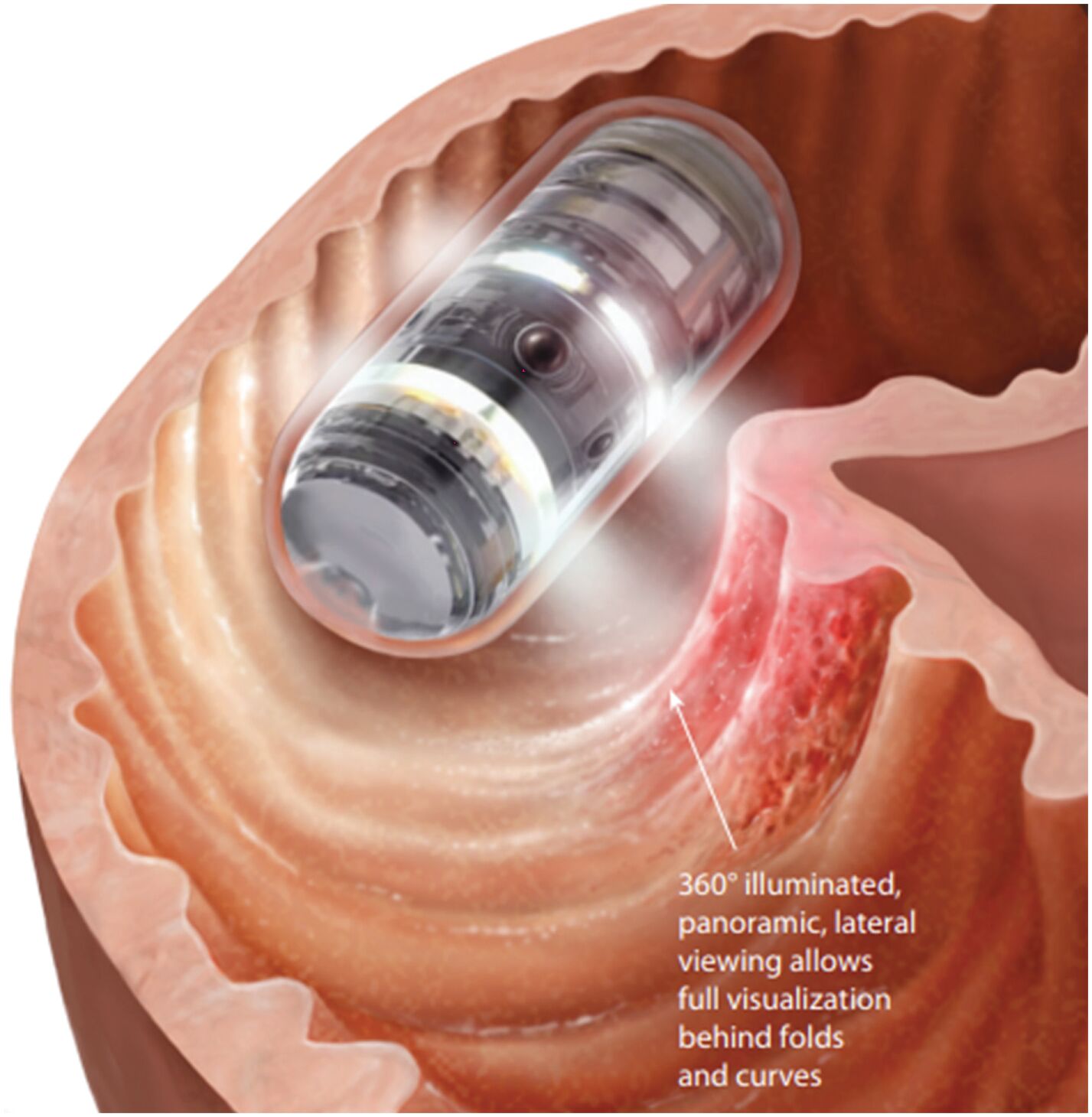

96
Table of Contents
CapsoCam captures a complete 360° view of the GI mucosa:
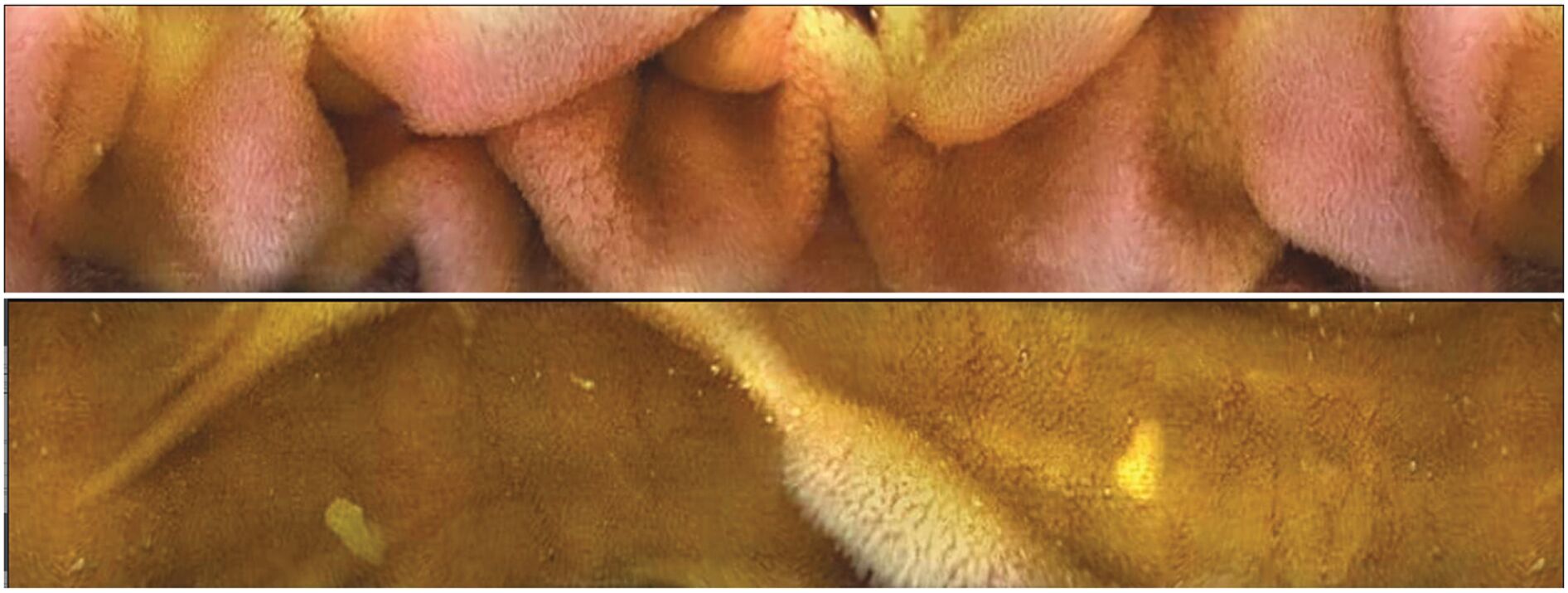
Competitive capsules have a “tunnel view” in straight sections of the small bowel:
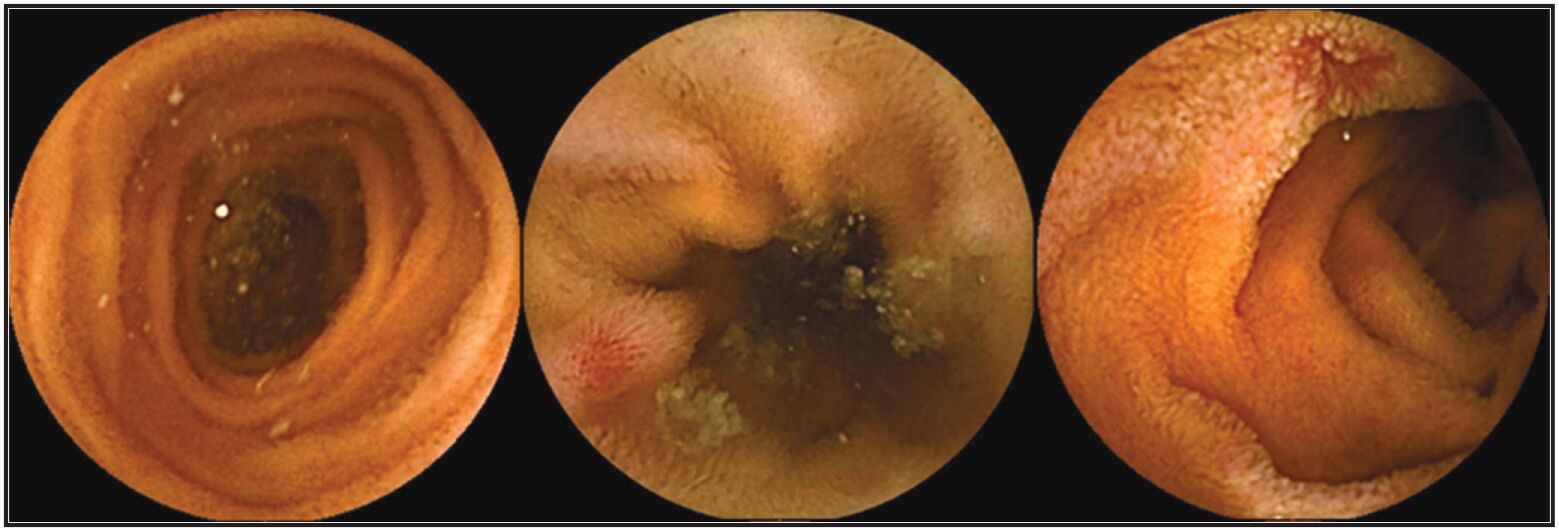
Competitive capsules have a partial wall view in curved sections of the small bowel:
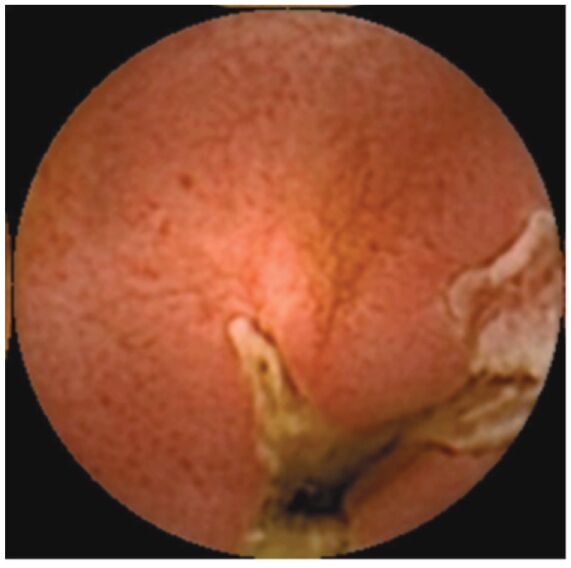
| • | Telemedicine-enabled and zero-capex “wire-free” data collection. Our CapsoCam is a zero-capex solution for providers as it stores the entire video in onboard memory. In addition, patients are able to ingest our capsule in the comfort of their own homes, under the remote supervision of providers. The CapsoCam solution frees up exam-room schedules for providers and provides flexibility to administer capsules any day at any time. A provider’s practice can easily scale to multiple capsules per day with no added cost. In contrast, our competitors’ data recorder comprises a belt that must be worn close to the |
97
Table of Contents
| skin around the patient’s abdomen, which is connected by wires to a recorder module. We believe this system is an uncomfortable and inconvenient encumbrance for patients. In addition, this system is a burden for providers as it is a piece of capital equipment with upfront cost. The equipment must be recovered from the patient, cleaned and batteries recharged, before it is ready to be fitted for the next patient. The data must also be downloaded from the recorder to a computer, which takes additional time. |
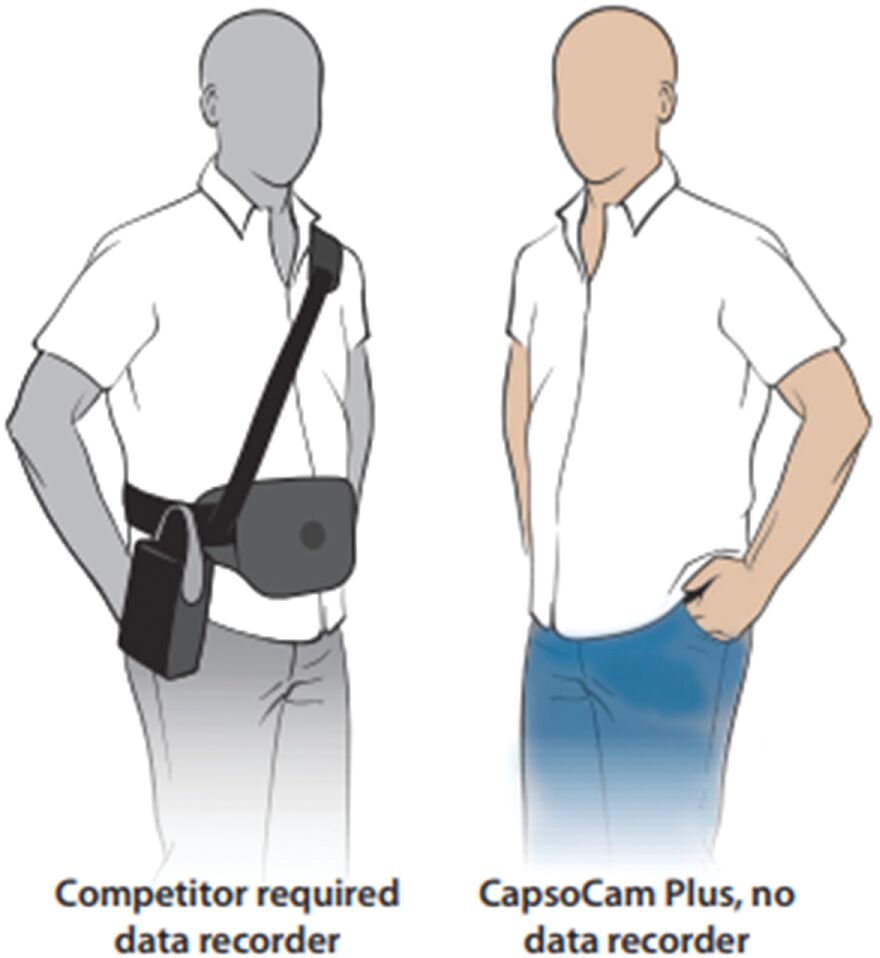
| • | Zero-capex remote data analysis via cloud-based platform. Our cloud-based platform, CapsoCloud, provides a flexible, trackable, streamlined, and capital-equipment-free workflow for providers in the U.S. By giving providers the ability following capsule retrieval to remotely access data obtained from the capsule endoscopy, CapsoCloud allows clinicians to track procedures and stream in vivo videos anywhere at their convenience, generate reports, store and manage patient data, and transfer data to third-party reading services. In contrast, our competitors’ data recorder equipment must be returned to the provider after the procedure. |
Key Components of CapsoCam Plus
The principal component of the CapsoCam Plus capsule endoscopy system is a single-use ingestible capsule that acquires and stores video images in onboard memory while moving through the GI tract, propelled by natural peristalsis. The patient or an authorized caregiver retrieves the capsule after it is egested using the retrieval kit and may return it directly to the clinic, or, in the U.S., mail it in a pre-paid envelop to a CapsoVision-affiliated download center. Thereupon, the capsule is cleaned and disinfected and the procedure data is downloaded using the CapsoAccess system.
98
Table of Contents
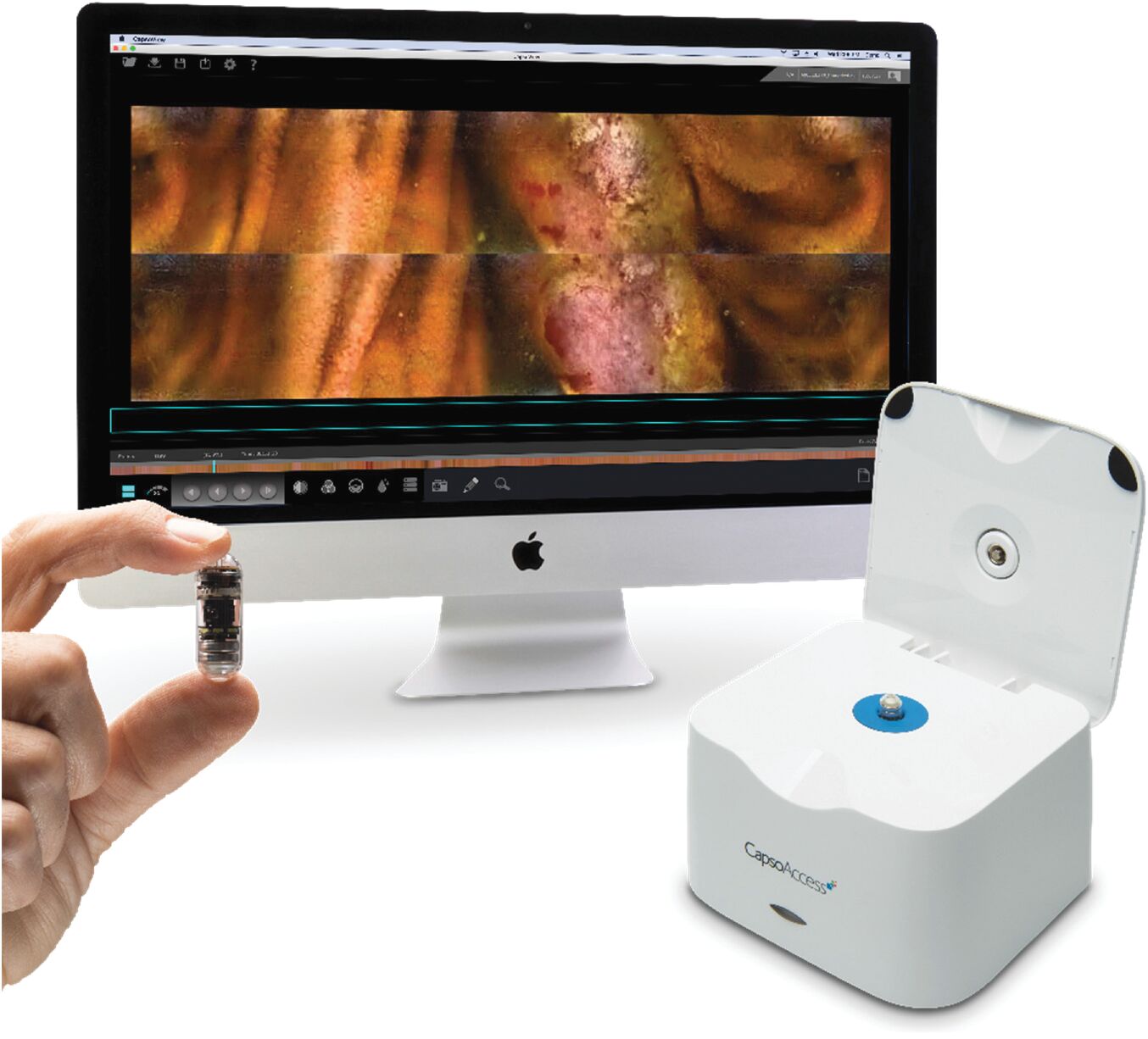
The components of a CapsoCam Plus capsule include the capsule housing, a lens module, the image sensor, the multichip package, an illumination system, a battery pack, a switch, the optical transceiver and a printed circuit board assembly.
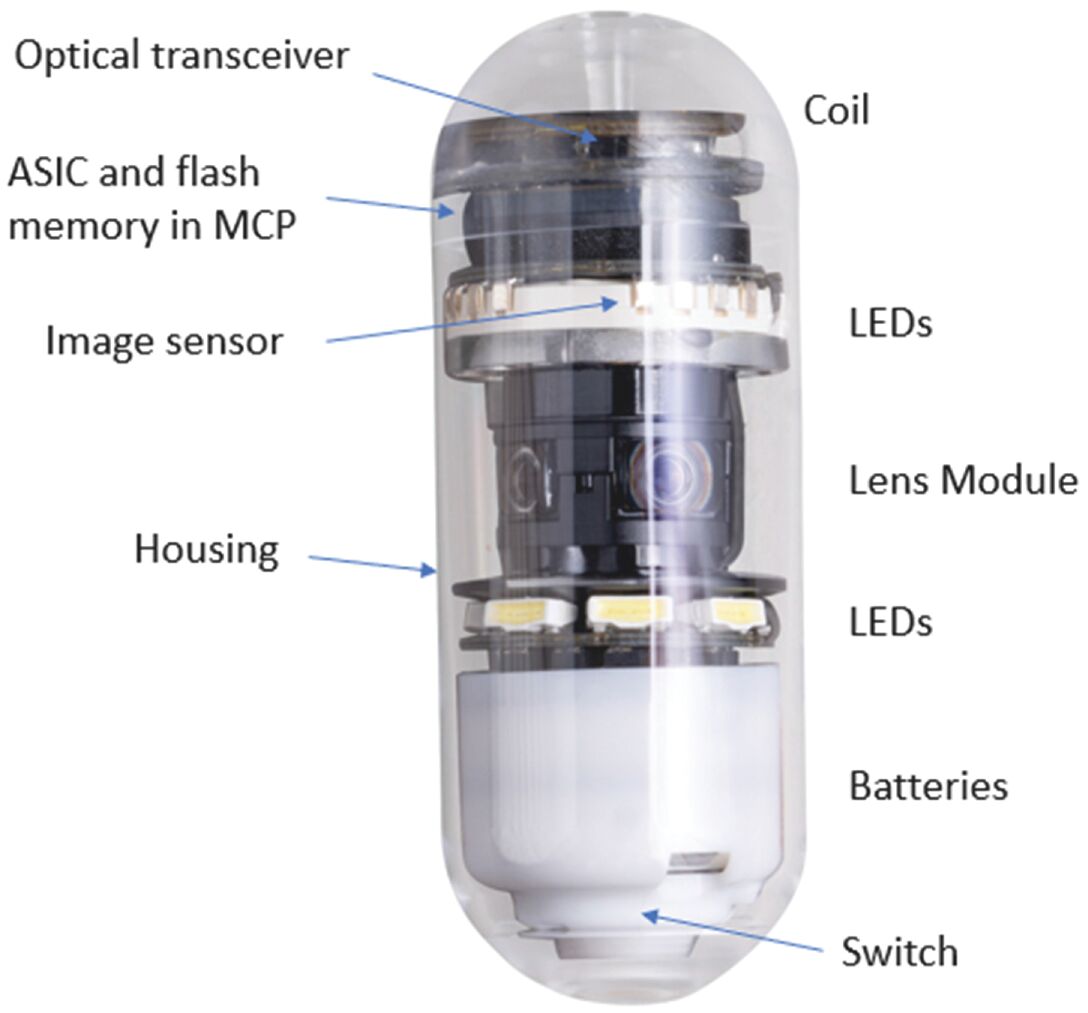
99
Table of Contents
In particular, our CapsoCam Plus capsule consists of a diagnostic imaging system in a capsule housing. The four cameras within the image sensor share a single custom CMOS image sensor, and, as the capsule passes through the GI tract, they together capture a full 360° panorama of the GI tract and the high-resolution color images and other data are stored in the onboard flash memory. The multichip package contains 1.5 GB memory to store the procedure data and an application-specific integrated circuit for controlling the capsule and performing image processing functions, including image compression.
Specifications:
| Length | 30.5 mm | |
| Diameter | 11.3 mm | |
| Mass | 3.7 grams | |
| Camera combined field of view | 74° x 360° | |
| Depth of field | 0 to 18 mm | |
| Video Format | JPEG color images | |
| Video resolution | 1152 x 212 pixels | |
| Frame rate | Up to 20 fps, 3-5 fps per camera | |
| Operating time (typical) | 15-20 hours |
The CapsoCam Plus procedure comprises the following steps:
| i. | Preparation. To ensure that the upper GI tract is free of food, the patient abstains from eating the morning of the procedure and may begin fasting at some point the prior day, depending on the physician’s instructions. A light dose of osmotic laxative is recommended to further clean the small bowel. |
| ii. | Ingestion. The patient ingests the capsule with a glass of water under the clinician’s supervision. Unlike competing capsule endoscopy systems, the patient need not be fitted with a data recorder and the in-office procedure consists only of the capsule ingestion and instructing the patient on the retrieval process. In the U.S., the patient may swallow the capsule at home or another remote location with telemedicine supervision by the clinician. Removing the capsule from its package activates it. Once the patient has successfully swallowed the capsule, they are free to go about their day, and after an additional four hours of fasting, they may eat a light meal. |
| iii. | Capsule Recovery. Patients place a rubber pan on the toilet to collect the capsule after excretion. When the patient next has a bowel movement, typically the next morning, they use the retrieval kit, CapsoRetrieve, to recover the capsule using a magnetic wand and package it for return to the clinic or to a data download center. The capsule is typically excreted within 3 to 30 hours after swallowing. |
| iv. | Data Access. The Capsule Data Access system, CapsoAccess, is used to recover the procedure video from the capsule after it has been cleaned and disinfected, which may be done at the clinic if the patient returns the capsule there. Alternatively, the patient may use a pre-paid envelope to mail the capsule to an authorized download center where the data is accessed and transmitted via the Internet to the clinician. |
| v. | Video Review. The physician reviews the procedure video and generates a report, using either CapsoView software or by streaming the video from CapsoCloud. CapsoCloud, a cloud-based software application, provides the physician the flexibility to review the procedure on any computer or Apple iPad connected to the Internet, at their convenience. CapsoCloud also stores the videos and reports, allows management and tracking of the procedure, and facilitates video review by third-party services or multiple physician colleagues. |
100
Table of Contents
CapsoRetrieve major elements—retrieval pan, magnetic wand, and capsule container:
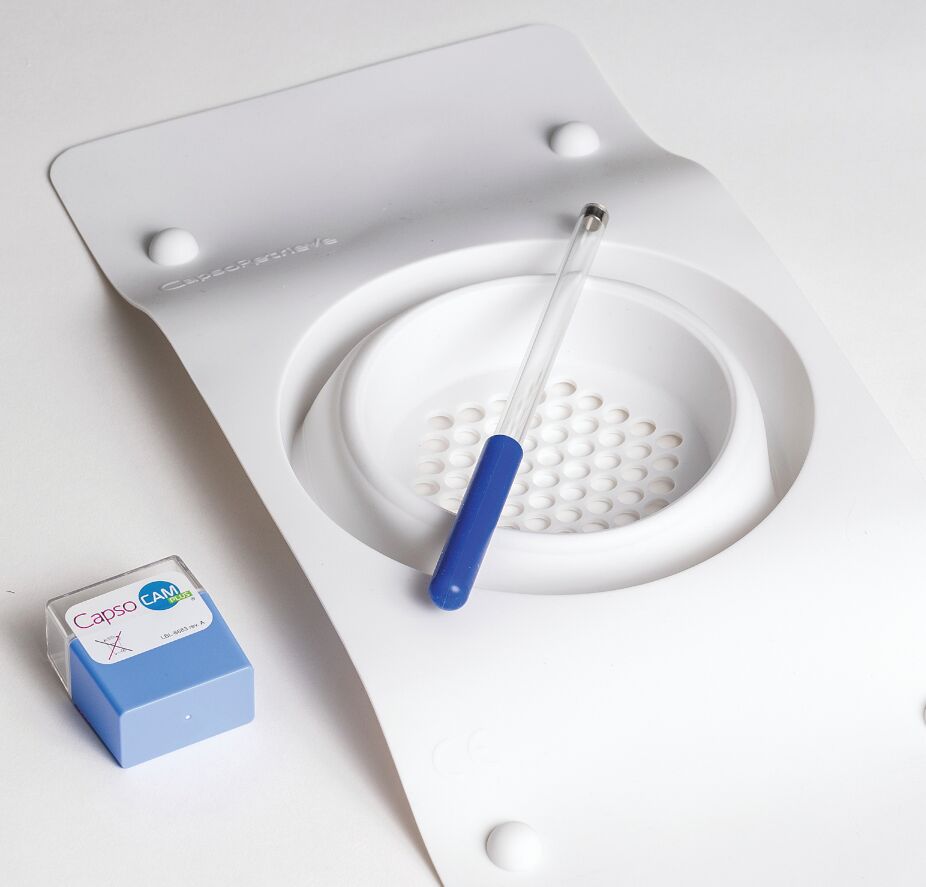
CapsoAccess accesses procedure data from the CapsoCam Plus capsule after its retrieval:
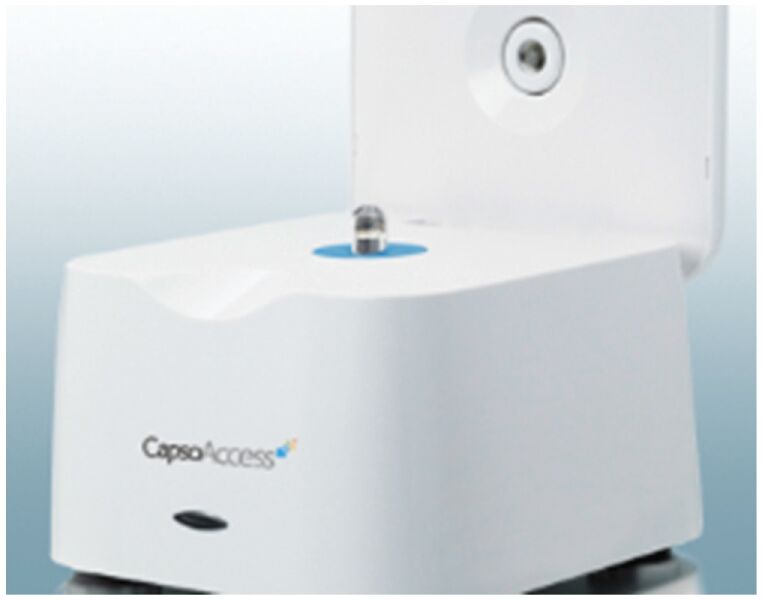
CapsoCam Colon
We have developed our next pipeline product, CapsoCam Colon, for visualization of the colon and detection and measurement of polyps. We are currently actively analyzing the data collected from the first arm of our pivotal study to support 510(k) clearance of CapsoCam Colon for use by currently indicated patients who are a subset of the colorectal cancer screening and surveillance populations. The first arm of our pivotal study involved 1,327 patients enrolled at 20 sites throughout the U.S. Based on the clinical results from the pivotal study, and assuming results are favorable, we are planning to submit our 510(k) application, with two existing capsule endoscopies as predicate devices, to the FDA in the first half of 2025 with a goal of obtaining 510(k) clearance in late 2025. To enhance the sensitivity and specificity of CapsoCam Colon for detecting and measuring polyps, we are developing our second generation CapsoCam Colon capsule and will extend our pivotal study to include a second arm. Our second generation CapsoCam Colon capsule will include improvements such as a new lens and illumination optics with an increased field of view and improved image quality. The second arm of the pivotal study is expected to involve approximately 200 patients enrolled at up to 10 sites in the U.S. We plan to use the clinical results of the second arm to support submission to the FDA of a 510(k) application in late 2025 with a goal of obtaining 510(k) clearance in the first half of 2026. As a part of this second 510(k) application and to
101
Table of Contents
increase the population of indicated patients, we intend to seek FDA clearance of expanded indications that remove the requirement for evidence of GI bleeding of lower GI origin for patients with major risks for colonoscopy or moderate sedation. There is no guarantee that the clinical results of any of our clinical trials will demonstrate the requisite performance needed to meet applicable regulatory requirements in order to obtain FDA clearance. Further, our 510(k) submission and FDA review thereof may be delayed and we may not receive 510(k) clearance from the FDA on a timely basis or at all.
Key Benefits of CapsoCam Colon
We believe that our CapsoCam Colon, once FDA cleared, will be a superior capsule endoscopy system compared to competitor systems, both in how it captures and presents images of the GI tract and the clinical workflow and patient experience that it enables. The benefits delivered by the CapsoCam Colon include the following:
| • | Sole capsule endoscope with a 360° panoramic view. We believe our CapsoCam is the only colon capsule endoscope that captures a full 360° panoramic video, providing a complete view of the colon mucosa—unobstructed by folds and with complete coverage of the bending intestine’s inner curvature. Our CapsoCam houses four high-resolution cameras around the capsule circumference, and the images from each are stitched into a single panoramic image. Our competitors’ end-view systems have a camera at each end of the capsule, which affords a limited “tunnel view” and polyps may be hidden by pockets (haustra) between folds. Our CapsoCam, by contrast, has a panoramic view of the colon and can visualize polyps on folds or within the pockets (haustra) between folds. In addition, the inflatable balloon which extends the CapsoCam Colon capsule helps to stabilize its movement through the intestines, resulting in a smoother video. |
CapsoCam captures a complete 360° view of the colon mucosa:



102
Table of Contents
Competitive capsules have a “tunnel view” of the colon:
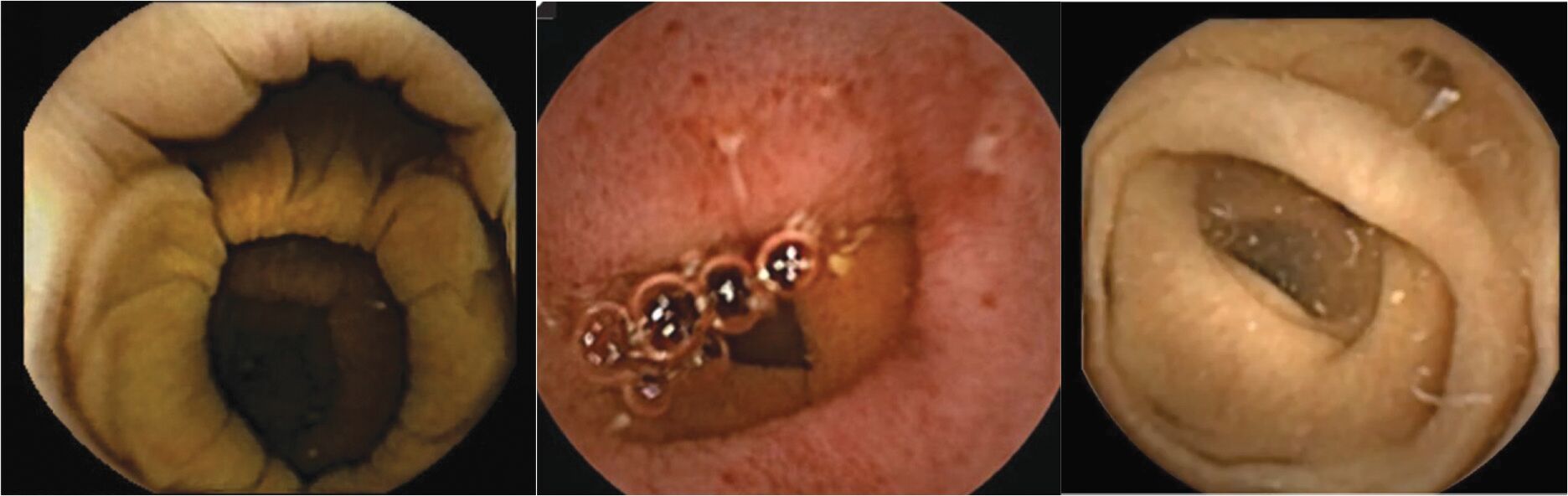
| • | Automated pathology detection due to usage of AI. We believe our CapsoCam Colon is the only colon capsule endoscopy system (subject to FDA clearance) that utilizes AI for automated polyp detection. Instead of reviewing the entire procedure video, clinicians can focus on those frames with suspected lesions, highlighted with a bonding box, reducing the time taken to review the video and making colon capsule endoscopy financially attractive to their practice. AI improves diagnostic yield and provides more consistent accuracy with reduced dependency on the experience level of the physician video reader and their level of fatigue and distraction. Without AI, physicians can overlook polyps captured in the video. In addition, CapsoCloud automatically accumulates patient data critical to develop and train improved AI-based lesion-detection and classification capabilities. We have an in-house AI development team of experts who will leverage archived patient data on CapsoCloud as it grows during commercial use of CapsoCam Colon to make ongoing improvements to the AI algorithm. In contrast, with competitor capsule endoscopy systems, the clinic downloads patient data from the data recorder and the manufacturer does not have ready access to that data. |

| • | 3D-sensing technology informs follow-on care decisions. Our CapsoCam Colon (subject to FDA clearance) also incorporates our proprietary 3D-sensing technology to more accurately measure polyp sizes. Polyp size is highly correlated with its risk of becoming cancer. No other capsule endoscope currently in the market has 3D-enabled measurement capability. With automated pathology detection and the ability to manually review video frames adjacent to an identified polyp, physicians can more confidently decide that patients with small (e.g., less than 6mm) polyps may forgo a follow-on colonoscopy, increasing the utility of the procedure for healthcare providers and patients alike. |
| • | Telemedicine-enabled and zero-capex “wire-free” data collection. Our CapsoCam is a zero-capex solution for providers as it stores the entire video in onboard memory. In contrast, our competitors’ data recorder comprises a belt that must be worn close to the skin around the patient’s abdomen, which is connected by wires to a recorder module. We believe this system is an uncomfortable and inconvenient encumbrance for patients. In addition, this system is a burden for providers as it is a piece of capital equipment with upfront cost. The equipment must be recovered from the patient, cleaned and batteries recharged, before it is ready to be fitted for the next patient. The data must also be downloaded from the recorder to a computer, which takes additional time. With no data recorder, our CapsoCam frees up exam-room schedules for providers and provides flexibility to administer capsules any day at any time. A provider’s practice can easily scale to multiple capsules per day with no added cost. |
103
Table of Contents
| • | Zero-capex remote data analysis via cloud-based platform. Our cloud-based platform, CapsoCloud, provides a flexible, trackable, streamlined, and capital-equipment-free workflow for providers in the U.S. In contrast, our competitors’ data recorder equipment must be returned to the provider after the procedure. Following the commercial launch of our CapsoCam Colon solution, providers will initially utilize CapsoCloud to download in vivo videos for remote review. Within one year of commercial launch, we plan to introduce user-friendly streaming functions to facilitate via CapsoCloud remote in vivo video review, procedure report generation and image annotation. |
| • | Panenteric capsule. CapsoCam Colon is a panenteric capsule which, when programmed with slightly different operating parameters, can be used to visualize both the small bowel and the colon in one procedure for the evaluation of Crohn’s disease, ulcerative colitis, irritable bowel syndrome and obscure GI bleeding. |
Key Components of CapsoCam Colon
The principal component of the CapsoCam Colon capsule endoscopy system is a single-use ingestible capsule that acquires and stores video images in onboard memory while moving through the GI tract, propelled by natural peristalsis. The patient or an authorized caregiver retrieves the capsule after it is egested using the retrieval kit and may return it directly to the clinic, or, in the U.S., mail it in a pre-paid envelop to a CapsoVision-affiliated download center. Thereupon, the capsule is cleaned and disinfected and the procedure data is downloaded using the CapsoAccess system.
The components of a CapsoCam Colon capsule include the capsule housing, a balloon, a shell, a lens module, the image sensor, the multichip package, an illumination system, a structured-light projector, a battery pack, a switch, the optical transceiver and a printed circuit board assembly.
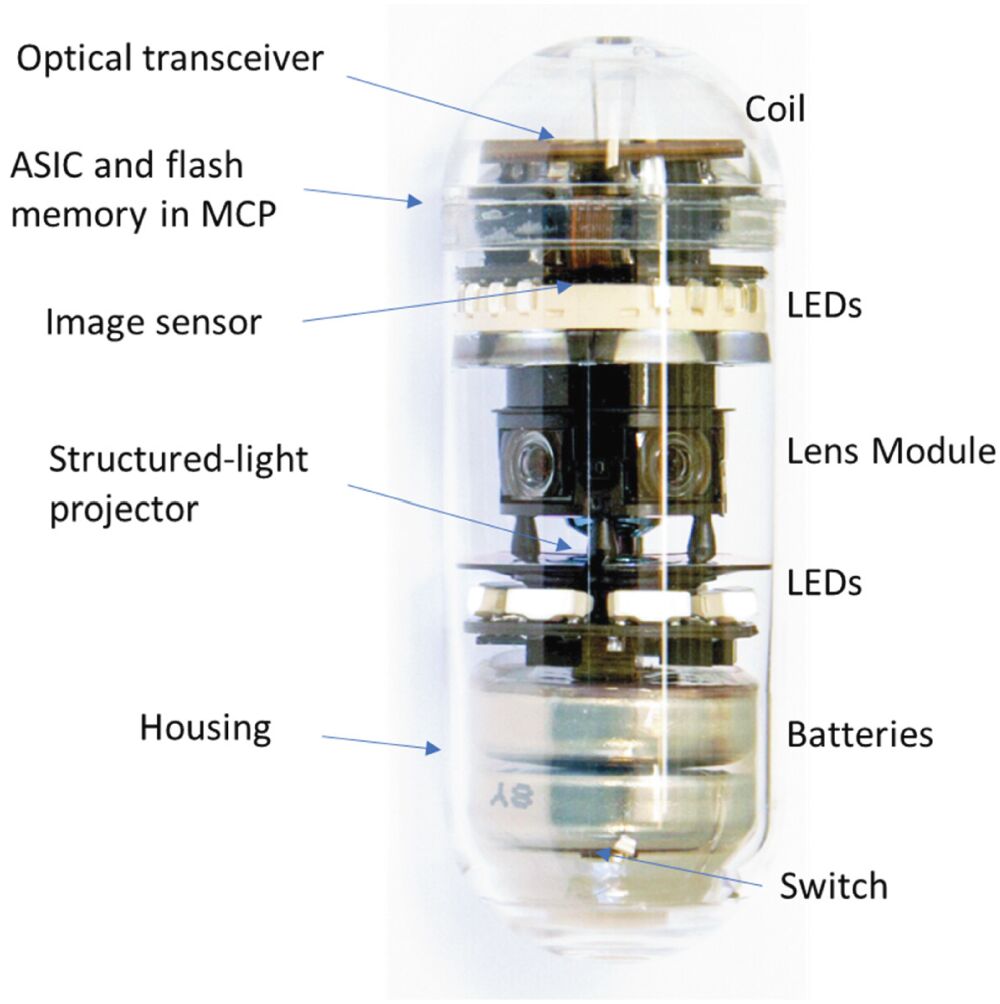
|
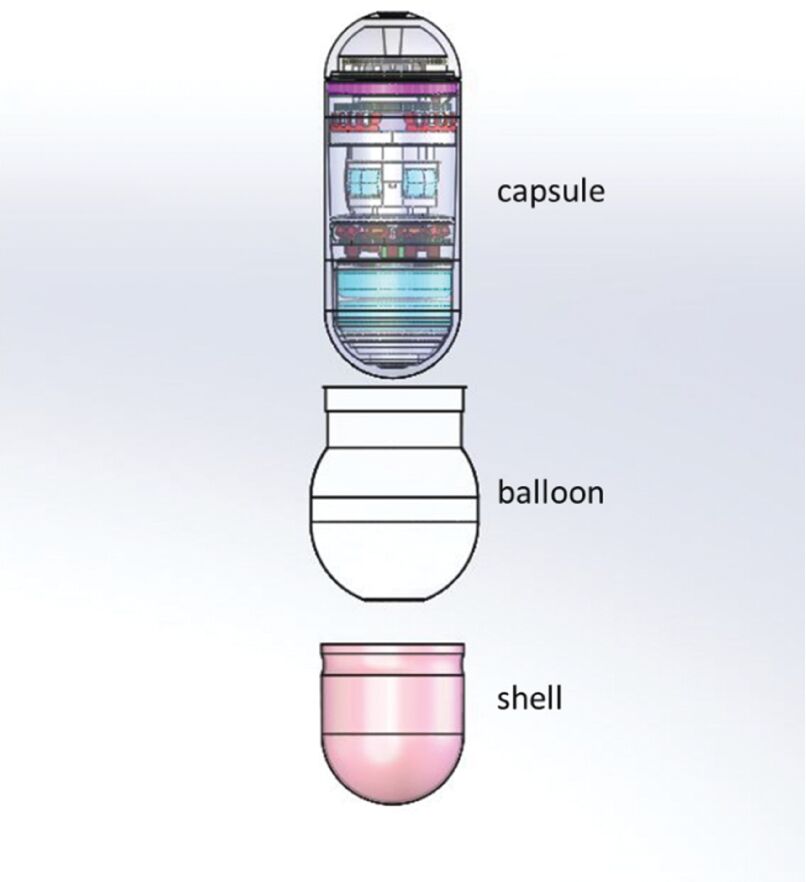
|
In particular, our CapsoCam Colon capsule consists of a diagnostic imaging system in a capsule housing with an attached inflatable balloon, where the inflatable balloon is protected by an outer dissolvable shell covering only the balloon end of the camera capsule. Once inside a liquid environment, the shell softens and dissolves. When the balloon is fully inflated, typically after about 2-3 hours, the capsule is slightly buoyant, enabling it to move through the intestines more readily with flowing liquid, increasing the likelihood of a complete colon visualization.
104
Table of Contents
Specifications:
| Length (at ingestion / at max inflation) | 32.6 mm / 38 mm | |
| Diameter (at ingestion / at max inflation) | 11.8 mm / 12.4 mm | |
| Mass | 3.8 grams | |
| Camera combined field of view | 74° x 360° | |
| Depth of field | 0 to 18 mm | |
| Video Format | JPEG color images | |
| Video resolution | 1152 x 144 pixels | |
| Frame rate | Up to 48 fps, 12 fps per camera | |
| Operating time (typical) | 24 hours |
The CapsoCam Colon procedure comprises the following steps:
| i. | Preparation. The colon is cleansed with a preparation similar to that needed for a colonoscopy. The exact protocol is determined by the patient’s physician, but the recommended process comprises a low-residue diet for several days, clear liquids the day before and on the day of ingestion, and 4 liters of PEG osmotic laxative solution split between the night before and the morning of ingestion. Shortly before ingesting the capsule, the patient may be administered a prokinetic to speed the capsule’s transit through the stomach and small bowel. |
| ii. | Ingestion. The patient ingests the capsule with a glass of water under the clinician’s supervision. Unlike competing capsule endoscopy systems, the patient need not be fitted with a data recorder and the in-office procedure consists only of the capsule ingestion and instructing the patient on the retrieval process. Where authorized, the patient may swallow the capsule at home or another remote location with telemedicine supervision by the clinician. Removing the capsule from its package activates it. The patient continues a clear-liquid diet until the capsule is egested or the following morning, whichever comes first. The patient drinks low-volume osmotic laxative boosters every few hours for a total of 2-4 doses, stopping if the capsule is egested. If the capsule has not yet been egested, a bisacodyl suppository in the evening and upon arising the next day is recommended. |
| iii. | Capsule Recovery. Patients place a rubber pan on the toilet to collect the capsule after excretion. When the patient next has a bowel movement, they use the retrieval kit, CapsoRetrieve, to recover the capsule using a magnetic wand and package it for return to the clinic or to a data download center. The capsule is typically excreted within 1 to 24 hours after swallowing. |
| iv. | Data Access. The Capsule Data Access system, CapsoAccess, is used to recover the procedure video from the capsule after it has been cleaned and disinfected, which may be done at the clinic if the patient returns the capsule there. Alternatively, the patient may use a pre-paid envelope to mail the capsule to an authorized download center where the data is accessed and transmitted via the Internet to the clinician. |
| v. | Video Review. The physician reviews the procedure video and generates a report, using either CapsoView software or, when and where available, by streaming the video from CapsoCloud. Following the commercial launch of our CapsoCam Colon solution, providers will initially utilize CapsoCloud to download in vivo videos for remote review. Within one year of commercial launch, we plan to introduce user-friendly streaming functions to facilitate via CapsoCloud remote in vivo video review, procedure report generation and image annotation. |
Clinical Development
CapsoCam Colon
Following the completion of our Pilot Study described below, in 2021, we commenced our pivotal study for CapsoCam Colon (described below). As of the date of this prospectus, (i) patient enrollment (i.e. capsule
105
Table of Contents
ingestion) and all study activities and the associated data clean-up are complete and (ii) the related data analysis for pivotal study endpoints and the standalone performance assessment are underway in preparation for our 510(k) submission. To enhance the sensitivity and specificity of CapsoCam Colon for detecting and measuring polyps, we are developing our second generation CapsoCam Colon capsule and will extend our pivotal study to include a second arm. Our second generation CapsoCam Colon capsule will include improvements such as a new lens and illumination optics with an increased field of view and improved image quality. The second arm of the pivotal study is expected to involve approximately 200 patients enrolled at up to 10 sites in the U.S.
As of the date of this prospectus, the FDA has only authorized one colon capsule imaging system, the Medtronic PillCam COLON 2, introduced in 2014, which does not include any AI-driven analytics; and one AI-driven capsule endoscopy analysis software, the AnX Robotics NaviCam ProScan, introduced in 2023, which exclusively supports AnX Robotics’ small bowel capsule system. These devices will respectively serve as predicate devices for our CapsoCam Colon 510(k) submission. In particular, to receive initial FDA clearance for our first generation CapsoCam Colon, the clinical results must demonstrate that:
| • | CapsoCam Colon, considered without the integration of AI, demonstrates a polyp-detection accuracy that is, at a minimum, comparable to the performance of the predicate device (i.e., Medtronic PillCam COLON 2); and |
| • | our AI technology can (i) reliably and accurately identify and analyze images and video of the colon to detect abnormalities as quantified by diagnostic accuracy measures such as sensitivity and specificity, and, in doing so, (ii) aid qualified physicians in achieving improved diagnostic performance relative to not using AI. |
Pivotal Study
First Arm. As of the date of this prospectus, we are actively analyzing the data collected from the first arm of our pivotal study in preparation for our 510(k) submission seeking FDA clearance of our initial, first generation CapsoCam Colon capsule endoscope.
This study is a prospective, open label, pivotal study of the accuracy of CapsoCam Colon in detecting colonic polyps, using colonoscopy as the reference. Enrollment began in 2021, and the final patient of the first arm of the study was enrolled (i.e., ingested our capsule endoscopy) in October 2024. A total of 1,327 patients were enrolled at 20 sites throughout the U.S. The patient population were males and females between 45-75 years of age referred for colonoscopy. The study was designed to enroll sufficient subjects with clinically-significant colon polyps (≥6mm), accounting for sufficient polyp prevalence in the study population, which is necessary to evaluate the device performance in accordance with study endpoints, as discussed below.
The purpose of this pivotal study is to evaluate the safety and effectiveness of our CapsoCam Colon capsule endoscope system in the visualization of the colon and in the detection and size measurement of colonic polyps and to show that AI-based computer assisted detection improves the polyp-detection accuracy and efficiency of capsule video readers. In the study, each enrolled patient (i.e., patients who were otherwise scheduled to receive a colonoscopy under applicable standard of care) agreed for comparative purposes to (i) first, undergo a capsule endoscopy using the CaspsoCam Colon capsule and (ii) second, within a specified time period (typically, 3-6 weeks) undergo an optical colonoscopy, conducted per standard of care with administration by a GI at a medical facility and sedation as appropriate. The capsule video resulting from the capsule endoscopy is then interpreted by a video reader twice with a month’s separation: once relying solely on the video and once with the aid of AI recommendations. Following this, the results of the capsule endoscopy readings are compared to the findings of optical colonoscopy to evaluate diagnostic performance. If these comparative findings suggest that a clinically-significant polyp was missed in the colonoscopy (as determined by an independent Clinical Events Committee), a second colonoscopy may be recommended for the patient. Additional notable study activities and analyses following these initial activities are required, including the measurement and characterization of polyps detected within the study (e.g., to facilitate appropriate subject stratification for endpoint analysis and facilitate
106
Table of Contents
evaluation of size measurement accuracy) and the use of a subset of the study data to conduct a standalone performance assessment of the AI algorithm.
The pivotal study’s coprimary endpoints are (a) sensitivity of the CapsoCam Colon for detecting the presence in a patient of the largest polyp detected by optical colonoscopy if that polyp is ≥ 6mm, where a match is considered to have occurred if a polyp detected by the CapsoCam Colon is assessed as having a size within plus or minus 50% of the size of the polyp detected by optical colonoscopy and as having a location within the same or an adjacent colon segment and (b) specificity of the CapsoCam Colon for not detecting any polyp ≥ 6mm in a patient for whom optical colonoscopy did not detect any polyp ≥ 6mm.
The secondary endpoints include, among others, the sensitivity and specificity of non-AI assisted detection reading versus AI-assisted detection reading for polyps ≥ 6mm and for advanced neoplasia.
As of the date of this prospectus, all study activities and the associated data clean-up are complete. Data analysis for pivotal study endpoints and the standalone performance assessment are underway. Assuming results are favorable, we will proceed with filing with the FDA of our 510(k) Premarket Notification to seek marketing clearance for the first-generation CapsoCam Colon. While we believe the analyses will be completed in a timely manner and our study results will support our planned 510(k) filing in the first half of 2025, there can be no assurance that our final pivotal study results (or other necessary test results) will not be delayed, such results will be sufficiently favorable, the FDA will agree with our study findings and/or that we will timely or otherwise receive 510(k) marketing clearance.
Second Arm. The second arm of the pivotal study (modeled after the first arm of the pivotal study) will evaluate the safety and effectiveness of our second-generation CapsoCam Colon capsule in a similar patient population expected to involve approximately 200 patients enrolled at up to 10 sites in the U.S. As of the date of this prospectus, no patients have been enrolled within the second arm.
Pilot Study
Prior to the initiation of the pivotal study, we completed our pilot study for our CapsoCam Colon in 2021. That study was a prospective, open label, pilot study of the CapsoCam Colon capsule endoscope compared to optical colonoscopy. Enrollment began in January 2020 and was completed in February 2021. A total of 112 patients ingested the capsule at 5 sites in the U.S. and results from 105 patients were included in the analysis. The patient population were males and females between 50-75 years of age who had been referred for colonoscopy and had an increased risk for having colon polyps.
This was a non-significant risk pilot study designed to evaluate the safety and performance of the CapsoCam Colon capsule endoscope in patients who met the eligibility criteria and were scheduled for colonoscopy. This study was not statistically powered.
Primary Efficacy Assessments: Sensitivity/Specificity
The coprimary endpoints were (a) sensitivity of the CapsoCam Colon for detecting the presence in a patient of the largest polyp detected by optical colonoscopy if that polyp was ≥ 6mm, where a match was considered to have occurred if a polyp detected by the CapsoCam Colon was assessed as having a size within plus or minus 50% of the size of the polyp detected by optical colonoscopy and as having a location within the same or an adjacent colon segment and (b) specificity of the CapsoCam Colon for not detecting any polyp ≥ 6mm in a patient for whom optical colonoscopy did not detect any polyp ≥ 6mm.
Overall, across 105 patients and for polyps ≥ 6mm in size, with a prevalence of 21.9%, sensitivity was 84.8% (95% confidence interval (“C.I.”): 71.1-95.5%) and specificity was 92.7% (95% C.I.: 87.5-97.9%). Overall, for polyps ≥ 10mm in size, with a prevalence of 7.6%, sensitivity was 87.5% (95% C.I.: 57.9 – 100%) and specificity was 99.0% (95% C.I.: 78.5 – 100%).
107
Table of Contents
Safety Analysis
There were no reports of device-related adverse events, serious adverse events or unanticipated adverse device effects across 112 patients. All events and observations reported in the pilot study were not related to the study or related to medications for bowel preparation or to the prokinetic boosters. There were no serious adverse events reported for bowel preparation or booster consumption. These results are supportive of the safety of the CapsoCam Colon.
CapsoCam Plus
In the second half of 2025, we plan to seek FDA 510(k) clearance for the use of AI in our small bowel capsule, CapsoCam Plus. The incorporation of AI technology into our GI-tract capsule endoscopy solution (including the associated software, CapsoCloud and CapsoView) requires appropriate FDA regulatory authorization, supported by requisite clinical and other studies, prior to its commercialization in the U.S. Under the FDA’s current regulatory framework, our capsule endoscopy solution and the AI technology are assessed separately, with each component falling under a different regulatory classification and subject to distinct regulatory requirements. This bifurcated approach, set by precedent, ensures that each component meets the necessary safety, effectiveness, and performance expectations.
In seeking 510(k) clearance for our AI technology as incorporated into CapsoCam Plus we are (i) utilizing the NaviCam ProScan as the predicate device (confirmed with the FDA) and (ii) currently conducting a retrospective clinical study of the CapsoCam Plus solution with the AI technology incorporated to analyze in vivo videos from completed, real-world clinical cases, to assess the performance of the AI technology for small bowel. Similar to the first arm of our CapsoCam Colon pivotal study, the study seeks to demonstrate that the AI technology can (i) reliably and accurately identify and analyze images and video of the small bowel to detect abnormalities as quantified by diagnostic accuracy measures such as sensitivity and specificity, and, in doing so, (ii) aid qualified physicians in achieving improved diagnostic performance relative to not using AI.
Sales, Marketing and Distribution
We primarily generate revenues from the sales of our CapsoCam Plus capsule to our customers, including gastroenterologists practicing in clinics and/or hospitals, which typically place their orders on a monthly or bimonthly basis, as well as our distributors. We engage our customers by using data mining platforms to identify potential customers, initiating their comprehensive evaluation of our CapsoCam capsule and solutions, followed by our strategic sales efforts that ensure a high retention rate. Our customer retention rate stands at approximately 90% for 2024, showcasing our commitment to customer satisfaction and loyalty.
We operate with two sales groups and conduct our marketing strategies differently: one for the U.S. market and one for the international market, each tailored to effectively serve different geographical markets. Our U.S. market sales group, primarily using a direct sales model, focuses on the U.S. domestic market. Our international market sales group is comprised primarily of qualified distributors responsible for selling to customers outside the U.S. Using distributors internationally allows us to extend our global reach and effectively penetrate diverse markets. We are confident that our skilled sales force can be effectively leveraged to promote and distribute our CapsoCam Plus capsules and future CapsoCam capsules (including, once FDA cleared, our CapsoCam Colon capsules).
Our revenues for the year ended December 31, 2023 and 2024 totaled approximately $9.8 million and $11.8 million, respectively, representing a year-over-year growth of approximately 21%. Our revenues for the three months ended March 31, 2024 and 2025 totaled approximately $2.5 million and $2.8 million, respectively, representing a year-over-year growth of approximately 12%. In 2023 and 2024, international sales accounted for 26% and 23% of total revenue. In the three month period ended March 31, 2024 and 2025, international sales accounted for 23% of total revenue. Our average accounts receivable balance for the three months ended March
108
Table of Contents
31, 2025 was $1.8 million with 3% of our accounts receivable aged more than 60 days. As of March 31, 2025, we only had one customer representing more than 10% of our outstanding accounts receivable (with an accounts receivable balance of approximately $0.4 million).
U.S. Market
We currently market our CapsoCam Plus capsule endoscopy solution in the U.S. through a combination of our in-house sales team, integrated GPOs, and to a limited extent, select independent sales representatives. We intend to expand our direct sales force by increasing the number of sales employees and independent sales representatives and contractors. This strategic growth should enhance our market reach and drive higher sales performance. As of March 31, 2025, we had 27 full-time sales employees, including 4 sales directors and 20 territory managers, and 3 independent sales representatives covering all of the states in the U.S. We offer comprehensive training programs to our sales employees, sales representatives and contractors, aimed at enhancing sales performance and ensuring strict compliance with FDA regulations and any other applicable regulations.
Since the launch of our CapsoCam Plus capsule in 2017, we have endeavored to market our CapsoCam Plus capsule endoscopy solution effectively by leveraging the network outreach of independent sales representatives, who managed to bring our products to the attention of GI physicians across the U.S. Meanwhile, we also invested in building our in-house sales team by establishing the role of territory managers for overseeing and coordinating our sales effort in a specific state or states. We believe our hybrid marketing and sales team will enable our CapsoCam capsules to further penetrate into the healthcare market.
In-house Sales Team
We have built a dedicated team of sales directors and territory managers to promote our CapsoCam capsules. Based on our current sales output and strategic planning, we have put in place four regional sales directors, each overseeing a distinct region within the U.S. Our regional sales directors are responsible for supervising the work of territory managers within their region, providing them with technical support and training, as well as setting overall sales strategies for the region. Our regional sales directors are industry veterans who possess rich experience in medical device sales and distribution matters.
Our territory managers are our front-line sales persons who interact with physicians, clinics, hospitals and other healthcare providers on a daily basis. Utilizing the data-mining platforms we have procured, each of our territory managers generates a list of potential customers, and reaches out to introduce them to our CapsoCam capsule. After this introduction, subject to their protocols and practices, the potential customers will generally make an initial purchase of 5 to 10 capsules for evaluation, before placing subsequent orders. We provide constant assistance and monitoring throughout the customer evaluation process to answer questions, identify potential issues and obtain relevant feedback to a potential customer’s purchase decision. Following the evaluation process, we seek to onboard the customer, with customers typically ordering capsules, subject to their needs, on a monthly or bi-monthly basis and we strive to meet their expected timeline of delivery.
Our territory managers provide continued service and support to our customers, including periodic education of physicians, nurses and other healthcare providers about our capsule, feedback collection to understand and attend to any issues encountered in the course of using our capsule and CapsoCloud, and tracking any adverse events. As a result, we were able to secure a high customer retention rate of approximately 90% for 2024.
Independent Sales Representatives
We engage independent sales representatives to complement our in-house sales team. We pay our independent sales representatives commissions and bonuses, if eligible, based on their sales results. We discourage our independent sales representatives from concurrently representing our competitors in promoting similar products.
109
Table of Contents
Marketing Methods
We also use various sales and marketing methods to generate awareness and demand for our CapsoCam Plus capsule, such as traditional marketing through direct sales, channel partners and trade shows as well as digital marketing through websites, social media, videos and organic and paid searches.
Sales Arrangement with GPOs
We have entered into agreements with several GPOs, which are organizations that leverage the collective purchasing power of their members, such as hospitals, clinics, and other healthcare providers, to negotiate favorable pricing and terms for medical products and services. Our arrangement with GPOs can significantly enhance our ability to meet the stringent requirements set by hospitals, clinics, and other healthcare providers. By leveraging the collective purchasing power and compliance expertise of GPOs, we can ensure adherence to industry standards and regulations more effectively. Under these agreements, the GPOs’ members may elect to purchase our CapsoCam capsules from us on a direct sale basis. During the term of these agreements, which typically ranges from two to three years and are subject to renewal, we are generally prohibited from entering into new contracts outside of these agreements with the GPOs’ members for our CapsoCam capsules. The agreements also contain firm pricing provisions, which may limit our ability to adjust our prices in response to market conditions or competitive pressures. However, we may offer bulk purchase options or special promotions to the GPOs’ members, subject to certain conditions and approvals. We also agree to provide the GPOs’ members with pricing, terms, and conditions that are equal or better than those offered to our other customers. In addition, we agree to negotiate in good faith to equitably adjust the pricing for any current products under the agreements if it is affected by any new technology. We pay administrative fees to the GPOs based on a percentage of sales for products their members purchase from us.
International Market
We initially began commercial sales in Europe in 2012 for our GI-tract capsule endoscopy solution (i.e., our small bowel capsule). Since then, we have expanded into other non-U.S. countries or regions, and our largest international shipping destinations now include France, Germany, and Canada. Our distributors typically have exclusivity in their respective country or territory. As of December 31, 2024, we had entered into distribution agreements with approximately 50 exclusive distributors in connection with multiple non-U.S. regions, including the European Union (“EU”), South and Central America, Asia, Australia, the Middle East and Africa, which respectively accounted for approximately 46%45, 10%, 5%, 3%, 3% and 3% of our total non-U.S. sales revenue in 2024. As of December 31, 2024, the total revenue generated from our top ten distributors, most of which are in the EU, accounted for approximately 67% of our total non-U.S. sales revenue. We also have one exclusive distributor for sales of our CapsoCam capsule for the veterinary market worldwide. Although we have historically utilized exclusive distributors to access various countries or regions, we may choose to implement a direct sales model. For example, (i) in 2023, we established a direct sales team in Germany to better serve our customers and strengthen our market presence in this key market and (ii) we are transitioning to a direct sales model in some pivotal countries, including the G7 countries, to enhance market penetration and drive growth.
For both our direct sales and distributor sales, we are responsible for obtaining and maintaining the regulatory permits for our current CapsoCam Plus capsule, future CapsoCam capsules and associated software, CapsoCloud and CapsoView, in the relevant countries and regions.
Exclusive Distribution Agreements
We typically enter into exclusive distribution agreements with our international distributors, which typically specify the purchase price, payment terms, minimum purchase obligations, territory, term, renewal, termination, and other rights and obligations of the parties. The purchase price is usually agreed in the distribution agreement and may be revised through mutual agreement, taking into account the prevailing market prices. Such revision
| 45 | Including shipments to Aureliance, our authorized agent and importer in the EU and EEA. |
110
Table of Contents
usually occurs no more than once per year. The payment terms vary depending on the distributor’s creditworthiness and performance, but generally range from 30 to 60 days from the date of invoice. The minimum purchase obligations are based on the projected sales volume and growth potential of the territory. The territory is defined as the country or region where the distributor has the exclusive right to sell and market our CapsoCam capsule endoscopy solution. The term of the distribution agreement is initially one to five years, and may be renewed for additional one to three years upon agreement or automatically, unless terminated earlier by either party for cause or convenience. Our exclusive distributors usually have the right of first offer for any new products that we develop.
We are responsible for the manufacturing, supply, packaging, and labeling of our CapsoCam capsules and for obtaining and maintaining the regulatory permit to manufacture and market our capsule endoscopy solution in the U.S. and other countries or regions where we export our products. We are also required to report any death, serious injury, or malfunction incidents involving our CapsoCam product to the relevant authorities and to conduct any necessary product recalls or corrective actions. Our distributors agree to supply us with any information and assistance related to such incidents and to comply with our instructions and policies regarding product safety and quality. Our distributors also agree to forward any customer and/or regulatory complaints or correspondence regarding our CapsoCam capsule endoscopy solution to us promptly and to cooperate with us in resolving any such issues.
We are prohibited from selling our CapsoCam capsules or engaging another distributor to sell our CapsoCam capsules in the territory of our exclusive distributors, unless we terminate the distribution agreement with the existing distributor. Our distributors are prohibited from advertising, marketing, or selling our CapsoCam capsules outside their territory or soliciting orders from persons or entities located outside their territory.
We may terminate our distribution agreements with our exclusive distributors for cause, such as breach of contract, failure to meet minimum purchase obligations, insolvency, or misconduct, or for convenience, subject to a prior notice period and a break-up fee based on the anticipated margin, if applicable. We also agree to honor our obligations to the distributor’s key customers (including governmental bodies) for a period of at least one year following the termination of the distribution agreement, unless we assign such obligations to a successor distributor.
Coverage and Reimbursement for CapsoCam
In the U.S., we derive substantially all of our revenue from gastroenterologists practicing in clinics and/or hospitals that use our CapsoCam Plus capsule endoscopy solution. These providers, in turn, bill third-party payers, including private insurers, Medicare, and Medicaid, for the services and items they provide to patients. The CapsoCam Plus enables our customers to operate under the existing reimbursement structure for optical capsule endoscopy of the small bowel, which has well-established reimbursement levels via CPT codes that varies by state. Subject to patient and provider compliance with guidelines around recommended procedures, government and commercial payers generally provide coverage for optical capsule endoscopy of the small bowel under this framework.
Similarly, our CapsoCam Colon, once FDA cleared, is expected to be covered under the existing reimbursement structure for colon capsule endoscopy for our initially indicated patient group, which has reimbursement levels via CPT codes.
Research and Development
We invest in research and development initiatives that are focused on introducing enhancements and improvements aimed at increasing the value provided by our GI-tract capsule endoscopy solution. Our solution is currently comprised of our CapsoCam Plus capsule for the small bowel, our planned CapsoCam Colon (subject to FDA clearance), CapsoCloud, our cloud-based platform, and our CapsoView software. In doing so, we hope to
111
Table of Contents
realize our vision of creating an ingestible capsule that, in a single convenient non-invasive procedure, cost-effectively screens and/or identifies multiple pathologies in a broad patient population. In particular, for CRC, we hope to screen for both cancerous and precancerous polyps and lesions, recognizing that early detection can assist in the prevention and treatment of CRC. Our research and development team includes hardware and software engineers with deep expertise in medical technology, optics, data science, AI, and cloud-based data and security architecture and individuals with extensive clinical development expertise.
Initial and recent research and development efforts focused on developing our first capsule endoscopy, the small bowel capsule (510(k) clearance received in 2016) and improved versions thereof (the current generation of which we refer to as CapsoCam Plus), development of our AI assisted reading technology and improving on CapsoCam Plus to develop CapsoCam Colon (with 510(k) clearance targeted for late 2025). CapsoCam Colon incorporates our self-developed AI technology and other multiple self-developed proprietary technologies designed to assist in effectively visualizing the colon and detecting and measuring polyps. In addition to having AI for automated pathology detection of polyps, it incorporates a 360° panoramic lateral view and 3D-sensing technology to more accurately measure polyp sizes. We are researching and developing improvements to our CapsoCam Plus capsule to incorporate our AI assisted reading technology. We are working on improvements to our CapsoCam, including a new lens and illumination optics with an increased field of view, improved image quality and higher peak frame rate. For our AI assisted reading technology, we plan to incorporate improvements designed to deliver increased sensitivity for identifying polyps and pre-cancerous lesions, reduced viewing times, enhanced usability of the polyp size measurement tool, improved camera dynamic range for a clearer view of dark areas and improvements to increase completion rates. We also plan to continue making improvements to our CapsoCloud and CapsoView software.
Certain of our research and development efforts may also include conducting and overseeing clinical studies and obtaining FDA clearance, which may or may not be granted.
We incurred approximately $9.3 million and $15.1 million in research and development expenses for the year ended December 31, 2023 and 2024, respectively. Our research and developments expenses for three months ended March 31, 2024 and 2025 were $3.3 million and $3.1 million, respectively. For additional information, see “Management’s Discussion and Analysis of Financial Condition and Results of Operations—Components of our Results of Operations and Balance Sheet—Operating Expenses.”
Manufacturing and Supply
We manage all aspects of manufacturing, supply chain and distribution of our GI-tract capsule endoscopy products from our headquarters in Saratoga, California. We manufacture our products using component suppliers and assembly manufacturers based in Asia. The critical components of our products, such as lens modules, CMOS image sensors, and ASICs are provided by single-source suppliers. In particular, our lens modules are sourced from Largan, a single supplier based in Taiwan who we have an over 16-year relationship with, our CMOS image sensors are sourced from Toshiba, a single supplier based in Japan who we have an over 10-year relationship with, and our ASICs are sourced from Moai/Speedbridge, suppliers based in Taiwan who we have, respectively, an over 10-year and 5-year relationship with. As a result of our long-standing relationships with these suppliers, we are able to source those component parts on favorable terms and within reasonable lead-times.
In particular, we have entered into a memorandum of understanding with Largan Precision Company, Ltd. (“Largan”), which is based in Taiwan, in May 2008, for the supply of lens modules for our first generation capsules, pursuant to which we make purchases on a purchase order basis. The terms of the memorandum of understanding were subsequently amended in January 2010 (as amended, the “First Largan MOU”). In addition, we entered into another memorandum of understanding with Largan in October 2022, for the supply of lens modules for our second generation capsules (together with the First Largan MOU, collectively, the “Largan MOUs”). Each Largan MOU was effective upon signing and will continue until terminated in accordance
112
Table of Contents
thereunder. Either party may terminate either Largan MOU for certain breaches of the agreement by the other party and that party fails to cure the breach within 45 days after notice of such breach from the terminating party.
We have also entered into a development agreement with Toshiba, which is based in Japan, in August 2013 (the “Toshiba Agreement”), for the development and supply of our CMOS image sensors, pursuant to which we make purchases on a purchase order basis. The Toshiba Agreement contains a provision, pursuant to which Toshiba may discontinue the supply of CMOS image sensors to us if we do not place purchase orders totaling more than a specified number of units in any consecutive 12 months. The Toshiba Agreement was effective upon signing and will continue until terminated in accordance thereunder. If Toshiba intends to discontinue supply of the CMOS image sensors to us, Toshiba must provide us with 12 months’ prior notice and obtain our approval. Either party may also immediately terminate the Toshiba Agreement upon written notice if any of the Force Majeure events (as defined therein) extends for a period in excess of 30 days.
We have also entered into a development and manufacturing agreement with Moai, which is based in Taiwan, in June 2014, for the supply of our ASICs, pursuant to which we make purchases on a purchase order basis. The terms of the development and manufacturing agreement were subsequently amended in March 2015 (as amended, the “Moai Agreement”) and supplemented in February 2020, pursuant to which Moai, the owner of the ASIC design, outsourced the maintenance and technical support functions to Speedbridge (the “Speedbridge Supplement”, and together with the Moai Agreement, the “Moai/Speedbridge Agreement”). The Moai/Speedbridge Agreement was effective upon signing and will continue until terminated in accordance thereunder. We may terminate the Moai/Speedbridge Agreement if Moai and/or Speedbridge (i) breach(es) certain quality requirements, (ii) fail(s) to manufacture products and/or provide services specified therein, or (iii) breach(es) or is/are unable to perform any of the agreements or obligations thereunder, and, in the case of (i) and (ii) above, the breach is not cured within 30 days after notice thereof. The Moai/Speedbridge Agreement prohibits Moai and/or Speedbridge (including any subsidiary or affiliate) from entering into or continuing any discussions to develop, make or otherwise commercialize any competing products during the term thereof and for a period ending on the first anniversary of the termination thereof.
Currently, assembled CapsoCam capsules are shipped from Taiwan to our U.S. facility where we complete the manufacturing process before distributing the capsules to our distribution network. Once the assembled products in test form are delivered to us, we are responsible for the testing, cleaning, packaging and labeling of our products at our headquarters in Saratoga, California.
We are also in the process of planning or implementing various mitigation measures to address supply chain risks (including qualifying a backup supplier for certain critical components and looking to build reserve supplies of capsules and critical components to address unanticipated delays).
Competition
We operate in a highly competitive industry. The medical device market, particularly in the area of diagnostic imaging and endoscopic procedures, is characterized by rapid technological advancements and the continuous introduction of new products. The competition that we face for our current and future GI-tract capsule endoscopy solutions will vary based on numerous factors including: the nature of the pathology(ies) or medical condition(s); the ease of use of our products; the relevant patient population and related indicated patients; available indicated means to diagnose or treat the pathology/condition and related accuracy, reliability and safety; patient considerations (such as adherence, comfort, safety and convenience); provider considerations (such as clinical workflow and convenience); and economic and time considerations (such as cost, availability of third-party reimbursement and provider time required).
CapsoCam Plus (small bowel). The competition that we face for our small bowel CapsoCam Plus is primarily from traditional enteroscopy procedures performed by trained physicians in hospital or clinical settings and other capsule-based imaging solutions manufactured by companies such as Medtronic, IntroMedic, JinShan
113
Table of Contents
and Ankon. Those competitors include well-established companies with significant resources and brand recognition such as Medtronic, that are constantly developing and marketing innovative products that may offer superior features or lower costs. With respect to Medtronic, it also enjoys other competitive advantages including (i) a “first mover advantage” as the first manufacturer of a small bowel capsule endoscopy and a colon capsule endoscopy (described below); (ii) exclusive supply arrangements (sometimes up to three years) with some of the larger GI practices and hospitals (particularly in the Northeast region of the U.S.) which our sales team also targets; and (iii) greater brand recognition and financial resources.
The competitor capsule endoscopy systems currently available in the market (i) consist of capsules with end-view systems, providing only limited “tunnel” or partial “wall” views of the small bowel and (ii) utilize wired data recorders worn on the patient’s. As a result, providers are forced to incur upfront capital expenses and clinical workflow complications and patients experience discomfort and multiple clinical visits. We believe our CapsoCam Plus is a superior capsule endoscopy system, both in how it captures and presents images of the GI tract and the clinical workflow and patient experience that it enables. Our CapsoCam captures a full 360° panoramic video, providing a complete view of the GI mucosa—unobstructed by folds and with complete coverage of the bending intestine’s inner curvature, ultimately resulting in superior diagnostic yield. Also, our CapsoCam is a zero-capex “wire-free” data collection solution for providers as it stores the entire video in onboard memory. Following retrieval, our cloud-based platform, CapsoCloud, gives providers in the U.S. the ability to remotely access data from the cloud and stream in vivo videos anywhere at their convenience. Outside of the U.S., providers review procedure videos using CapsoView software (primarily due to foreign data privacy and access regulations).
CapsoCam Colon. The competition that we face for CapsoCam Colon is primarily from (i) procedure-based detection technologies such as optical colonoscopy, flexible sigmoidoscopy and CTC (or “virtual” colonoscopy); (ii) stool-based DNA tests such as Cologuard (initial FDA clearance in 2014); and (iii) other capsule-based imaging solutions like PillCam COLON 2 (initial FDA clearance in 2014). Other sources of competition include (a) other common CRC screening tests, such as the FOBT and the FIT, and (b) other screening technologies including liquid biopsy tests, such as Epi proColon (510(k) clearance received in 2016) and C-Scan (CE Mark obtained in 2019). Those competitors include well-established companies with significant resources such as Medtronic, and are constantly developing and marketing innovative products that may offer superior features or lower costs.
We believe that our CapsoCam Colon, once FDA cleared, will compare favorably to other available products and services. All other colorectal cancer detection methods in use today are constrained by some combination of poor sensitivity, poor adherence, or high cost. For example, colonoscopy requires advanced dietary restrictions and bowel cleansing, potential time away from work, someone to drive the patient home from the procedure and can also be uncomfortable, time-consuming, hazardous, and expensive. Fecal blood testing, including FIT testing, suffers from poor sensitivity, with only a 74% detection rate for cancer and 24% detection rate for advanced precancerous lesions. Stool tests and blood tests have demonstrated good sensitivity for cancer, but sensitivity for advanced precancerous lesions is under 50%. Relatively high false-positive rates for multi-targeted stool DNA tests, such as Cologuard, lead to unnecessary colonoscopies. In a study with over 10,000 average-risk screening patients, advanced neoplasia was not detected by colonoscopy in 75% of Cologuard-positive cases.46
Colon capsule endoscopy provides non-invasive visualization of the entire colon from the cecum to the rectum, and it has demonstrated good sensitivity and specificity for the detection of colon polyps. Currently, the
| 46 | For FIT test, see Imperiale, Thomas F.; Ransohoff, David F.; Itzkowitz, Steven H.; Levin, Theodore R; Lanvin, Philip;Lidgard, Graham P. Multitarget Stool DNA Testing for Colorectal-Cancer Screening. N Engl J Med. 2014 April 13. DOI: 10.1056/NEJMoa1311194 For blood test, see Chung, Daniel C; Gray, Darrell M.; Singh, Harminder; Issaka, Rachel B.; Raymond, Victoria M.; Eagle, Craig; Hu Sylvia; Chudova, Darya I.; Talasaz AmirAli; Greenson, Joel K.; Sinicrope Frank A.; Gupta, S,amir;Grady, William M. A Cell-free DNA Blood-Based Test for Colorectal Cancer Screening. N Engl J Med. 2024 Mar 14;390(11):973-983. DOI: 10.1056/NEJMoa2304714. |
114
Table of Contents
only two competitor products that are available in the market for a limited subset of indicated patients have end-view systems and require wired data recorders to be worn on the body. We believe our CapsoCam Colon, once FDA cleared, will be a superior capsule endoscopy system, both in how it captures and presents images of the GI tract and the clinical workflow and patient experience that it enables. In addition to the competitive advantages described above for our CapsoCam Plus, which also apply to our CapsoCam Colon, CapsoCam Colon utilizes our self-developed AI for automated polyp detection and incorporates our proprietary 3D-sensing technology to more accurately measure the size of polyps in the GI tract.
CapsoCloud. Our cloud-based platform, CapsoCloud, provides a flexible, trackable, streamlined, and capital-equipment-free workflow for providers in the U.S. By giving providers the ability following capsule retrieval to remotely access data obtained from the capsule endoscopy, CapsoCloud (in connection with the CapsoCam Plus) allows clinicians to track procedures and stream in vivo videos anywhere at their convenience, generate reports, store and manage patient data, and transfer data to third-party reading services. Following the commercial launch of our CapsoCam Colon solution, providers will initially utilize CapsoCloud to download in vivo videos for remote review. Within one year of commercial launch, we plan to introduce user-friendly streaming functions to facilitate via CapsoCloud remote in vivo video review, procedure report generation and image annotation.
CapsoView. Outside of the U.S., providers review procedure videos using CapsoView software (primarily due to foreign data privacy and access regulations).
We might not be able to compete successfully in our market, particularly as we seek to obtain the required FDA clearance and seek to commercialize CapsoCam Colon. If our competitors introduce new diagnostic tests that compete with or surpass the accuracy, price or ease of use of our products, we may be unable to satisfy existing customers or attract new customers at the prices and levels that would allow us to generate attractive rates of return on our investment. Increased competition could result in price reductions and revenue shortfalls, loss of customers and loss of market share, which could harm our business, prospects, financial condition and operating results.
Intellectual Property
Intellectual property rights are important to us. We seek to protect our intellectual property and proprietary technologies through combined means, including by pursuing patent applications that cover our technologies and product candidates, as well as any other relevant inventions and improvements that are considered commercially important to the development of our business. We have developed, and are continuing to develop, a comprehensive intellectual property portfolio related to our capsule camera products and their portable usage, including structural and compartmental design, imaging mechanics and algorithms for optimizing the screening and detection performance.
Our success depends in part on our ability to: (a) obtain, maintain, protect and enforce intellectual property and other proprietary rights for our current and future technology, inventions, improvements, and know-how we consider important to our business, (b) preserve the confidentiality of our trade secrets, (c) defend and enforce our intellectual property rights, (d) prevent others from infringing, misappropriating, or violating our intellectual property and other proprietary rights, and (e) operate without infringing, misappropriating, or violating the intellectual property and other proprietary rights of others. Our objective is to seek to protect our proprietary position by, among other methods, pursuing and obtaining patent protection in the U.S. and in jurisdictions outside of the U.S. related to our proprietary technology, inventions, and improvements that are important to the development and implementation of our business. Our patent portfolio is intended to cover components of our products, as well as any other inventions that are important to our business. We also rely on trademarks, trade secrets, and know-how to develop and maintain our proprietary position.
As set forth in the tables below, our patent portfolio, as of March 31, 2025, contains over 140 issued patents worldwide with anticipated expiration dates and types as indicated. With respect to non-U.S. patents, the
115
Table of Contents
corresponding estimated expiration dates provided are anticipatory in nature. The actual expiration date of a non-U.S. patent can be subject to variations due to the complexities and nuances of individual country patent laws, regulations, and administrative practices, such as any applicable country specific term adjustment laws or regulations.
| Jurisdiction |
Title |
Patent No. |
Status |
Date of Expiration |
Type | |||||||||
| US |
In vivo autonomous camera with on-board data storage or digital wireless transmission in regulatory approved band | 8073223 | Issued | 9/19/2026 | Apparatus | |||||||||
| US |
Capture control for in vivo camera | 7940973 | Issued | 9/19/2026 | Apparatus and Method | |||||||||
| US |
Image capture control for in vivo autonomous camera | 7792344 | Issued | 9/19/2026 | Apparatus and Method | |||||||||
| US |
Onboard data storage and method | 7495993 | Issued | 10/25/2026 | Apparatus and Method | |||||||||
| US |
System and method for capsule camera with on-board storage | 8472795 | Issued | 11/22/2026 | Apparatus | |||||||||
| US |
Methods to compensate Manufacturing Variations and Design Imperfections in a Capsule Camera | 9307233 | Issued | 1/9/2027 | Method | |||||||||
| US |
Methods to compensate manufacturing variations and design imperfections in a display device | 11019318 | Issued | 1/9/2027 | Apparatus | |||||||||
| US |
Methods to compensate manufacturing variations and design imperfections in a display device | 10499029 | Issued | 1/20/2027 | Method | |||||||||
| US |
Systems and methods for capsule camera control | 8213698 | Issued | 6/23/2027 | Apparatus and Method | |||||||||
| US |
Panoramic imaging system | 7817354 | Issued | 3/7/2028 | Apparatus and Method | |||||||||
| US |
Lighting control for in vivo capsule camera | 7796870 | Issued | 6/5/2028 | Apparatus and Method | |||||||||
| US |
Detection of when a capsule camera enters into or goes out of a human body and associated operations | 9025017 | Issued | 1/2/2029 | Apparatus and Method | |||||||||
| US |
In vivo camera with multiple sources to illuminate tissue at different distances | 8956281 | Issued | 5/29/2029 | Apparatus and Method | |||||||||
| US |
Retrieval pan | D737,959 | Issued | 9/1/2029 | Design | |||||||||
| US |
In vivo autonomous camera with on-board data storage or digital wireless transmission in regulatory approved band | 7983458 | Issued | 11/24/2029 | Apparatus and Method | |||||||||
| US |
Detection of when a capsule camera enters into or goes out of a human body and associated operations | 8187174 | Issued | 4/10/2030 | Method | |||||||||
| US |
Capture control for in vivo camera | 7974454 | Issued | 5/10/2030 | Apparatus and Method | |||||||||
| US |
Multiple capsule camera apparatus and methods for using the same | 9041785 | Issued | 6/1/2030 | Apparatus and Method | |||||||||
| US |
Methods to compensate manufacturing variations and design imperfections in a capsule camera | 8405711 | Issued | 6/14/2030 | Method | |||||||||
| US |
System and method for multiple viewing-window display of capsule images | 8150124 | Issued | 6/20/2030 | Apparatus and Method | |||||||||
| US |
System and method for image enhancement of dark areas of capsule images | 8150123 | Issued | 9/3/2030 | Apparatus and Method | |||||||||
116
Table of Contents
| Jurisdiction |
Title |
Patent No. |
Status |
Date of Expiration |
Type | |||||||||
| US |
Capsule imaging system having a folded optical axis | 9001187 | Issued | 9/25/2030 | Apparatus | |||||||||
| US |
System and method for display of panoramic capsule images | 8724868 | Issued | 10/3/2030 | Apparatus and Method | |||||||||
| US |
Methods to compensate manufacturing variations and design imperfections in a capsule camera | 9007478 | Issued | 10/29/2030 | Apparatus and Method | |||||||||
| US |
Data communication between capsulated camera and its external environments | 9285670 | Issued | 12/7/2030 | Method | |||||||||
| US |
Multi-stream image decoding apparatus and method | 8803961 | Issued | 1/12/2031 | Apparatus and Method | |||||||||
| US |
In vivo image capturing system including capsule enclosing a camera | 8773500 | Issued | 1/18/2031 | Apparatus and Method | |||||||||
| US |
System and method for capsule camera with capture control and motion-compensated video compression | 8165374 | Issued | 6/9/2031 | Apparatus and Method | |||||||||
| US |
Imaging system having a folded optical axis | 8717413 | Issued | 6/10/2031 | Apparatus | |||||||||
| US |
In vivo camera with multiple sources to illuminate tissue at different distances | 8636653 | Issued | 8/3/2031 | Apparatus and Method | |||||||||
| US |
Multiple capsule camera apparatus and methods for using the same | 8300091 | Issued | 8/31/2031 | Apparatus and Method | |||||||||
| US |
Camera system with multiple pixel arrays on a chip | 9118850 | Issued | 11/3/2031 | Apparatus and Method | |||||||||
| US |
In vivo camera with multiple sources to illuminate tissue at different distances | 10244929 | Issued | 2/5/2032 | Apparatus and Method | |||||||||
| US |
Camera System with multiple Pixel Arrays On A Chip | 9621825 | Issued | 4/12/2032 | Apparatus | |||||||||
| US |
In vivo camera with multiple sources to illuminate tissue at different distances | 11103129 | Issued | 2/2/2033 | Apparatus and Method | |||||||||
| US |
System and Method for Displaying Annotated Capsule Images | 9626477 | Issued | 4/16/2033 | Apparatus and Method | |||||||||
| US |
Capsule orientation detection for capsule docking system with inductive power drive circuit | 10159400 | Issued | 5/2/2033 | Apparatus | |||||||||
| US |
Optical docking system with inductive powering for capsule camera | 10602913 | Issued | 5/2/2033 | Apparatus | |||||||||
| US |
Docking system with inductive powering for capsule camera | 10869594 | Issued | 5/2/2033 | Apparatus | |||||||||
| US |
Docking system with inductive powering for capsule camera | 10881282 | Issued | 5/2/2033 | Apparatus | |||||||||
| US |
System and method for displaying bookmarked capsule images | 10154226 | Issued | 9/30/2033 | Apparatus and Method | |||||||||
| US |
System and Method for Displaying Annotated Capsule Images | 9304669 | Issued | 3/1/2034 | Apparatus and Method | |||||||||
| US |
Method of overlap-dependent image stitching for images captured using a capsule camera | 9324172 | Issued | 5/19/2034 | Method | |||||||||
| US |
Power source control for medical capsules | 11129516 | Issued | 7/10/2034 | Apparatus | |||||||||
| US |
Image sensor with integrated power conservation control | 9357150 | Issued | 8/12/2034 | Apparatus | |||||||||
| US |
In vivo capsule device with electrodes | 10531786 | Issued | 8/20/2034 | Apparatus | |||||||||
| US |
Reconstruction of images from an in vivo multi-camera capsule | 10068334 | Issued | 5/28/2035 | Method | |||||||||
117
Table of Contents
| Jurisdiction |
Title |
Patent No. |
Status |
Date of Expiration |
Type | |||||||||
| US |
Power source control for medical capsules | 10206557 | Issued | 9/13/2035 | Apparatus | |||||||||
| US |
Method and apparatus for endoscope with distance measuring for object scaling | 10402992 | Issued | 10/16/2035 | Apparatus and Method | |||||||||
| US |
Single image sensor for capturing mixed structured-light images and regular images | 10447950 | Issued | 10/16/2035 | Apparatus | |||||||||
| US |
Endoscope employing structured light providing physiological feature size measurement | 10531074 | Issued | 10/16/2035 | Apparatus and Method | |||||||||
| US |
Endoscope with images optimized based on depth map derived from structured light images | 10624533 | Issued | 10/16/2035 | Apparatus and Method | |||||||||
| US |
Single image sensor for capturing mixed structured-light images and regular images | 10742909 | Issued | 10/16/2035 | Apparatus and Method | |||||||||
| US |
Single image sensor for capturing mixed structured-light images and regular images | 10785428 | Issued | 10/16/2035 | Apparatus and Method | |||||||||
| US |
Method and apparatus of sharpening of gastrointestinal images based on depth information | 10943333 | Issued | 10/16/2035 | Apparatus and Method | |||||||||
| US |
Single image sensor for capturing mixed structured-light images and regular images | 11102428 | Issued | 10/16/2035 | Apparatus | |||||||||
| US |
Endoscope employing structured light providing physiological feature size measurement | 11019327 | Issued | 10/16/2035 | Method | |||||||||
| US |
Reconstruction with Object Detection for Images Captured from a Capsule Camera | 9672620 | Issued | 12/18/2035 | Method | |||||||||
| US |
Capsule orientation detection for capsule docking system with inductive power drive circuit | 10010241 | Issued | 12/28/2035 | Apparatus | |||||||||
| US |
Single image sensor control for capturing mixed mode images | 10201266 | Issued | 1/28/2036 | Apparatus and Method | |||||||||
| US |
Reconstruction of images from an in vivo multi-camera capsule with two-stage confidence matching | 11116390 | Issued | 7/12/2037 | Apparatus | |||||||||
| US |
Single Image Sensor for Capturing Mixed Structured-light Images and Regular Images | 9936151 | Issued | 3/9/2036 | Method | |||||||||
| US |
Reconstruction of images from an in vivo multi-camera capsule with two-stage confidence matching | 11120547 | Issued | 3/28/2036 | Apparatus and Method | |||||||||
| US |
Method and apparatus of sharpening of gastrointestinal images based on depth information | 11354783 | Issued | 4/15/2036 | Apparatus and Method | |||||||||
| US |
Single image sensor for capturing mixed structured-light images and regular images | 10484629 | Issued | 7/31/2036 | Apparatus and Method | |||||||||
| US |
Method and apparatus for image stitching of images captured using a capsule camera | 10943342 | Issued | 2/4/2037 | Apparatus and Method | |||||||||
| US |
Capsule device having variable specific gravity | 10098526 | Issued | 2/10/2037 | Apparatus | |||||||||
| US |
Capsule device having variable specific gravity | RE48181 | Issued | 2/10/2037 | Apparatus | |||||||||
| US |
De-ghosting of images captured using a capsule camera | 10015372 | Issued | 3/18/2037 | Apparatus and Method | |||||||||
| US |
Method of image processing and display for images captured by a capsule camera | 11074672 | Issued | 4/19/2037 | Apparatus and Method | |||||||||
| US |
Method and apparatus of lens alignment for capsule | 10638920 | Issued | 6/30/2037 | Apparatus and Method | |||||||||
118
Table of Contents
| Jurisdiction |
Title |
Patent No. |
Status |
Date of Expiration |
Type | |||||||||
| US |
Method and apparatus for estimating area or volume of object of interest from gastrointestinal images | 10580157 | Issued | 8/4/2037 | Apparatus and Method | |||||||||
| US |
Method and apparatus for estimating area or volume of object of interest from gastrointestinal images | 10736559 | Issued | 8/4/2037 | Apparatus and Method | |||||||||
| US |
Method and apparatus for area or volume of object of interest from gastrointestinal images | 10346978 | Issued | 8/18/2037 | Apparatus and Method | |||||||||
| US |
Capsule enteric coating for controlling balloon expansion start time | 10674899 | Issued | 7/9/2038 | Apparatus | |||||||||
| US |
Method and apparatus for capturing images and associated 3D model based on a single image sensor and structured-light patterns in the visible spectrum | 10593055 | Issued | 9/12/2038 | Apparatus and Method | |||||||||
| US |
Method and apparatus for travelled distance measuring by a capsule camera in the gastrointestinal tract | 10506921 | Issued | 10/11/2038 | Apparatus and Method | |||||||||
| US |
Method and apparatus for travelled distance measuring by a capsule camera in the gastrointestinal tract | 10835113 | Issued | 10/11/2038 | Apparatus and Method | |||||||||
| US |
Method and apparatus for detecting missed areas during endoscopy | 11219358 | Issued | 3/2/2040 | Apparatus and Method | |||||||||
| US |
Method and apparatus for leveraging residue energy of capsule endoscope | 11612303 | Issued | 9/29/2041 | Apparatus and Method | |||||||||
| US |
Method and apparatus for objective assessment of gastrointestinal conditions based on images captured in the GI tract | 11948303 | Issued | 4/7/2042 | Apparatus and Method | |||||||||
| Jurisdiction |
Title |
Patent No. |
Status |
Date of Expiration |
Type | |||||||||
| Japan |
In Vivo Sensor with Panoramic Camera | JP5,695,142B | Granted | 12/19/2026 | Method | |||||||||
| Japan |
In Vivo Sensor with Panoramic Camera | JP5,523,713B | Granted | 12/19/2026 | Apparatus | |||||||||
| Japan |
Multi-Stream Image Decoding Apparatus And Method | JP5,368,469B | Granted | 11/26/2028 | Apparatus | |||||||||
| Japan |
Method to Compensate Manufactoring Variation and Design Imperfections In A Capsule Camera | JP5,926,345B | Granted | 12/12/2027 | Apparatus and Method | |||||||||
| Japan |
Multi-Stream Image Decoding Apparatus And Method | JP5,592,358 | Granted | 3/30/2029 | Apparatus and Method | |||||||||
| Japan |
Optical Wireless Docking System for Capsule Camera | JP6,177,315 | Granted | 5/2/2033 | Apparatus | |||||||||
| Japan |
Power Source Control For Medical Capsulese | JP6,280,876 | Granted | 1/24/2033 | Apparatus | |||||||||
| Japan |
Reconstruction of Images from an in Vivo Multi-Cameras Capsule | JP6,501,800 | Granted | 4/27/2035 | Apparatus and Method | |||||||||
| Japan |
System and Method for Capsule Device with Multiple Phases of Density | JP6,510,591 | Granted | 10/22/2033 | Apparatus | |||||||||
| Japan |
Methods to Compensate Manufacturing Variations and Design Imperfections In A Display Device | JP6,737,937 | Granted | 7/25/2036 | Apparatus and Method | |||||||||
119
Table of Contents
| Jurisdiction |
Title |
Patent No. |
Status |
Date of Expiration |
Type | |||||||||
| Japan |
Methods to Compensate Manufacturing Variations and Design Imperfections In A Display Device | JP6,563,870 | Granted | 7/25/2036 | Apparatus and Method | |||||||||
| Japan |
Single Image Sensor for Capturing Mixed Structured-light Images and Regular Images | JP6,803,908 | Granted | 9/22/2036 | Method | |||||||||
| Japan |
Single Image Sensor for Capturing Mixed Structured-light Images and Regular Images | JP7,114,666 | Granted | 9/22/2036 | Apparatus | |||||||||
| Japan |
Single Image Sensor for Capturing Mixed Structured-light Images and Regular Images | JP7,114,667 | Granted | 9/22/2036 | Apparatus and Method | |||||||||
| Japan |
Camera System With Multiple Pixel Arrays On A Chip | JP5,368,469 | Granted | 11/26/2028 | Apparatus | |||||||||
| Japan |
Endoscope Employing Structured Light Providing Physiological Feature Size Measurement | JP6,891,345 | Granted | 4/12/2038 | Apparatus | |||||||||
| Europe |
Data communication between capsulated camera and its external environments | EP2198342 | Granted | 9/12/2028 | Method | |||||||||
| Europe |
In vivo sensor with panoramic camera | EP1974240 | Granted | 12/19/2026 | Apparatus and Method | |||||||||
| Europe |
Camera system with multiple pixel arrays on a chip | EP2225877 | Granted | 11/26/2028 | Apparatus | |||||||||
| Europe |
Power source control for medical capsules | EP 2816946 | Granted | 1/24/2033 | Apparatus | |||||||||
| Europe |
Capsule endoscopic docking system | EP 2858549 | Granted | 5/23/2033 | Apparatus | |||||||||
| Europe |
Multi-stream image decoding apparatus and method | EP2291119 | Granted | 3/30/2029 | Apparatus and Method | |||||||||
| Europe |
Optical wireless docking system for capsule camera | EP 2849627 | Granted | 5/2/2033 | Apparatus | |||||||||
| Europe |
Power source control for medical capsules | EP 3272270 | Granted | 1/24/2033 | Apparatus | |||||||||
| Europe |
In vivo camera with multiple sources to illuminate tissue at different distances | EP 2299895 | Granted | 6/1/2029 | Apparatus | |||||||||
| Europe |
Capsule device having variable specific gravity | EP 3270761 | Granted | 3/1/2036 | Apparatus | |||||||||
| Europe |
Reconstruction of images from an in vivo multi-camera capsule with confidence matching | EP 3148399 | Granted | 4/27/2035 | Apparatus and Method | |||||||||
| Europe |
Capsule coating for image capture control | EP 3226745 | Granted | 12/4/2034 | Apparatus and Method | |||||||||
| Europe |
Single image sensor for capturing structured-light images and regular images and its method of operation | EP3362989 | Granted | 9/22/2036 | Apparatus and Method | |||||||||
| Taiwan |
Reconstruction of images from an in vivo multi-camera capsule | TWI532460 | Granted | 5/26/2034 | Method | |||||||||
| Taiwan |
Method and Apparatus for Endoscope with Distance Measuring for Object Scaling | TW-I596931 | Granted | 11/05/2035 | Method | |||||||||
| Taiwan |
Capsule Orientation Detection for Capsule Docking System with Inductive Power Drive Circuit | TW-I592129 | Granted | 9/25/2034 | Apparatus | |||||||||
120
Table of Contents
| Jurisdiction |
Title |
Patent No. |
Status |
Date of Expiration |
Type | |||||||||
| China |
Image Capture Control For In Vivo Camera | ZL201180011653.4 | Granted | 3/21/2031 | Apparatus and Method | |||||||||
| China |
Multi-Stream Image Decoding Apparatus And Method | ZL200980129312.X | Granted | 3/30/2029 | Apparatus and Method | |||||||||
| China |
In Vivo Camera with Multiple Sources to Illuminate Tissue At different Distances | ZL200980120587.7 | Granted | 6/1/2029 | Apparatus and Method | |||||||||
| China |
Data Communication Between Capsulated Camera and Its External Environments | ZL200880106599.X | Granted | 9/12/2028 | Method | |||||||||
| China |
In Vivo Autonomous Camera with On-Board Data Storage or Digital Wireless Transmission in Regulatory Approved Band | ZL200680040026.2 | Granted | 10/26/2026 | Apparatus and Method | |||||||||
| China |
Camera System With Multiple Pixel Arrays On A Chip | ZL200880125638.0 | Granted | 11/26/2028 | Apparatus | |||||||||
| China |
Method to Compensate Manufactoring Variation and Design Imperfections In A Capsule Camera | ZL200780052067.8 | Granted | 12/12/2027 | Apparatus and Method | |||||||||
| China |
Method to Compensate Manufactoring Variation and Design Imperfections In A Capsule Camera | ZL201210082410.6 | Granted | 12/12/2027 | Method | |||||||||
| China |
Power Source Control for Medical Capsules | ZL201380004147.1 | Granted | 1/24/2033 | Apparatus | |||||||||
| China |
Optical Wireless Docking System for Capsule Camera | ZL201380026186.1 | Granted | 5/2/2033 | Apparatus | |||||||||
| China |
In Vivo Camera With Multiple Sources To Illuminate Tissue At Different Distance | ZL201410534382.6 | Granted | 6/1/2029 | Apparatus and Method | |||||||||
| China |
In Vivo Capsule Device with Electrodes | ZL201310346793.8 | Granted | 8/9/2033 | Apparatus | |||||||||
| China |
Capsule Camera Device With Multi-Spectral Light Sources | ZL201380081896.4 | Granted | 12/27/2033 | Apparatus | |||||||||
| China |
In Vivo Sensor with Panoramic Camera | ZL200680050987.1 | Granted | 12/19/2026 | Apparatus and Method | |||||||||
| China |
Reconstruction of Images From An In Vivo Multi-Camera Capsule | ZL201480030874.X | Granted | 5/19/2034 | Method | |||||||||
| China |
In Vivo Camera With Multiple Sources To Illuminate Tissue At Different Distances | ZL201410532920.8 | Granted | 6/1/2029 | Apparatus and Method | |||||||||
| China |
In Vivo Camera With Multiple Sources To Illuminate Tissue At Different Distances | ZL201811307576.7 | Granted | 6/1/2029 | Apparatus and Method | |||||||||
| China |
Method of Overlap-Dependent Image Stitching for Images Captured Using a Capsule Camera | ZL201680020175.6 | Granted | 3/30/2036 | Method | |||||||||
| China |
Capsule Device Having Variable Specific Gravity | ZL201680016549.7 | Granted | 3/1/2036 | Apparatus | |||||||||
| China |
Reconstruction With Object Detection For Images Captured From A Capsule Camera | ZL201680047653.2 | Granted | 7/25/2036 | Method | |||||||||
| China |
Single Image Sensor for Capturing Mixed Structured-light Images and Regular Images | ZL201680059418.7 | Granted | 9/22/2036 | Apparatus and Method | |||||||||
121
Table of Contents
| Jurisdiction |
Title |
Patent No. |
Status |
Date of Expiration |
Type | |||||||||
| China |
Method and Apparatus for Gastric Examination Using a Capsule Camera | ZL201780097479.7 | Granted | 12/18/2037 | Apparatus and Method | |||||||||
| China |
Image Sensor with Integrated Power Conservation Control | ZL201580079351.9 | Granted | 4/28/2035 | Apparatus | |||||||||
| China |
Method and Apparatus of Lens Alignment for Capsule Camera | ZL201780036954.X | Granted | 6/1/2037 | Apparatus and Method | |||||||||
| China |
Method and Apparatus for Area or Volume of Object of Interest From Gastrointestinal Images | ZL201710768987.5 | Granted | 8/31/2037 | Apparatus and Method | |||||||||
| China |
De-ghosting of Images Captured Using a Capsule Camera | ZL201711016971.5 | Granted | 10/26/2037 | Apparatus and Method | |||||||||
| China |
Method and Apparatus for Image Stitching of Images Captured Using a Capsule Camera | ZL201680091275.8 | Granted | 11/30/2036 | Apparatus and Method | |||||||||
| China |
Method and Apparatus for Travelled Distance Measuring by a Capsule Camera in the Gastrointestinal Tract | ZL201910119473.6 | Granted | 2/18/2039 | Apparatus and Method | |||||||||
| China |
Endoscope Employing Structured Light Providing Physiological Feature Size Measurement | ZL201880045690.9 | Granted | 4/12/2038 | Apparatus and Method | |||||||||
| China |
Method of Image Processing and Display for Images Captured by a Capsule Camera | ZL201780089753.6 | Granted | 4/19/2037 | Apparatus and Method | |||||||||
| China |
Method and Apparatus for Capturing Images and Associated 3D Model Based on a Single Image Sensor and Structured-Light Patterns in the Visible Spectrum | ZL201910228496.0 | Granted | 3/25/2039 | Apparatus and Method | |||||||||
| China |
Method and Apparatus for Travelled Distance Measuring by a Capsule Camera in the Gastrointestinal Tract | ZL202210637502.X | Granted | 2/18/2039 | Apparatus and Method | |||||||||
In addition to patents, we also rely upon trademarks, trade secrets, know-how, and continuing technological innovation to develop and maintain our competitive position. We maintain and are seeking registered trademarks. We have certain know-how and trade secrets relating to our capsule camera and other technologies. We rely on trade secrets to protect certain aspects of our technology. See the section titled “Risk factors—Risks Relating to Our Intellectual Property” for a more comprehensive description of risks related to our intellectual property.
Employees and Human Capital Resources
As of March 31, 2025, we had approximately 90 full time employees. None of our employees are represented by a labor union or party to a collective bargaining agreement. We consider our relationship with our employees to be good.
Our human capital resources objectives include, as applicable, identifying, recruiting, retaining, incentivizing, and integrating our existing and additional employees.
Facilities
Our corporate headquarters is in Saratoga, California, where we lease an approximately 2,000 square foot office facility pursuant to a lease agreement which initially commenced on March 14, 2017 and was modified by
122
Table of Contents
follow-on addendums, and will expire on December 31, 2027. We lease two office facilities in Taiwan, where a small group of our employees are stationed, pursuant to two lease agreements which commenced on February 15, 2025 and May 16, 2024, respectively, and will expire on February 14, 2026 and May 15, 2025, respectively.
Our existing facilities will continue to support our research and development, finance, marketing, and administrative teams. We believe that our facilities are adequate to support our expansion through the end of the facilities’ lease periods. We believe that suitable additional or alternative space would be available in the future as required on commercially reasonable terms.
Legal Proceedings
From time to time, we may be involved in various legal proceedings arising from the normal course of business activities. We are not presently a party to any litigation the outcome of which, we believe, if determined adversely to us, would individually or taken together, materially and adversely affect our business, financial condition, or results of operations. Future litigation may be necessary to defend ourselves, our partners, and our customers by determining the scope, enforceability, and validity of third-party proprietary rights, to establish our proprietary rights or for other matters. Involvement in such proceedings is costly and can impose a significant burden on management and employees. The results of any current or future litigation cannot be predicted with certainty, and regardless of the outcome, litigation can have an adverse impact on us because of legal expenses and settlement costs, diversion of management attention, and resources and other factors.
Government Regulation
Our products and operations are subject to extensive regulation by the FDA and other federal and state authorities in the U.S., as well as comparable authorities in foreign jurisdictions. Our product candidates are subject to regulation as medical devices in the U.S. under the Federal Food, Drug, and Cosmetic Act (the “FDCA”), as implemented and enforced by the FDA.
United States Regulation of Medical Devices
The FDA regulates the development, design, non-clinical and clinical research, manufacturing, safety, efficacy, labeling, packaging, storage, installation, servicing, recordkeeping, premarket clearance or approval, adverse event reporting, advertising, promotion, marketing and distribution, and import and export of medical devices to ensure that medical devices distributed domestically are safe and effective for their intended uses and otherwise meet the requirements of the FDCA.
FDA premarket clearance and approval requirements
Unless an exemption applies, each medical device commercially distributed in the U.S. requires either FDA clearance of a 510(k) premarket notification, or approval of a PMA. Under the FDCA, medical devices are classified into one of three classes—Class I, Class II or Class III—depending on the degree of risk associated with each medical device and the extent of manufacturer and regulatory control needed to ensure its safety and effectiveness. Class I includes devices with the lowest risk to the patient for which safety and effectiveness can be assured by adherence to the FDA’s General Controls for medical devices, which include compliance with the applicable portions of the QSR, facility registration and product listing, reporting of adverse medical events, and truthful and non-misleading labeling, advertising, and promotional materials. Class II devices are subject to the FDA’s General Controls, as well as any special controls deemed necessary by the FDA to ensure the safety and effectiveness of the device. These special controls can include performance standards, post-market surveillance, patient registries and FDA guidance documents.
While most Class I devices are exempt from the 510(k) premarket notification requirement, manufacturers of most Class II devices are required to submit to the FDA a premarket notification under Section 510(k) of the
123
Table of Contents
FDCA, requesting permission to commercially distribute the device. The FDA’s permission to commercially distribute a device subject to a 510(k) premarket notification is generally known as 510(k) clearance. Devices deemed by the FDA to pose the greatest risks, such as life-sustaining, life-supporting and some implantable devices, devices that have a new intended use, or devices that use advanced technology that is not substantially equivalent to that of a legally marketed device, are placed in Class III, requiring approval of a PMA. Some pre-amendment devices are unclassified, but are subject to FDA’s premarket notification and clearance process in order to be commercially distributed. The product that we currently market, the CapsoCam Plus, is classified as a Class II device and has received FDA marketing authorization through the 510(k) clearance process.
510(k) Clearance marketing pathway
To obtain 510(k) clearance, a manufacturer must submit to the FDA a premarket notification demonstrating that the proposed device is “substantially equivalent” to a predicate device already on the market. A predicate device is a legally marketed device that is not subject to premarket approval, i.e., a device that was legally marketed prior to May 28, 1976 (pre-amendments) and for which a PMA is not required, a device that has been reclassified from Class III to Class II or I, or a device that was found substantially equivalent through the 510(k) process. The FDA’s 510(k) clearance process usually takes from three to twelve months, but may take longer. The FDA may require additional information, including clinical data, to make a determination regarding substantial equivalence. FDA collects user fees for certain medical device submissions and annual fees and for medical device establishments.
If the FDA agrees that the device is substantially equivalent to a predicate device currently on the market, it will grant 510(k) clearance to commercially market the device. If the FDA determines that the device is “not substantially equivalent” to a previously-cleared device, the device is automatically designated as a Class III device. The device sponsor must then fulfill more rigorous PMA requirements. The PMA process requires that the manufacturer demonstrate that the device is safe and effective for its intended uses, which generally requires the submission of extensive data, including results from pre-clinical studies and human clinical trials. A PMA must also contain a full description of the device and its components, the methods, facilities, and controls used for manufacturing, and proposed labeling. The PMA process is burdensome, and in practice, the FDA’s review of a PMA application may take up to several years following initial submission. Alternatively, a manufacturer can request a risk-based classification determination for a novel device in accordance with the “de novo” process, described below. We currently do not market any medical devices pursuant to a PMA.
After a device receives 510(k) clearance or de novo classification, any modification that could significantly affect its safety or effectiveness, or that would constitute a major change or modification in its intended use, will require a new 510(k) clearance or, depending on the modification, PMA approval or de novo classification. The FDA requires each manufacturer to determine whether the proposed change requires submission of a 510(k), de novo request or a PMA in the first instance, but the FDA can review any such decision and disagree with a manufacturer’s determination. If the FDA disagrees with a manufacturer’s determination, the FDA can require the manufacturer to cease marketing and/or request the recall of the modified device until 510(k) marketing clearance or PMA approval is obtained or a de novo request is granted. In these circumstances, the manufacturer may be subject to significant regulatory fines or penalties.
De novo classification process
Medical device types that the FDA has not previously classified as Class I, II, or III are automatically classified into Class III regardless of the level of risk they pose. The Food and Drug Administration Modernization Act of 1997 established a route to market for low-to-moderate risk medical devices that are automatically placed into Class III due to the absence of a predicate device, called the “Request for Evaluation of Automatic Class III Designation,” or the de novo classification procedure. This procedure allows a manufacturer whose novel device is automatically classified into Class III to request down-classification of its medical device into Class I or Class II on the basis that the device presents low or moderate risk, rather than requiring the
124
Table of Contents
submission and approval of a PMA application. Pursuant to the Food and Drug Administration Safety and Innovation Act (the “FDASIA”) manufacturers may request de novo classification directly without first submitting a 510(k) pre-market notification to the FDA and receiving a not-substantially-equivalent determination. De novo classification requests are subject to the payment of user fees.
Under FDASIA, FDA is required to classify the device within 120 days following receipt of the de novo request, although the process may take significantly longer. If the manufacturer seeks reclassification into Class II, the manufacturer must include a draft proposal for special controls that are necessary to provide a reasonable assurance of the safety and effectiveness of the medical device. If FDA grants the de novo request, the device may be legally marketed in the U.S. However, the FDA may reject the request if the FDA identifies a legally marketed predicate device that would be appropriate for a 510(k) notification, determines that the device is not low-to-moderate risk, or determines that General Controls would be inadequate to control the risks and/or special controls cannot be developed. After a device receives de novo classification, any modification that could significantly affect its safety or efficacy, or that would constitute a major change or modification in its intended use, will require a new 510(k) clearance or, depending on the modification, another de novo request or even PMA approval.
Medical device clinical trials
Clinical trials are sometimes required to support 510(k) or de novo submissions. All clinical investigations of devices to determine safety and effectiveness must be conducted in accordance with the FDA’s IDE, regulations which govern investigational device labeling, prohibit promotion of the investigational device, and specify an array of recordkeeping, reporting and monitoring responsibilities of study sponsors and study investigators. If the device presents a “significant risk” to human health, as defined by the FDA, the FDA requires the device sponsor to submit an IDE application to the FDA, which must become effective prior to commencing human clinical trials. If the device under evaluation does not present a significant risk to human health, then the device sponsor is not required to submit an IDE application to the FDA before initiating human clinical trials, but must still comply with abbreviated IDE requirements when conducting such trials. A significant risk device is one that presents a potential for serious risk to the health, safety or welfare of a patient and either is implanted, used in supporting or sustaining human life, substantially important in diagnosing, curing, mitigating or treating disease or otherwise preventing impairment of human health, or presents a potential for serious risk to a patient in some other way. An IDE application must be supported by appropriate data, such as animal and laboratory test results, showing that it is safe to test the device in humans and that the testing protocol is scientifically sound. The IDE will automatically become effective 30 days after receipt by the FDA unless the FDA notifies the company that the investigation may not begin. If the FDA determines that there are deficiencies or other concerns with an IDE for which it requires modification, the FDA may permit a clinical trial to proceed under a conditional approval.
Regardless of the degree of risk presented by the medical device, clinical studies must be approved by, and conducted under the oversight of, an Institutional Review Board (the “IRB”), for each clinical site. The IRB is responsible for the initial and continuing review of the clinical study, and may pose additional requirements for the conduct of the study. If an IDE application is approved by the FDA and one or more IRBs, human clinical trials may begin at a specific number of investigational sites with a specific number of patients, as approved by the FDA. If the device presents a non-significant risk to the patient, a sponsor may begin the clinical trial after obtaining approval for the trial by one or more IRBs without separate approval from the FDA, but must still follow abbreviated IDE requirements, such as monitoring the investigation, ensuring that the investigators obtain informed consent, and labeling and record-keeping requirements. Acceptance of an IDE application for review does not guarantee that the FDA will allow the IDE to become effective and, if it does become effective, the FDA may or may not determine that the data derived from the trials support the safety and effectiveness of the device or warrant the continuation of clinical trials.
During a study, the sponsor is required to comply with the applicable FDA requirements, including, for example, trial monitoring, selecting clinical investigators and providing them with the investigational plan,
125
Table of Contents
ensuring IRB review, adverse event reporting, record keeping and prohibitions on the promotion of investigational devices or on making safety or effectiveness claims for them. The clinical investigators in the clinical study are also subject to FDA’s regulations and must obtain patient informed consent, rigorously follow the investigational plan and study protocol, control the disposition of the investigational device, and comply with all reporting and recordkeeping requirements. Additionally, after a trial begins, we, the FDA or the IRB could suspend or terminate a clinical trial at any time for various reasons, such as strategic business decisions or a belief that the risks to study subjects may outweigh the anticipated benefits.
Expedited development and review programs
Following passage of the 21st Century Cures Act, the FDA implemented the Breakthrough Devices Program, which is a voluntary program offered to manufacturers of certain medical devices and device-led combination products that may provide for more effective treatment or diagnosis of life-threatening or irreversibly debilitating diseases or conditions. The goal of the program is to provide patients and health care providers with more timely access to qualifying devices by expediting their development, assessment and review, while preserving the statutory standards for PMA approval, 510(k) clearance and de novo classification. The program is available for medical devices that meet certain eligibility criteria, including that the device provides more effective treatment or diagnosis of life-threatening or irreversibly debilitating diseases or conditions, and that: (i) the device represents a breakthrough technology, (ii) no approved or cleared alternatives exist, (iii) the device offers significant advantages over existing approved or cleared alternatives, or (iv) the availability of the device is in the best interest of patients. Breakthrough Device Designation provides certain benefits to device developers, including more interactive and timely communications with FDA staff; use of post-market data collection, when scientifically appropriate, to facilitate expedited and efficient development and review of the device; opportunities for more efficient and flexible clinical study design; and prioritized review of premarket submissions. When reviewing Breakthrough Device Designation requests, the FDA may require a combination of literature or preliminary bench, animal or clinical data to demonstrate a reasonable likelihood of clinical and technological success. Receiving a Breakthrough Device Designation from the FDA does not guarantee that the FDA will grant marketing authorization for the device. In the first half of 2026, we plan to commence clinical investigation of our CapsoCam’s accuracy in detecting abnormalities indicative of cancerous and precancerous pancreatic neoplasia (abnormal cell growth) by visualizing abnormalities of the duodenal papilla, subject to timely availability of sufficient funding and liquidity and/or potential adjustment of our clinical development priorities. Thereafter, we hope to secure Breakthrough Device Designation.
Post-market regulation
After a device is cleared or approved for marketing, numerous and pervasive regulatory requirements continue to apply. These include:
| • | establishment registration and device listing with the FDA; |
| • | QSR requirements, which require manufacturers, including third-party manufacturers, to follow stringent design, testing, control, documentation and other quality assurance procedures during all aspects of the design and manufacturing process; |
| • | labeling regulations and FDA prohibitions against the promotion of investigational products, or the promotion of “off-label” uses of cleared or approved products; |
| • | requirements related to promotional activities; |
| • | clearance or approval of product modifications to cleared devices or devices authorized through the de novo classification process that could significantly affect safety or effectiveness, or that would constitute a major change in intended use of such devices, or approval of certain modifications to PMA-approved devices; |
126
Table of Contents
| • | medical device reporting regulations, which require that a manufacturer report to the FDA if a device it markets may have caused or contributed to a death or serious injury, or has malfunctioned and the device or a similar device that it markets would be likely to cause or contribute to a death or serious injury, if the malfunction were to recur; |
| • | correction, removal and recall reporting regulations, which require that manufacturers report to the FDA field corrections and product recalls or removals if undertaken to reduce a risk to health posed by the device or to remedy a violation of the FDCA that may present a risk to health; |
| • | the FDA’s recall authority, whereby the agency can order device manufacturers to recall from the market a product that is in violation of governing laws and regulations; and |
| • | post-market surveillance activities and regulations, which apply when deemed by the FDA to be necessary to protect the public health or to provide additional safety and effectiveness data for the device. |
Manufacturing processes for medical devices are required to comply with the applicable portions of the QSR, which cover the methods and the facilities and controls for the design, manufacture, testing, production, processes, controls, quality assurance, labeling, packaging, distribution, installation and servicing of finished devices intended for human use. The QSR also requires, among other things, maintenance of a device master file, device history file, and complaint files. As a manufacturer, we are subject to periodic scheduled or unscheduled inspections by the FDA. Failure to maintain compliance with the QSR requirements could result in the shutdown of, or restrictions on, manufacturing operations and the recall or seizure of marketed products. The discovery of previously unknown problems with marketed medical devices, including unanticipated adverse events or adverse events of increasing severity or frequency, whether resulting from the use of the device within the scope of its clearance or off-label by a physician in the practice of medicine, could result in restrictions on the device, including the removal of the product from the market or voluntary or mandatory device recalls.
The FDA has broad regulatory compliance and enforcement powers. If the FDA determines that a manufacturer has failed to comply with applicable regulatory requirements, it can take a variety of compliance or enforcement actions, which may result in any of the following sanctions, among others:
| • | warning letters, untitled letters, it has come to our attention letters, fines, injunctions, consent decrees, and civil penalties; |
| • | recalls, withdrawals, or administrative detention or product seizures; |
| • | operating restrictions or partial suspension or total shutdown of production; |
| • | refusing or delaying requests for 510(k) marketing clearance or PMA approvals of new products or modified products; |
| • | withdrawing 510(k) clearances or PMA approvals that have already been granted; |
| • | refusal to grant export approvals for devices being shipped to foreign markets; or |
| • | criminal prosecution. |
We are also subject to regulation by the California Department of Public Health Food and Drug Branch (“FDB”) through the Medical Device Safety Program. We must maintain a California Medical Device Manufacturing license. Our facilities may be subjected to scheduled or unscheduled inspections by the FDB.
Healthcare Fraud and Abuse Laws
In the U.S., we are subject to a number of federal and state healthcare regulatory laws that restrict business practices in the healthcare industry. These laws include, but are not limited to, federal and state anti-kickback, false claims, and other healthcare fraud and abuse laws.
127
Table of Contents
The federal Anti-Kickback Statute prohibits, among other things, any person or entity from knowingly and willfully offering, paying, soliciting, receiving or providing any remuneration, directly or indirectly, overtly or covertly, to induce or in return for purchasing, leasing, ordering, or arranging for or recommending the purchase, lease, or order of any good, facility, item, or service reimbursable, in whole or in part, under Medicare, Medicaid or other federal healthcare programs. A person or entity does not need to have actual knowledge of the statute or specific intent to violate it in order to have committed a violation.
The federal false claims laws, including the civil False Claims Act, prohibit, among other things, any person or entity from knowingly presenting, or causing to be presented, a false, fictitious or fraudulent claim for payment to, or approval by, the federal government, knowingly making, using, or causing to be made or used a false record or statement material to a false or fraudulent claim to the federal government, or knowingly making a false statement to avoid, decrease or conceal an obligation to pay money to the federal government. A claim includes “any request or demand” for money or property presented to the government. Actions under the civil False Claims Act may be brought by the Attorney General or as a qui tam action by a private individual in the name of the government. Moreover, a claim including items or services resulting from a violation of the federal Anti-Kickback Statute constitutes a false or fraudulent claim for purposes of the federal civil False Claims Act.
In addition, the civil monetary penalties statute, subject to certain exceptions, prohibits, among other things, the offer or transfer of remuneration, including waivers of copayments and deductible amounts (or any part thereof), to a Medicare or state healthcare program beneficiary if the person knows or should know it is likely to influence the beneficiary’s selection of a particular provider, practitioner, or supplier of services reimbursable by Medicare or a state healthcare program.
The federal Health Insurance Portability and Accountability Act of 1996 (“HIPAA”) created additional federal criminal statutes that prohibit, among other actions, knowingly and willfully executing, or attempting to execute, a scheme to defraud any healthcare benefit program, including private third party payers, knowingly and willfully embezzling or stealing from a healthcare benefit program, willfully obstructing a criminal investigation of a healthcare offense, and knowingly and willfully falsifying, concealing or covering up a material fact or making any materially false, fictitious, or fraudulent statement in connection with the delivery of or payment for healthcare benefits, items, or services. Similar to the U.S. federal Anti-Kickback Statute, a person or entity does not need to have actual knowledge of the statute or specific intent to violate it in order to have committed a violation.
HIPAA, as amended by the Health Information Technology for Economic and Clinical Health Act of 2009 (“HITECH”), and their respective implementing regulations, impose requirements relating to the privacy, security and transmission of individually identifiable health information on certain covered healthcare providers, health plans, and healthcare clearinghouses, as well as business associates, independent contractors or agents of covered entities that create, receive, maintain or transmit protected health information in connection with providing a service for or on behalf of a covered entity. HITECH also created new tiers of civil monetary penalties, amended HIPAA to make civil and criminal penalties directly applicable to business associates, and gave state attorneys general new authority to file civil actions for damages or injunctions in federal courts to enforce the federal HIPAA laws and seek attorneys’ fees and costs associated with pursuing federal civil actions.
The federal Physician Payments Sunshine Act requires certain manufacturers of drugs, devices, biologics and medical supplies for which payment is available under Medicare, Medicaid or the Children’s Health Insurance Program, with specific exceptions, to report annually to the CMS, information related to payments or other transfers of value made to physicians (defined to include doctors, dentists, optometrists, podiatrists, and chiropractors), certain other healthcare professionals such as physician assistants and nurse practitioners, and teaching hospitals, and applicable manufacturers and applicable group purchasing organizations to report annually to CMS ownership and investment interests held by physicians and their immediate family members.
Several states have also adopted fraud and abuse laws similar to those described above. The scope of these laws and the interpretations of them vary from state to state and are enforced by state courts and regulatory
128
Table of Contents
authorities, each with broad discretion. Some state fraud and abuse laws apply to items or services reimbursed by any payer, including patients and commercial insurers, not just those reimbursed by a federally funded healthcare program.
Violations of fraud and abuse laws, including federal and state anti-kickback and false claims laws, may be punishable by criminal and civil sanctions, including fines and civil monetary penalties, the possibility of exclusion from federal healthcare programs (including Medicare and Medicaid), disgorgement, and corporate integrity agreements, which impose, among other things, rigorous operational and monitoring requirements on companies. Similar sanctions and penalties, as well as imprisonment, also can be imposed upon executive officers and employees of such companies.
Coverage and Reimbursement Regulation
In the U.S., our commercial success depends in part on the extent to which governmental authorities, private health insurers and other third-party payers provide coverage for and establish adequate reimbursement levels for our products and related services. Use of the CapsoCam Plus capsule endoscopy system is reimbursed under existing physician and hospital codes. We do not bill any third-party payers for the CapsoCam Plus. Instead, we invoice healthcare providers and the cost is bundled into the reimbursement received by healthcare providers when the CapsoCam Plus is used. Failure by physicians, hospitals, and other users of our products to obtain adequate reimbursement from third-party payers for services performed with our products, or adverse changes in government and private third-party payers’ coverage and reimbursement policies, could adversely impact demand for our products.
Coverage and reimbursement for use of the CapsoCam Plus capsule endoscopy system can differ significantly from payer to payer. Third-party payers are increasingly auditing and challenging the prices charged for medical products and services with concern for upcoding, miscoding, using inappropriate modifiers, or billing for inappropriate care settings. Some third-party payers must approve coverage for new or innovative devices before they will reimburse healthcare providers who use the products or therapies. Even though a new product may have been cleared for commercial distribution by the FDA, we may find limited demand for the product unless and until reimbursement approval has been obtained from governmental and private third-party payers.
In addition to uncertainties surrounding coverage policies, there are periodic changes to reimbursement levels. Third-party payers regularly update reimbursement amounts and also from time to time revise the methodologies used to determine reimbursement amounts. This includes routine updates to payments to hospitals under the IPPS. These updates could directly impact the demand for our products.
We believe the overall escalating cost of medical products and services being paid for by the government and private health insurance has led to, and will continue to lead to, increased pressures on the healthcare and medical device industries to reduce the costs of products and services. Third-party payers are developing increasingly sophisticated methods of controlling healthcare costs through prospective reimbursement and capitation programs, group purchasing, redesign of benefits, and exploration of more cost-effective methods of delivering healthcare. In the U.S., some insured individuals enroll in managed care programs, which monitor and often require pre-approval of the services that a member will receive. Some managed care programs pay their providers on a per capita (patient) basis, which puts the providers at financial risk for the services provided to their patients by paying these providers a predetermined payment per member per month and, consequently, may limit the willingness of these providers to use our products.
As we also sell into international markets, we note that reimbursement and healthcare payment systems vary significantly by country, and many countries have instituted price ceilings on specific product lines and procedures. In particular, in Europe, reimbursement is entirely regulated at member state level, varies significantly between countries, and member states are facing increased pressure to limit public healthcare spending. There can be no assurance that our products will be considered cost-effective by third party payers, that
129
Table of Contents
an adequate level of reimbursement will be available or that the third-party payers’ reimbursement policies will not adversely affect our ability to sell our products profitably. More and more, local, product specific reimbursement law is applied as an overlay to medical device regulation, which has provided an additional layer of clearance requirements.
Healthcare Reform
The U.S. and some foreign jurisdictions are considering or have enacted a number of legislative and regulatory proposals to change the healthcare system in ways that could affect our ability to sell our products profitably. Among policy makers and payers in the U.S. and elsewhere, there is significant interest in promoting changes in healthcare systems with the stated goals of containing healthcare costs, improving quality or expanding access. Current and future legislative proposals to further reform healthcare or reduce healthcare costs may limit coverage of or lower reimbursement for the procedures associated with the use of our products. The cost containment measures that payers and providers are instituting and the effect of any healthcare reform initiative implemented in the future could impact our revenue from the sale of our products.
The implementation of the Affordable Care Act (the “ACA”) in the U.S., for example, has substantially changed healthcare financing and delivery by both governmental and private insurers, and significantly affected medical device manufacturers. The ACA, among other things, provided incentives to programs that increase the federal government’s comparative effectiveness research, and implemented payment system reforms including a national pilot program on payment bundling to encourage hospitals, physicians, and other providers to improve the coordination, quality and efficiency of certain healthcare services through bundled payment models. Additionally, the ACA expanded eligibility criteria for Medicaid programs and created a new Patient-Centered Outcomes Research Institute to oversee, identify priorities in, and conduct comparative clinical effectiveness research, along with funding for such research. Since its enactment, there have been judicial, executive and political challenges to certain aspects of the ACA. On June 17, 2021, the U.S. Supreme Court dismissed a judicial challenge to the ACA brought by several states without specifically ruling on its constitutionality.
Other legislative changes have been proposed and adopted since the ACA was enacted. For example, the Budget Control Act of 2011, among other things, reduced Medicare payments to providers, effective on April 1, 2013 and, due to subsequent legislative amendments to the statute, will remain in effect through 2032, with the exception of a temporary suspension from May 1, 2020 through March 31, 2022, unless additional Congressional action is taken. Additionally, the American Taxpayer Relief Act of 2012, among other things, further reduced Medicare payments to several providers, including hospitals, and increased the statute of limitations period for the government to recover overpayments to providers from three to five years.
We expect additional state and federal healthcare reform measures to be adopted in the future, any of which could limit the amounts that federal and state governments will pay for healthcare products and services, which could result in reduced demand for our products or additional pricing pressure.
Data Privacy and Security Laws
Numerous state, federal, and foreign laws, regulations, and standards govern the collection, use, disclosure, access to, confidentiality, and security of health-related and other personal information, and could apply now or in the future to our operations or the operations of our collaborators, third-party providers, and others upon whom we commercially rely upon. In the U.S., numerous federal and state laws and regulations, including data breach notification laws, health information privacy and security laws, and consumer protection laws and regulations govern the collection, use, disclosure and protection of health-related and other personal information. In addition, certain foreign laws govern the privacy and security of personal data, including health-related data. Privacy and security laws, regulations, and other obligations are constantly evolving, may conflict with each other to complicate compliance efforts, and can result in investigations, proceedings or actions that lead to significant civil and/or criminal penalties and restrictions on data processing.
130
Table of Contents
Regulation of Medical Devices Outside the United States
Outside of the U.S., the regulation of medical devices is also complex. In Europe, for instance, products are subject to extensive regulatory requirements. In 2021, a new regulatory scheme for medical devices, the Medical Devices Regulation (“MDR”), became effective in EU member states. The MDR sets out the basic regulatory framework for medical devices in the EU and the European Economic Area (“EEA”) Countries. The MDR requires that medical devices may only be placed on the market if they are safe and effective and do not compromise safety and health when properly installed, maintained, and used in accordance with their intended purpose. The MDR has significant requirements for many medical devices, including requirements for clinical evidence and documentation, device identification and traceability, registration of economic operators throughout the distribution chain and post-market surveillance. The system of regulating medical devices operates by way of a certification for each medical device. Each certified device is marked with an EC certificate of conformity (“CE Mark”) which shows that the device has a Certificat de Conformité. There are national bodies known as Competent Authorities in each member state which oversee the implementation of the MDR within their jurisdiction. The means for achieving the requirements for the CE Mark vary according to the nature of the device. Devices are classified in accordance with their perceived risks, similarly to the U.S. system. The class of a product determines the conformity assessment required before the CE Mark can be placed on a product. Conformity assessments for our products are carried out as required by the MDR. Each member state can appoint Notified Bodies within its jurisdiction. If a Notified Body of one member state has issued a Certificat de Conformité, the device can be sold throughout the EU and the EEA without further conformance tests being required in other member states. The CE Mark is contingent upon continued compliance with the applicable regulations and the quality system requirements of the ISO 13485:2016 standard. Our current CE Mark is issued by TÜV Rheinland.
In some regions, the level of government regulation of medical devices is increasing, which can lengthen time to market and increase registration and approval costs. In many countries, the national health or social security organizations require products to be qualified before they can be marketed and considered eligible for reimbursement.
In many instances, global regulatory agencies have come together in an attempt to harmonize medical device regulatory requirements. In 2011, the regulatory agencies of the U.S., Canada, Brazil, Australia and Japan came together and established the International Medical Device Regulators Forum (the “IMDRF”). The IMDRF continues to grow and now has a management committee of regulatory agency representatives from 11 countries and affiliate members representing 7 countries. One example of the IMDRF harmonizing medical device regulatory requirements is the Medical Device Single Audit Program (the “MDSAP”), whereby a medical device manufacturer can have a single Quality Management System audit of their facility which covers the regulatory requirements of Australia, Brazil, Canada, Japan and the U.S. Instead of having periodic quality inspections from regulators of each of these countries, a single comprehensive inspection is performed. We are audited in compliance with the MDSAP.
Other regional groups working to harmonize regulatory requirements are the Asia-Pacific Economic Cooperation group, Global Harmonization Working Party and African Medical Devices Forum. While regulatory requirements are constantly evolving, regulatory agencies recognize the impact and are attempting to harmonize their efforts.
While the list of regulated countries continues to grow, many of the regulated countries leverage device approvals from the U.S. or Europe, meaning that the testing and clinical studies required to satisfy device safety and efficacy requirements of the U.S. and Europe, often carry over to other geographies.
131
Table of Contents
Directors and Executive Officers
The following table sets forth the names and ages of all of our directors and executive officers as of the date of this prospectus:
| Name |
Age | Position | ||||
| Executive Officers |
||||||
| Kang-Huai (Johnny) Wang |
68 | President, Chief Executive Officer and Director | ||||
| Kevin Lundquist |
57 | Chief Financial Officer | ||||
| Rebecca Petersen |
62 | Director of Clinical Affairs | ||||
| Douglas Atkinson |
57 | Head of Global Sales | ||||
| Non-Employee Directors |
||||||
| Chen Lung Tsai |
73 | Chair | ||||
| Julia Gouw |
65 | Independent Director Nominee* | ||||
| Joanne Imperial, M.D. |
75 | Independent Director Nominee* | ||||
| Wen-Herng Henry King |
61 | Independent Director Nominee* | ||||
| Hui Ying (Patty) Kuo |
54 | Director | ||||
| * | Each of Julia Gouw, Dr. Joanne Imperial and Wen-Herng Henry King has accepted appointment as a director, which will be immediately effective upon the declaration of effectiveness of our registration statement on Form S-1 by the SEC, of which this prospectus forms a part. |
Set forth below is biographical information about each of the individuals named in the tables above:
Executive Officers
Kang-Huai (Johnny) Wang is a co-founder of our Company and a member of our board of directors, and has served as our President and Chief Executive Officer since November 2024, and before then our President and Chief Technology Officer from October 2006 to October 2024. Prior to joining the Company, Mr. Wang was Vice President of Engineering for ESS Technology, a technology company from September 2003 to November 2004; Chief Executive Officer and co-founder of Divio, Inc, a video processing chip design company, from March 1996 to August 2003; and as Design Manager for C-Cube Mircrosystem, an IC design house from March 1992 to August 1995. Prior to 1992, Mr. Wang held various engineering roles in the semiconductor industry. Mr. Wang holds a B.S. in electrical engineering from National Chiao-Tung University in Taiwan, and a M.S. in electrical engineering from Texas A&M University. We believe that Mr. Wang is qualified to serve on our board of directors due to the valuable expertise and perspective he brings in his capacity as a co-founder and our chief executive officer and because of his extensive experience and knowledge of our industry.
Kevin Lundquist joined the Company in November 2024 and currently serves as our Chief Financial Officer. Prior to joining the Company, Mr. Lundquist served as Chief Financial Officer of Abzena Biologics, a biotechnology company, from January 2022 to December 2023; as Vice President of finance of Revance, Inc, a biotechnology company from August 2020 to January 2022; as Senior Director of Global Manufacturing Finance of Roche, a pharmaceutical company from August 2014 to August 2020; and as Chief Financial Officer for Caterpillar Japan, a heavy machinery company from May 2010 to January 2014; as Director of Finance Operations for Caterpillar India, a heavy machinery company from August 2006 to May 2010; as Director of International Business Development for Abbott Laboratories, a pharmaceutical company from May 2003 to August 2006. Mr. Lundquist holds an M.B.A. in International Finance from Utah State University and a B.S. in accounting and finance from the University of Utah.
Rebecca Petersen joined the Company and has served as our Director of Clinical Affairs since March 2022, Associate Director from January 2022 to March 2022, and our Senior Clinical Project Manager from June 2020
132
Table of Contents
to January 2022. Ms. Petersen has worked in both device and pharmaceutical clinical operations during her 19 years of career in clinical research. Ms. Petersen worked as Senior Clinical Trials Manager at Gilead Sciences, a pharmaceutical company from March 2017 to July 2018 and before then in various clinical research roles from October 2011 to March 2017; and as a Senior Clinical Research Associate at Abbott Vascular, a medical device company from December 2006 to October 2011. Ms. Petersen also has a nursing background working in direct patient care. Ms. Petersen received a B.S. in computer science from California State University Hayward.
Douglas Atkinson joined the Company and has served as our Head of Global Sales since October 2016. Prior to joining the Company, Mr. Atkinson was Director of Sales for MedTech Micro-Fixation, a distributor of Zimmer-Biomet, a medical device company, from May 2015 to October 2016; as Regional Sales Director at Medtronic PLC, a gastrointestinal medical device company, from January 2005 to April 2015. Before serving at Medtronic, Mr. Atkinson also served as Regional Director of Sales and National Accounts at Stryker Corporation from May 1995 to December 2004. At Stryker, Mr. Atkinson was recognized for multiple sales leadership and revenue growth awards. Mr. Atkinson received a B.A. in economics and political science from Duke University.
Non-Employee Directors
Chen Lung Tsai has served as a member of our board of directors since 2014. Mr. Tsai also served as the Chairman of the Board for One Test Systems, a technology innovation company, from 2018 to 2023; as USA Representative for TeraPower, a nuclear power plant, from 2016 to 2018; as Chief Operations Officer and board director for Lucis-Tech, an innovative technology manufacturer, from 2015 to 2016; as President of Operations and Senior Vice President (“SVP”) of Manufacturing Operations for Greenliant Systems, a solid state storage company, from 2010 to 2015; as SVP of Worldwide Backend Operations and a board director for Silicon Storage Technology, a data storage technology company from 1996 to 2010, as well as various other engineering roles in the semiconductor manufacturing industry. Mr. Tsai holds a B.S. from Show Chu University, and a M.S. in Physics and Electrical Engineering from the Florida Institute of Technology. We believe Mr. Tsai is qualified to serve on our board of directors because of his leadership in global semiconductor manufacturing, innovation in secure storage technologies, and significant contributions to the advancement of semiconductor testing and operations.
Julia Gouw has served as a member of our board of directors since , 2025. Ms. Gouw has served as a board member and Chair of the Investment and Finance Committee for Pacific Life, an insurance company, since 2011; and as Chair of the Board for Piermont Bank, since 2019. Ms. Gouw also served as a board member and Chair of the Audit Committee for Vizio, a publicly traded technology company, from 2021 to 2024; as the President and Chief Operating Officer of East West Bank, from 2008 to 2016, Chief Financial Officer from 1994 to 2008, and Controller from 1989 to 1994; and as Senior Audit Manager at KPMG from 1983 to 1989. Ms. Gouw holds a B.S. in Accounting from the University of Illinois at Urbana-Champaign. We believe Ms. Gouw is qualified to serve on our board of directors because of her leadership in the banking industry and her extensive experience as a senior executive in the finance and technology industries.
Joanne Imperial, M.D. has served as a member of our board of directors since , 2025. Dr. Imperial has served as Chief Medical Officer at HepQuant LLC, a medical research company since March 2025 and as Director, Clinical Affairs since November 2024. Dr. Imperial also served as Senior Medical Director for Fortea, a medical diagnostics company, from September 2020 to October 2024; as Vice President for Blade Therapeutics, a biotechnology company, from February 2019 to September 2020; as Senior Medical Director for Conatus Pharmaceuticals, a pharmaceutical company, from February 2017 to February 2019; as Medical Director for Fibrogen, a biotech company from August 2014 to February 2017; and as Medical Director, Medical Affairs for Onyx Pharmaceuticals, a pharmaceutical company from August 2010 to August 2014. Dr. Imperial also served in various academic and professorship roles at Stanford University from April 1995 to February 2017; and as Clinical Associate Professor at University of California, San Francisco from August 2007 to February 2010. Dr Imperial holds a B.S. in Psychology from Thomas Moore University and a M.D. from New York Medical College. Dr. Imperial completed her residency in medicine and fellowship in clinical nutrition/gastroenterology at New England Deaconess Hospital and also received her fellowship in gastroenterology from University of
133
Table of Contents
California, San Francisco. We believe Dr. Imperial is qualified to serve on our board of directors due to her medical and scientific background and training, and her extensive experience and knowledge in the gastroenterology industry.
Wen-Herng Henry King has served as a member of our board of directors since , 2025. Mr. King has served as Chairman of Kashman Investment, an investment firm since 2015. Mr. King has also served as an independent director of Silergy Corp, a semiconductor IC design company since 2019; as an independent director of Panram International, a flash memory module design and manufacturing company since 2017; and as a director of Golden Bridge Electech, an interconnect cable company since 2016. Mr. King has also served as an independent director of Chip Hope Ltd, an integrated circuit design company, from 2015 to 2024; as Managing Director at Goldman Sachs Asia from 2006 to 2012; as well as various other finance roles in investment companies. Mr. King holds a B.S. in Electrical Engineering from National Central University in Taiwan and a M.B.A. from Loyola University of Chicago. We believe Mr. King is qualified to serve on our board of directors because of his significant experience as a senior executive and as a board member of multiple public companies, including growth-oriented technology companies. His extensive understanding of technology investment strategy, financing, and operating strategy enhances the board’s corporate governance and strategy capabilities.
Hui Ying (Patty) Kuo has served as a member of our board of directors since February 2024. Ms. Kuo has served as the Corporate Governance Officer for Asia Vital Components Co., a public thermal solutions provider since May 2020; as a Director for Furukawa Electric Co., an electrics services company since 2005; and as a Supervisor for Hongye Investment company since 2011. Ms. Kuo has also served as Director of Audit Operations for Asia Vital Components Co. from August 2008 to May 2020, and as its IPO Project Manager from 2001 to 2008; as Underwriting staff for Yuanta Securities Co, a securities company, from 1996 to 2001; and as Audit Staff for PwC Taiwan, from 1992 to 1996. Ms. Kuo holds a B.S. in Accounting and a M.B.A. from Soochow University in Taiwan. We believe Ms. Kuo is qualified to serve on our board of directors because of her background and extensive experience in finance and accounting.
Director Independence
In accordance with our amended and restated certificate of incorporation, which will be effective immediately prior to the completion of this offering, our board of directors will consist of seven directors. The rules of the Nasdaq Stock Market, or the Nasdaq Rules, require a majority of a listed company’s board of directors to be composed of independent directors within one year of listing. In addition, the Nasdaq Rules require that, subject to specified exceptions, each member of a listed company’s audit, compensation and nominating and governance committees be independent. Under the Nasdaq Rules, a director will only qualify as an independent director if, in the opinion of our board of directors, that person does not have a relationship that would interfere with the exercise of independent judgment in carrying out the responsibilities of a director. The Nasdaq Rules also require that audit committee members satisfy independence criteria set forth in Rule 10A-3 under the Exchange Act. In order to be considered independent for purposes of Rule 10A-3, a member of an audit committee of a listed company may not, other than in his or her capacity as a member of the audit committee, the board of directors, or any other board committee, accept, directly or indirectly, any consulting, advisory, or other compensatory fee from the listed company or any of its subsidiaries or otherwise be an affiliated person of the listed company or any of its subsidiaries. In considering the independence of compensation committee members, the Nasdaq Rules require that our board of directors must consider additional factors relevant to the duties of a compensation committee member, including the source of any compensation we pay to the director and any affiliations with the Company.
Classified Board of Directors
In accordance with our amended and restated certificate of incorporation, which will be effective immediately prior to the completion of this offering, our board of directors will be divided into three classes with staggered three-year terms. At each annual general meeting of stockholders, the successors to directors whose
134
Table of Contents
terms then expire will be elected to serve from the time of election and qualification until the third annual meeting following election. Our directors will be divided among the three classes as follows:
| • | The Class I directors will be Dr. Joanne Imperial and Wen-Herng Henry King, and their terms will expire at the annual meeting of stockholders to be held in 2026; |
| • | The Class II directors will be Julia Gouw and Hui Ying (Patty) Kuo, and their terms will expire at the annual meeting of stockholders to be held in 2027; and |
| • | The Class III directors will be Kang-Huai (Johnny) Wang and Chen Lung Tsai, and their terms will expire at the annual meeting of stockholders to be held in 2028. |
We expect that any additional directorships resulting from an increase in the number of directors will be distributed among the three classes so that, as nearly as possible, each class will consist of one-third of the directors. The division of our board of directors into three classes with staggered three-year terms may delay or prevent a change of our management or a change in control.
Leadership Structure of the Board
Our amended and restated bylaws and corporate governance guidelines to be in place immediately prior to the consummation of this offering will provide our board of directors with flexibility to combine or separate the positions of Chair of the board of directors and Chief Executive Officer and to implement a lead director in accordance with its determination regarding which structure would be in the best interests of our Company.
Our board of directors has concluded that our current leadership structure is appropriate at this time. However, our board of directors will continue to periodically review our leadership structure and may make such changes in the future as it deems appropriate.
Board Committees
Our board of directors will establish an audit committee and a compensation committee, immediately prior to the completion of this offering. Our board of directors may establish other committees to facilitate the management of our business. The composition and functions of each committee are described below. Members will serve on these committees until their resignation or until otherwise determined by our board of directors. Each committee will adopt a written charter that satisfies the applicable rules and regulations of the SEC and Nasdaq Rules, which we will post on our website at capsovision.com upon the completion of this offering.
Audit Committee
Our audit committee will oversee our corporate accounting and financial reporting process. Among other matters, the audit committee will:
| • | appoint our independent registered public accounting firm; |
| • | evaluate the independent registered public accounting firm’s qualifications, independence, and performance; |
| • | determine the engagement of the independent registered public accounting firm; |
| • | review and approve the scope of the annual audit and pre-approves the audit and non-audit fees and services; |
| • | review and approve all related-party transactions on an ongoing basis; |
| • | establish procedures for the receipt, retention, and treatment of any complaints received by us regarding accounting, internal accounting controls, or auditing matters; |
135
Table of Contents
| • | discuss with management and our independent registered public accounting firm the results of the annual audit and the review of our quarterly financial statements; |
| • | approve the retention of the independent registered public accounting firm to perform any proposed permissible non-audit services; |
| • | discuss on a periodic basis, or as appropriate, with management our policies and procedures with respect to risk assessment and risk management, including information security, financial, and regulatory compliance related risks; |
| • | be responsible for reviewing our financial statements and our management’s discussion and analysis of financial condition and results of operations to be included in our annual and quarterly reports to be filed with the SEC; |
| • | be responsible for our controls and procedures for mitigating cybersecurity and other information technology risks, including our plans to respond to data breaches; |
| • | review and investigate complaints regarding accounting, internal control over financial reporting, and auditing matters received through our compliance helpline (and other means) pursuant to our whistleblower policy; and |
| • | review the audit committee charter and the audit committee’s performance on an annual basis. |
Our audit committee will consist of Julia Gouw, Wen-Herng Henry King and Hui Ying (Patty) Kuo. Our board of directors has determined that Julia Gouw, Wen-Herng Henry King and Hui Ying (Patty) Kuo are independent under the Listing Rules and Rule 10A-3(b)(1) of the Exchange Act. The chair of our audit committee will be Julia Gouw. Our board of directors has determined that Julia Gouw is an “audit committee financial expert” as such term is currently defined in Item 407(d)(5) of Regulation S-K. Our board of directors has also determined that each member of our audit committee can read and understand fundamental financial statements, in accordance with applicable requirements.
Compensation Committee
Our compensation committee will oversee policies relating to compensation and benefits of our officers and employees. Among other matters, the compensation committee will:
| • | review and approve or recommends corporate goals and objectives relevant to compensation of our Chief Executive Officer; |
| • | evaluate the performance of the Chief Executive Officer in light of those goals and objectives and approves, or make recommendations to the board of directors regarding, the compensation of the Chief Executive Officer based on such evaluations; |
| • | review and approve or makes recommendations to our board of directors regarding the issuance of stock options and other awards under our stock plans to our Chief Executive Officer, other executive officers, employees, and other service providers; |
| • | oversee the evaluation of our executive officers (other than our Chief Executive Officer) and, after considering such evaluation, review and approve, or make recommendations to the board of directors regarding, the compensation of such executive officers; and |
| • | review the compensation committee charter and the compensation committee’s performance on annual basis. |
Our compensation committee will consist of Chen Lung Tsai and Dr. Joanne Imperial. Our board of directors has determined that Chen Lung Tsai and Dr. Joanne Imperial are independent under the Listing Rules and are non-employee directors, as defined by Rule 16b-3 promulgated under the Exchange Act. The chair of our compensation committee is Chen Lung Tsai.
136
Table of Contents
Nominating and Corporate Governance Committee
Our board of directors will not have a nominating committee. Our board of directors has determined that the functions of a nominating committee can be adequately fulfilled by our independent directors.
Compensation Committee Interlocks and Insider Participation
None of the members of our compensation committee is currently, or has been at any time, one of our executive officers or employees. None of our executive officers currently serves, or has served during the last year, as a member of the board of directors or compensation committee of any entity that has one or more executive officers serving as a member of our board of directors or on our compensation committee.
Code of Business Conduct and Ethics
In connection with this offering, our board of directors intends to adopt a written code of business conduct and ethics that applies to all of our directors, officers, and employees, including our principal executive officer, principal financial officer, and principal accounting officer or controller, or persons performing similar functions, and agents and representatives. The full text of our code of business conduct and ethics will be posted on our website at capsovision.com upon the completion of this offering. The audit committee of our board of directors will be responsible for overseeing our code of business conduct and ethics and any waivers applicable to any director, executive officer, or employee. We intend to disclose any future amendments to certain provisions of our code of business conduct and ethics, or waivers of such provisions applicable to our directors, officers, and employees, including our principal executive officer, principal financial officer, principal accounting officer or controller, or persons performing similar functions, and agents and representatives, on our website identified above or in public filings.
Policies on Clawback and Recovery of Compensation
In connection with this offering, we will adopt, prior to the listing of our shares on Nasdaq, a clawback policy to address the recovery of erroneously-awarded incentive compensation in compliance with the requirements of the Dodd-Frank Act, final SEC rules and applicable listing standards.
Limitations on Liability and Indemnification Matters
Our amended and restated certificate of incorporation and our amended and restated bylaws, both of which will become effective immediately prior to the completion of this offering, limit our directors’ and officers’ liability and provide that we shall indemnify our directors and officers to the fullest extent permitted under the General Corporation Law of the State of Delaware (the “DGCL”). The DGCL provides that directors and officers of a corporation will not be personally liable for monetary damages for breach of their fiduciary duties as directors or officers, except for liability for any:
| • | transaction from which the director or officer derives an improper personal benefit; |
| • | act or omission not in good faith or that involves intentional misconduct or a knowing violation of law; |
| • | unlawful payment of dividends or redemption of shares; or |
| • | breach of a director’s or officer’s duty of loyalty to the corporation or its stockholders. |
These limitations of liability do not apply to liabilities arising under federal securities laws and do not affect the availability of equitable remedies such as injunctive relief or recession.
The DGCL, our amended and restated certificate of incorporation, and our amended and restated bylaws provide that we will, in certain situations, indemnify our directors and officers and may indemnify other employees and other agents, to the fullest extent permitted by law. Any indemnified person is also entitled, subject to certain limitations, to advancement, direct payment, or reimbursement of reasonable expenses (including attorneys’ fees and disbursements) in advance of the final disposition of the proceeding.
137
Table of Contents
In addition, we have entered, and intend to continue to enter, into separate indemnification agreements with our directors and officers. These indemnification agreements, among other things, require us to indemnify our directors and officers for certain expenses, including attorneys’ fees, judgments, fines, and settlement amounts incurred by a director or officer in any action or proceeding arising out of their services as a director or officer, or any other company or enterprise to which the person provides services at our request.
In connection with this offering, we will put in place a directors’ and officers’ insurance policy pursuant to which our directors and officers will be insured against liability for actions taken in their capacities as directors and officers. We believe that these provisions in our amended and restated certificate of incorporation and amended and restated bylaws and these indemnification agreements are necessary to attract and retain qualified persons as directors and officers.
Insofar as indemnification for liabilities arising under the Securities Act may be permitted to directors, officers, or control persons, in the opinion of the SEC, such indemnification is against public policy, as expressed in the Securities Act and is therefore unenforceable.
138
Table of Contents
EXECUTIVE AND DIRECTOR COMPENSATION
This section describes the material components of the executive compensation program for our executive officers and directors. This discussion may contain forward-looking statements that are based on our current plans, considerations, expectations and determinations regarding future compensation programs. Actual compensation programs that we adopt following the completion of this offering may differ materially from the existing and currently planned programs summarized or referred to in this discussion.
Executive Compensation Program
In connection with this offering, we intend to develop a compensation program that is designed to align executives’ compensation with our business objectives and the creation of stockholder value, while helping us to continue to attract, motivate and retain individuals who contribute to the long-term success of the company. We anticipate that compensation for our executive officers will have three primary components: base salary, an annual cash incentive bonus opportunity, and long-term equity-based incentive compensation.
Decisions on the design and implementation of the executive compensation program will be made by the compensation committee, as established in connection with this offering. The executive compensation program actually adopted will depend on the judgment of the members of the compensation committee.
The table below sets forth the compensation for the year ended December 31, 2024 awarded to or earned by our chief executive officer and the other executive officers employed by us on that date (the “NEOs”).
Summary Compensation Table — Fiscal Year 2024
| Year | Salary ($) |
Bonus ($)(1) |
Stock Awards ($)(2) |
Option Awards ($)(2) |
Non-Equity Incentive Plan Compensation ($)(1) |
All Other Compensation ($) |
Total ($) |
|||||||||||||||||||||||||
| Kang-Huai (Johnny) Wang |
||||||||||||||||||||||||||||||||
| President and Chief Executive Officer |
2024 | 204,091 | — | — | 105,613 | — | — | 309,704 | ||||||||||||||||||||||||
| Kevin Lundquist(3) |
||||||||||||||||||||||||||||||||
| Chief Financial Officer |
2024 | 54,167 | — | — | 165,113 | — | — | 219,280 | ||||||||||||||||||||||||
| Rebecca Petersen |
||||||||||||||||||||||||||||||||
| Director of Clinical Affairs |
2024 | 196,100 | — | — | — | — | — | 196,100 | ||||||||||||||||||||||||
| Douglas Atkinson |
||||||||||||||||||||||||||||||||
| Head of Global Sales |
2024 | 283,150 | 140,550 | — | — | — | — | 423,700 | ||||||||||||||||||||||||
| (1) | The amount reported in this column for Mr. Atkinson represents sales commissions earned during fiscal 2024. The NEOs did not receive any bonuses for services performed during 2024. |
| (2) | The amounts reported in these columns reflect the grant date fair value of stock awards and option awards granted to the NEOs during 2024 under the CapsoVision, Inc. Amended and Restated 2005 Stock Plan and are accounted for in accordance with FASB ASC Topic 718. Please see Note 10 to the Financial Statements included elsewhere in this prospectus for a discussion of the relevant assumptions used in calculating these amounts. |
| (3) | Mr. Lundquist commenced employment with us effective November 1, 2024. |
Outstanding Equity Awards as of December 31, 2024
The following table provides information regarding outstanding options to purchase shares of our common stock held by each of the NEOs as of December 31, 2024, including the vesting dates for the portions of these awards that had not vested as of that date. Each of the options held by the NEOs reported in the table below, to
139
Table of Contents
the extent then outstanding and unvested, will vest in full upon a change in control of the Company. The NEOs did not hold any other outstanding equity awards as of that date.
| Option Awards |
||||||||||||||||||||
| Name |
Number of Securities Underlying Unexercised Options (#) Exercisable |
Number of Securities Underlying Unexercised Options (#) Unexercisable |
Equity Incentive Plan Awards: Number of Securities Underlying Unexercised Unearned Options (#) |
Option Exercise Price ($) |
Option Expiration Date |
|||||||||||||||
| Kang-Huai (Johnny) Wang |
50,000 | — | — | 0.09 | 7/2/2027 | |||||||||||||||
| 50,000 | — | — | 0.09 | 10/3/2028 | ||||||||||||||||
| 68,333 | 11,667 | (1) | — | 0.11 | 6/14/2031 | |||||||||||||||
| 33,333 | 16,667 | (2) | — | 0.11 | 3/22/2032 | |||||||||||||||
| — | 887,500 | (3) | — | 0.17 | 10/23/2034 | |||||||||||||||
| Kevin Lundquist |
— | 1,387,500 | (3) | — | 0.17 | 11/12//2034 | ||||||||||||||
| Rebecca Petersen |
25,000 | — | — | 0.11 | 10/27/2031 | |||||||||||||||
| 46,666 | 23,334 | (2) | — | 0.11 | 3/22/2032 | |||||||||||||||
| Douglas Atkinson |
120,000 | — | — | 0.086 | 11/9/2026 | |||||||||||||||
| 85,416 | 14,583 | (1) | — | 0.11 | 6/14/2031 | |||||||||||||||
| 75,000 | 125,000 | (4) | — | |||||||||||||||||
| (1) | These options vest as to 25% of the shares subject to the option on July 1, 2022 and as to the remaining 75% of the shares in 36 equal monthly installments thereafter through July 1, 2025. |
| (2) | These options vest as to 25% of the shares subject to the option on April 1, 2023 and as to the remaining 75% of the shares in 36 equal monthly installments thereafter through April 1, 2026. |
| (3) | These options vest as to 25% of the shares subject to the option on November 1, 2025 and as to the remaining 75% of the shares in 36 equal monthly installments thereafter through November 1, 2028. |
| (4) | This option vests as to 25% of the shares subject to the option on June 16, 2024 and as to the remaining 75% of the shares in 36 equal monthly installments thereafter through June 16, 2027. |
Employment Agreements
In connection with this offering, we plan to enter into new employment agreements with each of our named executive officers, which will supersede any prior employment agreements or offer letters.
Equity Incentive Plans
As of , 2025, our employees, consultants and directors held outstanding stock options to purchase up to shares of our common stock. These awards were granted under our Amended and Restated 2005 Stock Plan (the “2005 Plan”). As of , 2025, the outstanding options were vested with respect to shares and were unvested with respect to shares. The exercise prices of those options ranged from $ per share to $ per share, and each of the options had a maximum term of 10 years from the applicable date of grant.
The following sections provide more detailed information concerning our benefit plans and, with respect to our equity compensation plans, the shares that are available for future awards under these plans. Each summary below is qualified in its entirety by the full text of the relevant plan document, which has been filed with the SEC as an exhibit to the registration statement of which this prospectus is a part and is available through the SEC’s internet site at http://www.sec.gov.
140
Table of Contents
2005 Stock Plan
Under the 2005 Plan, we are generally authorized to grant options and other equity-based awards to our employees, directors, officers and consultants and those of our subsidiaries. Options under the 2005 Plan are either incentive stock options, within the meaning of Section 422 of the Internal Revenue Code, or nonqualified stock options. All options granted under the plan expire no later than ten years from their date of grant. As of , 2025, we had reserved shares of our common stock for issuance under the 2005 Plan and shares remained available for future grant. No new awards will be granted under the 2005 Plan after the consummation of this offering.
Our board of directors, or a committee appointed by the board, administers the 2005 Plan. As is customary in incentive plans of this nature, the number of shares subject to outstanding awards under the 2005 Plan and the exercise prices of those awards, are subject to adjustment in the event of changes in our capital structure, reorganizations and other extraordinary events. If a merger or similar transaction involving the Company occurs, or there is a sale of substantially all shares or assets of the Company occurs, the board of directors may provide for outstanding options to either be assumed, continued or substituted by the acquirer or successor entity or, alternatively, to terminate upon the transaction. The plan administrator may also provide for the accelerated vesting of awards granted under the 2005 Plan.
Our board of directors may amend or terminate the 2005 Plan at any time. The 2005 Plan requires that certain amendments specified in the plan be submitted to stockholders for their approval.
2025 Equity Incentive Plan
We expect our board of directors to adopt a 2025 Equity Incentive Plan, or the 2025 Plan, prior to the consummation of this offering to provide an additional means through the grant of awards to attract, motivate, retain and reward selected employees and other eligible persons. We also intend to obtain approval of this plan from our stockholders prior to the consummation of this offering. The below summary of the 2025 Plan is what we expect the terms of the plan will be. Employees, officers, directors and consultants that provide services to us or one of our subsidiaries may be selected to receive awards under the 2025 Plan.
Our compensation committee will administer the 2025 Plan. The compensation committee has broad authority to:
| • | select participants and determine the types of awards that they are to receive; |
| • | determine the number of shares that are to be subject to awards and the terms and conditions of awards, including the price (if any) to be paid for the shares or the award and establish the vesting conditions (if applicable) of such shares or awards; |
| • | cancel, modify or waive our rights with respect to, or modify, discontinue, suspend or terminate any or all outstanding awards, subject to any required consents; |
| • | construe and interpret the terms of the 2025 Plan and any agreements relating to the plan; |
| • | accelerate or extend the vesting or exercisability or extend the term of any or all outstanding awards subject to any required consent; |
| • | subject to the other provisions of the 2025 Plan, make certain adjustments to an outstanding award and authorize the termination, conversion, substitution or succession of an award; and |
| • | allow the purchase price of an award or shares of our common stock to be paid in the form of cash, check or electronic funds transfer, by the delivery of previously-owned shares of our common stock or by a reduction of the number of shares deliverable pursuant to the award, by services rendered by the recipient of the award, by notice and third party payment or cashless exercise on such terms as the administrator may authorize or any other form permitted by law. |
141
Table of Contents
A total of 14,000,000 shares of our common stock will initially be authorized for issuance with respect to awards granted under the 2025 Plan. Shares subject to outstanding awards granted under the 2005 Plan that are not paid, delivered or exercised before they expire or are canceled or terminated will be available for award grants under the 2025 Plan. In addition, the share limit will automatically increase on the first trading day in January of each year (commencing with 2026) by an amount equal to lesser of (1) 4% of the total number of shares of our common stock that are issued and outstanding on the last trading day in December in the prior year, or (2) such lesser number as determined by our board of directors. Any shares subject to awards that are not paid, delivered or exercised before they expire or are canceled or terminated, fail to vest, as well as shares used to pay the purchase or exercise price of awards or related tax withholding obligations, will become available for other award grants under the 2025 Plan. As of the date of this prospectus, no awards have been granted under the 2025 Plan, and the full number of shares currently authorized under the 2025 Plan is available for award purposes.
Awards under the 2025 Plan may be in the form of incentive or nonqualified stock options, stock appreciation rights, stock bonuses, restricted stock, stock units and other forms of awards including cash awards. Awards under the plan generally will not be transferable other than by will or the laws of descent and distribution, except that the plan administrator may authorize certain transfers.
Nonqualified and incentive stock options may not be granted at prices below the fair market value of the shares of our common stock on the date of grant. Incentive stock options must have an exercise price that is at least equal to the fair market value of our common stock, or 110% of fair market value of our common stock for incentive stock option grants to any 10% owner of our common stock, on the date of grant. The maximum term of options and stock appreciation rights granted under the plan is 10 years. These and other awards may also be issued solely or in part for services. Awards are generally paid in cash or shares of our common stock. The plan administrator may provide for the deferred payment of awards and may determine the terms applicable to deferrals.
As is customary in incentive plans of this nature, the number and type of shares available under the 2025 Plan and any outstanding awards, as well as the exercise or purchase prices of awards, will be subject to adjustment in the event of certain reorganizations, mergers, combinations, recapitalizations, stock splits, stock dividends or other similar events that change the number or kind of shares outstanding, and extraordinary dividends or distributions of property to the stockholders. In no case (except due to an adjustment referred to above or any repricing that may be approved by our stockholders) will any adjustment be made to a stock option or stock appreciation right award under the 2025 Plan (by amendment, cancellation and regrant, exchange or other means) that would constitute a repricing of the per-share exercise or base price of the award.
Generally, and subject to limited exceptions set forth in the 2025 Plan, if we dissolve or undergo certain corporate transactions such as a merger, business combination or other reorganization, or a sale of all or substantially all of its assets, all awards then-outstanding under the 2025 Plan will become fully vested or paid, as applicable, and will terminate or be terminated in such circumstances, unless the plan administrator provides for the assumption, substitution or other continuation of the award. The plan administrator also has the discretion to establish other change in control provisions with respect to awards granted under the 2025 Plan. For example, the administrator could provide for the acceleration of vesting or payment of an award in connection with a corporate event that is not described above and provide that any such acceleration shall be automatic upon the occurrence of any such event.
Our board of directors may amend or terminate the 2025 Plan at any time, but no such action will affect any outstanding award in any manner materially adverse to a participant without the consent of the participant. Plan amendments will be submitted to stockholders for their approval as required by applicable law or any applicable listing agency. The 2025 Plan is not exclusive—our board of directors and compensation committee may grant stock and performance incentives or other compensation, in stock or cash, under other plans or authority.
The plan will terminate on , 2035. However, the plan administrator will retain its authority until all outstanding awards are exercised or terminated.
142
Table of Contents
Defined Contribution Plans
As part of its overall compensation program, we provide all full-time employees, including each of the NEOs, with the opportunity to participate in a defined contribution 401(k) plan. The plan is intended to qualify under Section 401 of the Internal Revenue Code so that employee contributions and income earned on such contributions are not taxable to employees until withdrawn. Employees may elect to defer a percentage of their eligible compensation (not to exceed the statutorily prescribed annual limit) in the form of elective deferral contributions to the plan. The 401(k) plan also has a “catch-up contribution” feature for employees aged 50 or older (including those who qualify as “highly compensated” employees) who can defer amounts over the statutory limit that applies to all other employees. The Company does not currently make any matching or other contributions to participants’ accounts under the 401(k) plan.
DIRECTOR COMPENSATION
One of our current non-employee directors (Chen Lung Tsai) will continue to serve on our board of directors following this offering. We are currently evaluating the compensation to be provided to our non-employee directors following this offering and have not yet determined the terms of our director compensation policy. Mr. Wang, who is employed by us, will also serve on our board following the closing.
Director Compensation Table — Fiscal Year 2024
The following table sets forth certain information concerning compensation paid to members of our board of directors who are not employed by us or any of our subsidiaries (“non-employee directors”) and who served on our board during the year ended December 31, 2024. The compensation for the year ended December 31, 2024 for Mr. Wang is reported in the “Summary Compensation Table—Fiscal Year 2024” above. Mr. Wang did not receive any compensation for his service on our board of directors during 2024.
| Name |
Fees Earned or Paid in Cash ($) |
Stock Awards ($)(1)(2)(3) |
Option Awards ($)(1)(2)(3) |
All Other Compensation ($) |
Total ($) |
|||||||||||||||
| Min-Liang Chen(6) |
— | — | — | — | — | |||||||||||||||
| Eliyahou Harari(6) |
— | — | — | — | — | |||||||||||||||
| Hui Ying (Patty) Kuo(6) |
— | — | — | — | — | |||||||||||||||
| Howard Lee(6) |
— | — | — | — | — | |||||||||||||||
| Heidi Chung Sutardja(6) |
— | — | — | — | — | |||||||||||||||
| Chen Lung Tsai |
— | — | — | 13,108 | (4) | 13,108 | ||||||||||||||
| Wen-Hung Tsai(5)(6) |
— | — | 11,900 | — | 11,900 | |||||||||||||||
| Pen-Jung Tseng(6) |
— | — | — | — | — | |||||||||||||||
| (1) | In November 2024, the Company granted Mr. Wen-Hung Tsai an option to purchase 100,000 shares of our common stock at an exercise price of $0.17 per share. The option vests over four years, subject to Mr. Tsai’s continued services to the Company, and would vest in full upon a change in control of the Company. |
| (2) | The amounts reported in these columns reflect the grant date fair value of the stock and option awards granted to the non-employee directors during 2024 under the 2005 Plan described in note (1) above and are accounted for in accordance with FASB ASC Topic 718. Please see Note 10 to the Financial Statements included elsewhere in this prospectus for a discussion of the relevant assumptions used in calculating these amounts. |
143
Table of Contents
| (3) | As of December 31, 2024, the non-employee directors listed in the table above held outstanding Stock Awards and Option Awards with respect to the number of shares of our common stock set forth below: |
| Name |
Stock Awards (#) |
Option Awards (#) |
||||||
| Min-Liang Chen |
— | — | ||||||
| Eliyahou Harari |
— | — | ||||||
| Hui Ying (Patty) Kuo |
— | — | ||||||
| Howard Lee |
— | — | ||||||
| Heidi Chung Sutardja |
— | — | ||||||
| Chen Lung Tsai |
— | — | ||||||
| Wen-Hung Tsai |
— | 100,000 | ||||||
| Pen-Jung Tseng |
— | — | ||||||
| (4) | The amount reported in this column for Mr. Chen Lung Tsai represents reimbursement of expenses for health insurance. |
| (5) | Mr. Wen-Hung Tsai resigned as a member of our board on February 26, 2024 and continues to serve as an advisor to the Company. The option grant described in note (1) above represents his sole compensation for these services. |
| (6) | It is currently anticipated that none of these directors will remain on our board upon the completion of this offering. |
144
Table of Contents
CERTAIN RELATIONSHIPS AND RELATED PARTY TRANSACTIONS
The following includes a summary of transactions since January 1, 2022 to which we have been a party in which (1) the amount involved exceeded or will exceed $120,000, and (2) any of our directors, executive officers, or holders of more than 5% of our capital stock, or any affiliate or member of the immediate family of the foregoing persons, had or will have a direct or indirect material interest, other than compensation and other arrangements that are described under the section titled “Executive and Director Compensation.”
Preferred Stock Financings
Series H Preferred Stock Financing. Since January 1, 2022, we issued and sold to investors in private placements an aggregate of 33,120,656 shares of our Series H preferred stock at a purchase price of $1.45 per share, for aggregate consideration of approximately $48.02 million.
The following table sets forth the aggregate number of shares of our capital stock acquired by beneficial owners of more than 5% of our capital stock in the financing transaction described above. Each share of our preferred stock identified in the following table will convert into shares of common stock immediately upon the closing of this offering.
|
Name(1) |
Series H Preferred Stock (#) |
Aggregate Cash Purchase Price ($) |
||||||
| Eliyahou Harari |
8,086,655 | $ | 11,725,649.18 | |||||
| Ching-Hang Shen |
12,997,319 | $ | 18,846,112.43 | |||||
| (1) | For additional information regarding these shareholders and their equity holdings, see “Security Ownership of Certain Beneficial Owners and Management.” |
Investors’ Rights Agreement
We entered into an amended and restated investor rights agreement on November 21, 2019 with the holders of our preferred stock, including holders of more than 5% of our capital stock and entities with which certain of our directors are affiliated. The agreement provides for certain rights relating to the registration of such holders’ common stock, including shares issuable upon conversion of preferred stock, and a right of first refusal to purchase future securities sold by us. See “Description of Capital Stock—Registration Rights” for additional information.
Voting Agreement
We entered into an amended and restated voting agreement on November 21, 2019 with certain holders of our common stock and preferred stock, including certain of our directors and executive officers, holders of more than 5% of our capital stock, and entities with which certain of our directors are affiliated. Upon the consummation of this offering, the amended and restated voting agreement will terminate.
Right of First Refusal and Co-Sale Agreement
We entered into an amended and restated right of first refusal and co-sale agreement on November 21, 2019 with certain holders of our common stock and preferred stock, including certain of our directors and executive officers, holders of more than 5% of our capital stock, and entities with which certain of our directors are affiliated. This agreement provides for rights of first refusal and co-sale relating to the shares of our common stock held by the parties to the agreement. Upon the consummation of this offering, the amended and restated right of first refusal and co-sale agreement will terminate.
145
Table of Contents
Executive Officer and Director Compensation
Please see the section titled “Executive and Director Compensation” for information regarding the compensation of our directors and executive officers.
Employment Agreements
We have entered into employment agreements with our named executive officers. For more information regarding the agreements with our named executive officers, see the section titled “Executive and Director Compensation—Executive Compensation Program.”
Indemnification Agreements
We intend to enter into indemnification agreements with each of our directors and executive officers. These agreements, among other things, require us or will require us to indemnify each director (and in certain cases their related venture capital funds) and executive officer to the fullest extent permitted by Delaware law, including indemnification of expenses such as attorneys’ fees, judgments, fines and settlement amounts incurred by the director or executive officer in any action or proceeding, including any action or proceeding by or in right of us, arising out of the person’s services as a director or executive officer. For further information, see the section titled “Management—Limitations on Liability and Indemnification Matters.”
Stock Option Grants to Executive Officers and Directors
We have granted stock options to our executive officers and certain of our directors as more fully described in the section entitled “Executive and Director Compensation.”
Policies and Procedures for Related Party Transactions
Our audit committee charter will provide that our audit committee will be responsible for reviewing and approving in advance any related party transaction. This will cover, with certain exceptions set forth in Item 404 of Regulation S-K under the Securities Act, any transaction, arrangement or relationship, or any series of similar transactions, arrangements or relationships in which we were or are to be a participant, where the amount involved exceeds $120,000 and a related person had or will have a direct or indirect material interest, including, without limitation, purchases of goods or services by or from the related person or entities in which the related person has a material interest, indebtedness, guarantees of indebtedness and employment by us of a related person. All of the transactions described in this section occurred prior to the creation of our audit committee and the adoption of this policy, and, as such, they were not conducted on an arms’ length basis.
146
Table of Contents
SECURITY OWNERSHIP OF CERTAIN BENEFICIAL OWNERS AND MANAGEMENT
The following table sets forth information, as of April 30, 2025, regarding beneficial ownership of our common stock by:
| • | each of our directors; |
| • | each of our executive officers; |
| • | all directors and executive officers as a group; and |
| • | each person, or group of affiliated persons, known by us to beneficially own more than five percent of our shares of common stock. |
The percentage ownership information under the column titled “Beneficial Ownership Prior to this Offering” is based on 136,087,636 shares of our common stock outstanding as of April 30, 2025, including 128,756,397 shares of our common stock resulting from the Preferred Stock Conversion, as if this conversion had occurred as of April 30, 2025. The percentage ownership information under the column titled “Beneficial Ownership After this Offering” assumes the foregoing and the issuance of shares of common stock in this offering and assumes no exercise of the underwriters’ option to purchase additional shares.
Beneficial ownership is determined according to the rules of the SEC, and generally means that person has beneficial ownership of a security if he or she possesses sole or shared voting or investment power of that security, and includes options that are currently exercisable or exercisable within 60 days. Each director or officer, as the case may be, has furnished us with information with respect to beneficial ownership. Except as otherwise indicated, we believe that the beneficial owners of common stock listed below, based on the information each of them has given to us, have sole investment and voting power with respect to their shares, except where community property laws may apply. Except as otherwise noted below, the address for each person or entity listed in the table is c/o CapsoVision, Inc, 18805 Cox Ave Suite 250 Saratoga, CA 95070.
| Shares Beneficially Owned Prior to This Offering |
Shares Beneficially Owned After This Offering |
|||||||||||||||||||||||
| Number of Outstanding Shares Beneficially Owned |
Number of Shares Exercisable Within 60 Days |
Number of Shares Beneficially Owned |
% of Beneficial Ownership |
Number of Shares Beneficially Owned |
% of Beneficial Ownership |
|||||||||||||||||||
| 5% and Greater Stockholders: |
||||||||||||||||||||||||
| Eliyahou Harari(1) |
14,340,669 | — | 14,340,669 | 10.5 | % | |||||||||||||||||||
| Ching-Hang Shen(2) |
12,997,319 | — | 12,997,319 | 9.6 | % | |||||||||||||||||||
| KIOXIA Corporation(3) |
11,478,261 | — | 11,478,261 | 8.4 | % | |||||||||||||||||||
| CID Greater China Venture Capital Fund III, L.P.(4) |
10,408,694 | — | 10,408,694 | 7.6 | % | |||||||||||||||||||
| Shih-Chang Stephen Wu(5) |
7,858,948 | — | 7,858,948 | 5.8 | % | |||||||||||||||||||
| Named Executive Officers and Directors: |
||||||||||||||||||||||||
| Kang-Huai (Johnny) Wang(6) |
2,188,172 | 217,916 | 2,406,088 | 1.8 | % | |||||||||||||||||||
| Kevin Lundquist |
— | — | — | — | ||||||||||||||||||||
| Rebecca Petersen(7) |
— | 80,416 | 80,416 | * | ||||||||||||||||||||
| Douglas Atkinson(8) |
— | 317,916 | 317,916 | * | ||||||||||||||||||||
| Chen Lung Tsai(9) |
247,490 | — | 247,490 | * | ||||||||||||||||||||
| Hui Ying (Patty) Kuo(10) |
34,482 | — | 34,482 | * | ||||||||||||||||||||
| Joanne Imperial, M.D. |
— | — | — | — | ||||||||||||||||||||
| Julia Gouw |
— | — | — | — | ||||||||||||||||||||
| Wen-Herng Henry King(11) |
68,966 | — | 68,966 | * | ||||||||||||||||||||
| Directors and executive officers as a group |
16,879,779 | 616,248 | 17,496,027 | 12.8 | % | |||||||||||||||||||
147
Table of Contents
Notes:
| * | Represents less than 1% of our total outstanding shares on an as converted basis as of the date of this prospectus. |
| (1) | Consists of (i) 280,000 shares of common stock directly held by Eliyahou Harari; (ii) 222,222 shares of Series D-1 preferred stock, 934,588 shares of Series D-2 preferred stock, 434,782 shares of Series E preferred stock, 434,783 shares of Series F-1 preferred stock, 2,000,000 shares of Series F-2 preferred stock, 740,741 shares of Series G preferred stock, 1,206,898 shares of Series G-1 preferred stock and 4,638,377 shares of Series H preferred stock directly held by Harari Family Trust; (iii) 1,724,139 shares of Series H preferred stock directly held by Harari 2010 Children Remainder Trust – DAH; and (iv) 1,724,139 shares of Series H preferred stock directly held by Harari 2010 Children Remainder Trust – MHG (together with Harari Family Trust, Harari 2010 Children Remainder Trust – DAH, the “Harari Family Trusts”). Eliyahou Harari and Britt Harari, Eliyahou Harari’s wife, are trustees of Harari Family Trusts and have the voting power and investment power attached to and may be deemed as the beneficial owners of the shares of preferred stock held by the Harari Family Trusts. All shares of the preferred stock held by Harari Family Trusts will be converted into shares of common stock immediately prior to the completion of this offering. The business address of Mr. Eliyahou Harari is 225 Charcot, San Jose, California, U.S. |
| (2) | Consists of 12,997,319 shares of Series H preferred stock directly held by Ching-Hang Shen. All shares of the preferred stock held by Ching-Hang Shen will be converted into shares of common stock immediately prior to the completion of this offering. Mr. Ching-Hang Shen’s business address is No.112, Ln. 189, Sec. 2, Zhongshan N. Rd. Tamsui Dist. New Taipei City 251, Taiwan, R.O.C. |
| (3) | Consists of 11,478,261 shares of Series E preferred stock directly held by KIOXIA Corporation. KIOXIA Corporation is wholly-owned by KIOXIA Holdings Corporation, a company listed on the Tokyo Stock Exchange Prime Market, which may be deemed to have the beneficial ownership of the shares of the preferred stock directly held by KIOXIA Corporation. All shares of the preferred stock held by KIOXIA Corporation will be converted into shares of common stock immediately prior to the completion of this offering. The business address of KIOXIA Corporation is 1-21, Shibaura 3-Chome, Minato-ku, Tokyo 108-0023 Japan. |
| (4) | Consists of (i) 6,999,999 shares of Series D preferred stock; (ii) 869,565 shares of Series E preferred stock; (iii) 1,739,130 shares of Series F-1 preferred stock; and (iv) 800,000 shares of Series F-2 preferred stock directly held by CID Greater China Venture Capital Fund III, L.P., the general partner of which is CID Venture Capital General Partner III, Limited, which is wholly-owned by Altenza International Limited, which is controlled by Ching Yi Chang and Chih Cheng Chang. Each of these entities and individuals may be deemed to have the beneficial ownership of the shares of the preferred stock directly held CID Greater China Venture Capital Fund III, L.P. All shares of the preferred stock held by China Venture Capital Fund III, L.P. will be converted into shares of common stock immediately prior to the completion of this offering. The business address of CID Greater China Venture Capital Fund III, L.P. is Walker House, 87 Mary Street, George Town, Grand Cayman, KY1-9005 Cayman Islands. |
| (5) | Consists of (i) 150,000 shares of common stock; (ii) 2,222,138 shares of Series A preferred stock; (iii) 4,285,682 shares of Series B preferred stock; (iv) 1,034,462 shares of Series C preferred stock; and (v) 166,666 shares of Series D preferred stock directly held by Mr. Shih-Chang Stephen Wu. All shares of the preferred stock held by Mr. Shih-Chang Stephen Wu will be converted into shares of common stock immediately prior to the completion of this offering. The business address of Mr. Shih-Chang Stephen Wu is No. 498, Sec. 2, Bentian Road, Tainan, Taiwan, R.O.C. |
| (6) | Consists of (i) 700,000 shares of common stock; (ii) 1,407,407 shares of Series A preferred stock; (iii) 33,707 shares of Series C-1 preferred stock; (iv) 11,111 shares of Series D preferred stock; (v) 35,947 shares of Series H preferred stock directly held by Kang-Huai (Johnny) Wang; and (vi) 217,916 shares of common stock subject to options exercisable within 60 days of April 30, 2025. All shares of the preferred stock held by Kang-Huai (Johnny) Wang will be converted into shares of common stock immediately prior to the completion of this offering. |
| (7) | Consists of 80,416 shares of common stock subject to options exercisable within 60 days of April 30, 2025. |
148
Table of Contents
| (8) | Consists of 317,916 shares of common stock subject to options exercisable within 60 days of April 30, 2025. |
| (9) | Consists of (i) 70,000 shares of common stock, 86,956 shares of Series E preferred stock, 21,568 shares of Series H preferred stock directly held by Chen Lung Tsai; and (ii) 68,966 shares of Series H preferred stock directly held by The Tsai Family Trust. Chen Lung Tsai and Mei Man Tsai, Chen Lung Tsai’s wife, are trustees of The Tsai Family Trust and have the voting power and investment power attached to and may be deemed as the beneficial owners of the shares directly held by The Tsai Family Trust. All shares of the preferred stock held by Chen Lung Tsai and The Tsai Family Trust will be converted into shares of common stock immediately prior to the completion of this offering. |
| (10) | Consists of 34,482 shares of Series H preferred stock directly held by Hui Ying (Patty) Kuo. All shares of the preferred stock held by Hui Ying (Patty) Kuo will be converted into shares of common stock immediately prior to the completion of this offering. |
| (11) | Consists of 68,966 shares of Series H preferred stock directly held by Wen-Herng Henry King. All shares of the preferred stock held by Wen-Herng Henry King will be converted into shares of common stock immediately prior to the completion of this offering. |
149
Table of Contents
The following description of our capital stock and provisions of our amended and restated certificate of incorporation and amended and restated bylaws are summaries. You should also refer to the amended and restated certificate of incorporation, the amended and restated bylaws, and the amended and restated investors’ rights agreement, which are filed as exhibits to the registration statement of which this prospectus is a part.
General
Upon the completion of this offering and the filing of our amended and restated certificate of incorporation, our authorized capital stock will consist of shares of common stock, par value $0.001 per share, and shares of preferred stock, par value $0.001 per share.
Common Stock
Outstanding Shares
As of , we had shares of common stock outstanding, held of record by stockholders, after giving effect to the Preferred Stock Conversion. On , 2025, we consummated a -for- reverse stock split of our common stock.
Voting Rights
Each holder of common stock is entitled to one vote for each share on all matters submitted to a vote of the stockholders, including the election of directors. Our stockholders do not have cumulative voting rights in the election of directors. Accordingly, holders of a majority of the voting shares are able to elect all of the directors.
Dividends
Subject to preferences that may be applicable to any then outstanding preferred stock, holders of our common stock are entitled to receive ratably any dividends that our board of directors may declare out of funds legally available.
Liquidation
In the event of our liquidation, dissolution, or winding up, holders of our common stock will be entitled to share ratably in the net assets legally available for distribution to stockholders after the payment of all of our debts and other liabilities, subject to the satisfaction of any liquidation preference granted to the holders of any then outstanding shares of preferred stock.
Rights and Preferences
Holders of our common stock have no preemptive, conversion, or subscription rights, and there are no redemption or sinking-fund provisions applicable to our common stock. The rights, preferences, and privileges of the holders of our common stock are subject to, and may be adversely affected by, the rights of the holders of shares of any series of our preferred stock that we may designate and issue in the future.
Preferred Stock
Upon the completion of this offering, all of our currently outstanding shares of preferred stock will convert into common stock, and we will not have any preferred shares outstanding. Immediately prior to the completion of this offering, our certificate of incorporation will be amended and restated to delete all references to such shares of preferred stock. Under the amended and restated certificate of incorporation, our board of directors will
150
Table of Contents
have the authority, without further action by the stockholders, to issue up to shares of preferred stock in one or more series, to establish from time to time the number of shares to be included in each such series, to fix the rights, preferences, and privileges of the shares of each wholly unissued series and any qualifications, limitations, or restrictions thereon, and to increase or decrease the number of shares of any such series, but not below the number of shares of such series then outstanding.
Our board of directors may authorize the issuance of preferred stock with voting or conversion rights that could adversely affect the voting power or other rights of the holders of common stock. The issuance of preferred stock, while providing flexibility in connection with possible acquisitions and other corporate purposes, could, among other things, have the effect of delaying, deferring, or preventing a change in control of our Company that may otherwise benefit holders of our common stock and may adversely affect the market price of the common stock and the voting and other rights of the holders of common stock. We have no current plans to issue any shares of preferred stock.
Stock Options
As of , 2025, shares of common stock were issuable upon the exercise of outstanding stock options, at a weighted-average exercise price of $ per share. For additional information regarding terms of our equity incentive plans, see the section titled “Executive and Director Compensation—Equity Incentive Plans.”
Warrants
The following table sets forth information about outstanding warrants to purchase shares of our stock as of March 31, 2025.
| Class of Stock Underlying | Issue Date | Number of Shares of Common Stock Underlying Warrants |
Exercise Price Per Share |
Expiration Date | ||||||||||||
| Common Stock |
1/12/2021 | 50,000 | $ | 1.45 | January 12, 2026 | |||||||||||
|
|
|
|
|
|||||||||||||
Registration Rights
Upon the completion of this offering and subject to the lock-up agreements entered into in connection with this offering and federal securities laws, certain holders of shares of our common stock, including those shares of our common stock that will be issued upon the conversion of our preferred stock in connection with this offering, will initially be entitled to certain rights with respect to registration of such shares under the Securities Act. These shares are referred to as registrable securities. The holders of these registrable securities possess registration rights pursuant to the terms of our amended and restated investors’ rights agreement, as amended, and are described in additional detail below. The registration of shares of our common stock pursuant to the exercise of the registration rights described below would enable the holders to trade these shares without restriction under the Securities Act when the applicable registration statement is declared effective. We will pay the registration expenses, other than underwriting discounts, selling commissions, stock transfer taxes, fees and disbursements of more than one special counsel for the holders, and the compensation of regular employees of the company, of the shares registered pursuant to the demand, piggyback, and Form S-3 registrations described below.
Generally, in an underwritten offering, the managing underwriter, if any, has the right, subject to specified conditions and limitations, to limit the number of shares the holders may include. The demand, piggyback, and Form S-3 registration rights described below will terminate upon the earliest to occur of (1) the date five years after the consummation of this offering or (2) with respect to each stockholder, such time after the completion of this offering at which Rule 144 of the Securities Act (“Rule 144”) or another similar exemption under the Securities Act is available for the sale of all of such stockholder’s shares without limitation, during a three-month period without registration.
151
Table of Contents
Demand Registration Rights
Upon the completion of this offering, holders of up to approximately million shares of our common stock issuable upon conversion of our outstanding preferred stock will be entitled to certain demand registration rights. Beginning on the earlier of (i) November 21, 2024 and (ii) six months following the effectiveness of the registration statement of which this prospectus is a part, investors holding, collectively, not less than 50% of registrable securities may, on not more than two occasions, request that we register all or a portion of their shares, subject to certain specified exceptions. Such request for registration must cover securities the anticipated aggregate offering price of which is at least $5.0 million. If such holders exercise their demand registration rights, then holders of approximately million shares of our common stock issuable upon conversion of our outstanding preferred stock will be entitled to register their shares, subject to specified conditions and limitations in the corresponding offering.
Piggyback Registration Rights
In the event that we propose to register any of our securities under the Securities Act in another offering, either for our own account or for the account of other security holders, the holders of registrable securities will be entitled to certain “piggyback” registration rights allowing them to include their shares in such registration, subject to specified conditions and limitations.
S-3 Registration Rights
Upon the completion of this offering, the holders of up to approximately million shares of our common stock issuable upon conversion of our outstanding preferred stock will initially be entitled to certain Form S-3 registration rights. Any holder or holders of registrable securities may, with respect to not more than two such registrations within any 12-month period, request that we register all or a portion of their shares on Form S-3 if we are qualified to file a registration statement on Form S-3, subject to specified exceptions. Such request for registration on Form S-3 must cover securities with aggregate proceeds, net of underwriting discounts and expenses related to the issuance, which equal or exceed $1.0 million. The right to have such shares registered on Form S-3 is further subject to other specified conditions and limitations.
Anti-Takeover Provisions of Delaware Law and Our Amended and Restated Certificate of Incorporation and Amended and Restated Bylaws
Section 203 of the Delaware General Corporation Law
We are subject to Section 203 of the DGCL, which prohibits a Delaware corporation from engaging in any business combination with any interested stockholder for a period of three years after the date that such stockholder became an interested stockholder, with the following exceptions:
| • | before such date, the board of directors of the corporation approved either the business combination or the transaction that resulted in the stockholder becoming an interested stockholder; |
| • | upon completion of the transaction that resulted in the stockholder becoming an interested stockholder, the interested stockholder owned at least 85% of the voting stock of the corporation outstanding at the time the transaction began, excluding for purposes of determining the voting stock outstanding (but not the outstanding voting stock owned by the interested stockholder) those shares owned (i) by persons who are directors and also officers and (ii) employee stock plans in which employee participants do not have the right to determine confidentially whether shares held subject to the plan will be tendered in a tender or exchange offer; or |
| • | on or after such date, the business combination is approved by the board of directors and authorized at an annual or special meeting of the stockholders, and not by written consent, by the affirmative vote of at least % of the outstanding voting stock that is not owned by the interested stockholder. |
152
Table of Contents
In general, Section 203 defines a “business combination” to include the following:
| • | any merger or consolidation involving the corporation and the interested stockholder; |
| • | any sale, transfer, pledge, or other disposition of 10% or more of the assets of the corporation involving the interested stockholder; |
| • | subject to certain exceptions, any transaction that results in the issuance or transfer by the corporation of any stock of the corporation to the interested stockholder; |
| • | any transaction involving the corporation that has the effect of increasing the proportionate share of the stock or any class or series of the corporation beneficially owned by the interested stockholder; and |
| • | the receipt by the interested stockholder of the benefit of any loans, advances, guarantees, pledges, or other financial benefits by or through the corporation. |
In general, Section 203 defines an “interested stockholder” as an entity or person who, together with the person’s affiliates and associates, beneficially owns, or within three years prior to the time of determination of interested stockholder status did own, 15% or more of the outstanding voting stock of the corporation.
The statute could prohibit or delay mergers or other takeover or change in control attempts and, accordingly, may discourage attempts to acquire us even though such a transaction may offer our stockholders the opportunity to sell their stock at a price above the prevailing market price.
Amended and Restated Certificate of Incorporation and Amended and Restated Bylaws
Among other things, our amended and restated certificate of incorporation and amended and restated bylaws will:
| • | permit our board of directors to issue up to shares of preferred stock, with any rights, preferences, and privileges as they may designate; |
| • | provide that the authorized number of directors may be changed only by resolution of our board of directors; |
| • | provide that our board of directors will be classified into three classes of directors, divided as nearly as equal in number as possible; |
| • | provide that, subject to the rights of any series of preferred stock to elect directors, directors may only be removed for cause, which removal may be effected, subject to any limitation imposed by law, by the holders of at least % of the voting power of all of our then-outstanding shares of the capital stock entitled to vote generally at an election of directors; |
| • | provide that all vacancies, including newly created directorships, may, except as otherwise required by law, be filled by the affirmative vote of a majority of directors then in office, even if less than a quorum; |
| • | require that any action to be taken by our stockholders must be effected at a duly called annual or special meeting of stockholders and not be taken by written consent or electronic transmission; |
| • | provide that stockholders seeking to present proposals before a meeting of stockholders or to nominate candidates for election as directors at a meeting of stockholders must provide advance notice in writing and also specify requirements as to the form and content of a stockholder’s notice; |
| • | provide that special meetings of our stockholders may be called only by our board of directors pursuant to a resolution adopted by a majority of the total number of directors constituting the board, and not by our stockholders; and |
| • | not provide for cumulative voting rights, therefore allowing the holders of a majority of the shares of common stock entitled to vote in any election of directors to elect all of the directors standing for election, if they should so choose. |
153
Table of Contents
The amendment of any of these provisions would require approval by the holders of at least % of the voting power of all of our then-outstanding common stock.
The combination of these provisions will make it more difficult for our existing stockholders to replace our board of directors as well as for another party to obtain control of us by replacing our board of directors. Because our board of directors has the power to retain and discharge our officers, these provisions could also make it more difficult for existing stockholders or another party to effect a change in management. In addition, the authorization of undesignated preferred stock makes it possible for our board of directors to issue preferred stock with voting or other rights or preferences that could impede the success of any attempt to effect a change in control of our Company.
These provisions are intended to enhance the likelihood of continued stability in the composition of our board of directors and its policies and to discourage coercive takeover practices and inadequate takeover bids. These provisions are also designed to reduce our vulnerability to hostile takeovers and to discourage certain tactics that may be used in proxy fights. However, such provisions could have the effect of discouraging others from making tender offers for our shares and may have the effect of delaying changes in control or management of our Company. As a consequence, these provisions may also inhibit fluctuations in the market price of our stock that could result from actual or rumored takeover attempts. We believe that the benefits of these provisions, including increased protection of our potential ability to negotiate with the proponent of an unfriendly or unsolicited proposal to acquire or restructure our Company, outweigh the disadvantages of discouraging takeover proposals because negotiation of takeover proposals could result in an improvement of their terms.
Choice of Forum
Our amended and restated certificate of incorporation will provide that, unless we consent in writing to the selection of an alternative forum, the Court of Chancery of the State of Delaware (or, in the event that the Court of Chancery does not have jurisdiction, the federal district court for the District of Delaware or other state courts of the State of Delaware) is the exclusive forum for any derivative action or proceeding brought on our behalf; any action asserting a claim of breach of fiduciary duty; any action asserting a claim against us arising pursuant to the DGCL, our amended and restated certificate of incorporation, or our amended and restated bylaws (as either may be amended from time to time); or any action asserting a claim against us that is governed by the internal affairs doctrine; provided that, the exclusive forum provision will not apply to suits brought to enforce any liability or duty created by the Exchange Act or any other claim for which the federal courts have exclusive jurisdiction; and provided further that, if and only if the Court of Chancery of the State of Delaware dismisses any such action for lack of subject matter jurisdiction, such action may be brought in another state or federal court sitting in the State of Delaware. Our amended and restated certificate of incorporation will also provide that the federal district courts of the United States of America will be the exclusive forum for the resolution of any complaint asserting a cause of action against us or any of our directors, officers, employees, or agents and arising under the Securities Act. Nothing in our amended and restated certificate of incorporation or amended and restated bylaws precludes stockholders that assert claims under the Exchange Act from bringing such claims in state or federal court, subject to applicable law.
If any Foreign Action is filed in a court other than a court located within the State of Delaware, in the name of any stockholder, such stockholder shall be deemed to have consented to the personal jurisdiction of the state and federal courts located within the State of Delaware in connection with any action brought in any such court to enforce the applicable provisions of our amended and restated certificate of incorporation and having service of process made upon such stockholder in any such action by service upon such stockholder’s counsel in the Foreign Action as agent for such stockholder. Although our amended and restated certificate of incorporation will contain the choice of forum provision described above, it is possible that a court could find that such a provision is inapplicable for a particular claim or action or that such provision is unenforceable.
This choice of forum provision may limit a stockholder’s ability to bring a claim in a judicial forum that it finds favorable for disputes with us or any of our directors, officers, other employees, or stockholders, which
154
Table of Contents
may discourage lawsuits with respect to such claims, although our stockholders will not be deemed to have waived our compliance with federal securities laws and the rules and regulations thereunder. In addition, this choice of forum provision may result in increased costs for stockholders to bring a claim. Furthermore, the enforceability of similar choice of forum provisions in other companies’ certificates of incorporation has been challenged in legal proceedings, and it is possible that a court could find these types of provisions to be inapplicable or unenforceable.
Limitations on Liability and Indemnification
For a discussion of liability and indemnification, see the section titled “Management—Limitations on Liability and Indemnification Matters.”
Listing
In connection with this offering, we have applied to list our common stock on Nasdaq under the trading symbol “CV.”
Transfer Agent and Registrar
Upon completion of this offering, the transfer agent and registrar for our common stock will be Computershare Trust Company, N.A. The transfer agent and registrar’s address is 150 Royall Street, Canton, Massachusetts 02021.
155
Table of Contents
SHARES ELIGIBLE FOR FUTURE SALE
Future sales of substantial amounts of common stock in the public market after this offering could adversely affect market prices prevailing from time to time and could impair our ability to raise capital through the sale of our equity securities. We are unable to estimate the number of shares of common stock that may be sold in the future.
Upon the closing of this offering, we will have:
| • | shares of common stock outstanding; and |
| • | shares of common stock issuable upon exercise of warrants to be issued to the representative of the underwriters in connection with this offering. |
All of the shares sold in this offering will be freely tradable without restriction under the Securities Act unless purchased by one of our affiliates as that term is defined in Rule 144 under the Securities Act, which generally includes directors, officers or 10% stockholders. None of the holders of shares of our common stock or securities exercisable for or convertible into shares of our common stock have any registration rights.
Lock-Up
Our directors, officers and holders (but limited to such holders that hold an aggregate of not more than 95%) of our outstanding shares of common stock have agreed not to offer, sell, dispose of or hedge any shares of our common stock, subject to specified limited exceptions, during the period continuing through the date that is 6 months after the date of closing of this offering.
Rule 144
Shares of common stock held by any of our affiliates, as that term is defined in Rule 144 of the Securities Act, as well as shares held by our current stockholders, may be resold only pursuant to further registration under the Securities Act or in transactions that are exempt from registration under the Securities Act. In general, under Rule 144 as currently in effect, any person who is or has been our affiliate during the 90 days immediately preceding the sale and who has beneficially owned shares for at least six months is entitled to sell, within any three-month period commencing 90 days after the date of this prospectus, a number of shares that does not exceed the greater of: (i) 1% of the number of shares of common stock then outstanding, or (ii) the average weekly trading volume of the common stock during the four calendar weeks preceding the filing of a Form 144 with respect to the sale.
Sales under Rule 144 by our affiliates will also be subject to manner of sale provisions and notice requirements and to the availability of current public information about us.
Regulation S
Regulation S under the Securities Act provides that securities owned by any person may be sold without registration in the United States, provided that the sale is effected in an “offshore transaction” and no “directed selling efforts” are made in the United States (as these terms are defined in Regulation S) and subject to certain other conditions. In general, this means that our shares of common stock may be sold in some manner outside the United States without requiring registration in the United States.
Rule 701
In general, under Rule 701 as in effect on the date of this prospectus, any of our employees, directors, officers, consultants, or advisors who purchased shares from us in reliance on Rule 701 in connection with a
156
Table of Contents
compensatory stock or option plan or other written agreement before the effective date of this offering, or who purchase shares from us after that date upon the exercise of options granted before that date, are eligible to resell such shares 90 days after the effective date of this offering in reliance upon Rule 144. If such person is not an affiliate, such sale may be made subject only to current public information provisions of Rule 144.
If such a person is an affiliate, such sale may be made under Rule 144 without compliance with the holding period requirement, but subject to the other Rule 144 restrictions described above.
157
Table of Contents
MATERIAL U.S. FEDERAL INCOME TAX CONSEQUENCES FOR NON-U.S. HOLDERS
The following is a summary of material U.S. federal income tax consequences to non-U.S. holders (as defined below) of the purchase, ownership and disposition of our common stock issued pursuant to this offering. This discussion is not a complete analysis of all potential U.S. federal income tax consequences relating thereto, does not address the special tax accounting rules under Section 451(b) of the Internal Revenue Code of 1986, as amended (the “Code”), or any U.S. federal non-income tax consequences, such as estate or gift tax consequences, or any tax consequences arising under any state, local or foreign tax laws. This discussion is based on the Code, Treasury Regulations promulgated thereunder, judicial decisions, and published rulings and administrative pronouncements of the Internal Revenue Service (“IRS”) all as in effect on the date hereof. These authorities are subject to differing interpretations and may change, possibly retroactively, resulting in U.S. federal income tax consequences different from those discussed below. We have not requested a ruling from the IRS with respect to the statements made and the conclusions reached in the following summary, and there can be no assurance that the IRS or a court will agree with such statements and conclusions.
This discussion is limited to non-U.S. holders who purchase our common stock pursuant to this offering and who hold our common stock as a “capital asset” within the meaning of Section 1221 of the Code (generally, property held for investment). This discussion does not address all of the U.S. federal income tax consequences that may be relevant to a non-U.S. holder in light of such non-U.S. holder’s particular circumstances. This discussion also does not consider any specific facts or circumstances that may be relevant to non-U.S. holders subject to special rules under the U.S. federal income tax laws, including:
| • | certain former citizens or long-term residents of the United States; |
| • | partnerships or other entities or arrangements treated as pass-through or disregarded entities for U.S. federal income tax purposes (and investors therein); |
| • | “controlled foreign corporations” as defined in Section 957 of the Code; |
| • | “passive foreign investment companies” as defined in Section 1297 of the Code; |
| • | corporations that accumulate earnings to avoid U.S. federal income tax; |
| • | banks, financial institutions, investment funds, insurance companies, brokers, dealers or traders in securities; |
| • | tax-exempt organizations and governmental organizations; |
| • | tax-qualified retirement plans; |
| • | persons who acquire our common stock through the exercise of an option or otherwise as compensation; |
| • | “qualified foreign pension funds” as defined in Section 897(l)(2) of the Code and entities all of the interests of which are held by qualified foreign pension funds; |
| • | persons that own or have owned, actually or constructively, more than 5% of our common stock; |
| • | persons who have elected to mark securities to market; and |
| • | persons holding our common stock as part of a hedging or conversion transaction or straddle, or synthetic security or a constructive sale, or other risk reduction strategy or integrated investment. |
If an entity or arrangement that is classified as a partnership for U.S. federal income tax purposes holds our common stock, the U.S. federal income tax treatment of a partner in the partnership will generally depend on the status of the partner, the activities of the partnership and certain determinations made at the partner level. Partnerships holding our common stock and the partners in such partnerships are urged to consult their tax advisors about the particular U.S. federal income tax consequences to them of holding and disposing of our common stock.
158
Table of Contents
THIS DISCUSSION IS FOR INFORMATIONAL PURPOSES ONLY AND IS NOT TAX ADVICE. PROSPECTIVE INVESTORS SHOULD CONSULT THEIR TAX ADVISORS REGARDING THE PARTICULAR U.S. FEDERAL INCOME TAX CONSEQUENCES TO THEM OF ACQUIRING, OWNING AND DISPOSING OF OUR COMMON STOCK, AS WELL AS ANY TAX CONSEQUENCES ARISING UNDER ANY STATE, LOCAL OR FOREIGN TAX LAWS AND ANY OTHER U.S. FEDERAL TAX LAWS OR UNDER ANY APPLICABLE INCOME TAX TREATY.
Definition of Non-U.S. Holder
For purposes of this discussion, a non-U.S. holder is any beneficial owner of our common stock that is not a “U.S. holder” or a partnership (including any entity or arrangement treated as a partnership) for U.S. federal income tax purposes. A U.S. holder is any person that, for U.S. federal income tax purposes, is or is treated as any of the following:
| • | an individual who is a citizen or resident of the United States; |
| • | a corporation created or organized under the laws of the United States, any state thereof or the District of Columbia; |
| • | an estate, the income of which is subject to U.S. federal income tax regardless of its source; or |
| • | a trust (1) whose administration is subject to the primary supervision of a U.S. court and which has one or more U.S. persons who have the authority to control all substantial decisions of the trust or (2) that has a valid election in effect under applicable Treasury Regulations to be treated as a U.S. person. |
Distributions on Our Common Stock
If we distribute cash or other property to holders of shares of our common stock, such distributions will constitute dividends for U.S. federal income tax purposes to the extent such distribution is made from our current or accumulated earnings and profits, as determined under U.S. federal income tax principles. Amounts not treated as dividends for U.S. federal income tax purposes will constitute a return of capital and will first be applied against and reduce a holder’s tax basis in our common stock, but not below zero. Any excess will be treated as gain realized on the sale or other disposition of our common stock and will be treated as described under “ Gain on Disposition of Our Common Stock” below.
Subject to the discussion below regarding effectively connected income, backup withholding and FATCA (as defined below), dividends paid to a non-U.S. holder of shares of our common stock generally will be subject to U.S. federal withholding tax at a rate of 30% of the gross amount of the dividends or such lower rate specified by an applicable income tax treaty. To receive the benefit of a reduced treaty rate, a non-U.S. holder must furnish us or our withholding agent with a valid IRS Form W-8BEN (in the case of individuals) or IRS Form W-8BEN-E (in the case of entities), or other appropriate form, certifying such holder’s qualification for the reduced rate. This certification must be provided to us or our withholding agent before the payment of the dividends and must be updated periodically. In the case of a non-U.S. Holder that is an entity, Treasury Regulations and the relevant tax treaty provide rules to determine whether, for purposes of determining the applicability of the tax treaty, dividends will be treated as paid to the entity or to those holding an interest in the entity. If the non-U.S. holder holds our common stock through a financial institution or other agent acting on the non-U.S. holder’s behalf, the non-U.S. holder will be required to provide appropriate documentation to the agent, which then will be required to provide certification to us or our withholding agent, either directly or through other intermediaries.
If a non-U.S. holder holds shares of our common stock in connection with the conduct of a trade or business in the United States, and dividends paid on our common stock are effectively connected with such holder’s U.S. trade or business (and are attributable to such holder’s permanent establishment or fixed base in the United States if required by an applicable tax treaty), the non-U.S. holder will be exempt from U.S. federal withholding tax. To claim the exemption, the non-U.S. holder must generally furnish a valid IRS Form W-8ECI (or applicable successor form) to the applicable withholding agent.
159
Table of Contents
However, any such effectively connected dividends generally will be subject to U.S. federal income tax on a net income basis at the regular U.S. federal income tax rates in the same manner as if such holder were a resident of the United States. A non-U.S. holder that is a foreign corporation also may be subject to an additional branch profits tax equal to 30% (or such lower rate specified by an applicable income tax treaty) of its effectively connected dividends, as adjusted for certain items.
Non-U.S. holders that do not provide the required certification on a timely basis, but that qualify for a reduced treaty rate, may obtain a refund of any excess amounts withheld by timely filing an appropriate claim for refund with the IRS. Non-U.S. holders should consult their tax advisors regarding any applicable income tax treaties that may provide for different rules.
Gain on Disposition of Our Common Stock
Subject to the discussion below regarding backup withholding and FATCA, a non-U.S. holder generally will not be subject to U.S. federal income tax on any gain realized on the sale or other disposition of our common stock, unless:
| • | the gain is effectively connected with the non-U.S. holder’s conduct of a trade or business in the United States and, if required by an applicable income tax treaty, is attributable to a permanent establishment or fixed base maintained by the non-U.S. holder in the United States; |
| • | the non-U.S. holder is a nonresident alien individual present in the United States for 183 days or more during the taxable year of the disposition, and certain other requirements are met; or |
| • | our common stock constitutes a “United States real property interest” by reason of our status as a United States real property holding corporation (“USRPHC”) for U.S. federal income tax purposes at any time within the shorter of the five-year period preceding the disposition or the non-U.S. holder’s holding period for our common stock, and our common stock is not “regularly traded” on an established securities market during the calendar year in which the sale or other disposition occurs. |
Gain described in the first bullet point above generally will be subject to U.S. federal income tax on a net income basis at the regular U.S. federal income tax rates in the same manner as if such holder were a resident of the United States. A non-U.S. holder that is a foreign corporation also may be subject to an additional branch profits tax equal to 30% (or such lower rate specified by an applicable income tax treaty) of its effectively connected earnings and profits for the taxable year, as adjusted for certain items.
Gain described in the second bullet point above will be subject to U.S. federal income tax at a flat 30% rate (or such lower rate specified by an applicable income tax treaty), but may be offset by certain U.S.- source capital losses (even though the individual is not considered a resident of the United States), provided that the non-U.S. holder has timely filed U.S. federal income tax returns with respect to such losses.
Determining whether we are a USRPHC depends on the fair market value of our U.S. real property interests relative to the fair market value of our other trade or business assets and our foreign real property interests. We believe that we are not currently, and we do not anticipate becoming, a USRPHC for U.S. federal income tax purposes, although there can be no assurance we will not in the future become a USRPHC. Even if we are treated as a USRPHC, gain realized by a non-U.S. Holder on a disposition of our common stock will not be subject to U.S. federal income tax so long as (1) the non-U.S. Holder owned, directly, indirectly and constructively, no more than 5% of our common stock at all times within the shorter of (a) the five-year period preceding the disposition or (b) the holder’s holding period and (2) our common stock is regularly traded on an established securities market within the meaning of applicable U.S. Treasury regulations. There can be no assurance that our common stock qualifies as regularly traded on an established securities market. If any gain on a non-U.S. holder’s disposition of our common stock is taxable because we are a USRPHC and such holder’s ownership of our common stock exceeds 5%, such holder will be taxed on such disposition generally in the manner applicable to U.S. persons and in addition, a purchaser of such holder’s common stock may be required to withhold tax with respect to that obligation.
160
Table of Contents
Non-U.S. holders should consult their tax advisors regarding any applicable income tax treaties that may provide for different rules.
Information Reporting and Backup Withholding
Annual reports are required to be filed with the IRS and provided to each non-U.S. holder indicating the amount of distributions on our common stock paid to such holder and the amount of any tax withheld with respect to those distributions. These information reporting requirements apply even if no withholding was required because the distributions were effectively connected with the holder’s conduct of a U.S. trade or business, or withholding was reduced or eliminated by an applicable income tax treaty. This information also may be made available under a specific treaty or agreement with the tax authorities in the country in which the non-U.S. holder resides or is established. Backup withholding, currently at a 24% rate, generally will not apply to payments to a non-U.S. holder of dividends on or the gross proceeds of a disposition of our common stock provided the non-U.S. holder furnishes the required certification for its non-U.S. status, such as by providing a valid IRS Form W-8BEN, IRS Form W-8BEN-E or IRS Form W-8ECI, or otherwise establishes an exemption, and if the payor does not have actual knowledge, or reason to know, that the holder is a U.S. person who is not an exempt recipient.
Backup withholding is not an additional tax. If any amount is withheld under the backup withholding rules, the non-U.S. holder should consult with a U.S. tax advisor regarding the possibility of and procedure for obtaining a refund or a credit against the non-U.S. holder’s U.S. federal income tax liability, if any.
Withholding on Foreign Entities
Sections 1471 through 1474 of the Code, which are commonly referred to as FATCA, impose a U.S. federal withholding tax of 30% on certain payments made to a “foreign financial institution” (as specially defined under these rules) unless such institution enters into an agreement with the U.S. government to withhold on certain payments and to collect and provide to the U.S. tax authorities substantial information regarding certain U.S. account holders of such institution (which includes certain equity and debt holders of such institution, as well as certain account holders that are foreign entities with U.S. owners) or an exemption applies. FATCA also generally imposes a U.S. federal withholding tax of 30% on certain payments made to a “non-financial foreign entity” (as specially defined under these rules) unless such entity provides the withholding agent a certification that it does not have any “substantial United States owners” or provides information identifying certain direct and indirect U.S. owners of the entity or an exemption applies. An intergovernmental agreement between the United States and an applicable foreign country may modify these requirements. Under certain circumstances, a non-U.S. holder might be eligible for refunds or credits of such taxes. FATCA currently applies to dividends paid on our common stock and would have applied also to payments of gross proceeds from the sale or other disposition of our common stock. However, the U.S. Treasury Department has released proposed regulations under FATCA providing for the elimination of the federal withholding tax of 30% applicable to gross proceeds of a sale or other disposition of from property of a type that can produce U.S. source dividends or interest. Under these proposed Treasury Regulations (which may be relied upon by taxpayers prior to finalization), FATCA will not apply to gross proceeds from sales or other dispositions of our common stock.
Prospective investors are encouraged to consult with their tax advisors regarding the possible implications of FATCA on their investment in our common stock.
EACH PROSPECTIVE INVESTOR SHOULD CONSULT ITS TAX ADVISOR REGARDING THE TAX CONSEQUENCES OF PURCHASING, HOLDING AND DISPOSING OF OUR COMMON STOCK, INCLUDING THE CONSEQUENCES OF ANY RECENT AND PROPOSED CHANGE IN APPLICABLE LAW, AS WELL AS TAX CONSEQUENCES ARISING UNDER ANY STATE, LOCAL, NON-U.S. OR U.S. FEDERAL NON-INCOME TAX LAWS.
161
Table of Contents
We will enter into an underwriting agreement with The Benchmark Company, LLC, acting as the representative of the underwriters in this offering (“Benchmark” or the “Representative”). Subject to the terms and conditions of the underwriting agreement, we have agreed to sell to the underwriters named below, and the underwriters have agreed, severally and not jointly, to purchase from us the number of shares of common stock set forth opposite the underwriter’s name in the following table at the initial public offering price less the underwriting discounts set forth in the cover page of this prospectus:
| Underwriter |
Number of Shares |
|||
| The Benchmark Company, LLC |
||||
|
|
|
|||
| Roth Capital Partners, LLC |
||||
| TOTAL |
||||
|
|
|
|||
The underwriters have committed to purchase all of the shares offered by us other than those shares covered by the over-allotment option described below, if they purchase any shares. The obligations of the underwriters may be terminated upon the occurrence of certain events specified in the underwriting agreement. Furthermore, pursuant to the underwriting agreement, the underwriters’ obligations are subject to customary conditions, representations and warranties contained in the underwriting agreement, such as receipt by the underwriters of officers’ certificates and legal opinions.
We have agreed to indemnify the underwriters against specified liabilities, including liabilities under the Securities Act, or to contribute to payments the underwriters may be required to make in respect of those liabilities.
The underwriters are offering the shares, subject to prior sale, when, as and if issued to and accepted by them, subject to approval of legal matters by their counsel and other conditions contained in the underwriting agreement. The underwriters reserve the right to withdraw, cancel or modify offers to the public and to reject orders in whole or in part.
Over-Allotment Option
We have granted the underwriters an option to purchase from us, at the initial public offering price less the underwriting discounts and commissions, up to an additional shares of our common stock, solely to cover over-allotments, if any. The underwriters may exercise this option, in whole or in part, for our common stock, any time during the 30-day period from the date of the closing of this offering. If this option is exercised in full, the total price to the public will be $ and the total net proceeds before expenses to us will be $ .
Underwriting Discount, Commissions and Expenses
The following table shows the per share and total underwriting discounts and commissions to be paid to the underwriters. These amounts are shown assuming both no exercise and full exercise of the underwriters’ option to purchase additional shares of our common stock, assuming an initial public offering price of $ per share, the midpoint of the estimated price range set forth on the cover page of this prospectus.
| Total | ||||||||||||
| Per Share | No Exercise | Full Exercise | ||||||||||
| Initial public offering price(1) |
$ | $ | $ | |||||||||
| Underwriting discounts and commissions(2) |
$ | $ | $ | |||||||||
| Proceeds, before expenses, to us |
$ | $ | $ | |||||||||
162
Table of Contents
| (1) | Assuming an initial public offering price is $ , the midpoint of the range set forth on the cover page of this prospectus. |
| (2) | Represents underwriting discounts equal to (i) 7% per share, which is the underwriting discounts we have agreed to pay on investors in this offering introduced by the underwriters; and (ii) 5% per share, which is the underwriting discounts we have agreed to pay on investors in this offering introduced by us. For purpose of the calculation only, we assume 100% investors in this offering are introduced by the underwriters. |
The Representative has advised us that the underwriters propose initially to offer the shares to the public at the initial public offering price set forth on the cover page of this prospectus and to dealers at that price less a concession not in excess of $ per share. After the initial public offering, the public offering price, concession and discount may be changed.
We have agreed to pay all of the reasonable, documented, necessary and accountable out-of-pocket expenses relating to the offering, including the Representative’s out-of-pocket and accountable expenses up to a maximum aggregate allowance of $182,500 (including, but not limited to, the fees and expenses of underwriters’ legal counsel up to $150,000, book-building costs, “road show” expenses and background checks on our senior management in an amount not to exceed $7,500).
We have paid a $25,000 expense advance to the Representative, which shall be applied against actual out-of-pocket-accountable expenses, which will be returned to us to the extent such out-of-pocket accountable expenses are not actually incurred in accordance with FINRA Rule 5110(g)(4)(A).
We estimate that the total expenses of the offering payable by us, excluding the total underwriting discount, will be approximately $ .
Discretionary Accounts
The underwriters do not intend to confirm sales of the shares offered hereby to any accounts over which they have discretionary authority.
Electronic Distribution
A prospectus in electronic format may be made available on the websites maintained by one or more of the underwriters or selling group members, if any, participating in the offering. Benchmark may allocate a number of shares to the underwriters and selling group members, if any, for sale to their online brokerage account holders. Any such allocations for online distributions will be made by Benchmark on the same basis as other allocations.
Representative’s Warrants
We have agreed to issue to the Representative or its designees at the closing of this offering warrants to purchase the number of common stock equal to 3% of the aggregate number of shares sold in this offering. The warrants will be exercisable at any time and from time to time, in whole or in part, commencing six months after the closing of this offering and may be exercised on a cashless basis. The warrants will be exercisable at a per share price equal to 125% of the initial public offering price per share in the offering. The warrants will terminate five years from the commencement of sales of this offering.
The warrants have been deemed compensation by FINRA and are therefore subject to a 180-day lock-up pursuant to FINRA Rule 5110(e)(1). The Representative’s Warrants will not be sold, transferred, assigned, pledged, or hypothecated or the subject of any hedging, short sale, derivative, put, or call transaction that would result in the effective economic disposition of the warrants or the underlying securities for a period of 180 days from the commencement of sales of this offering except as permitted pursuant to FINRA Rule 5110(e)(2). The shares of common stock underlying the warrants are being registered as a part of the registration statement of which this prospectus forms a part and will be freely tradable upon exercise after the expiration of the FINRA lock-up.
163
Table of Contents
The exercise price and number of shares of common stock issuable upon exercise of the warrants may be adjusted in certain circumstances including in the event of a stock dividend, extraordinary cash dividend or recapitalization, reorganization, merger or consolidation.
Lock-Up Agreements
Our officers and directors, and holders (but limited to such holders that hold an aggregate of not more than 95%) of our outstanding shares of common stock have agreed not to, without the prior written consent of the underwriters, directly or indirectly, offer to sell, sell or otherwise transfer or dispose of any shares of our common stock (or enter into any transaction or device that is designed to, or could be expected to, result in the transfer or disposition by any person at any time in the future of shares of our common stock), enter into any swap or other derivatives transaction that transfers to another, in whole or in part, any of the economic benefits or risks of ownership of shares of common stock, make any demand for or exercise any right or cause to be filed a registration statement, including any amendments thereto, with respect to the registration of any of the shares of common stock or securities convertible into or exercisable or exchangeable for shares of common stock or any other of our securities or publicly disclose the intention to do any of the foregoing, subject to customary exceptions, for a period of 6 months from the date of closing of this offering.
Securities Issuance Standstill
Unless otherwise agreed by the underwriters of this offering, we have agreed that for a period of six (6) months from the closing of this offering, each of us and our successors will not (a) offer, sell, or otherwise transfer or dispose of, directly or indirectly, any shares of our capital stock or any securities convertible into or exercisable or exchangeable for shares of our capital stock; or (b) file or caused to be filed any registration statement with the SEC relating to the offering of any shares of our capital stock or any securities convertible into or exercisable or exchangeable for shares of our capital stock.
Tail Financing
If we decide to conduct private financings instead of the public offering, the Representative will be entitled to an aggregate fee equal to the discounts and commissions as described above in this section with respect to such private financings consummated solely with investors (a) with whom we have had a conference call or a meeting arranged by the Representative during the engagement agreement, dated October 10, 2024, with the Representative, and (b) provided that the private financing is consummated at any time within the twelve (12) month period following the expiration or termination of such engagement letter; however, this fee will be extinguished if the Representative is terminated for cause by the Company as provided in FINRA Rule 5110(g)(5)(B).
Right of First Refusal
We have granted the Representative the right to act as lead or joint-lead investment banker, lead or joint book-runner and/or lead or joint placement agent, for any of our future public and private equity and debt offerings, including all equity linked financings, during the twelve (12) month period following the completion of this initial public offering in compliance with FINRA Rule 5110(g)(6); provided, however, if the underwriting agreement is terminated for cause by the Company, the right of first refusal shall be terminated as provided in FINRA Rule 5110(g)(5)(B).
164
Table of Contents
Determination of Offering Price
The public offering price was negotiated between Benchmark and us. In determining the public offering price of our common stock, Benchmark considered:
| • | the history and prospects for the industry in which we compete; |
| • | our financial information; |
| • | the ability of our management and our business potential and earning prospects; |
| • | the prevailing securities markets at the time of this offering; and |
| • | the recent market prices of, and the demand for, publicly traded shares of generally comparable companies, as well as the recent market price of our Company’s common stock. |
Stabilization
In connection with this offering, the underwriters may engage in stabilizing transactions, over-allotment transactions, syndicate-covering transactions, penalty bids, and purchases to cover positions created by short sales.
| • | Stabilizing transactions permit bids to purchase securities so long as the stabilizing bids do not exceed a specified maximum and are engaged in for the purpose of preventing or retarding a decline in the market price of the securities while the offering is in progress. |
| • | Over-allotment transactions involve sales by the underwriters of securities in excess of the number of securities the underwriters are obligated to purchase. This creates a syndicate short position which may be either a covered short position or a naked short position. In a covered short position, the number of securities over-allotted by the underwriters is not greater than the number of securities that they may purchase in the over-allotment option. In a naked short position, the number of securities involved is greater than the number of securities in the over-allotment option. The underwriters may close out any short position by exercising their over-allotment option and/or purchasing securities in the open market. |
| • | Syndicate covering transactions involves purchases of securities in the open market after the distribution has been completed in order to cover syndicate short positions. In determining the source of securities to close out the short position, the underwriters will consider, among other things, the price of securities available for purchase in the open market as compared with the price at which they may purchase securities through exercise of the over-allotment option. If the underwriters sell more securities than could be covered by exercise of the over-allotment option and, therefore, have a naked short position, the position can be closed out only by buying securities in the open market. A naked short position is more likely to be created if the underwriters are concerned that after pricing there could be downward pressure on the price of the securities in the open market that could adversely affect investors who purchase in the offering. |
| • | Penalty bids permit the underwriters to reclaim a selling concession from a syndicate member when the securities originally sold by that syndicate member are purchased in stabilizing or syndicate covering transactions to cover syndicate short positions. |
These stabilizing transactions, over-allotment transactions, syndicate covering transactions, and penalty bids may have the effect of raising or maintaining the market price of our securities or preventing or retarding a decline in the market price of our securities. As a result, the price of our securities in the open market may be higher than it would otherwise be in the absence of these transactions. Neither we nor the underwriters make any representation or prediction as to the effect that the transactions described above may have on the price of our securities. These transactions may be affected on the Nasdaq Stock Market, in the over-the-counter market or otherwise and, if commenced, may be discontinued at any time.
165
Table of Contents
Passive Market Making
In connection with this offering, underwriters, and selling group members may engage in passive market making transactions in our securities on the Nasdaq Stock Market in accordance with Rule 103 of Regulation M under the Exchange Act, during a period before the commencement of offers or sales of the shares and extending through the completion of the distribution. A passive market maker must display its bid at a price not in excess of the highest independent bid of that security. However, if all independent bids are lowered below the passive market maker’s bid, then that bid must then be lowered when specified purchase limits are exceeded.
Other Relationships
The underwriters and their respective affiliates are full service financial institutions engaged in various activities, which may include sales and trading, commercial and investment banking, advisory, investment management, investment research, principal investment, hedging, market making, brokerage and other financial and non-financial activities and services. Certain of the underwriters and their respective affiliates have provided, and may in the future provide, a variety of these services to us and to persons and entities with relationships with us, for which they received or will receive customary fees and expenses.
166
Table of Contents
SELLING RESTRICTIONS
Other than in the United States, no action has been taken by us or the underwriters that would permit a public offering of the securities offered by this prospectus in any jurisdiction where action for that purpose is required. The securities offered by this prospectus may not be offered or sold, directly or indirectly, nor may this prospectus or any other offering material or advertisements in connection with the offer and sale of any such securities be distributed or published in any jurisdiction, except under circumstances that will result in compliance with the applicable rules and regulations of that jurisdiction. Persons who come into possession of this prospectus are advised to inform themselves about and to observe any restrictions relating to the offering and the distribution of this prospectus. This prospectus does not constitute an offer to sell or a solicitation of an offer to buy any securities offered by this prospectus in any jurisdiction in which such an offer or a solicitation is unlawful.
Australia
This prospectus:
| • | does not constitute a disclosure document or a prospectus under Chapter 6D.2 of the Corporations Act 2001 (Cth), or the Corporations Act; |
| • | has not been, and will not be, lodged with the Australian Securities and Investments Commission, or ASIC, as a disclosure document for the purposes of the Corporations Act and does not purport to include the information required of a disclosure document for the purposes of the Corporations Act; and |
| • | may only be provided in Australia to select investors who are able to demonstrate that they fall within one or more of the categories of investors, available under section 708 of the Corporations Act, or Exempt Investors. |
The securities may not be directly or indirectly offered for subscription or purchased or sold, and no invitations to subscribe for or buy the securities may be issued, and no draft or definitive offering memorandum, advertisement or other offering material relating to any securities may be distributed in Australia, except where disclosure to investors is not required under Chapter 6D of the Corporations Act or is otherwise in compliance with all applicable Australian laws and regulations. By submitting an application for the securities, you represent and warrant to us that you are an Exempt Investor.
As any offer of securities under this prospectus will be made without disclosure in Australia under Chapter 6D.2 of the Corporations Act, the offer of those securities for resale in Australia within 12 months may, under section 707 of the Corporations Act, require disclosure to investors under Chapter 6D.2 if none of the exemptions in section 708 applies to that resale. By applying for the securities you undertake to us that you will not, for a period of 12 months from the date of issue of the securities, offer, transfer, assign or otherwise alienate those securities to investors in Australia except in circumstances where disclosure to investors is not required under Chapter 6D.2 of the Corporations Act or where a compliant disclosure document is prepared and lodged with ASIC.
Canada
The securities may be sold only to purchasers purchasing, or deemed to be purchasing, as principal that are accredited investors, as defined in National Instrument 45-106 Prospectus Exemptions or subsection 73.3(1) of the Securities Act (Ontario), and are permitted clients, as defined in National Instrument 31-103 Registration Requirements, Exemptions and Ongoing Registrant Obligations. Any resale of the securities must be made in accordance with an exemption from, or in a transaction not subject to, the prospectus requirements of applicable securities laws.
Securities legislation in certain provinces or territories of Canada may provide a purchaser with remedies for rescission or damages if this prospectus (including any amendment thereto) contains a misrepresentation,
167
Table of Contents
provided that the remedies for rescission or damages are exercised by the purchaser within the time limit prescribed by the securities legislation of the purchaser’s province or territory. The purchaser should refer to any applicable provisions of the securities legislation of the purchaser’s province or territory for particulars of these rights or consult with a legal advisor.
Pursuant to section 3A.3 of National Instrument 33-105 Underwriting Conflicts (NI 33-105), the underwriters are not required to comply with the disclosure requirements of NI 33-105 regarding underwriters conflicts of interest in connection with this offering.
Cayman Islands
This prospectus does not constitute an invitation or offer to the public in the Cayman Islands of the securities, whether by way of sale or subscription. The underwriters have not offered or sold, and will not offer or sell, directly or indirectly, any securities in the Cayman Islands.
Dubai International Finance Center, or DIFC
This prospectus relates to an Exempt Offer in accordance with the Markets Rules 2012 of the Dubai Financial Services Authority, or DFSA. This prospectus is intended for distribution only to persons of a type specified in the Markets Rules 2012 of the DFSA. It must not be delivered to, or relied on by, any other person. The DFSA has no responsibility for reviewing or verifying any documents in connection with Exempt Offers. The DFSA has not approved this prospectus supplement nor taken steps to verify the information set forth herein and has no responsibility for this prospectus. The securities to which this prospectus relates may be illiquid and/or subject to restrictions on their resale. Prospective purchasers of the securities offered should conduct their own due diligence on the securities. If you do not understand the contents of this prospectus you should consult an authorized financial advisor.
In relation to its use in the DIFC, this prospectus is strictly private and confidential and is being distributed to a limited number of investors and must not be provided to any person other than the original recipient, and may not be reproduced or used for any other purpose. The interests in the securities may not be offered or sold directly or indirectly to the public in the DIFC.
European Economic Area
In relation to each Member State of the European Economic Area and the United Kingdom, or each a Relevant State, no securities have been offered or will be offered pursuant to this offering to the public in that Relevant State prior to the publication of a prospectus in relation to the securities which has been approved by the competent authority in that Relevant State or, where appropriate, approved in another Relevant State and notified to the competent authority in that Relevant State, all in accordance with the Prospectus Regulation, except that offers of securities may be made to the public in that Relevant State at any time under the following exemptions under the Prospectus Regulation:
(a) to any legal entity which is a qualified investor as defined under the Prospectus Regulation;
(b) to fewer than 150 natural or legal persons (other than qualified investors as defined under the Prospectus Regulation), subject to obtaining the prior consent of the underwriters; or
(c) in any other circumstances falling within Article 1(4) of the Prospectus Regulation,
provided that no such offer of securities shall require us or any underwriter to publish a prospectus pursuant to Article 3 of the Prospectus Regulation or supplement a prospectus pursuant to Article 23 of the Prospectus Regulation and each person who initially acquires any securities or to whom any offer is made will be deemed to
168
Table of Contents
have represented, acknowledged and agreed to and with each of the underwriters and us that it is a “qualified investor” within the meaning of Article 2(e) of the Prospectus Regulation. In the case of any securities being offered to a financial intermediary as that term is used in the Prospectus Regulation, each such financial intermediary will be deemed to have represented, acknowledged and agreed that the securities acquired by it in the offer have not been acquired on a non-discretionary basis on behalf of, nor have they been acquired with a view to their offer or resale to, persons in circumstances which may give rise to an offer of any securities to the public other than their offer or resale in a Relevant State to qualified investors as so defined or in circumstances in which the prior consent of the representative of the underwriters has been obtained to each such proposed offer or resale.
For the purposes of this provision, the expression an “offer to the public” in relation to securities in any Relevant State means the communication in any form and by any means of sufficient information on the terms of the offer and any securities to be offered so as to enable an investor to decide to purchase or subscribe for any securities, and the expression “Prospectus Regulation” means Regulation (EU) 2017/1129.
Hong Kong
The securities have not been offered or sold and will not be offered or sold in Hong Kong, by means of any document, other than (a) to “professional investors” as defined in the Securities and Futures Ordinance (Cap. 571 of the Laws of Hong Kong), or the SFO, of Hong Kong and any rules made thereunder; or (b) in other circumstances which do not result in the document being a “prospectus” as defined in the Companies (Winding Up and Miscellaneous Provisions) Ordinance (Cap. 32) of Hong Kong), or the CO, or which do not constitute an offer to the public within the meaning of the CO. No advertisement, invitation or document relating to the securities has been or may be issued or has been or may be in the possession of any person for the purposes of issue, whether in Hong Kong or elsewhere, which is directed at, or the contents of which are likely to be accessed or read by, the public of Hong Kong (except if permitted to do so under the securities laws of Hong Kong) other than with respect to securities which are or are intended to be disposed of only to persons outside Hong Kong or only to “professional investors” as defined in the SFO and any rules made thereunder.
Israel
This prospectus does not constitute a prospectus under the Israeli Securities Law, 5728-1968, and has not been filed with or approved by the Israel Securities Authority. In Israel, this prospectus may be distributed only to, and is directed only at, investors listed in the first addendum, or the Addendum, to the Israeli Securities Law, consisting primarily of joint investment in trust funds; provident funds; insurance companies; banks, portfolio managers, investment advisors, members of the Tel Aviv Stock Exchange Ltd., underwriters, each purchasing for their own account; venture capital funds; entities with equity in excess of NIS 50 million and “qualified individuals,” each as defined in the Addendum (as it may be amended from time to time), collectively referred to as qualified investors. Qualified investors shall be required to submit written confirmation that they fall within the scope of the Addendum.
Japan
The securities have not been and will not be registered pursuant to Article 4, Paragraph 1 of the Financial Instruments and Exchange Act. Accordingly, none of the securities nor any interest therein may be offered or sold, directly or indirectly, in Japan or to, or for the benefit of, any “resident” of Japan (which term as used herein means any person resident in Japan, including any corporation or other entity organized under the laws of Japan), or to others for re-offering or resale, directly or indirectly, in Japan or to or for the benefit of a resident of Japan, except pursuant to an exemption from the registration requirements of, and otherwise in compliance with, the Financial Instruments and Exchange Act and any other applicable laws, regulations and ministerial guidelines of Japan in effect at the relevant time.
169
Table of Contents
Kingdom of Saudi Arabia
This prospectus may not be distributed in the Kingdom of Saudi Arabia except to such persons as are permitted under the Offers of Securities Regulations as issued by the board of the Saudi Arabian Capital Market Authority, or CMA, pursuant to resolution number 2-11-2004 dated 4 October 2004 as amended by resolution number 1-28-2008, as amended, or the CMA Regulations. The CMA does not make any representation as to the accuracy or completeness of this prospectus and expressly disclaims any liability whatsoever for any loss arising from, or incurred in reliance upon, any part of this prospectus. Prospective purchasers of the securities offered hereby should conduct their own due diligence on the accuracy of the information relating to the securities. If you do not understand the contents of this prospectus, you should consult an authorized financial adviser.
Korea
The securities have not been and will not be registered under the Financial Investments Services and Capital Markets Act of Korea and the decrees and regulations thereunder, or the FSCMA, and the securities have been and will be offered in Korea as a private placement under the FSCMA. None of the securities may be offered, sold or delivered directly or indirectly, or offered or sold to any person for re-offering or resale, directly or indirectly, in Korea or to any resident of Korea except pursuant to the applicable laws and regulations of Korea, including the FSCMA and the Foreign Exchange Transaction Law of Korea and the decrees and regulations thereunder, or the FETL. The securities have not been listed on any of securities exchanges in the world including, without limitation, the Korea Exchange in Korea. Furthermore, the purchaser of the securities shall comply with all applicable regulatory requirements (including but not limited to requirements under the FETL) in connection with the purchase of the securities. By the purchase of the securities, the relevant holder thereof will be deemed to represent and warrant that if it is in Korea or is a resident of Korea, it purchased the securities pursuant to the applicable laws and regulations of Korea.
Kuwait
Unless all necessary approvals from the Kuwait Capital Markets Authority pursuant to Law No. 7 of 2010 Concerning the Establishment of the Capital Markets Authority and Regulating of Securities Activities and the implementing regulations thereto (as amended), and the various resolutions, regulations, instructions and announcements issued from time to time pursuant thereto, or in connection therewith, have been given in relation to the marketing of, and sale of, the securities, the securities may not be marketed, offered for sale, nor sold in the State of Kuwait. Neither this prospectus (including any related document), nor any of the information contained therein is intended to lead to the conclusion of any contract of whatsoever nature within Kuwait.
Malaysia
No prospectus or other offering material or document in connection with the offer and sale of the securities has been or will be registered with the Securities Commission of Malaysia, or Commission, for the Commission’s approval pursuant to the Capital Markets and Services Act 2007. Accordingly, this prospectus and any other document or material in connection with the offer or sale, or invitation for subscription or purchase, of the securities may not be circulated or distributed, nor may the securities be offered or sold, or be made the subject of an invitation for subscription or purchase, whether directly or indirectly, to persons in Malaysia other than (i) a closed end fund approved by the Commission; (ii) a holder of a Capital Markets Services Licence; (iii) a person who acquires the securities, as principal, if the offer is on terms that the securities may only be acquired at a consideration of not less than RM250,000 (or its equivalent in foreign currencies) for each transaction; (iv) an individual whose total net personal assets or total net joint assets with his or her spouse exceeds RM3 million (or its equivalent in foreign currencies), excluding the value of the primary residence of the individual; (v) an individual who has a gross annual income exceeding RM300,000 (or its equivalent in foreign currencies) per annum in the preceding twelve months; (vi) an individual who, jointly with his or her spouse, has a gross annual income of RM400,000 (or its equivalent in foreign currencies), per annum in the preceding twelve
170
Table of Contents
months; (vii) a corporation with total net assets exceeding RM10 million (or its equivalent in a foreign currencies) based on the last audited accounts; (viii) a partnership with total net assets exceeding RM10 million (or its equivalent in foreign currencies); (ix) a bank licensee or insurance licensee as defined in the Labuan Financial Services and Securities Act 2010; (x) an Islamic bank licensee or takaful licensee as defined in the Labuan Financial Services and Securities Act 2010; and (xi) any other person as may be specified by the Commission; provided that, in the each of the preceding categories (i) to (xi), the distribution of the securities is made by a holder of a Capital Markets Services Licence who carries on the business of dealing in securities. The distribution in Malaysia of this prospectus is subject to Malaysian laws. This prospectus does not constitute and may not be used for the purpose of public offering or an issue, offer for subscription or purchase, invitation to subscribe for or purchase any securities requiring the registration of a prospectus with the Commission under the Capital Markets and Services Act 2007.
Mexico
None of the securities or the ordinary shares have been or will be registered with the National Securities Registry (Registro Nacional de Valores) maintained by the Mexican National Banking and Securities Commission (Comision Nacional Bancaria y de Valores), or CNBV, of Mexico and, as a result, may not be offered or sold publicly in Mexico. The securities and the ordinary shares may only be sold to Mexican institutional and qualified investors, pursuant to the private placement exemption set forth in the Mexican Securities Market Law (Ley del Mercado de Valores). As required under the Mexican Securities Market Law, the company will give notice to the CNBV of the offering of the securities under the terms set forth herein. Such notice will be submitted to the CNBV to comply with the Mexican Securities Market Law, and for informational purposes only. The delivery to, and receipt by, the CNBV of such notice does not certify the solvency of the company, the investment quality of the securities, or that the information contained in this prospectus or in any prospectus supplement. The company has prepared this prospectus and is solely responsible for its content, and the CNBV has not reviewed or authorized such content.
People’s Republic of China
This prospectus will not be circulated or distributed in the PRC and the securities will not be offered or sold, and will not be offered or sold to any person for re-offering or resale directly or indirectly to any residents of the PRC except pursuant to any applicable laws and regulations of the PRC. Neither this prospectus nor any advertisement or other offering material may be distributed or published in the PRC, except under circumstances that will result in compliance with applicable laws and regulations.
Singapore
This prospectus has not been registered as a prospectus with the Monetary Authority of Singapore. Accordingly, the underwriters have not offered or sold any securities or caused the securities to be made the subject of an invitation for subscription or purchase and will not offer or sell any securities or cause the securities to be made the subject of an invitation for subscription or purchase, and has not circulated or distributed, nor will it circulate or distribute, this prospectus or any other document or material in connection with the offer or sale, or invitation for subscription or purchase, of the securities, whether directly or indirectly, to any person in Singapore other than:
(a) to an institutional investor (as defined in Section 4A of the Securities and Futures Act (Chapter 289) of Singapore, as modified or amended from time to time, or the SFA) pursuant to Section 274 of the SFA;
(b) to a relevant person (as defined in Section 275(2) of the SFA) pursuant to Section 275(1) of the SFA, or any person pursuant to Section 275(1A) of the SFA, and in accordance with the conditions specified in Section 275 of the SFA; or
171
Table of Contents
(c) otherwise pursuant to, and in accordance with the conditions of, any other applicable provision of the SFA.
Where the securities are subscribed or purchased under Section 275 of the SFA by a relevant person which is:
(a) a corporation (which is not an accredited investor (as defined in Section 4A of the SFA)) the sole business of which is to hold investments and the entire share capital of which is owned by one or more individuals, each of whom is an accredited investor; or
(b) a trust (where the trustee is not an accredited investor) whose sole purpose is to hold investments and each beneficiary of the trust is an individual who is an accredited investor,
securities or securities-based derivatives contracts (each term as defined in Section 2(1) of the SFA) of that corporation or the beneficiaries’ rights and interest (howsoever described) in that trust shall not be transferred within six months after that corporation or that trust has acquired the securities pursuant to an offer made under Section 275 of the SFA except:
(i) to an institutional investor or to a relevant person, or to any person arising from an offer referred to in Section 275(1A) or Section 276(4)(i)(B) of the SFA;
(ii) where no consideration is or will be given for the transfer;
(iii) where the transfer is by operation of law;
(iv) as specified in Section 276(7) of the SFA; or
(v) as specified in Regulation 37A of the Securities and Futures (Offers of Investments) (Securities and Securities-based Derivatives Contracts) Regulations 2018.
State of Qatar
The securities described in this prospectus have not been, and will not be, offered, sold or delivered, at any time, directly or indirectly in the State of Qatar in a manner that would constitute a public offering. This prospectus has not been, and will not be, registered with or approved by the Qatar Financial Markets Authority or Qatar Central Bank and may not be publicly distributed. This prospectus is intended for the original recipient only and must not be provided to any other person. It is not for general circulation in the State of Qatar and may not be reproduced or used for any other purpose.
Switzerland
The securities may not be publicly offered in Switzerland and will not be listed on the SIX Swiss Exchange, or SIX, or on any other stock exchange or regulated trading facility in Switzerland. This prospectus does not constitute a prospectus within the meaning of, and has been prepared without regard to the disclosure standards for issuance prospectuses under art. 652a or art. 1156 of the Swiss Code of Obligations or the disclosure standards for listing prospectuses under art. 27 ff. of the SIX Listing Rules or the listing rules of any other stock exchange or regulated trading facility in Switzerland. Neither this prospectus nor any other offering or marketing material relating to the securities or the offering may be publicly distributed or otherwise made publicly available in Switzerland.
Neither this prospectus nor any other offering or marketing material relating to the offering, the Company, the securities have been or will be filed with or approved by any Swiss regulatory authority. In particular, this prospectus will not be filed with, and the offer of securities will not be supervised by, the Swiss Financial Market Supervisory Authority FINMA (FINMA), and the offer of securities has not been and will not be authorized
172
Table of Contents
under the Swiss Federal Act on Collective Investment Schemes, or CISA. The investor protection afforded to acquirers of interests in collective investment schemes under the CISA does not extend to acquirers of securities.
Taiwan
The securities have not been and will not be registered with the Financial Supervisory Commission of Taiwan pursuant to relevant securities laws and regulations and may not be sold, issued or offered within Taiwan through a public offering or in circumstances which constitutes an offer within the meaning of the Securities and Exchange Act of Taiwan that requires a registration or approval of the Financial Supervisory Commission of Taiwan. No person or entity in Taiwan has been authorized to offer, sell, give advice regarding or otherwise intermediate the offering and sale of the securities in Taiwan.
United Arab Emirates
The securities have not been, and are not being, publicly offered, sold, promoted or advertised in the United Arab Emirates (including the Dubai International Financial Centre) other than in compliance with the laws of the United Arab Emirates (and the Dubai International Financial Centre) governing the issue, offering and sale of securities. Further, this prospectus does not constitute a public offer of securities in the United Arab Emirates (including the Dubai International Financial Centre) and is not intended to be a public offer. This prospectus has not been approved by or filed with the Central Bank of the United Arab Emirates, the Securities and Commodities Authority or the Dubai Financial Services Authority.
United Kingdom
The securities may not be made in the United Kingdom, except that an offer to the public of any securities may be made in the United Kingdom at any time:
(a) to any legal entity which is a qualified investor as defined under Article 2 of the UK Prospectus Regulation;
(b) to fewer than 150 natural or legal persons (other than qualified investors as defined under Article 2 of the UK Prospectus Regulation), subject to obtaining the prior consent of the representative for any such offer; or
(c) in any other circumstances falling within Section 86 of the Financial Services and Markets Act 2000 (as amended, the “FSMA”);
provided that no such offer of securities shall result in the requirement for the publication by us of a prospectus pursuant to Section 85 of the FSMA or supplement a prospectus pursuant to Article 23 of the UK Prospectus Regulation.
For the purposes of this provision, the expression an “offer to the public” in relation to the any securities in the United Kingdom means the communication in any form and by any means of sufficient information on the terms of the offer and the securities to be offered so as to enable an investor to decide to purchase or subscribe for the securities, and the expression “UK Prospectus Regulation” means Regulation (EU) 2017/1129 as it forms part of domestic law by virtue of the European Union (Withdrawal) Act 2018.
This prospectus is only being distributed to and is only directed at: (1) persons who are outside the United Kingdom; (2) investment professionals falling within Article 19(5) of the Financial Services and Markets Act 2000 (Financial Promotion) Order 2005 (the “Order”); or (3) high net worth companies, and other persons to whom it may lawfully be communicated, falling within Article 49(2)(a) to (ed) of the Order (all such persons falling within (1)-(3) together being referred to as “relevant persons”). The securities are only available to, and any invitation, offer or agreement to subscribe, purchase or otherwise acquire the securities will be engaged in only with, relevant persons. Any person who is not a relevant person should not act or rely on this prospectus or any of its contents.
173
Table of Contents
The validity of the securities offered hereby will be passed upon for us by O’Melveny & Myers LLP with respect to certain legal matters as to United States federal securities and New York State law. The underwriters are being represented by Ellenoff Grossman & Schole LLP with respect to certain legal matters as to United States federal securities and New York State law.
174
Table of Contents
The financial statements of CapsoVision, Inc. as of and for the years ended December 31, 2023 and 2024 appearing in this prospectus, have been audited by Baker Tilly US, LLP, an independent registered public accounting firm, as set forth in their report appearing in this prospectus, in reliance upon such report and upon the authority of said firm as experts in accounting and auditing.
175
Table of Contents
WHERE YOU CAN FIND MORE INFORMATION
We have filed with the SEC a registration statement on Form S-1 under the Securities Act for the shares of common stock being offered by this prospectus. This prospectus, which is part of the registration statement, does not contain all of the information included in the registration statement and the exhibits. For further information about us and the common stock offered by this prospectus, you should refer to the registration statement and its exhibits. References in this prospectus to any of our contracts or other documents are not necessarily complete, and you should refer to the exhibits attached to the registration statement for copies of the actual contract or document. You may read and copy any document that we file at the SEC’s public reference room located at 100 F Street, NE, Washington, D.C. 20549. Please call the SEC at 1-800-SEC-0330 for further information on the public reference rooms. SEC filings are also available to the public at the SEC’s website at www.sec.gov.
We will be subject to the reporting and information requirements of the Exchange Act and, as a result, will file periodic and current reports, proxy statements and other information with the SEC. We expect to make our periodic reports and other information filed with or furnished to the SEC, available, free of charge, through our website as soon as reasonably practicable after those reports and other information are filed with or furnished to the SEC. Additionally, these periodic reports, proxy statements and other information will be available for inspection and copying at the public reference room and website of the SEC referred to above.
176
Table of Contents
Years ended December 31, 2023 and 2024,
and Three Months Ended March 31, 2024
and 2025 (unaudited)
| Page | ||||
| F-2 | ||||
| F-3 | ||||
| F-5 | ||||
| Statements of Convertible Preferred Stock and Stockholders’ Deficit |
F-6 | |||
| F-7 | ||||
| F-8 | ||||
Table of Contents
REPORT OF INDEPENDENT REGISTERED PUBLIC ACCOUNTING FIRM
To the Shareholders and the Board of Directors of CapsoVision, Inc.
Opinion on the Financial Statements
We have audited the accompanying balance sheets of CapsoVision, Inc. (the “Company”) as of December 31, 2024 and 2023, the related statements of operations and comprehensive loss, convertible preferred stock and stockholders’ deficit and cash flows for the years then ended, and the related notes (collectively referred to as the “financial statements”). In our opinion, the financial statements present fairly, in all material respects, the financial position of the Company as of December 31, 2024 and 2023, and the results of its operations and its cash flows for the years then ended, in conformity with accounting principles generally accepted in the United States of America.
Going Concern Uncertainty
The accompanying financial statements have been prepared assuming that the Company will continue as a going concern. As discussed in Note 2 to the financial statements, the Company has suffered recurring losses, negative cash outflows from operations, and had a stockholders’ deficit as of December 31, 2024. These matters raise substantial doubt about its ability to continue as a going concern. Management’s plans in regard to these matters are also described in Note 2. The financial statements do not include any adjustments that might result from the outcome of this uncertainty.
Basis for Opinion
These financial statements are the responsibility of the Company’s management. Our responsibility is to express an opinion on the Company’s financial statements based on our audits. We are a public accounting firm registered with the Public Company Accounting Oversight Board (United States) (“PCAOB”) and are required to be independent with respect to the Company in accordance with the U.S. federal securities laws and the applicable rules and regulations of the Securities and Exchange Commission and the PCAOB.
We conducted our audits in accordance with the standards of the PCAOB. Those standards require that we plan and perform the audit to obtain reasonable assurance about whether the financial statements are free of material misstatement, whether due to error or fraud. Our audits included performing procedures to assess the risks of material misstatement of the financial statements, whether due to error or fraud, and performing procedures that respond to those risks. Such procedures included examining, on a test basis, evidence regarding the amounts and disclosures in the financial statements. Our audits also included evaluating the accounting principles used and significant estimates made by management, as well as evaluating the overall presentation of the financial statements. We believe that our audits provide a reasonable basis for our opinion.
/s/ Baker Tilly US, LLP
We have served as the Company’s auditor since 2024.
San Jose, California
April 1, 2025
F-2
Table of Contents
CAPSOVISION, INC.
(in thousands, except par value and share amounts)
| December 31, 2023 |
December 31, 2024 |
March 31, 2025 (unaudited) |
||||||||||
| ASSETS |
||||||||||||
| Current Assets |
||||||||||||
| Cash |
$ | 14,559 | $ | 9,319 | $ | 4,398 | ||||||
| Accounts receivable, net |
1,866 | 2,001 | 1,635 | |||||||||
| Inventory |
2,195 | 2,629 | 3,037 | |||||||||
| Prepaid expenses and other current assets |
582 | 898 | 1,519 | |||||||||
|
|
|
|
|
|
|
|||||||
| Total current assets |
19,202 | 14,847 | 10,589 | |||||||||
| Property and equipment, net |
773 | 720 | 708 | |||||||||
| Operating lease right-of-use assets |
1,510 | 1,195 | 1,110 | |||||||||
| Other long-term assets |
42 | 41 | 41 | |||||||||
|
|
|
|
|
|
|
|||||||
| TOTAL ASSETS |
$ | 21,527 | $ | 16,803 | $ | 12,448 | ||||||
|
|
|
|
|
|
|
|||||||
| LIABILITIES, CONVERTIBLE PREFERRED STOCK, AND STOCKHOLDERS’ DEFICIT |
||||||||||||
| Current Liabilities |
||||||||||||
| Accounts payable |
$ | 361 | $ | 749 | $ | 883 | ||||||
| Accrued expenses and other current liabilities |
774 | 569 | 1,402 | |||||||||
| Deferred revenue |
96 | 132 | 84 | |||||||||
| Operating lease liabilities – current |
276 | 351 | 365 | |||||||||
|
|
|
|
|
|
|
|||||||
| Total current liabilities |
1,507 | 1,801 | 2,734 | |||||||||
| Operating lease liabilities – long-term |
1,238 | 887 | 788 | |||||||||
|
|
|
|
|
|
|
|||||||
| Total liabilities |
2,745 | 2,688 | 3,522 | |||||||||
| Commitments and contingencies - Note 8 |
||||||||||||
| Convertible Preferred Stock (each Series: $0.001 par value) |
||||||||||||
| Series A: 17,962,675 shares authorized, 17,962,675 issued and outstanding, and liquidation preference of $4,850 as of March 31, 2025 (unaudited), December 31, 2024 and 2023, respectively |
4,850 | 4,850 | 4,850 | |||||||||
| Series B: 6,000,000 shares authorized, 6,000,000 issued and outstanding, and liquidation preference of $4,319 as of March 31, 2025 (unaudited), December 31, 2024 and 2023, respectively |
4,319 | 4,319 | 4,319 | |||||||||
| Series C: 5,747,127 shares authorized, 2,931,022 issued and outstanding, and liquidation preference of $2,550 as of March 31, 2025 (unaudited), December 31, 2024 and 2023, respectively |
2,550 | 2,550 | 2,550 | |||||||||
| Series C-1: 3,876,405 shares authorized, 2,825,835 issued and outstanding, and liquidation preference of $2,515 as of March 31, 2025 (unaudited), December 31, 2024 and 2023, respectively |
2,515 | 2,515 | 2,515 | |||||||||
| Series D: 2,222,222 shares authorized, 1,733,329 issued and outstanding, and liquidation preference of $1,560 as of March 31, 2025 (unaudited), December 31, 2024 and 2023, respectively |
1,560 | 1,560 | 1,560 | |||||||||
The accompanying notes are an integral part of these financial statements.
F-3
Table of Contents
CAPSOVISION, INC.
BALANCE SHEETS
(in thousands, except par value and share amounts)
| December 31, 2023 |
December 31, 2024 |
March 31, 2025 (unaudited) |
||||||||||
| Convertible preferred stock (each Series: $0.001 par value) (continued) |
||||||||||||
| Series D-1: 6,766,666 shares authorized, 555,553 issued and outstanding, and liquidation preference of $500 as of March 31, 2025 (unaudited), December 31, 2024 and 2023, respectively |
500 | 500 | 500 | |||||||||
| Series D-2: 11,083,333 shares authorized, 9,725,761 issued and outstanding, and liquidation preference of $17,506 as of March 31, 2025 (unaudited), December 31, 2024 and 2023, respectively |
8,753 | 8,753 | 8,753 | |||||||||
| Series E: 14,000,000 shares authorized, 13,826,084 issued and outstanding, and liquidation preference of $15,900 as of March 31, 2025 (unaudited), December 31, 2024 and 2023, respectively |
15,900 | 15,900 | 15,900 | |||||||||
| Series F-1: 13,043,479 shares authorized, 4,000,005 issued and outstanding, and liquidation preference of $4,600 as of March 31, 2025 (unaudited), December 31, 2024 and 2023, respectively |
4,600 | 4,600 | 4,600 | |||||||||
| Series F-2: 12,000,000 shares authorized, 8,320,000 issued and outstanding, and liquidation preference of $10,400 as of March 31, 2025 (unaudited), December 31, 2024 and 2023, respectively |
10,400 | 10,400 | 10,400 | |||||||||
| Series G: 5,926,000 shares authorized, 5,925,931 issued and outstanding, and liquidation preference of $8,000 as of March 31, 2025 (unaudited), December 31, 2024 and 2023, respectively |
8,000 | 8,000 | 8,000 | |||||||||
| Series G-1: 6,896,552 shares authorized, 6,792,389 issued and outstanding, and liquidation preference of $9,849 as of March 31, 2025 (unaudited), December 31, 2024 and 2023, respectively |
9,849 | 9,849 | 9,849 | |||||||||
| Series H: 48,157,821 shares authorized, 48,157,813 issued and outstanding; liquidation preferences of $69,829 as of March 31, 2025 (unaudited) and December 31, 2024 and 37,812,994 shares authorized; 37,812,974 issued and outstanding; liquidation preferences of $54,829 as of December 31, 2023 |
54,829 | 69,829 | 69,829 | |||||||||
|
|
|
|
|
|
|
|||||||
| Total preferred stock |
128,625 | 143,625 | 143,625 | |||||||||
| Stockholders’ Deficit |
||||||||||||
| Common stock, $0.001 par value: 190,000,000; 190,000,000 and 170,000,000 shares authorized; 7,254,390; 6,962,851 and 6,117,333 issued and outstanding as of March 31, 2025 (unaudited), December 31, 2024 and 2023, respectively |
6 | 7 | 7 | |||||||||
| Additional paid-in capital |
603 | 833 | 1,019 | |||||||||
| Accumulated deficit |
(110,452 | ) | (130,350 | ) | (135,725 | ) | ||||||
|
|
|
|
|
|
|
|||||||
| Total stockholders’ deficit |
(109,843 | ) | (129,510 | ) | (134,699 | ) | ||||||
|
|
|
|
|
|
|
|||||||
| TOTAL LIABILITIES, CONVERTIBLE PREFERRED STOCK, AND STOCKHOLDERS’ DEFICIT |
$ | 21,527 | $ | 16,803 | $ | 12,448 | ||||||
|
|
|
|
|
|
|
|||||||
The accompanying notes are an integral part of these financial statements.
F-4
Table of Contents
CAPSOVISION, INC.
STATEMENTS OF OPERATIONS AND COMPREHENSIVE LOSS
(in thousands, except share and per-share amounts)
| Year Ended December 31, | Three Months Ended (unaudited) |
|||||||||||||||
| 2023 | 2024 | 2024 | 2025 | |||||||||||||
| REVENUE |
||||||||||||||||
| Revenue |
$ | 9,753 | $ | 11,756 | $ | 2,495 | $ | 2,783 | ||||||||
| COSTS OF REVENUE |
||||||||||||||||
| Costs of revenue |
4,262 | 5,379 | 1,101 | 1,289 | ||||||||||||
|
|
|
|
|
|
|
|
|
|||||||||
| Gross profit |
5,491 | 6,377 | 1,394 | 1,494 | ||||||||||||
| OPERATING EXPENSES |
||||||||||||||||
| Selling and marketing |
5,533 | 6,967 | 1,639 | 1,961 | ||||||||||||
| Research and development |
9,333 | 15,120 | 3,260 | 3,107 | ||||||||||||
| General and administrative |
1,972 | 4,207 | 705 | 1,808 | ||||||||||||
|
|
|
|
|
|
|
|
|
|||||||||
| Total operating expenses |
16,838 | 26,294 | 5,604 | 6,876 | ||||||||||||
| Operating loss |
(11,347 | ) | (19,917 | ) | (4,210 | ) | (5,382 | ) | ||||||||
| NON-OPERATING INCOME |
||||||||||||||||
| Interest income |
49 | 26 | 9 | 6 | ||||||||||||
| Other non-operating income, net |
4 | 4 | 1 | 1 | ||||||||||||
|
|
|
|
|
|
|
|
|
|||||||||
| Total non-operating income, net |
53 | 30 | 10 | 7 | ||||||||||||
| Loss before provision for income taxes |
(11,294 | ) | (19,887 | ) | (4,200 | ) | (5,375 | ) | ||||||||
| Provision for income taxes |
11 | 11 | — | — | ||||||||||||
|
|
|
|
|
|
|
|
|
|||||||||
| Net loss and comprehensive loss |
$ | (11,305) | $ | (19,898) | $ | (4,200) | $ | (5,375) | ||||||||
|
|
|
|
|
|
|
|
|
|||||||||
| Net loss per share – basic and diluted |
$ | (1.93 | ) | $ | (2.96 | ) | $ | (0.67 | ) | $ | (0.75 | ) | ||||
|
|
|
|
|
|
|
|
|
|||||||||
| Weighted average shares – basic and diluted |
5,862,935 | 6,726,856 | 6,225,547 | 7,184,899 | ||||||||||||
|
|
|
|
|
|
|
|
|
|||||||||
The accompanying notes are an integral part of these financial statements.
F-5
Table of Contents
CAPSOVISION, INC.
STATEMENTS OF CONVERTIBLE PREFERRED STOCK AND STOCKHOLDERS’ DEFICIT
(in thousands, except share amounts)
| Convertible Preferred Stock | Common Stock | |||||||||||||||||||||||||||
| Shares | Amount | Shares | Par Value | Additional Paid-in- Capital |
Accumulated Deficit | Total Stockholders’ Deficit |
||||||||||||||||||||||
| December 31, 2022 |
104,373,643 | $ | 108,270 | 5,651,647 | $ | 6 | $ | 386 | $ | (99,147 | ) | $ | (98,755 | ) | ||||||||||||||
| Issuance of Series H convertible preferred stock |
14,037,914 | 20,355 | — | — | — | — | — | |||||||||||||||||||||
| Issuance of common stock upon exercises of stock options and warrants |
— | — | 465,686 | — | 174 | — | 174 | |||||||||||||||||||||
| Stock-based compensation |
— | — | — | — | 43 | — | 43 | |||||||||||||||||||||
| Net loss |
— | — | — | — | — | (11,305 | ) | (11,305 | ) | |||||||||||||||||||
|
|
|
|
|
|
|
|
|
|
|
|
|
|
|
|||||||||||||||
| December 31, 2023 |
118,411,557 | $ | 128,625 | 6,117,333 | $ | 6 | $ | 603 | $ | (110,452 | ) | $ | (109,843 | ) | ||||||||||||||
|
|
|
|
|
|
|
|
|
|
|
|
|
|
|
|||||||||||||||
| Issuance of Series H convertible preferred stock |
10,344,839 | 15,000 | — | — | — | — | — | |||||||||||||||||||||
| Issuance of common stock upon exercises of stock options and warrants |
— | — | 845,518 | 1 | 74 | — | 75 | |||||||||||||||||||||
| Stock-based compensation |
— | — | — | — | 156 | — | 156 | |||||||||||||||||||||
| Net loss |
— | — | — | — | — | (19,898 | ) | (19,898 | ) | |||||||||||||||||||
|
|
|
|
|
|
|
|
|
|
|
|
|
|
|
|||||||||||||||
| December 31, 2024 |
128,756,396 | $ | 143,625 | 6,962,851 | $ | 7 | $ | 833 | $ | (130,350 | ) | $ | (129,510 | ) | ||||||||||||||
|
|
|
|
|
|
|
|
|
|
|
|
|
|
|
|||||||||||||||
| Issuance of common stock upon exercise of stock options (unaudited) |
— | — | 291,539 | — | 34 | — | 34 | |||||||||||||||||||||
| Stock-based compensation (unaudited) |
— | — | — | — | 152 | — | 152 | |||||||||||||||||||||
| Net loss (unaudited) |
— | — | — | — | — | (5,375 | ) | (5,375 | ) | |||||||||||||||||||
|
|
|
|
|
|
|
|
|
|
|
|
|
|
|
|||||||||||||||
| March 31, 2025 (unaudited) |
128,756,396 | $ | 143,625 | 7,254,390 | $ | 7 | $ | 1,019 | $ | (135,725 | ) | $ | (134,699 | ) | ||||||||||||||
|
|
|
|
|
|
|
|
|
|
|
|
|
|
|
|||||||||||||||
| December 31, 2023 |
118,411,557 | $ | 128,625 | 6,117,333 | $ | 6 | $ | 603 | $ | (110,452 | ) | $ | (109,843 | ) | ||||||||||||||
|
|
|
|
|
|
|
|
|
|
|
|
|
|
|
|||||||||||||||
| Issuance of common stock upon exercise of stock options (unaudited) |
— | — | 362,019 | 1 | 40 | — | 41 | |||||||||||||||||||||
| Stock-based compensation (unaudited) |
— | — | — | — | 13 | — | 13 | |||||||||||||||||||||
| Net loss (unaudited) |
— | — | — | — | — | (4,200 | ) | (4,200 | ) | |||||||||||||||||||
|
|
|
|
|
|
|
|
|
|
|
|
|
|
|
|||||||||||||||
| March 31, 2024 (unaudited) |
118,411,557 | $ | 128,625 | 6,479,352 | $ | 7 | $ | 656 | $ | (114,652 | ) | $ | (113,989 | ) | ||||||||||||||
|
|
|
|
|
|
|
|
|
|
|
|
|
|
|
|||||||||||||||
The accompanying notes are an integral part of these financial statements.
F-6
Table of Contents
CAPSOVISION, INC.
(in thousands)
| Year Ended December 31, | Three Months Ended (unaudited) |
|||||||||||||||
| 2023 | 2024 | 2024 | 2025 | |||||||||||||
| CASH FLOWS FROM OPERATING ACTIVITIES |
||||||||||||||||
| Net loss |
$ | (11,305 | ) | $ | (19,898 | ) | $ | (4,200 | ) | $ | (5,375 | ) | ||||
| Adjustments to reconcile net loss to net cash used in operating activities: |
||||||||||||||||
| Depreciation and amortization |
141 | 206 | 51 | 52 | ||||||||||||
| Amortization of operating lease right-of-use assets |
247 | 315 | 78 | 85 | ||||||||||||
| Unrealized foreign exchange (gains) losses |
(93 | ) | 103 | 14 | (12 | ) | ||||||||||
| Stock-based compensation |
43 | 156 | 13 | 152 | ||||||||||||
| Bad debt expense |
4 | 8 | 3 | 11 | ||||||||||||
| Changes in operating assets and liabilities: |
||||||||||||||||
| Accounts receivable |
7 | (176 | ) | 309 | 296 | |||||||||||
| Inventory |
(673 | ) | (434 | ) | (177 | ) | (408 | ) | ||||||||
| Prepaid expenses and other current assets |
783 | (316 | ) | (246 | ) | (621 | ) | |||||||||
| Other long-term assets |
(5 | ) | 2 | — | — | |||||||||||
| Accounts payable |
202 | 388 | 142 | 134 | ||||||||||||
| Accrued expenses and other current liabilities |
102 | (205 | ) | 69 | 833 | |||||||||||
| Deferred revenue |
22 | 36 | (6 | ) | (48 | ) | ||||||||||
| Operating lease liabilities |
(277 | ) | (276 | ) | (75 | ) | (85 | ) | ||||||||
|
|
|
|
|
|
|
|
|
|||||||||
| Net cash used in operating activities |
$ | (10,802 | ) | $ | (20,091 | ) | $ | (4,025 | ) | $ | (4,986 | ) | ||||
|
|
|
|
|
|
|
|
|
|||||||||
| CASH FLOWS FROM INVESTING ACTIVITIES |
||||||||||||||||
| Purchases of property and equipment |
(754 | ) | (153 | ) | (7 | ) | (40 | ) | ||||||||
|
|
|
|
|
|
|
|
|
|||||||||
| Net cash used in investing activities |
$ | (754 | ) | $ | (153 | ) | $ | (7 | ) | $ | (40 | ) | ||||
|
|
|
|
|
|
|
|
|
|||||||||
| CASH FLOWS FROM FINANCING ACTIVITIES |
||||||||||||||||
| Proceeds from issuance of Series H convertible preferred stock |
20,355 | 15,000 | — | — | ||||||||||||
| Proceeds from exercises of options on common stock |
174 | 75 | 41 | 34 | ||||||||||||
|
|
|
|
|
|
|
|
|
|||||||||
| Net cash provided by financing activities |
$ | 20,529 | $ | 15,075 | $ | 41 | $ | 34 | ||||||||
|
|
|
|
|
|
|
|
|
|||||||||
| Effect of exchange rate changes on cash |
37 | (71 | ) | (18 | ) | 71 | ||||||||||
| Net (decrease) increase in cash |
8,971 | (5,169 | ) | (3,991 | ) | (4,992 | ) | |||||||||
| Cash at beginning of period |
5,551 | 14,559 | 14,559 | 9,319 | ||||||||||||
|
|
|
|
|
|
|
|
|
|||||||||
| Cash at end of period |
$ | 14,559 | $ | 9,319 | $ | 10,550 | $ | 4,398 | ||||||||
|
|
|
|
|
|
|
|
|
|||||||||
| SUPPLEMENTAL CASH FLOW DISCLOSURES |
||||||||||||||||
| Cash paid for income taxes |
$ | 1 | $ | 6 | — | — | ||||||||||
| Non-cash investing and financing activities |
||||||||||||||||
| Additional right-of-use asset obtained and associated lease liability incurred upon lease modification, net of effect of adjusting existing right-of-use asset and lease liability |
$ | 169 | — | — | — | |||||||||||
| Purchases of property and equipment in accounts payable and accruals |
$ | 7 | — | — | — | |||||||||||
The accompanying notes are an integral part of these financial statements.
F-7
Table of Contents
NOTES TO FINANCIAL STATEMENTS
(in thousands, except share and per-share amounts)
| 1. | DESCRIPTION OF BUSINESS AND ORGANIZATIONAL STRUCTURE |
CapsoVision, Inc. (“CapsoVision” or the “Company”), a commercial stage medical technology enterprise, innovates, manufactures, and markets endoscopic video imaging devices focused on internal imaging of the gastrointestinal (“GI”) system. Internal GI imaging facilitates earlier detection of colorectal cancer and other diseases, enabling more timely and effective treatment regimens for patients. The Company is based in Saratoga, California. Its customers include, in the U.S., gastrointestinal medical practices, clinics, and hospitals; outside of the U.S., the Company sells to distributor customers who resell products.
The Company’s core technology platform is an orally ingestable capsule including multiple cameras facilitating 360 degree imaging, light-emitting diodes for measurement, onboard memory storage, and battery life permitting recording and onboard storage of video images. This platform obviates the need for external data transmission or for a patient to remain in a medical facility throughout the digestive cycle. The Company’s products consist of (i) the on-market CapsoCam Plus®, directed at the small intestines, and (ii) the in-development CapsoColon 3D® directed at the large intestines (colon). Stored video imagery is downloaded from capsules with a data access device, CapsoAccess® and enabling software, CapsoView®. This video access solution permits on-site, on-demand video download and viewing by customers. The Company operates the CapsoCloud® cloud-based software-as-a-service ecosystem as an off-premise video access and download solution. Using CapsoCloud®, retrieved capsules are sent by customers to a centralized processing center for video downloading; patient video content is then made available via web portal or dedicated app access for customers to view, download, and generate patient reports. The Company’s services also include video reading; pursuant to this offering, physician customers may purchase a video reading and generation of patient report carried out by a second physician.
Since its 2005 formation, the Company’s organizational structure has comprised a single Delaware corporation with a branch office in Taiwan, Republic of China, the location of certain suppliers and Company personnel.
CapsoCam Plus® was cleared by the U.S. Food and Drug Administration (“FDA”) in 2016 and has since been approved in various other countries. CapsoColon 3D® is completing a pivotal clinical study with planned submission for regulatory clearance, starting with the FDA. The Company is subject to risks and uncertainties common to life sciences companies including, but not limited to, risks associated with the success of research and development, risks associated with contract manufacturing, competition from other companies, protection of intellectual property and the risk of litigation related thereto, compliance with government regulations, and the ability to secure additional capital to fund operations and research & development. Current and future programs, including for products focused on other areas of the GI system, will require significant research and development efforts, extensive clinical testing, and submissions for regulatory approval prior to commercialization.
| 2. | GOING CONCERN |
The Company historically has funded its operations from the issuance of convertible preferred stock. Since the launch of CapsoCam Plus®, the Company has been able to fund increasing portions of its operating expenses from sales. However, the Company has incurred operating losses, net losses, and negative operating cash flows since inception and has a stockholders’ deficit. The Company expects to continue to experience similar circumstances until existing and future products’ sales yield further growth in revenues, achievement of break-even, and realization of future operating income, net income, and positive operating cash flows. As of March 31, 2025, or for the three months ended (unaudited) the Company had cash of $4,398, an operating loss of $5,382, a net loss and comprehensive loss of $5,375, net cash used in operating activities of $4,986, and a stockholders’ deficit of $134,699. As of December 31, 2024, or for the year then ended the Company had cash of $9,319, an operating loss of $19,917, a net loss and comprehensive loss of $19,898, cash used in operating activities of $20,091, and a stockholders’ deficit of $129,510. During 2024, the Company raised $15,000 from the issuance of
F-8
Table of Contents
CAPSOVISION, INC.
NOTES TO FINANCIAL STATEMENTS
(in thousands, except share and per-share amounts)
Series H convertible preferred stock. The Company, having evaluated the extant facts and circumstances, concluded that the facts and circumstances raise substantial doubt about the Company’s ability to continue as a going concern within one year after the date of issuance of these financial statements. While the Company has planned and intends to consummate additional capital raising activities sufficient to fund expenditures necessary to achieve sales growth and innovation objectives, there is no certainty as to such capital raising activities occurring at all, or occurring with sufficient timing or magnitude, sufficient to alleviate such substantial doubt.
| 3. | SUMMARY OF SIGNIFICANT ACCOUNTING POLICIES |
Basis of Presentation
The accompanying financial statements are prepared in conformity with accounting principles generally accepted in the United States of America (“U.S. GAAP”). Any reference in these notes as it concerns U.S. GAAP is meant to refer to authoritative pronouncements as found in the Accounting Standards Codification (“ASC”) and Accounting Standards Updates (“ASU”) issued by the Financial Accounting Standards Board (“FASB”). Certain prior period amounts have been reclassified to conform to the current period presentation. These reclassifications had no effect on the previously reported net income (loss), total assets, or total stockholders’ equity.
The accompanying financial statements have been prepared on a going concern basis, which contemplates the realization of assets and the satisfaction of liabilities and commitments in the ordinary course of business.
Unaudited Interim Financial Information
The accompanying balance sheet as of March 31, 2025, the statements of operations and comprehensive loss and cash flows for the three months ended March 31, 2025 and 2024, and the statements of convertible preferred stock and stockholders’ deficit as of March 31, 2025 and 2024, are unaudited. The financial data and other information disclosed in these notes to the financial statements related to March 31, 2025, and the three months ended March 31, 2025 and 2024, are also unaudited. The unaudited interim condensed financial statements have been prepared on the same basis as the annual financial statements and, in the opinion of management, reflect all adjustments, which include only normal recurring adjustments, necessary to a fair statement of the Company’s financial position as of March 31, 2025, and the results of its operations and cash flows for the three months ended March 31, 2025 and 2024. These interim financial results are not necessarily indicative of results expected for the full fiscal year or for any subsequent interim period.
Reporting Entity
The Company’s organizational structure reflects a single incorporated entity, CapsoVision, Inc.; there are no legal entity subsidiaries or affiliated entities requiring consolidation under the economic interest (variable interest entity) model or voting interest model. This single entity has a foreign branch and physical presence in Taiwan, Republic of China, which is an extension of the U.S. corporation.
Foreign Currency
The reporting currency for the financial statements of the Company is the United States Dollar. The functional currency of the U.S. corporation, and its foreign branch which is an extension of the U.S. corporation, is the U.S. Dollar. The assets, liabilities, and expenses of the Company’s foreign branch recorded in local currency are remeasured into the U.S. Dollar each period, with associated gains and losses included in operating expenses (as a component of general and administrative expenses). Monetary assets and liabilities denominated in currencies other than the functional currency are translated at exchange rates in effect at the balance sheet date with associated gains and losses included in operating expenses (as a component of general and administrative
F-9
Table of Contents
CAPSOVISION, INC.
NOTES TO FINANCIAL STATEMENTS
(in thousands, except share and per-share amounts)
expenses). For the three months ended March 31, 2025 and 2024 (unaudited), the Company recorded $(6) and $(7), respectively, of net foreign exchange losses as components of general and administrative expenses. For the years ended December 31, 2024 and 2023, the Company recorded $(93) and $126, respectively, of net foreign exchange (losses) gains as components of general and administrative expenses.
Use of Estimates
The preparation of financial statements in conformity with U.S. GAAP requires the making and usage of estimates and assumptions that affect the reported amounts of assets, liabilities, revenue, expenses and the related disclosure of contingent assets and liabilities, if any. The Company bases its estimates on historical experience when available and on other assumptions that management believes are reasonable under the circumstances. The Company seeks to moderate the influence of subjectivity and estimation uncertainty through reliance on useful information from market participants and peers wherever possible. Estimates and assumptions affect various financial statement amounts and their related disclosures, including, but not limited to, the recognition of revenue, stock based compensation, research and development expenses, income tax-related amounts, lease-related amounts, and allowances for credit losses. Actual results could materially differ from estimates.
Segments
The Company is organized as, and managed as, a single operating (and reportable) segment. Its chief operating decision maker is its Chief Executive Officer.
Fair Value Measurements
Where required, certain assets and liabilities are carried at fair value. Fair value is defined as the exchange price that would be received for an asset or paid to transfer a liability (an exit price) in the principal or most advantageous market for the asset or liability in an orderly transaction between market participants on the measurement date. Valuation techniques used to measure fair value must maximize the use of observable inputs and minimize the use of unobservable inputs. A framework is used for measuring fair value utilizing a three-tier hierarchy that prioritizes the inputs to valuation techniques used to measure fair value. Financial assets and liabilities carried at fair value are to be classified and disclosed in one of the three levels of the hierarchy:
| • | Level 1 - defined as observable inputs, such as quoted prices unadjusted in active markets for identical assets or liabilities |
| • | Level 2 - defined as inputs other than quoted prices included in Level 1 that are either directly or indirectly observable |
| • | Level 3 - defined as significant unobservable inputs for which little or no market data exists, therefore necessitating entity-specific assumptions |
To the extent that the valuation is based on models or inputs that are less observable or unobservable in the market, the determination of fair value requires more judgment. An asset or liability’s level within the fair value hierarchy is based on the lowest level of any input that is significant to the fair value.
The carrying amounts of the Company’s financial assets (which include cash and accounts receivable) and liabilities (which include accounts payable) approximate fair value due to their insensitivity to interest rates and/or close proximity to maturity and qualify as Level 1 measurements.
F-10
Table of Contents
CAPSOVISION, INC.
NOTES TO FINANCIAL STATEMENTS
(in thousands, except share and per-share amounts)
Concentration Risk
Financial instruments which potentially subject the Company to concentrations of credit risk consist principally of demand deposits at well-known financial institutions and accounts receivable. At times, the Company’s cash deposits may exceed U.S. Federal deposit insurance limits.
The Company’s sales to customers are typically originated with trade credit terms and receivables are uncollateralized, with limited exceptions for prepayments required for certain customers or credit card sales. The Company historically has experienced insignificant levels of bad debt; allowances for credit losses on accounts receivable were insignificant for all periods presented.
The Company’s concentration risk related to revenues relates primarily to its product revenues being derived from a single product. With respect to customers, for the three months ended, and as of March 31, 2025 (unaudited), the same single customer represented 9% of revenue and 22% of accounts receivable, respectively. For the three months ended, and as of March 31, 2024 (unaudited), that same customer represented 5% and 25% of revenue and accounts receivable, respectively. For the year ended, and as of December 31, 2024, the same single customer represented 10% of revenue and 21% of accounts receivable, respectively. For the year ended, and as of December 31, 2023, that same customer represented 12% and 28% of revenue and accounts receivable, respectively.
The Company’s supply concentration risk relates primarily to its materials procurement and contract manufacturing being substantially concentrated with vendors located in Asia.
Comprehensive Income (Loss)
Comprehensive income (loss) comprises net income (loss) and other comprehensive income (loss), which is defined as all changes in stockholders’ equity (deficit) other than net income (loss) and those resulting from investments by and distributions to stockholders. Historically, and for all periods presented, there are no differences between net loss and comprehensive loss.
Revenue Recognition
Revenue is recognized in accordance with ASC 606, Revenue from Contracts with Customers. The core principle is that an entity should recognize revenue to depict the transfer of control of promised goods or services to customers in an amount that reflects the consideration to which the entity expects to be entitled in exchange for those goods or services. The Company recognizes revenue using a five-step model resulting in revenue being recognized as performance obligations within a contract are satisfied. The steps within that model include: (i) identifying the existence of a contract with a customer; (ii) identifying the performance obligations within the contract; (iii) determining the contract’s transaction price; (iv) allocating the transaction price to the contract’s performance obligations; and (v) recognizing revenue as the contract’s performance obligations are satisfied. Judgment is required to apply the model and make certain estimates and assumptions about the Company’s contracts with its customers, including, among others, the nature and extent of its performance obligations, its transaction price amounts and any allocations thereof (including estimates of standalone selling prices), the events which constitute satisfaction of its performance obligations, and when control of any promised goods or services is transferred to customers. The guidance also requires certain incremental costs incurred to obtain or fulfill a contract to be deferred and amortized on a systematic basis consistent with the transfer of goods or services to a customer.
F-11
Table of Contents
CAPSOVISION, INC.
NOTES TO FINANCIAL STATEMENTS
(in thousands, except share and per-share amounts)
The Company generates (i) product revenue from the sale of capsule medical devices, (ii) service revenue from the provision of reading services for videos, and (iii) product or service revenue depending on which video delivery option is utilized by the customer to download and view capsule videos. The customer’s delivery options include (1) a capsule data reading device shipped to the customer which works together with downloadable software installed locally on a customer’s computer (classified as product revenue), or (2) a software-as-a-service offering which involves the customer mailing capsule devices to an off-site Company-operated facility which processes uploads of video content to a cloud platform the customer can access via a web browser or a smart device application in order to view videos and generate reports (classified as service revenue).
The Company’s contracts with customers contain fixed consideration reflecting prices negotiated with customers and variable consideration; variable consideration is not material. For contracts with variable consideration, the Company uses the most likely amount method to estimate the transaction price. Variable consideration is constrained to the extent that it is deemed probable that a significant reversal of the amount of revenue recognized will not occur. Where products or services are not sold separately or experience a range of selling prices, the Company estimates standalone selling prices using a cost-plus-expected margin approach and utilizes the resultant standalone selling prices to allocate transaction prices at transaction inception on a relative standalone selling price basis. The Company recognizes revenue for its product and reading service performance obligations at a point in time, that being when the performance obligations are satisfied and control is transferred to the customer (generally upon shipment for products, or conveyance of final deliverable for services). For the software-as-a-service video delivery offering performance obligation, the associated revenue is recognized over time, typically less than one fiscal quarter, representing the estimate of the typical period of time in which customers derive utility from the cloud-based service.
The Company does not have any significant financing components as payment is received at or shortly after sale. Standard trade credit terms are typically 30-60 days from invoice date. Costs incurred to obtain or fulfill a contract are expensed as incurred when the amortization period is less than one year, which is the case for the Company. The Company considers all shipping and handling to be fulfillment activities and not a separate performance obligation. Shipping and handling costs are recorded as costs of revenue. The Company has elected an accounting policy to exclude sales taxes and other similar taxes from the measurement of the transaction price.
The Company has certain U.S. customers characterized as group purchasing organizations that function as procurement agents for their underlying medical practice, clinic, or hospital members; these group purchasing organizations typically charge the Company percentage-based fees in exchange for the right to do business with the group purchasing organization. Such fees, which do not provide a distinct separate benefit to the Company, are recorded as reductions to revenue in the same period as the recognition of the related revenue.
The Company’s products are sold with the same limited quality assurance warranties offered to all customers; the Company typically does not allow returns of products, except for cases of damage or defect, whereby products would be replaced. Actual product returns have historically been immaterial given the one-time-use nature of capsule devices; estimated product returns (periodically adjusted to reflect actual experience), if warranted, are accounted for as reductions to revenue with offsets to a product return liability included within accrued expenses and other current liabilities in the balance sheet.
Contract Assets and Contract Liabilities; Accounts Receivable and Related Allowance
The Company records contract assets when it has completed performance obligations prior to receiving consideration from the customer and where such amounts are unbilled; where billed, amounts are reflected as trade accounts receivable. The Company promptly invoices its accounts receivable; therefore, the Company’s contract assets were zero for all periods presented.
F-12
Table of Contents
CAPSOVISION, INC.
NOTES TO FINANCIAL STATEMENTS
(in thousands, except share and per-share amounts)
Contract liabilities, portrayed as deferred revenue, reflect (i) obligations to provide goods for which the Company has already received consideration (generally arising from up-front payments received) and (ii) performance obligations to provide services which are not yet satisfied in the context of a particular contract (principally consisting of video delivery obligations related to the Company’s off-premise cloud-based video delivery offering).
Trade accounts receivable are recorded at invoiced amounts and do not bear interest. The Company grants trade credit to most of its customers in the normal course of business and generally does not require collateral. An allowance for credit losses arises subsequent to the origination of a sale for estimated uncollectible receivables based on the Company’s assessment of the collectability of customer accounts. A provision (or a reversal of the allowance) is recorded as a component of general and administrative expenses. In determining the amount of the allowance, the Company considers aging of accounts, historical credit losses, customer-specific information, the current economic environment, supportable forecasts, and other relevant factors. Uncollectible receivables are written off against the allowance when all attempts to collect have been exhausted. Allowances for credit losses were insignificant for all periods presented.
Costs of Revenue
Costs of revenue include materials, direct labor, and manufacturing overhead costs related to sold products, as well as certain period costs such as non-allocated overhead, scrap, and outbound freight costs, fees paid to physicians for providing reading services, and the costs of operating the Company’s cloud-based software-as-a-service offering for video delivery such as shipping costs, processing costs, and data storage costs. All shipping and handling costs directly related to bringing products to their final point of sale are included in costs of revenue and were $17 and $11 for the three months ended March 31, 2025 and 2024 (unaudited), respectively. All shipping and handling costs directly related to bringing products to their final point of sale are included in costs of revenue and were $51 and $63 for the years ended December 31, 2024 and 2023, respectively.
Selling and Marketing Expenses
Selling and marketing expenses include costs directly attributable to actively marketing the Company’s products and services using both direct employees and outside contractors or vendors. These costs include, but are not limited to, salaries, bonuses, benefits, stock-based compensation, sales commissions, travel costs and expense reimbursements, and the costs of sponsoring programs, events, and conferences. Advertising costs were nil for all periods presented.
Research and Development Expenses (including Clinical Trial Expenses)
Research and development costs are expensed as incurred in accordance with ASC 730, Research and Development. Research and development expenses include costs directly attributable to the conduct of research and development programs, including salaries, bonuses, benefits, and stock-based compensation for employees focused on research and development or clinical trials, costs of independent contractors and outside vendors, costs of supplies consumed in or product inventory utilized in clinical trials, and the costs of clinical trial activities as charged by trial sites or vendors responsible for multiple trial sites.
The Company capitalizes prepayments for goods or services, including trial device inventory, that will be used, consumed, or rendered for future research and development activities and recognizes expense as the related goods are delivered or services are performed. The Company also records expenses and accruals for estimated
F-13
Table of Contents
CAPSOVISION, INC.
NOTES TO FINANCIAL STATEMENTS
(in thousands, except share and per-share amounts)
costs of research and development activities, including third party services for clinical trials. The Company bases its estimates on information available at the time. Costs for certain clinical trial activities are recognized based on the pattern of performance of the individual arrangements, which may differ from the pattern of billings incurred, and are reflected in the balance sheet as prepaid expenses or as accrued expenses.
For the three months ended March 31, 2025 and 2024 (unaudited), the Company incurred $697 and $1,457, respectively, of expenses related to ongoing clinical trial activities which are included within research and development expenses.
For the years ended December 31, 2024 and 2023, the Company incurred $7,647 and $2,364, respectively, of expenses related to ongoing clinical trial activities which are included within research and development expenses.
General and Administrative Expenses
General and administrative expenses consist primarily of salaries, bonuses, benefits, and stock-based compensation related to the Company’s executive, administrative, finance, human resources, and other supporting functions. Also included are professional fees for legal services, consulting services, tax matters and audits, information technology, office expenses, rent, insurance, and foreign exchange gains (losses).
Net Loss Per Share
Basic net loss per common share is computed by dividing net loss by the weighted average number of common shares outstanding during the period without consideration of potentially dilutive securities. Diluted net loss per share reflects the potential dilution that could occur if options on common stock were exercised or convertible preferred stock shares were converted into common stock. Diluted net loss per share is the same as basic net loss per common share since the effect of the potentially dilutive securities are anti-dilutive. Potential dilutive common share equivalents consist of incremental common shares issuable upon exercise of vested stock options, common stock warrants, and the Company’s various series of convertible preferred stock.
Cash
Cash comprises demand deposits in the form of checking accounts and money market accounts (which may be deposited into and withdrawn at will with no restrictions as to investment or redemption) and includes cash balances denominated in the Euro and New Taiwan Dollar, for which fluctuations in exchange rates result in gains or losses reported within operating expenses as a component of general and administrative expenses.
Prepaid Expenses and Other Current Assets
These amounts comprise prepayments to vendors for the acquisition of inventory, costs paid in advance which are amortized to expense over short time periods, and include, as of March 31, 2025 (unaudited) and December 31, 2024, specific incremental costs directly attributable to a planned initial public offering of equity securities (Note 5, Balance Sheet Components). If consummated, upon completion of the planned initial public offering, these deferred offering costs will be reclassified from current assets to stockholders’ equity and recorded as reductions to the gross proceeds from the offering.
F-14
Table of Contents
CAPSOVISION, INC.
NOTES TO FINANCIAL STATEMENTS
(in thousands, except share and per-share amounts)
Inventory
Inventories, consisting of materials, direct labor and manufacturing overhead, are subdivided into raw materials, work-in-process, and finished goods and are stated at the lower of cost (average cost) or net realizable value.
The Company evaluates inventories as to (i) net realizable value and (ii) circumstances or indicators of loss, damage, insufficient time to expiry (determined by battery life), excess quantities, or obsolescence and provisions accordingly via direct charges against the carrying value of inventory.
Long-Lived Assets
Property and equipment is recorded at historical cost, less accumulated depreciation. The Company capitalizes major improvements and expenses repairs and maintenance as incurred. Depreciation is recorded using the straight-line method based on the estimated useful lives of the depreciable property or, for leasehold improvements, the remaining term of the lease, whichever is shorter. Useful lives are as follows.
| Asset Class |
Estimated Useful Life | |
| Machinery & equipment | 5 years | |
| Computer equipment and office equipment | 3 to 5 years | |
| Purchased software | 3 to 5 years | |
| Leasehold improvements | Shorter of remaining lease term or useful life |
Upon disposal (retirement or sale) of property and equipment, as applicable, the cost and related accumulated depreciation are removed and any resulting gain or loss is reflected within operating expenses. Such amounts were insignificant for all periods presented.
Long-lived assets are evaluated for impairment as warranted by triggering events related to changes in facts and circumstances. There have historically been no impairments and there were none for all periods presented.
Leases
The Company has operating leases for office and storage space in California and office space in Taiwan, Republic of China. The Company determines if an arrangement is a lease at inception and classifies its leases at commencement. Operating leases are presented as right-of-use (“ROU”) assets and the corresponding lease liabilities are depicted in operating lease liabilities, current and operating lease liabilities, non-current in the balance sheet. ROU assets represent the right to use an underlying asset, and lease liabilities represent the obligation for lease payments in exchange for the ability to use the asset for the duration of the lease term.
ROU assets and lease liabilities are recognized at commencement date and determined using the present value of the future minimum lease payments over the lease term. The Company utilizes an incremental borrowing rate when assessing lease classification and measuring lease liabilities. The estimated incremental borrowing rate considers credit rating practices applied by well known statistical rating organizations to borrowers, Company-specific factors, and the actual lease term at commencement date. The lease term may include options to extend when it is reasonably certain that the Company will exercise that option. The Company recognizes operating lease expense on a straight-line basis over a lease’s term.
The Company has lease agreements which contain both lease and non-lease components, which it has elected to account for as a single lease component. Variable lease payments that are not dependent on an index or rate are not included in lease measurements and are accounted for as incurred.
F-15
Table of Contents
CAPSOVISION, INC.
NOTES TO FINANCIAL STATEMENTS
(in thousands, except share and per-share amounts)
Convertible Preferred Stock
The Company’s primary means of financing from start-up through development and into the commercial stage has been the issuance of convertible preferred stock in various series; these series share similar rights and obligations and contain similar qualifications as to the requirements an equity initial public offering would have to meet in order for the stock to convert to common stock. Convertible preferred stock is recorded at fair value on the date of issuance (historically, the same as the issue price), net of issuance costs. Application of the guidance contained in ASC 480-10-S99-3A, SEC Staff Announcement: Classification and Measurement of Redeemable Securities has led the Company to present each of the series of convertible preferred stock as mezzanine equity due to the similar features of the series concerning liquidation preferences and other rights and privileges inuring to the respective series’ holders, one or more of which may result in a settlement in cash not entirely within the Company’s control.
Stock-Based Compensation
The Company accounts for employee and nonemployee equity compensation awards in accordance with ASC 718, Compensation - Stock Compensation (“ASC 718”). In accordance therewith, the Company accounts for stock-based compensation for awards granted to nonemployees in a similar fashion to stock-based compensation awards to employees. ASC 718 requires the recognition of stock-based compensation expense, using a fair-value based method, for costs related to all stock-based compensation awards.
Stock-based compensation awards issued under the Company’s 2005 Stock Plan take the form of stock options (non-qualified or incentive stock options) or restricted stock. The Black-Scholes option-pricing model is used to determine the fair value of options; application of the model requires judgment to develop assumptions input into the model, some of which are more subjective, including: (i) the fair value of the underlying common stock on the date of grant; (ii) the expected term of the award; (iii) the expected volatility of the underlying common stock; (iv) the risk-free interest rate; and (v) expected dividends. Income and market approaches to valuation are judgmentally weighted and combined to determine a composite value representing the fair value of the underlying common stock. In estimating the fair value of the underlying common stock, the Company utilizes a third party professional valuation firm whose analyses support management’s concluded estimate. An expected volatility assumption is based on stock price volatility of a peer group of comparable public companies over a similar expected term. The risk-free rate is based on U.S. Treasury yields in effect at the time of grant for periods corresponding with the expected term; no dividends are assumed.
The Company’s employee and nonemployee stock-based compensation awards contain only service conditions for vesting. The Company recognizes stock-based compensation cost as a component of the related functional expense (costs of revenue or category of operating expenses) on a straight-line basis over the requisite service period, which is explicitly stated in the case of awards issued to employees and implicitly understood to be the period over which services are provided for nonemployees. The Company recognizes forfeitures as they occur and reverses any previously recognized compensation cost associated with pre-vesting forfeitures.
Income Taxes
The Company accounts for income taxes in accordance with ASC 740, Income Taxes (“ASC 740”), which requires that the asset and liability method be used. Deferred tax assets and liabilities are determined based on the differences between financial reporting (book basis) and the tax reporting (tax basis) amounts of assets and liabilities; these pre-tax differences are measured and reflected after-tax using the enacted tax rates and law that will be in effect when the differences are expected to reverse.
F-16
Table of Contents
CAPSOVISION, INC.
NOTES TO FINANCIAL STATEMENTS
(in thousands, except share and per-share amounts)
ASC 740 requires that deferred tax assets be reduced by a valuation allowance if it is more likely than not that some or all of the deferred tax assets will not be realized. The Company evaluates the realizability of its deferred tax assets at least annually and more frequently as warranted by changes in facts and circumstances and adjusts the amount of the valuation allowance accordingly. Factors considered include the presence of reversing taxable temporary differences as a source of taxable income, forecasts of future taxable income, and available tax planning strategies that could be implemented and are both prudent and feasible. The Company has recorded a full valuation allowance with respect to all of its deferred tax assets based upon the significant negative evidence presented by its accumulated deficit position, its operating losses and negative operating cash flows, and the uncertainty associated with the timing and amount of future profits and therefore taxable income that enable realization. In future periods, if the Company generates book income and taxable income, changes in judgment may reduce or eliminate the valuation allowance.
The Company accounts for uncertain tax positions in accordance with a two-step model. Firstly, a recognition threshold must be met; a tax benefit from an uncertain tax position may only be recognized if the tax position would, more likely than not, be sustained by the taxing authority assuming an examination and the application of typical practices and precedents. Secondly, a measurement rule is applied; the amount of tax benefit that can be recognized is the portion that is greater than 50% likely of being realized upon a settlement. The determination as to whether a tax benefit will, more likely than not, be realized is based upon the technical merits of the tax position as well as consideration of the available facts and circumstances, without consideration of detection risk. As of March 31, 2025 (unaudited) and December 31, 2024 and 2023 the Company’s uncertain tax positions were principally related to the non-recognition of a portion of Federal and U.S. state research and development tax credits. The Company recognizes any interest and penalties associated with its income tax positions in the provision for income taxes.
Accounting Standards Issued and Recently Adopted
In August 2020, the FASB issued ASU 2020-06, Debt — Debt with Conversion and Other Options (Subtopic 470-20) and Derivatives and Hedging — Contracts in Entity’s Own Equity (Subtopic 815-40): Accounting for Convertible Instruments and Contracts in an Entity’s Own Equity (“ASU 2020-06”), which simplifies accounting for convertible instruments by removing major separation models required under current GAAP. The ASU removes certain settlement conditions that are required for equity contracts to qualify for the derivative scope exception, and it also simplifies the diluted earnings per share calculation in certain areas. Early adoption is permitted, but no earlier than January 1, 2021. The Company early adopted ASU 2020-06 with effect from January 1, 2022; however, such early adoption had no impact on the financial statements and related disclosures.
In November 2023, the FASB issued ASU 2023-07, Segment Reporting (Topic 280): Improvements to Reportable Segment Disclosures (“ASU 2023-07”). This guidance requires disclosure on an annual and interim basis of the following: (i) significant segment expenses regularly provided to the chief operating decision maker (“CODM”) and a measure of segment profit or loss; (ii) an amount for other segment items by reportable segment and a description of its composition; (iii) all annual disclosures about a reportable segment’s profit and loss and assets as currently required by ASC Topic 280; (iv) clarifying if the CODM uses more than one measure of a segment’s profit or loss in assessing segment performance and deciding how to allocate resources; and (v) disclosing the title and position of the CODM and how the CODM uses the reported measures. Public entities with a single reportable segment are required to provide all the disclosures required by this amendment. ASU 2023-07 is effective for annual periods beginning after December 15, 2023, and for quarters in the years beginning after December 15, 2024; early adoption is permitted. The Company, a single reportable segment entity, early adopted ASU 2023-07 with effect from January 1, 2023; the related disclosures are included in Note 11, Segments.
F-17
Table of Contents
CAPSOVISION, INC.
NOTES TO FINANCIAL STATEMENTS
(in thousands, except share and per-share amounts)
Accounting Pronouncements Issued and Not Yet Adopted
In December 2023, the FASB issued ASU 2023-09, Income Taxes (Topic 740) — Improvements to Income Tax Disclosures (“ASU 2023-09”). The new guidance provides for disclosure on an annual basis of the following: (i) specific categories in the rate reconciliation, and (ii) additional information for reconciling items that meet a quantitative threshold of greater than 5% of the amount computed by multiplying pretax income (or loss) by the applicable statutory income tax rate. ASU 2023-09 is effective for public business entities for annual periods beginning after December 15, 2025; early adoption is permitted. The impact will be limited to the Company’s income tax disclosures only and the Company is evaluating the effect thereon.
In November 2024, the FASB issued ASU 2024-03, Disaggregation of Income Statement Expenses (“ASU 2024-03”). The new guidance requires more detailed information about specified categories of expenses (purchases of inventory, employee compensation, depreciation, amortization, and depletion) included in certain expense captions presented on the face of the statement of operations. ASU is effective for public business entities for annual periods beginning after December 15, 2026, and for quarters in the years beginning after December 15, 2027; early adoption is permitted. The new guidance may be applied either (1) prospectively to financial statements issued for reporting periods after the effective date or (2) retrospectively to all prior periods presented in the financial statements. The Company is currently evaluating the impact ASU 2024-03 will have on its disclosures.
| 4. | FAIR VALUE MEASUREMENTS |
The Company’s demand deposit accounts include money market demand deposits which constitute cash, not cash equivalents, given the lack of investment restrictions or redemption conditions and the ability to immediately withdraw funds. The carrying amounts of the Company’s financial assets (which include cash and accounts receivable) and liabilities (which include accounts payable and accrued expenses) approximate fair value due to their insensitivity to interest rates and/or close proximity to their maturities and qualify as Level 1 measurements. There were no transfers between Level 1, 2 or 3 during any periods presented.
| 5. | BALANCE SHEET COMPONENTS |
Inventory
Inventory comprised the following amounts.
| December 31, 2023 |
December 31, 2024 |
March 31, 2025 (unaudited) |
||||||||||
| Finished goods |
$ | 248 | $ | 176 | $ | 201 | ||||||
| Work in process |
534 | 897 | 1,370 | |||||||||
| Raw materials |
1,413 | 1,556 | 1,466 | |||||||||
|
|
|
|
|
|
|
|||||||
| Inventory |
$ | 2,195 | $ | 2,629 | $ | 3,037 | ||||||
|
|
|
|
|
|
|
|||||||
For the three months ended March 31, 2025 and 2024 (unaudited) and for each of the years ended December 31, 2024 and 2023 there were no provisions to write down inventories.
F-18
Table of Contents
CAPSOVISION, INC.
NOTES TO FINANCIAL STATEMENTS
(in thousands, except share and per-share amounts)
Prepaid Expenses and Other Current Assets
Prepaid expenses and other current assets comprised the following amounts.
| December 31, 2023 |
December 31, 2024 |
March 31, 2025 (unaudited) |
||||||||||
| Advance payments for inventory purchases |
$ | 211 | $ | 349 | $ | 191 | ||||||
| Deferred initial public offering costs |
— | 225 | 875 | |||||||||
| Other |
371 | 324 | 453 | |||||||||
|
|
|
|
|
|
|
|||||||
| Prepaid expenses and other current assets |
$ | 582 | $ | 898 | $ | 1,519 | ||||||
|
|
|
|
|
|
|
|||||||
Property and Equipment, Net
Property and Equipment comprised the following amounts.
| December 31, 2023 |
December 31, 2024 |
March 31, 2025 (unaudited) |
||||||||||
| Machinery and equipment |
$ | 805 | $ | 821 | $ | 861 | ||||||
| Computer equipment, office equipment, and purchased software |
92 | 101 | 101 | |||||||||
| Leasehold improvements |
29 | 157 | 157 | |||||||||
|
|
|
|
|
|
|
|||||||
| Accumulated depreciation and amortization |
(153 | ) | (359 | ) | (411 | ) | ||||||
|
|
|
|
|
|
|
|||||||
| Property and equipment, net |
$ | 773 | $ | 720 | $ | 708 | ||||||
|
|
|
|
|
|
|
|||||||
Depreciation and amortization expenses for the three months ended March 31, 2025 and 2024 (unaudited) of $52 and $51, respectively, and for the years ended December 31, 2024 and 2023 of $206 and $141, respectively, were recorded within costs of revenue and components of operating expenses. Property and equipment, net at December 31, 2024 and 2023 was located in Taiwan, Republic of China in the amounts of $506 and $632, respectively, with the balance located in the United States.
Accrued Expenses and Other Current Liabilities
Accrued expenses and other current liabilities comprised the following.
| December 31, 2023 |
December 31, 2024 |
March 31, 2025 (unaudited) |
||||||||||
| Accrued compensation |
$ | 308 | $ | 349 | $ | 456 | ||||||
| Accrued clinical trial expenses |
216 | 13 | 220 | |||||||||
| Accrued R&D expenses |
— | — | 522 | |||||||||
| Accrued sales taxes |
89 | 67 | 35 | |||||||||
| Other |
161 | 140 | 169 | |||||||||
|
|
|
|
|
|
|
|||||||
| Accrued expenses and other current liabilities |
$ | 774 | $ | 569 | $ | 1,402 | ||||||
|
|
|
|
|
|
|
|||||||
F-19
Table of Contents
CAPSOVISION, INC.
NOTES TO FINANCIAL STATEMENTS
(in thousands, except share and per-share amounts)
| 6. | REVENUE AND DEFERRED REVENUE |
Total revenue disaggregated by geographic source, type of customer, and products or services was as follows.
| Three Months ended March 31, (unaudited) |
||||||||
| 2024 | 2025 | |||||||
| United States (medical practice, clinic, and hospital customers): |
||||||||
| Products (capsules and capsule reading devices) |
$ | 1,750 | $ | 1,916 | ||||
| Services (cloud-based video delivery and reading services) |
181 | 232 | ||||||
| Outside United States (distributor customers): |
||||||||
| Products (capsules and capsule reading devices) |
564 | 635 | ||||||
|
|
|
|
|
|||||
| Total revenue |
$ | 2,495 | $ | 2,783 | ||||
|
|
|
|
|
|||||
| Year ended December 31, |
||||||||
| 2023 | 2024 | |||||||
| United States (medical practice, clinic, and hospital customers): |
||||||||
| Products (capsules and capsule reading devices) |
$ | 6,612 | $ | 8,302 | ||||
| Services (cloud-based video delivery and reading services) |
627 | 780 | ||||||
| Outside United States (distributor customers): |
||||||||
| Products (capsules and capsule reading devices) |
2,514 | 2,674 | ||||||
|
|
|
|
|
|||||
| Total revenue |
$ | 9,753 | $ | 11,756 | ||||
|
|
|
|
|
|||||
For the three months ended March 31, 2025 and 2024 (unaudited), U.S. service revenues included (i) $147 and $122, respectively, from the Company’s cloud-based software-as-a-service video delivery offering (recognized over time commencing with the shipment of capsules) and (ii) $85 and $59, respectively, of revenue from the provision of video reading to customers (recognized at a point in time upon provision of deliverables).
For the years ended December 31, 2024 and 2023, U.S. service revenues included (i) $548 and $426, respectively, from the Company’s cloud-based software-as-a-service video delivery offering (recognized over time commencing with the shipment of capsules) and (ii) $232 and $201, respectively, of revenue from the provision of video reading to customers (recognized at a point in time upon provision of deliverables).
Product revenues outside the United States are attributable to individual foreign countries based upon shipment destination. The Company’s distributor customers outside the United States typically serve the countries in which they are domiciled (and may distribute to adjacent countries or territories). Outside the United States, for the year ended December 31, 2024, product revenues included $1,160 and $565 attributable to France and Germany, respectively, with the balance attributable to other countries; for the year ended December 31, 2023 product revenues included $1,142 and $320 attributable to France and Germany, respectively, with the balance attributable to other countries.
Deferred revenue (contract liabilities, all of which are current in nature) consists of upfront purchases by customers related to the cloud-based software-as-a-service video delivery offering and prepaid video reading services. For each component of deferred revenue, the recognition of deferrals as revenue occurred within three months.
F-20
Table of Contents
CAPSOVISION, INC.
NOTES TO FINANCIAL STATEMENTS
(in thousands, except share and per-share amounts)
| Three months ended March 31, (unaudited) |
||||||||
| 2024 | 2025 | |||||||
| Deferred revenue, beginning of period |
$ | 96 | $ | 132 | ||||
| Additions during period |
153 | 163 | ||||||
| Deferred revenue recognized during period |
159 | 211 | ||||||
|
|
|
|
|
|||||
| Deferred revenue, end of period |
$ | 90 | $ | 84 | ||||
|
|
|
|
|
|||||
| Year ended December 31, |
||||||||
| 2023 | 2024 | |||||||
| Deferred revenue, beginning of year |
$ | 75 | $ | 96 | ||||
| Additions during year |
648 | 816 | ||||||
| Deferred revenue recognized during year |
627 | 780 | ||||||
|
|
|
|
|
|||||
| Deferred revenue, end of year |
$ | 96 | $ | 132 | ||||
|
|
|
|
|
|||||
Fees paid to group purchasing organizations and recorded as reductions to revenue were $22 and $20 for the three months ended March 31, 2025 and 2024 (unaudited), respectively, and $103 and $108 for the years ended December 31, 2024 and 2023, respectively.
| 7. | LEASES |
The Company has operating leases for office and manufacturing space in California and office space in Taiwan, Republic of China, with remaining lease terms ranging from under one year to approximately 3 years as of March 31, 2025 (unaudited) and from under one year to 3 years as of December 31, 2024.
Leases with an initial term of twelve months or less are not accounted for in the balance sheet; these are limited to minor leases in Taiwan, which are excluded from amounts presented in the following tables. The operating leases include certain variable payments related to operating expenses, which are billed by the landlord, as is customary with these types of charges for office space.
The Company’s existing leases contain escalation clauses and renewal options. The Company has evaluated several factors in assessing whether it is reasonably certain that the Company will exercise a contractual renewal option. For leases with renewal options that are reasonably certain to be exercised, the Company includes the renewal term in the total lease term used in deriving the right-of-use asset and lease liability. The Company’s main office lease includes a renewal option of three years, which was excluded after evaluation of those factors.
Amounts comprising total lease expense, reflected in general and administrative expenses and costs of revenue (including amounts capitalized as overhead to inventory), were as follows.
| Three months (unaudited) |
||||||||
| 2024 | 2025 | |||||||
| Operating lease expense |
$ | 121 | $ | 118 | ||||
| Short-term lease expense |
8 | 9 | ||||||
|
|
|
|
|
|||||
| Total lease expense |
$ | 129 | $ | 127 | ||||
|
|
|
|
|
|||||
F-21
Table of Contents
CAPSOVISION, INC.
NOTES TO FINANCIAL STATEMENTS
(in thousands, except share and per-share amounts)
| Year ended December 31, |
||||||||
| 2023 | 2024 | |||||||
| Operating lease expense |
$ | 409 | $ | 476 | ||||
| Short-term lease expense |
11 | 34 | ||||||
|
|
|
|
|
|||||
| Total lease expense |
$ | 420 | $ | 510 | ||||
|
|
|
|
|
|||||
Lease-related amounts reflected in the balance sheet and data related thereto, as well as amounts related to the three months ended March 31, 2025 (unaudited), and the years ended December 31, 2024 and 2023, were as follows.
| December 31 | March 31, 2025 | |||||||||||
| 2023 | 2024 | (unaudited) | ||||||||||
| Operating lease right-of-use assets |
$ | 1,510 | $ | 1,195 | $ | 1,110 | ||||||
|
|
|
|
|
|
|
|||||||
| Operating lease liabilities - current |
$ | 276 | $ | 351 | $ | 365 | ||||||
| Operating lease liabilities – long-term |
1,238 | 887 | 788 | |||||||||
|
|
|
|
|
|
|
|||||||
| Total operating lease liabilities |
$ | 1,514 | $ | 1,238 | $ | 1,153 | ||||||
|
|
|
|
|
|
|
|||||||
| Weighted average remaining lease term (years) |
4.0 | 3.0 | 2.8 | |||||||||
| Weighted average discount rate |
11.8% | 11.8% | 11.8% | |||||||||
| Year ended December 31, |
Three months ended March 31, (unaudited) |
|||||||||||||||
| 2023 | 2024 | 2024 | 2025 | |||||||||||||
| Variable lease payments related to operating leases |
$ | 26 | $ | 30 | $ | 4 | $ | — | ||||||||
| Cash payments related to operating leases |
$ | 399 | $ | 437 | $ | 117 | $ | 118 | ||||||||
Future minimum lease payments under non-cancellable leases are as follows.
| December 31, 2024 |
March 31, 2025 (unaudited) |
|||||||
| 2025 |
$ | 474 | $ | 355 | ||||
| 2026 |
488 | 488 | ||||||
| 2027 |
503 | 503 | ||||||
|
|
|
|
|
|||||
| Total minimum lease payments |
1,465 | 1,346 | ||||||
|
|
|
|
|
|||||
| Less: interest |
(227 | ) | (193 | ) | ||||
|
|
|
|
|
|||||
| Total operating lease liabilities |
$ | 1,238 | $ | 1,153 | ||||
|
|
|
|
|
|||||
Lease Modifications and New Leases
In October 2023, the Company consummated a third amendment to its main office lease in Saratoga, California modifying the previous amended and restated lease terms. This third amendment adjusted the term and the lease rate. This third amendment effectively commenced in November 2023 and restated the original lease term to expire on December 31, 2027; it provided for a three-year renewal thereafter with base rent to be adjusted to then-prevailing market rates. In conjunction with this modification, the Company re-evaluated relevant factors concerning renewal and concluded renewal was not reasonably certain. Accordingly, the lease modification
F-22
Table of Contents
CAPSOVISION, INC.
NOTES TO FINANCIAL STATEMENTS
(in thousands, except share and per-share amounts)
involved adjusting the lease term, the future minimum lease payments, and re-measuring the lease liability using an 11.8% incremental borrowing rate. This modification, given the shortened lease term, resulted in a $17 reduction to the pre-existing right-of-use asset and lease liability.
In relation to the preceding modification, the Company also procured additional rental space, taking possession of the space in December 2023. This additional rental space is also subject to an original term expiring on December 31, 2027 with a three-year renewal option for which renewal was not concluded to be reasonably certain. This additional rented space, classified as an operating lease, was accounted for as a new lease, with discounting of the future minimum lease payments at an 11.8% incremental borrowing rate. This new lease resulted in an additional right-of-use asset and associated lease liability of $185 at lease inception.
| 8. | COMMITMENTS AND CONTINGENCIES |
Contract Manufacturing Commitments
The Company, post-acquisition of raw materials, relies significantly upon third-party contract manufacturers located in Taiwan, Republic of China. Management believes that supply risks related to dependence on fewer key suppliers or contract manufacturers, and political risk, can potentially be hedged with the use of more than one supplier and a readiness to quickly adjust the supply chain (and geographic sourcing within Asia).
Indemnity Matters
In the ordinary course of business, the Company may provide indemnification of varying scope and terms to vendors and other parties with respect to certain matters including, but not limited to, losses arising out of breach of such agreements or from intellectual property infringement claims made by third parties. Future payments that the Company could be required to make under these indemnification agreements may not be limited. At March 31, 2025 (unaudited), December 31, 2024 and 2023, the Company had not incurred any material costs as a result of such indemnities and is not currently aware of any indemnification claims.
Litigation and Legal Matters
The Company may be the subject of adverse litigation as a defendant, arbitration, claims, or proceedings related to things such as intellectual property infringement or disputes, commercial contract breaches or disputes, employment matters, or other matters in the ordinary course of business. Such matters are subject to many uncertainties and outcomes may be unpredictable. Such matters may be fully or partially mitigated by the effect of insurance coverage in place or counter-party indemnitors. The Company provides for liabilities via a charge to operating expenses when it is both probable that a liability has been incurred and the amount of the loss can be reasonably estimated. The Company is not a party to any material litigation, arbitration, claims or proceedings and therefore did not have any contingency-related liabilities as of March 31, 2025 (unaudited), December 31, 2024 and 2023.
Receipt of Federal Government Assistance
During 2023, the Company received cash related to refundable payroll tax credits from the U.S. Federal government in the amount of $736 reflecting receipt of credit claims related to calendar 2020 and 2021 remitted to the U.S. Internal Revenue Service under the Employee Retention Credit program, a source of COVID-19 pandemic era Federal relief. This amount, due to the uncertainty of eventual receipt following claims made, was not recognized until receipt in 2023 and was reflected within general and administrative expenses given its
F-23
Table of Contents
CAPSOVISION, INC.
NOTES TO FINANCIAL STATEMENTS
(in thousands, except share and per-share amounts)
relationship to payroll taxes reflected as operating expenses. There can be no assurance that the Company’s program benefit received may not be examined, and if examined, possibly challenged as to a portion or all of the benefit received which, if required to be returned, would have an adverse impact on the Company’s liquidity.
9. CAPITAL STOCK
Convertible Preferred Stock – Financing History
The Company has issued multiple Series of preferred stock to investors as its primary financing vehicle to fund research and development and commercial stage maturity. A chronology of these capital raises follows; for each capital raise described, issuance costs were zero or not material.
From October 2006, with closure before the next series, the Company issued to various investors 17,962,675 shares of Series A Preferred Stock (“Series A”), par value $0.001 per share, for an original issue price of $0.27 per share, resulting in proceeds of $4,850.
From November 2008, with closure before the next series, the Company issued to various investors 6,000,000 shares of Series B Preferred Stock (“Series B”), par value $0.001 per share, for original issue prices of $0.70 to $0.79 per share, resulting in proceeds of $4,319.
From February 2010, with closure before the next series, the Company issued to various investors 2,931,022 shares of Series C Preferred Stock (“Series C”), par value $0.001 per share, for an original issue price of $0.87 per share, resulting in proceeds of $2,550.
From January 2011, with closure before the next series, the Company issued to various investors 2,825,835 shares of Series C-1 Preferred Stock (“Series C-1”), par value $0.001 per share, for an original issue price of $0.89 per share, resulting in proceeds of $2,515.
From December 2011, with closure before the next series, the Company issued to various investors 1,733,329 shares of Series D Preferred Stock (“Series D”), par value $0.001 per share, for an original issue price of $0.90 per share, resulting in proceeds of $1,560.
From June 2012, with closure before the next series, the Company issued to various investors 555,553 shares of Series D-1 Preferred Stock (“Series D-1”), par value $0.001 per share, for an original issue price of $0.90 per share, resulting in proceeds of $500.
From October 2012, with closure before the next series, the Company issued to various investors 9,725,761 shares of Series D-2 Preferred Stock (“Series D-2”), par value $0.001 per share, for an original issue price of $0.90 per share (with certain exceptions described in the next sentence), resulting in proceeds of $8,387. Included in these issued Series D-2 shares were a limited number issued at a lower price pursuant to previous pricing granted to a small number of earlier investors; given the then-existing fair value was indicated by the $0.90 per share issuance price, the excess of the per-share issuance price over the proceeds was charged to accumulated deficit as a deemed dividend in the amount of $366, resulting in a Series D-2 Preferred Stock carrying value of $8,753. Unlike all other Series of preferred stock, which have a liquidation preference equal to the original issuance price plus declared and unpaid dividends, Series D-2 has a liquidation preference equal to two times the original issuance price plus declared and unpaid dividends; this particular liquidation preference reflected the negotiation results between the particular investors and the Company.
F-24
Table of Contents
CAPSOVISION, INC.
NOTES TO FINANCIAL STATEMENTS
(in thousands, except share and per-share amounts)
From January 2014, with closure before the next series, the Company issued to various investors 13,826,084 shares of Series E Preferred Stock (“Series E”), par value $0.001 per share, for an original issue price of $1.15 per share, resulting in proceeds of $15,900.
From March 2016, with closure before the next series, the Company issued to various investors 4,000,005 shares of Series F-1 Preferred Stock (“Series F-1”), par value $0.001 per share, for an original issue price of $1.15 per share, resulting in proceeds of $4,600.
From October 2016, with closure before the next series, the Company issued to various investors 8,320,000 shares of Series F-2 Preferred Stock (“Series F-2”), par value $0.001 per share, for an original issue price of $1.25 per share, resulting in proceeds of $10,400.
From January 2018 until final closing for the series, the Company issued to various investors 5,925,931 shares of Series G Preferred Stock (“Series G”), par value $0.001 per share, for an original issue price of $1.35 per share, resulting in proceeds of $8,000.
From August 2018, with closure before the next series, the Company issued to various investors 6,792,389 shares of Series G-1 Preferred Stock (“Series G-1”), par value $0.001 per share, for an original issue price of $1.45 per share, resulting in proceeds of $9,849.
From November 2019 until December 31, 2022, pursuant to the originally resolved financing round and subsequent extensions thereof, the Company issued to various investors 23,775,060 shares of Series H Preferred Stock (“Series H”), par value $0.001 per share, for an original issue price of $1.45 per share, resulting in proceeds of $34,474. Via extension, in 2023 the Company issued 14,037,914 shares of Series H Preferred Stock for an original issue price of $1.45 per share, resulting in proceeds of $20,355. Via further extension, in 2024 the Company issued 10,344,839 shares of Series H Preferred Stock for an original issue price of $1.45 per share, resulting in proceeds of $15,000.
All Series of preferred stock are collectively referred to as the “Preferred Stock”.
Convertible Preferred Stock - Conversion Rights
Preferred Stock shares may be converted into shares of common stock at a ratio determined by dividing the original issuance price by the conversion price (the “Conversion Rate”). The conversion price is initially set at the original issuance price and may be adjusted downward, or upward, thereby reciprocally adjusting the Conversion Rate, for capital stock events such as stock splits, stock dividends, reorganizations, or other events where the consideration received relative to the number of shares issued would imperil or dilute holders of Preferred Stock. Thus, the Conversion Rate is 1:1 at issuance; there have been no events that have altered the Conversion Rate from 1:1 for any Series of Preferred Stock.
Preferred Stock shares convert to shares of common stock (i) electively, upon the receipt by the Company of a written request consented to by holders of at least a majority of the Preferred Stock then outstanding at the effective date specified in the request (provided further that such conversion shall not occur for either of Series G-1 and Series H unless a majority of holders within each of those series so consents), or (ii) automatically, upon the closing of a firm commitment underwritten initial public offering pursuant to an effective registration statement filed under the Securities Act of 1933, as amended, provided that the offering price per share of common stock is not less than $2.90 or $3.00, depending on the Series (as adjusted for recapitalizations) and the aggregate gross proceeds to the Company are $25 million or greater.
F-25
Table of Contents
CAPSOVISION, INC.
NOTES TO FINANCIAL STATEMENTS
(in thousands, except share and per-share amounts)
Convertible Preferred Stock - Liquidation Preferences
Liquidation, for purposes of liquidation preferences that favor holders of Preferred Stock, means a liquidation, dissolution, or winding up of the Company, whether voluntary or involuntary, an acquisition of the Company by another entity (other than a transaction which does not result in a change in the holders of at least 50% of voting stock outstanding before and after the transaction), or the sale, lease, exclusive license, or conveyance of all or substantially all of the Company’s assets.
The liquidation preference for each series of Preferred Stock is the sum of (i) the original issuance price per share (as adjusted for recapitalizations) – that is, one times the original issue price, and (ii) all declared but unpaid dividends, with the exception of Series D-2, where the liquidation preference includes two times the original issue price per share.
Liquidation preferences are rank-ordered by priority group - first: Series E, F-1, F-2, G, G-1 and H; second: Series D-2; third: Series D and D-1; fourth and last: Series A, B, C, and C-1. Should distributable assets upon liquidation be insufficient to satisfy respective liquidation preferences within a priority group, the distributable assets are to be distributed to the stockholders within the priority group pro rata and in relationship to the proportion of available distributable assets to the full liquidation preferences that would otherwise be due. When distributable assets are sufficient for a priority group, the remaining distributable assets shall cascade to the next priority group, and so on and so forth in descending order of priority group. Should remaining distributable assets exist, after satisfying the liquidation preferences of all Preferred Stock, such remainder is distributable to the holders of the Preferred Stock and common stock in proportion to the number of shares of common stock held by them on a combined basis, with the shares of Preferred Stock being treated as if converted.
Convertible Preferred Stock – Dividends
Outstanding shares of Preferred Stock are entitled to receive dividends, when, as and if declared by the Board of Directors at a dividend rate of 8.00% on original issuance price (as adjusted for recapitalizations) payable in preference and priority to any declaration or payment of any distribution related to common stock. The dividends are not cumulative and Preferred Stockholders do not acquire rights to dividends because they are not declared or paid in any given year. After the payment or setting aside for payment of the dividends for all Series of Preferred Stock, any additional dividends declared or paid in any fiscal year shall be split pro rata among the holders of the Series G-1 Preferred Stock, Series H Preferred Stock (with only those two Series additionally participating) and common stock in proportion to the number of shares of common stock held by them on an as-converted basis, as applicable. The Company has never declared or paid any dividends.
Convertible Preferred Stock - Voting Rights
The holders of Preferred Stock have the same voting rights as the holders of common stock, on an as-converted basis at the then-prevailing Conversion Rate.
As of March 31, 2025 (unaudited) and December 31, 2024, the Board of Directors of the Company comprised eight members. For holders of the following types or series of capital stock, voting together within each group, the following director entitlements exist: Series A – one director; Series C – one director; Series D-2 – one director; Series E – one director; Series G-1 – one director; Series H – two directors, and common stock – one director. Any director elected pursuant to the preceding, once resigned or removed, may only be replaced by a successor elected by the holders of the same type or series of capital stock.
F-26
Table of Contents
CAPSOVISION, INC.
NOTES TO FINANCIAL STATEMENTS
(in thousands, except share and per-share amounts)
Convertible Preferred Stock - Protective Provisions
As long as any Preferred Stock is issued and outstanding, the Company shall not, without first obtaining the approval (by vote or written consent) of the holders of a majority of outstanding shares of Preferred Stock, voting together as a single class:
| • | Amend, alter or repeal any provision of the certificate of incorporation or bylaws (including pursuant to a merger) if such action would adversely affect the Preferred Stock; |
| • | Increase or decrease the authorized number of shares of Preferred Stock (including any series thereof) or common stock; |
| • | Authorize or create any new class or series of shares having rights, preferences or privileges senior to or on parity with any series of Preferred Stock; |
| • | Voluntarily liquidate or dissolve, or enter into any transaction or series of related transactions deemed to be a liquidation, dissolution or any disposition of the Company’s property; |
| • | Effect a firm commitment underwritten initial public offering pursuant to an effective registration statement filed under the Securities Act of 1933; |
| • | Enter into any transaction (other than customary service or employment agreements) with any officer or director of the Company, or any party related thereto or affiliated therewith, unless approved by a majority of the Board of Directors; |
| • | Issue any indebtedness that is convertible into any equity security, or incur any other indebtedness other than loans, leases and similar transactions in the ordinary course of business; and |
| • | Redeem, repurchase or otherwise acquire any shares of Preferred Stock or common stock, except for the repurchase of shares of common stock from employees, officers, directors, consultants or other persons performing services pursuant to agreements granting the Company option or repurchase rights upon the occurrence of certain events. |
Common Stock
Pursuant to the Company’s certificate of incorporation, as amended and restated, for its $0.001 par value common stock, the Company had 190,000,000 authorized shares at March 31, 2025 (unaudited) and December 31, 2024, and 170,000,000 authorized shares at December 31, 2023. The Company had 7,254,390 and 6,962,851 issued and outstanding shares, as of March 31, 2025 (unaudited) and December 31, 2024, respectively, and 6,117,333 issued and outstanding shares, as of December 31, 2023. Additional common shares issued for all periods presented related solely to exercises of stock options and common stock warrants.
Authorized common stock was reserved for future issuance as follows, including pursuant to outstanding equity awards and future equity awards under the Amended and Restated 2005 Stock Plan (“2005 Plan”).
| December 31, 2023 |
December 31, 2024 |
March 31, 2025 (unaudited) |
||||||||||
| Conversion of preferred stock |
118,411,557 | 128,756,396 | 128,756,396 | |||||||||
| Exercises of stock options under 2005 Plan and warrants |
4,605,888 | 7,705,495 | 7,241,080 | |||||||||
| Reserved for future grants under 2005 Plan |
1,713,050 | 2,930,425 | 3,103,301 | |||||||||
|
|
|
|
|
|
|
|||||||
| Total reserved shares of common stock |
124,730,495 | 139,392,316 | 139,100,777 | |||||||||
|
|
|
|
|
|
|
|||||||
F-27
Table of Contents
CAPSOVISION, INC.
NOTES TO FINANCIAL STATEMENTS
(in thousands, except share and per-share amounts)
| 10. | STOCK-BASED COMPENSATION |
Amended and Restated 2005 Stock Plan
Pursuant to the 2005 Plan, the Company may grant equity-based incentive awards to the Company’s employees, directors, and consultants. The 2005 Plan permits the grant of stock options (either Incentive Stock Options (“ISO” – employees only) or Non-Qualified Stock Options (“NQSO”)) and restricted stock awards (“RSA”). The Company has issued RSAs, ISOs and NQSOs under the 2005 Plan; only ISOs and NQSOs are outstanding.
Under the 2005 Plan, the Company has reserved 15,662,500 shares of common stock for issuance (such figure reflecting an increase of 5,162,500 during 2024), of which 2,930,425 remain available at December 31, 2024, and 3,103,301 shares of common stock were reserved for issuance at March 31, 2025 (unaudited).
All RSAs took the form of 2,411,000 restricted common stock shares issued to certain founding individuals of the Company at or shortly after incorporation and all such RSAs have either (i) fully vested (stock released from restrictions) according to service conditions stipulated (vesting 25% on the first anniversary of the award and 1/48th each month thereafter, for a total vesting term of four years) or (ii) been forfeited pre-vesting.
Options granted to employees and non-employees contain only service vesting conditions, with typical grants vesting over a four-year period (vesting 25% on the first anniversary of the award and 1/48th each month thereafter) but may be granted with different vesting profiles ranging from vested-at-grant (immediate vesting) to different numbers of years. Option grants may contain provisions regarding acceleration of vesting on the occurrence of a change in control or major corporate event. Option grants are priced, due to the presence of service conditions only, using the Black-Scholes option pricing model. Options granted to employees and non-employees expire no more than 10 years from the date of grant.
Common Stock Warrants
The Company, outside of the 2005 Plan, through December 31, 2022 (no issuances since then), previously issued warrants to purchase its common stock to four non-employee service providers, with one of the providers being subject to a service vesting condition. Common stock shares of 300,000 were warranted; of these, 50,000 were forfeited pre-vesting prior to December 31, 2022, 100,000 expired unexercised in 2023, 100,000 were exercised in 2023 for proceeds of $145, and 50,000 remain outstanding at March 31, 2025 (unaudited) with an exercise price of $1.45 per share (scheduled to expire January 2026).
These common stock warrants are virtually identical to the Company’s stock options, with the exception of the contractual term (which is the earlier of five years from grant or a change in control of the Company); being outside of the 2005 Plan, they are excluded in the stock option award activity and stock-based compensation expense tables and descriptions which follow given the description of numbers of warrants in the preceding paragraph. The Company has recognized warrant-related expense, which is insignificant, upon the warrants’ grant dates given immediate vesting and has classified such expense within operating expenses identically to the manner in which cash payments to the service providers would be classified.
F-28
Table of Contents
CAPSOVISION, INC.
NOTES TO FINANCIAL STATEMENTS
(in thousands, except share and per-share amounts)
Stock Options
Stock option activity was as follows.
| Options on Common Stock |
Weighted Average Exercise Price |
Weighted Average Remaining Contractual Life (years) |
Aggregate Intrinsic Value |
|||||||||||||
| Outstanding as of December 31, 2023 |
4,555,888 | $ | 0.11 | 5.5 | $ | 285 | ||||||||||
| Granted |
4,028,000 | 0.17 | ||||||||||||||
| Exercised |
(845,518 | ) | 0.09 | 69 | ||||||||||||
| Forfeited, canceled, or expired |
(82,875 | ) | 0.15 | |||||||||||||
| Outstanding (vested and expected to vest) as of December 31, 2024 |
7,655,495 | 0.14 | 7.5 | $ | 4,961 | |||||||||||
|
|
|
|
|
|
|
|
|
|||||||||
| Exercisable as of December 31, 2024 |
3,203,663 | 0.11 | 4.8 | $ | 2,187 | |||||||||||
| Options on Common Stock |
Weighted Average Exercise Price |
Weighted Average Remaining Contractual Life (years) |
Aggregate Intrinsic Value |
|||||||||||||
| Outstanding as of December 31, 2024 |
7,655,495 | $ | 0.14 | 7.5 | $ | 4,961 | ||||||||||
| Granted (unaudited) |
— | — | ||||||||||||||
| Exercised (unaudited) |
(291,539 | ) | 0.12 | 196 | ||||||||||||
| Forfeited, canceled, or expired (unaudited) |
(172,876 | ) | 0.15 | |||||||||||||
| Outstanding (vested and expected to vest) as of March 31, 2025 (unaudited) |
7,191,080 | 0.14 | 7.6 | $ | 4,645 | |||||||||||
|
|
|
|
|
|
|
|
|
|||||||||
| Exercisable as of March 31, 2025 (unaudited) |
2,949,553 | 0.11 | 5.1 | $ | 2,005 | |||||||||||
The aggregate intrinsic values are calculated as the differences between the exercise prices of the underlying options and the fair value of the Company’s common stock for options that were in the money. The Company had 4,241,527 and 4,451,832 unvested stock options outstanding as of March 31, 2025 (unaudited) and December 31, 2024, respectively.
The weighted-average fair value of options granted during the years ended December 31, 2024 and December 31, 2023 was $0.55 and $0.11 per share, respectively. The total fair values of options vested were $72 and $45 during the years ended December 31, 2024 and December 31, 2023, respectively.
During the three months ended March 31, 2025 and 2024 (unaudited), 291,539 and 362,019 stock options were exercised and satisfied with newly-issued shares (the Company’s standard practice), resulting in cash proceeds of $34 and $41, respectively.
During the years ended December 31, 2024 and December 31, 2023, 845,518 and 365,686 stock options were exercised and satisfied with newly-issued shares (the Company’s standard practice), resulting in cash proceeds of $75 and $29, respectively.
As of December 31, 2024, unrecognized compensation cost of $2,111 related to outstanding unvested stock options is expected to be recognized as expense over a weighted average period of 2.0 years.
F-29
Table of Contents
CAPSOVISION, INC.
NOTES TO FINANCIAL STATEMENTS
(in thousands, except share and per-share amounts)
Valuation of Stock-Based Awards
Application of the Black-Scholes option-pricing model requires input assumptions; of these, the fair value of the underlying common stock and the expected volatility thereof are the most subjective.
Given the Company is privately held, the estimated fair value of the underlying common stock is determined using a combination of valuation techniques including (i) the income approach (discounted cash flows) and (ii) various market approaches (application of market multiples, or the application of the Black-Scholes option pricing model to the Company’s equity). Different techniques are weighted in arriving at the estimated fair value, including through the use of scenarios regarding different liquidity events (and times to those events). The valuation of common stock qualifies as a Level 3 measurement due to the use of significant unobservable inputs which directly or indirectly reflect Company-specific assumptions. Significant changes to the assumptions could result in different estimated fair values.
For the estimation of fair value per share of the underlying common stock during the year ended December 31, 2024, a straight-line calculation was performed by reference to the last formal valuation in the preceding year and the formal valuation as of December 31, 2024 in order to determine the fair value at specific grant dates during that year. This was necessitated by a larger number of grants at different dates during that year and the increase observed in the fair value during that year. Using the benefit of hindsight, it determined that this approach to estimation would provide the most reasonable conclusion for the valuation of common stock on specific grant dates as no single event or series of events were identified in the intervening period that would have implicated material non-linear value growth.
The expected term represents the period that the options granted are expected to be outstanding and is determined using the simplified method (based on the mid-point between the vesting date and the end of the contractual term) for substantially all awards (and the contractual term for certain nonemployee awards). The Company, with a limited history of stock option exercises, is unable to conclude that such limited history is a good predictor of exercise behavior that would be expected as a public entity; moreover, the Company does not expect substantially different exercise or post-vesting termination behavior patterns among sub-groups of equity awardees.
The Company uses a volatility measurement correlated to the expected term based upon peer group historical stock price volatility calculated from a selected peer group of public companies of varying sizes within the medical devices sector that are believed to possess reasonable similarities, due to the absence of an active market for the Company’s common stock. Similarly, the risk-free interest rate is correlated to the expected term and is based on the constant maturity rate of U.S. Treasury securities with similar maturities as of the date of the grant. Expected dividends are zero.
The following table summarizes Black-Scholes option pricing model inputs; the figures represent weighted averages with the exception of the fair value per share of common stock which is represented by ranges.
| Year ended December 31, | Three Months Ended March 31, (unaudited) | |||||||||||
| 2023 | 2024 |
2024 | 2025 | |||||||||
| Risk-free interest rate |
3.72% | 4.24% | 4.30% | * | ||||||||
| Expected term (in years) |
5.90 | 6.05 | 5.94 | * | ||||||||
| Volatility of common stock |
66.6% | 76.4% | 73.4% | * | ||||||||
| Expected dividend rate |
0% | 0% | 0% | * | ||||||||
| Fair value per share of common stock |
$ | 0.17 | $0.27 - $0.71 | $ | 0.27 | * | ||||||
F-30
Table of Contents
CAPSOVISION, INC.
NOTES TO FINANCIAL STATEMENTS
(in thousands, except share and per-share amounts)
Stock-Based Compensation Expense
Stock-based compensation, measured at the grant date, is recognized ratably over the requisite service period, using the straight-line method of expense attribution. Forfeitures are accounted for as a reduction in expense in the period in which they occur; no compensation cost is recorded for awards that do not vest. The Company recognized total stock-based compensation expense for employees and non-employees as components of the statement of operations and comprehensive loss as follows.
| Year ended December 31, | Three Months Ended March 31, (unaudited) |
|||||||||||||||
| 2023 | 2024 | 2024 | 2025 | |||||||||||||
| Costs of revenue |
$ | 1 | $ | 2 | $ | — | $ | 4 | ||||||||
| Selling and marketing |
9 | 17 | 3 | 10 | ||||||||||||
| Research and development |
21 | 53 | 6 | 43 | ||||||||||||
| General and administrative |
$ | 12 | $ | 84 | 4 | 95 | ||||||||||
|
|
|
|
|
|
|
|
|
|||||||||
| Total stock-based compensation expense |
$ | 43 | $ | 156 | $ | 13 | $ | 152 | ||||||||
|
|
|
|
|
|
|
|
|
|||||||||
| 11. | SEGMENTS |
The Company comprises a single operating (and reportable) segment known as the Capsule Endoscopy Segment; its chief operating decision maker is its Chief Executive Officer. The composition of this segment reflects the Company’s focus on capsule endoscope medical devices addressing different areas within the GI tract. Refer to Note 3, “Summary Of Significant Accounting Policies” and Note 6, “Revenue And Deferred Revenue” for descriptions of products and services. Segment accounting policies are the same as those described therein. The chief operating decision maker assesses performance for the Capsule Endoscopy Segment and decides how to allocate resources based upon net income (loss) as reported in the statement of operations and comprehensive loss; also considered is operating income (loss), measured on the same basis as in the statement of operations and comprehensive loss. Net income (loss) and operating income (loss) are used in the process of evaluating expenses and determining where to prioritize resources.
Segment assets are identical to those reported in the balance sheet as total assets. Segment revenue is identical to that reported in the statement of operations and comprehensive loss; significant segment expenses are identical to those identified in the statement of operations and comprehensive loss under the line items for selling and marketing expenses, research and development expenses, and general and administrative expenses. Other segment items are represented by non-operating income (expense), net (which includes insignificant interest income) and the provision for income taxes as reported in the statement of operations and comprehensive loss. Segment depreciation expense and capital expenditures are identical to amounts in the statement of cash flows.
| 12. | INCOME TAXES |
The domestic and foreign components of loss before income taxes are as follows.
| Year ended December 31, | ||||||||
| 2023 | 2024 | |||||||
| Domestic |
$ | (10,719 | ) | $ | (19,220 | ) | ||
| Foreign |
(575 | ) | (667 | ) | ||||
|
|
|
|
|
|||||
| Loss before income taxes |
$ | (11,294 | ) | $ | (19,887 | ) | ||
|
|
|
|
|
|||||
F-31
Table of Contents
CAPSOVISION, INC.
NOTES TO FINANCIAL STATEMENTS
(in thousands, except share and per-share amounts)
The following table reconciles the Federal statutory rate to the effective income tax rate (“ETR”).
| Year ended December 31, | ||||||||
| 2023 | 2024 | |||||||
| Federal statutory income tax rate |
21.0% | 21.0% | ||||||
| Permanent book-tax differences |
1.2% | (0.4)% | ||||||
| State income taxes, net of federal benefit |
3.7% | 3.7% | ||||||
| Federal and State research and development tax credits |
2.2% | (0.8)% | ||||||
| Change in valuation allowance |
(28.4)% | (23.6)% | ||||||
| Other |
0.2% | — % | ||||||
|
|
|
|
|
|||||
| ETR |
(0.1)% | (0.1)% | ||||||
|
|
|
|
|
|||||
The components of the income tax provision are as follows.
| Year ended December 31, | ||||||||
| 2023 | 2024 | |||||||
| Current provision |
||||||||
| U.S. Federal |
$ | — | $ | — | ||||
| U.S. State |
4 | 4 | ||||||
| Foreign |
7 | 7 | ||||||
|
|
|
|
|
|||||
| Total current provision |
11 | 11 | ||||||
| Deferred provision |
||||||||
| U.S. Federal |
— | — | ||||||
| U.S. State |
— | — | ||||||
| Foreign |
— | — | ||||||
|
|
|
|
|
|||||
| Total deferred provision |
— | — | ||||||
|
|
|
|
|
|||||
| Total income tax provision |
$ | 11 | $ | 11 | ||||
|
|
|
|
|
|||||
Deferred income taxes are accounted for using the asset and liability method, which requires recognition of deferred tax assets and liabilities for the expected future consequences of temporary differences between the financial reporting basis and the tax basis of assets and liabilities, as measured by enacted state and Federal tax rates. The main components of deferred tax assets (liabilities) are as follows.
| December 31, 2023 | December 31, 2024 | |||||||
| Deferred tax assets: |
||||||||
| Net operating loss carryforwards |
$ | 23,990 | $ | 26,441 | ||||
| Capitalized R&D expenses |
3,280 | 5,657 | ||||||
| Research and development tax credits |
1,470 | 1,318 | ||||||
| Accrued expenses |
82 | 95 | ||||||
| Operating lease liabilities |
368 | 306 | ||||||
| Other |
11 | 13 | ||||||
|
|
|
|
|
|||||
| Total deferred tax assets |
29,201 | 33,830 | ||||||
| Valuation allowance |
(28,684 | ) | (33,384 | ) | ||||
|
|
|
|
|
|||||
| Deferred tax assets less valuation allowance |
517 | 446 | ||||||
|
|
|
|
|
|||||
F-32
Table of Contents
CAPSOVISION, INC.
NOTES TO FINANCIAL STATEMENTS
(in thousands, except share and per-share amounts)
| December 31, 2023 | December 31, 2024 | |||||||
| Deferred tax liabilities: |
||||||||
| Depreciation |
(150 | ) | (151 | ) | ||||
| Operating lease right-of-use assets |
(367 | ) | (295 | ) | ||||
|
|
|
|
|
|||||
| Total deferred tax liabilities |
(517 | ) | (446 | ) | ||||
|
|
|
|
|
|||||
| Net deferred tax assets |
$ | — | $ | — | ||||
|
|
|
|
|
|||||
Valuation Allowance Considerations
A valuation allowance against a deferred tax asset must be established when it is “more likely than not” that all, or a portion of, deferred tax assets will not be realized. A review of all available positive and negative evidence needs to be considered, including the scheduled reversal of deferred tax liabilities, projected future taxable income, and tax planning strategies. After consideration of all the information available, in particular the Company’s accumulated deficit and history of operating losses, it was concluded that uncertainty exists with respect to future realization of deferred tax assets. The valuation allowance increased during the years ended December 31, 2024 and December 31, 2023 in the amounts of $4,700 and $3,189, respectively.
Net Operating Losses and Tax Credit Carryforwards
The Company has experienced and generated net operating losses (“NOLs”) for tax purposes since inception. As of December 31, 2024 (December 31, 2023), total available gross (pre-tax) Federal and U.S. state NOL carryforward amounts were $100,304 and $79,481 ($91,403 and $69,692), respectively. Under the Federal Tax Cuts and Jobs Act of 2017, NOLs incurred in tax years beginning on or after January 1, 2018, are carried forward indefinitely and subject to a usage limitation of 80% of taxable income; NOLs incurred in tax years prior to January 1, 2018, are subject to a twenty-year carryforward before expiring and not subject to a usage limitation of taxable income. As of December 31, 2024 (December 31, 2023), total Federal and U.S. state research and development tax credit carryforward amounts, net of unrecognized tax benefits, were $1,318 ($1,470), respectively. NOL, and tax credit, carryforwards comprised the following as of December 31, 2024.
| Amount | Expiration Years |
|||||||
| Net Operating Losses (gross; pre-tax) |
||||||||
| NOLs – Federal (arising after December 31, 2017) |
$ | 52,184 | No expiry | |||||
| NOLs – Federal (arising before January 1, 2018) |
$ | 48,120 | 2027 | |||||
| NOLs – State - indefinite |
$ | 1,423 | No expiry | |||||
| NOLs – State – definite lived |
$ | 78,058 | 2028 | |||||
| R&D Tax Credits |
||||||||
| R&D tax credits – Federal and State |
$ | 1,318 | 2033 | |||||
Utilization of NOL carryforwards and research and development tax credit carryforwards may be subject to a substantial annual limitation under Section 382 of the Internal Revenue Code of 1986 as amended (“Section 382”), or, for states, state laws, due to ownership changes that have occurred previously or that could occur in the future. These ownership changes may limit the amount of carryforwards that can be utilized annually to offset future taxable income.
F-33
Table of Contents
CAPSOVISION, INC.
NOTES TO FINANCIAL STATEMENTS
(in thousands, except share and per-share amounts)
In general, an ownership change, as defined by Section 382, results from transactions increasing the ownership of certain stockholders or public groups in the stock of a corporation by more than 50% over a three-year period. The Company has not conducted a study to assess whether a change of control has occurred or whether there have been multiple changes of control since inception. If the Company has experienced a change of control, as defined by Section 382, at any time since inception, utilization of the NOL or research and development tax credit carryforwards would be subject to an annual limitation under Section 382. Any limitation may result in expiration of a portion of the NOL or research and development tax credit carryforwards before utilization.
Section 174 Capitalization
The Tax Cuts and Jobs Act of 2017 made a significant change to Section 174 of the Internal Revenue Code of 1986 as amended that went into effect for taxable years beginning after December 31, 2021. The change eliminated the ability to currently deduct R&D expenses. Instead, taxpayers must now capitalize and amortize these costs for tax purposes. Capitalized Section 174 costs must be amortized over 5 years (15 years for expenditures attributable to foreign research) beginning with the midpoint of the tax year in which the expenditures are paid or incurred.
The Company incurred $13,910 and $1,116 ($8,177 and $1,146) of domestic and foreign R&D expenses for the tax years ended December 31, 2024 (December 31, 2023), respectively, which were capitalized and are being amortized over the respective periods noted above. These amounts are reflected in gross deferred tax assets (together with previous periods’ amounts, net of amounts amortized for tax purposes).
Uncertain Tax Positions
The following table presents a reconciliation of the beginning and ending balances of total unrecognized tax benefits on a tax-effected basis; substantially all of the unrecognized tax benefits relate to research and development credit carryforwards; these are netted against the related deferred tax assets.
| Unrecognized tax benefits, December 31, 2022 |
$ | 1,354 | ||
| Additions for current tax positions |
273 | |||
| Changes for previous tax positions |
7 | |||
|
|
|
|||
| Unrecognized tax benefits, December 31, 2023 |
$ | 1,634 | ||
|
|
|
|||
| Additions for current tax positions |
3 | |||
| Changes for previous tax positions |
(165 | ) | ||
|
|
|
|||
| Unrecognized tax benefits, December 31, 2024 |
$ | 1,472 | ||
|
|
|
The Company has not yet conducted a study of its research and development credit carryforwards. This study may result in an adjustment to the Company’s research and development credit carryforwards; however, until a study is completed and any adjustment is known, the gross tax assets associated with the research and development credit carryforwards have been partially offset with a reserve reflected in unrecognized tax benefits. A full valuation allowance has been provided against the Company’s net deferred tax assets, and if an adjustment to the unrecognized tax benefits were to occur, this adjustment would be offset by an equal adjustment to the valuation allowance. Changes for previous tax positions during the year ended December 31, 2024 related to adjustments to research and development credit carryforwards determined upon filing of tax returns.
F-34
Table of Contents
CAPSOVISION, INC.
NOTES TO FINANCIAL STATEMENTS
(in thousands, except share and per-share amounts)
The Company has recognized immaterial interest and penalties associated with its unrecognized tax benefits. There are no tax positions for which it is reasonably possible that the total amounts of unrecognized tax benefits will significantly increase or decrease within twelve months of the reporting date.
The Company files U.S. Federal and State income tax returns in jurisdictions with varying statutes of limitations. In the normal course of business, the Company is subject to examination by taxing authorities throughout the U.S. These examinations could include examining the timing and amount of deductions, the allocation of income among various tax jurisdictions, and compliance with laws.
The Company’s remaining open tax years subject to examination by federal and state tax authorities include the years ended December 31, 2019, through 2024 in the U.S and December 31, 2020 through 2024 in the Company’s foreign operations. However, for tax years from inception through the present, federal and state taxing authorities may examine and adjust loss carryforwards in the years in which those loss carryforwards are ultimately utilized. There are currently no pending income tax examinations.
Three Months Ended March 31, 2025 and 2024 (unaudited)
The provision for income taxes for the three months ended March 31, 2025 and 2024 (unaudited) was not material. The Company continues to incur operating losses. The Company had an approximately zero effective tax rate for each of the three months ended March 31, 2025 and 2024 (unaudited), respectively. The effective tax rates differ significantly from the statutory tax rate of 21%, primarily due to the Company’s maintenance of a full valuation allowance against its net deferred tax assets in three months ended March 31, 2025 and 2024 (unaudited).
| 13. | NET LOSS PER SHARE |
| Three Months ended March 31, | ||||||||
| (unaudited) | ||||||||
| 2024 | 2025 | |||||||
| Numerator: |
||||||||
| Net loss – basic and diluted |
$ | (4,200 | ) | $ | (5,375 | ) | ||
| Denominator: |
||||||||
| Weighted-average number of shares of common stock outstanding – basic and diluted |
6,225,547 | 7,184,899 | ||||||
| Net loss per share – basic and diluted |
$ | (0.67 | ) | $ | (0.75 | ) | ||
| Year Ended December 31, | ||||||||
| 2023 | 2024 | |||||||
| Numerator: |
||||||||
| Net loss – basic and diluted |
$ | (11,305 | ) | $ | (19,898 | ) | ||
| Denominator: |
||||||||
| Weighted-average number of shares of common stock outstanding – basic and diluted |
5,862,935 | 6,726,856 | ||||||
| Net loss per share – basic and diluted |
$ | (1.93 | ) | $ | (2.96 | ) | ||
F-35
Table of Contents
CAPSOVISION, INC.
NOTES TO FINANCIAL STATEMENTS
(in thousands, except share and per-share amounts)
Basic net loss per share is the same as diluted net loss per share as the inclusion of all potential common shares outstanding would have been anti-dilutive. Certain series of convertible preferred stock, as described in Note 9, Capital Stock, are participating securities; however, as a result of the net loss position, they are excluded from the calculation of basic net loss per share.
Potentially dilutive securities that were not included in the preceding calculations because they would be anti-dilutive were as follows.
| Year Ended December 31, | Three Months Ended March 31, (unaudited) |
|||||||||||||||
| 2023 | 2024 | 2024 | 2025 | |||||||||||||
| Convertible preferred stock (all series) |
118,411,557 | 128,756,396 | 118,411,558 | 131,170,201 | ||||||||||||
| Warrants on common stock |
50,000 | 50,000 | 50,000 | 50,000 | ||||||||||||
| Options on common stock |
4,555,888 | 7,655,495 | 4,667,347 | 7,268,472 | ||||||||||||
|
|
|
|
|
|
|
|
|
|||||||||
| Total |
123,017,445 | 136,461,891 | 123,128,905 | 138,488,673 | ||||||||||||
|
|
|
|
|
|
|
|
|
|||||||||
| 14. | RELATED PARTIES |
For the three months ended March 31, 2025 (unaudited), the Company’s material transactions with related parties were limited to certain R&D expenses ($361) for non-recurring engineering services with an R&D and manufacturing services vendor that holds an insignificant percentage of the Company’s capital stock. This balance was included in Accrued Expenses and Other Current Liabilities in the condensed balance sheet as of March 31, 2025 (unaudited). There were no material transactions with related parties during the three months ended March 31, 2024 (unaudited) and no amounts due from or to related parties at March 31, 2025 (unaudited) other than the accrued R&D expenses previously mentioned.
For the years ended December 31, 2024 and 2023, the Company’s material transactions with related parties were limited to certain R&D expenses ($320 and $1,000, respectively) incurred with a R&D and manufacturing services vendor that holds an insignificant percentage of the Company’s capital stock. There were no amounts due from or to related parties at December 31, 2024 or 2023.
| 15. | SUBSEQUENT EVENTS |
The following information reflects an evaluation of subsequent events undertaken through April 1, 2025, the date of issuance of the financial statements as of and for the years ended December 31, 2024 and 2023.
Subsequent to December 31, 2024, the Company, following previous authorization of the Board of Directors in late 2024, continued preparatory activities in pursuit of an initial public offering of its common stock, with proceeds of the intended offering to be used for general corporate purposes (and further research and development). Timing of the planned offering is dependent upon macroeconomic conditions. There is no assurance that such an offering will be successfully completed, or, if completed, completed with desired terms. In relation thereto, subsequent to December 31, 2024 and through the date these financial statements were available to be issued, the Company incurred and capitalized $650 of additional initial public offering costs (refer to Note 5, Balance Sheet Components, for the amount capitalized as of December 31, 2024).
The Company has evaluated subsequent events for possible impact on the financial statements through May 9, 2025, the date the unaudited interim condensed financial statements were available for issuance (unaudited).
F-36
Table of Contents
Shares
Common Stock
CapsoVision, Inc.
Prospectus
| The Benchmark Company | Roth Capital Partners | |
Through and including , 2025 (the 25th day after the date of this prospectus), all dealers effecting transactions in these securities, whether or not participating in this offering, may be required to deliver a prospectus. This is in addition to a dealer’s obligation to deliver a prospectus when acting as an underwriter and with respect to an unsold allotment or subscription.
Table of Contents
PART II
INFORMATION NOT REQUIRED IN PROSPECTUS
| Item 13. | Other Expenses of Issuance and Distribution. |
The following table sets forth the estimated costs and expenses to be incurred in connection with the issuance and distribution of the shares of common stock being registered hereby, other than underwriting discounts and commissions. All amounts are estimates except the SEC registration fee and the Financial Industry Regulatory Authority, Inc. (“FINRA”) filing fee and the stock exchange listing fee.
The following expenses will be borne solely by the registrant:
| Amount | ||||
| SEC registration fee |
$ | 4,593 | ||
| FINRA filing fee |
5,000 | |||
| Nasdaq listing fee |
* | |||
| Printing and engraving expenses |
* | |||
| Legal fees and expenses |
* | |||
| Accounting fees and expenses |
* | |||
| Transfer agent and registrar fees and expenses |
* | |||
| Miscellaneous fees and expenses |
* | |||
|
|
|
|||
| Total |
$ | * | ||
|
|
|
|||
| * | To be filed by amendment. |
| Item 14. | Indemnification of Directors and Officers. |
Pursuant to Section 145 of the Delaware General Corporation Law (the “DGCL”), a corporation shall have the power to indemnify any person who was or is a party or is threatened to be made a party to any threatened, pending or completed action, suit or proceeding, whether civil, criminal, administrative or investigative (other than a derivative action by or in the right of such corporation) by reason of the fact that such person is or was a director, officer, employee or agent of such corporation, or serving at the request of such corporation in such capacity for another corporation, partnership, joint venture, trust or other enterprise, against expenses (including attorneys’ fees), judgments, fines and amounts paid in settlement actually and reasonably incurred in connection with such action, suit or proceeding, if such person acted in good faith and in a manner he or she reasonably believed to be in or not opposed to the best interests of such corporation, and, with respect to any criminal action or proceeding, had no reasonable cause to believe his or her conduct was unlawful.
The DGCL also permits indemnification by a corporation under similar circumstances for expenses (including attorneys’ fees) actually and reasonably incurred by such persons in connection with the defense or settlement of a derivative action or suit, except that no indemnification shall be made in respect of any claim, issue or matter as to which such person shall have been adjudged to be liable to such corporation unless the Delaware Court of Chancery or the court in which such action or suit was brought shall determine upon application that such person is fairly and reasonably entitled to indemnity for such expenses which such court shall deem proper.
To the extent a present or former director or officer is successful in the defense of such an action, suit or proceeding referenced above, or in defense of any claim, issue or matter therein, a corporation is required by the DGCL to indemnify such person for actual and reasonable expenses incurred in connection therewith. Expenses (including attorneys’ fees) incurred by such persons in defending any action, suit or proceeding may be paid in
II-1
Table of Contents
advance of the final disposition of such action, suit or proceeding upon in the case of a current officer or director, receipt of an undertaking by or on behalf of such person to repay such amount if it is ultimately determined that such person is not entitled to be so indemnified.
The DGCL provides that the indemnification described above shall not be deemed exclusive of other indemnification that may be granted by a corporation pursuant to its bylaws, disinterested directors’ vote, stockholders’ vote and agreement or otherwise.
Section 102(b)(7) of the DGCL enables a corporation, in its certificate of incorporation or an amendment thereto, to eliminate or limit the personal liability of a director to the corporation or its stockholders for monetary damages for violations of the directors’ fiduciary duty, except (i) for any breach of the director’s duty of loyalty to the corporation or its stockholders, (ii) for acts or omissions not in good faith or which involve intentional misconduct or a knowing violation of law, (iii) pursuant to Section 174 of the DGCL (providing for liability of directors for unlawful payment of dividends or unlawful stock purchases or redemptions) or (iv) for any transaction from which a director derived an improper personal benefit. Our certificate of incorporation provides for such limitations on liability for its directors.
The DGCL also provides corporations with the power to purchase and maintain insurance on behalf of any person who is or was a director, officer, employee or agent of such corporation, or is or was serving at the request of such corporation in a similar capacity for another corporation, partnership, joint venture, trust or other enterprise, against any liability asserted against him or her in any such capacity or arising out of his or her status as such, whether or not the corporation would have the power to indemnify him or her against such liability as described above. In connection with this offering, the registrant will obtain liability insurance for its directors and officers. Such insurance would be available to its directors and officers in accordance with its terms.
Our certificate of incorporation requires us to indemnify and hold harmless, to the fullest extent permitted by applicable law as it presently exists or may hereafter be amended, any person (a “covered person”) who was or is made or is threatened to be made a party or is otherwise involved in any threatened, pending or completed action, suit or proceeding, whether civil, criminal, administrative or investigative (a “proceeding”) by reason of the fact that he or she is or was a director, officer or member of a committee, or, while a director or officer, is or was serving at our request as a director or officer, employee or agent of another corporation, partnership, joint venture, trust or other enterprise or non-profit entity, including service with respect to employee benefit plans, against all liability and loss suffered and expenses (including attorneys’ fees), judgment, fines and amounts paid in settlement actually and reasonably incurred by such person in connection with a proceeding.
In addition, under our certificate of incorporation, in certain circumstances, we are required to pay the expenses (including attorneys’ fees) incurred by a covered person in defending a proceeding in advance of the final disposition of such proceeding; provided, however, that we are not required to advance any expenses to a person against whom we directly bring an action, suit or proceeding alleging that such person (1) committed an act or omission not in good faith or (2) committed an act of intentional misconduct or a knowing violation of law. Additionally, an advancement of expenses incurred by a covered person shall be made only upon delivery to us of an undertaking, by or on behalf of such covered person, to repay all amounts so advanced if it shall ultimately be determined by final judicial decision from which there is no further right to appeal or otherwise in accordance with Delaware law that such covered person is not entitled to be indemnified for such expenses.
In addition, we plan to enter into indemnification agreements with our directors and executive officers that provide for additional indemnification protections, which form of agreement has been filed as an exhibit to this registration statement.
II-2
Table of Contents
| Item 15. | Recent Sales of Unregistered Securities. |
Set forth below is information regarding shares of capital stock issued by us within the past three years. Also included is the consideration received by us for such shares and information relating to the section of the Securities Act, or rule of the Securities and Exchange Commission, under which exemption from registration was claimed.
Equity Plan-Related Issuances
Since January 1, 2022, the registrant has granted to its employees and non-employees options to purchase an aggregate of 424,000 shares of its common stock under its 2005 Plan, at an exercise price of $0.11 per share, in connection with services provided to the registrant by such parties.
Since January 1, 2022, the registrant has granted to its employees and non-employees options to purchase an aggregate of 4,832,000 shares of its common stock under its 2005 Plan, at an exercise price of $0.17 per share, in connection with services provided to the registrant by such parties.
Since January 1, 2022, the registrant has issued to its employees and non-employees an aggregate of 1,602,889 shares of its common stock upon the exercise of stock options under its 2005 Plan, for an aggregate cash amount of approximately $0.1 million.
The issuances of such stock options and the shares of common stock issuable upon the exercise of such options were issued pursuant to written compensatory plans or arrangements with the registrant’s employees, directors and consultants, in reliance on the exemption provided by Rule 701 promulgated under the Securities Act, or pursuant to Section 4(a)(2) under the Securities Act, relative to transactions by an issuer not involving any public offering, to the extent an exemption from such registration was required.
Issuance of Preferred Stock
Since January 1, 2022, the registrant has issued an aggregate of 33,120,656 shares of its Series H preferred stock to 88 accredited investors at a purchase price of $1.45 per share, for an aggregate purchase price of $48.0 million. Each issuance of preferred stock was made pursuant to Section 4(a)(2) of the Securities Act and/or Rule 506 as a transaction not involving a public offering.
| Item 16. | Exhibits and Financial Statement Schedules. |
See the Exhibit Index attached to this registration statement, which Exhibit Index is incorporated herein by reference.
Schedules not listed above have been omitted because the information required to be set forth therein is not applicable or is shown in the financial statements or notes thereto.
| Item 17. | Undertakings. |
Insofar as indemnification for liabilities arising under the Securities Act may be permitted to directors, officers, and controlling persons of the registrant pursuant to the foregoing provisions, or otherwise, the registrant has been advised that in the opinion of the SEC such indemnification is against public policy as expressed in the Securities Act, and is, therefore, unenforceable. In the event that a claim for indemnification against such liabilities (other than the payment by the registrant of expenses incurred or paid by a director, officer, or controlling person of the registrant in the successful defense of any action, suit, or proceeding) is asserted by such director, officer, or controlling person in connection with the securities being registered, the registrant will,
II-3
Table of Contents
unless in the opinion of its counsel the matter has been settled by controlling precedent, submit to a court of appropriate jurisdiction the question of whether such indemnification by it is against public policy as expressed in the Securities Act and will be governed by the final adjudication of such issue.
The undersigned registrant hereby undertakes that:
| 1. | For purposes of determining any liability under the Securities Act, the information omitted from the form of prospectus filed as part of this Registration Statement in reliance upon Rule 430A and contained in a form of prospectus filed by the Registrant pursuant to Rule 424(b)(1) or (4) or 497(h) under the Securities Act shall be deemed to be part of this Registration Statement as of the time it was declared effective. |
| 2. | For the purpose of determining any liability under the Securities Act, each post-effective amendment that contains a form of prospectus shall be deemed to be a new registration statement relating to the securities offered therein, and the offering of such securities at that time shall be deemed to be the initial bona fide offering thereof. |
II-4
Table of Contents
Exhibit Index
II-5
Table of Contents
| Exhibit Number |
Exhibit Description | |
| 23.2* | Consent of O’Melveny & Myers LLP (included in Exhibit 5.1). | |
| 24.1 | Power of Attorney (reference is made to the signature page to the Registration Statement). | |
| 99.1 | Consent of Julia Gouw. | |
| 99.2 | Consent of Joanne Imperial, M.D. | |
| 99.3 | Consent of Wen-Herng Henry King. | |
| 107 | Filing Fee Table. | |
* To be filed by amendment.
# Indicates management contract or compensatory plan.
† Portions of the exhibit, marked by brackets, have been omitted because the omitted information is (i) not material and (ii) the type of information that the registrant customarily and actually treats as private or confidential. The confidential portions of this exhibit have been omitted and filed separately with the Securities and Exchange Commission.
II-6
Table of Contents
SIGNATURES
Pursuant to the requirements of the Securities Act, the registrant has duly caused this registration statement to be signed on its behalf by the undersigned, thereunto duly authorized, in the city of Saratoga, California, on May 9, 2025.
| CAPSOVISION, INC. | ||
| By: |
/s/ Kang-Huai Johnny Wang | |
| Kang-Huai (Johnny) Wang | ||
| President and Chief Executive Officer | ||
II-7
Table of Contents
KNOW ALL PERSONS BY THESE PRESENTS, that each person whose signature appears below hereby constitutes and appoints Kang-Huai (Johnny) Wang as attorney-in-fact and agent, with full power of substitution and re-substitution, to sign on his or her behalf, individually and in any and all capacities, including the capacities stated below, any and all amendments (including post-effective amendments) to this registration statement and any registration statements filed by the registrant pursuant to Rule 462 of the Securities Act of 1933, as amended, relating thereto and to file the same, with all exhibits thereto, and other documents in connection therewith, with the Securities and Exchange Commission, granting to said attorney-in-fact and agent, full power and authority to do and perform each and every act and thing requisite and necessary to be done in and about the premises, as fully to all intents and purposes as he or she might or could do in person, hereby ratifying and confirming all that said attorney-in-fact and agent, or his or her substitute, may lawfully do or cause to be done by virtue hereof.
Pursuant to the requirements of the Securities Act of 1933, as amended, this registration statement has been signed below by the following persons in the capacities and on the dates indicated:
| Signature |
Title |
Date | ||
| /s/ Kang-Huai (Johnny) Wang Kang-Huai (Johnny) Wang |
Director, President and Chief Executive Officer (Principal Executive Officer) | May 9, 2025 | ||
| /s/ Kevin Lundquist Kevin Lundquist |
Chief Financial Officer (Principal Financial Officer) | May 9, 2025 | ||
| /s/ Chen Lung Tsai Chen Lung Tsai |
Director | May 9, 2025 | ||
| /s/ Hui Ying (Patty) Kuo Hui Ying (Patty) Kuo |
Director | May 9, 2025 | ||
II-8
Exhibit 3.1
RESTATED CERTIFICATE OF INCORPORATION OF
CAPSOVISION, INC.
CapsoVision, Inc., a corporation organized and existing under the laws of the State of Delaware (the “Corporation”), certifies that:
A. The name of the Corporation is CapsoVision, Inc. The Corporation’s original Certificate of Incorporation was filed with the Secretary of State of the State of Delaware on August 1, 2005 under the name Capso Vision, Inc.
B. This Restated Certificate of Incorporation was duly adopted by this Corporation’s Board of Directors and stockholders in accordance with Sections 228, 242 and 245 of the General Corporation Law of the State of Delaware, and restates, integrates and further amends the provisions of the Corporation’s Certificate of Incorporation.
C. The text of the Certificate of Incorporation is restated to read as set forth in EXHIBIT A attached hereto.
IN WITNESS WHEREOF, CapsoVision, Inc. has caused this Restated Certificate of Incorporation to be signed by Johnny Wang, a duly authorized officer of the Corporation, on December 13, 2024.
| /s/ Johnny Wang |
| Johnny Wang, |
| President |
EXHIBIT A
ARTICLE I
The name of this Corporation is CapsoVision, Inc.
ARTICLE II
The purpose of this Corporation is to engage in any lawful act or activity for which corporations may be organized under the General Corporation Law of Delaware.
The address of the Corporation’s registered office in the State of Delaware is National Registered Agents, Inc., 160 Greentree Drive, Suite 101, Dover, County of Kent, Delaware 19904. The name of the registered agent at such address is National Registered Agents, Inc.
ARTICLE III
The total number of shares of stock that the Corporation shall have authority to issue is Three Hundred Forty-Three Million Six Hundred Eighty-Two Thousand Two Hundred Eighty (343,682,280), consisting of One Hundred Ninety Million (190,000,000) shares of Common Stock, $0.001 par value per share, and One Hundred Fifty-Three Million Six Hundred Eighty-Two Thousand Two Hundred Eighty (153,682,280) shares of Preferred Stock, $0.001 par value per share. The first Series of Preferred Stock shall be designated “Series A Preferred Stock” and shall consist of Seventeen Million Nine Hundred and Sixty-Two Thousand Six Hundred Seventy-Five (17,962,675) shares. The second Series of Preferred Stock shall be designated “Series B Preferred Stock” and shall consist of Six Million (6,000,000) shares. The third Series of Preferred Stock shall be designated “Series C Preferred Stock” and shall consist of Five Million Seven Hundred Forty-Seven Thousand One Hundred and Twenty-Seven (5,747,127) shares. The fourth Series of Preferred Stock shall be designated “Series C-1 Preferred Stock” and shall consist of Three Million Eight Hundred Seventy-Six Thousand Four Hundred and Five (3,876,405) shares. The fifth Series of Preferred Stock shall be designated “Series D Preferred Stock” and shall consist of Two Million Two Hundred Twenty-Two Thousand Two Hundred Twenty-Two (2,222,222) shares. The sixth Series of Preferred Stock shall be designated “Series D-1 Preferred Stock” and shall consist of Six Million Seven Hundred Sixty-Six Thousand Six Hundred Sixty-Six (6,766,666) shares. The seventh Series of Preferred Stock shall be designated “Series D-2 Preferred Stock” and shall consist of Eleven Million Eighty-Three Thousand Three Hundred Thirty-Three (11,083,333) shares. The eighth Series of Preferred Stock shall be designated “Series E Preferred Stock” and shall consist of Fourteen Million (14,000,000) shares. The ninth Series of Preferred Stock shall be designated “Series F-1 Preferred Stock” and shall consist of Thirteen Million Forty-Three Thousand Four Hundred Seventy-Nine (13,043,479) shares. The tenth Series of Preferred Stock shall be designated “Series F-2 Preferred Stock” and shall consist of Twelve Million (12,000,000) shares. The eleventh Series of Preferred Stock shall be designated “Series G Preferred Stock” and shall consist of Five Million Nine Hundred Twenty-Six Thousand (5,926,000) shares. The twelfth Series of Preferred Stock shall be designated “Series G-1 Preferred Stock” and shall consist of Six Million Eight Hundred Ninety-Six Thousand Five Hundred and Fifty-Two (6,896,552) shares. The thirteenth Series of Preferred Stock shall be designated “Series H Preferred Stock” and shall consist of Forty-Eight Million One Hundred Fifty-Seven Thousand Eight Hundred Twenty-One (48,157,821) shares.
-2-
ARTICLE IV
The terms and provisions of the Common Stock and Preferred Stock are as follows:
1. Definitions. For purposes of this ARTICLE IV, the following definitions shall apply:
(a) “Conversion Price” shall mean $0.27 per share for the Series A Preferred Stock, $0.70 per share for the Series B Preferred Stock, $0.87 per share for the Series C Preferred Stock, $0.89 per share for the Series C-1 Preferred Stock, $0.90 per share for the Series D Preferred Stock, $0.90 per share for the Series D-1 Preferred Stock, $0.90 per share for the Series D-2 Preferred Stock, $1.15 per share for the Series E Preferred Stock, $1.15 per share for the Series F-1 Preferred Stock, $1.25 per share for the Series F-2 Preferred Stock, $1.35 per share for the Series G Preferred Stock, $1.45 per share for the Series G-1 Preferred Stock and $1.45 per share for the Series H Preferred Stock (in each case subject to adjustment from time to time for Recapitalizations and as otherwise set forth elsewhere herein).
(b) “Convertible Securities” shall mean any evidences of indebtedness, shares or other securities convertible into or exchangeable for Common Stock.
(c) “Corporation” shall mean CapsoVision, Inc.
(d) “Distribution” shall mean the transfer of cash or other property without consideration whether by way of dividend or otherwise, or the purchase or redemption of shares of the Corporation for cash or property other than: (i) repurchases of Common Stock issued to or held by employees, officers, directors or consultants of the Corporation or its subsidiaries upon termination of their employment or services pursuant to agreements providing for the right of said repurchase at a repurchase price per share equal to the original purchase price, (ii) repurchases of Common Stock issued to or held by employees, officers, directors or consultants of the Corporation or its subsidiaries pursuant to rights of first refusal contained in agreements providing for such right, (iii) repurchase of capital stock of the Corporation in connection with the settlement of disputes with any stockholder approved by the Board of Directors of the Corporation (the ”Board of Directors”), (iv) any other repurchase or redemption of capital stock of the Corporation approved by the holders of the Common and Preferred Stock of the Corporation voting as separate classes.
(e) “Dividend Rate” shall mean an annual rate of $0.0216 per share for the Series A Preferred Stock, $0.056 per share for the Series B Preferred Stock, $0.0696 per share for the Series C Preferred Stock, $0.0696 per share for the Series C-1 Preferred Stock, $0.072 per share for the Series D Preferred Stock, $0.072 per share for the Series D-1 Preferred Stock, $0.072 per share for the Series D-2 Preferred Stock, $0.092 per share for the Series E Preferred Stock, $0.092 per share for the Series F-1 Preferred Stock, $0.10 per share for the Series F-2 Preferred Stock, $0.1080 per share for the Series G Preferred Stock, $0.1160 per share for the Series G-1 Preferred Stock and $0.1160 per share for the Series H Preferred Stock (in each case subject to adjustment from time to time for Recapitalizations as set forth elsewhere herein).
(f) “Liquidation Preference” shall mean $0.27 per share for the Series A Preferred Stock, $0.70 per share for the Series B Preferred Stock, $0.87 per share for the Series C Preferred Stock, $0.89 per share for the Series C-1 Preferred Stock, $0.90 per share for the Series D Preferred Stock, $0.90 per share for the Series D-1 Preferred Stock, $1.80 per share for the Series D-2 Preferred Stock, $1.15 per share for the Series E Preferred Stock, $1.15 per share for the Series F-1 Preferred Stock, $1.25 per share for the Series F-2 Preferred Stock, $1.35 per share for the Series G Preferred Stock, $1.45 per share for the Series G-1 Preferred Stock and $1.45 per share for the Series H Preferred Stock (in each case subject to adjustment from time to time for Recapitalizations as set forth elsewhere herein).
(g) “Options” shall mean rights, options or warrants to subscribe for, purchase or otherwise acquire Common Stock or Convertible Securities.
-3-
(h) “Original Issue Price” shall mean $0.27 per share for the Series A Preferred Stock, $0.70 per share for the Series B Preferred Stock, $0.87 per share for the Series C Preferred Stock, $0.89 per share for the Series C-1 Preferred Stock, $0.90 per share for the Series D Preferred Stock, $0.90 per share for the Series D-1 Preferred Stock, $0.90 per share for the Series D-2 Preferred Stock, $1.15 per share for the Series E Preferred Stock, $1.15 per share for the Series F-1 Preferred Stock, $1.25 per share for the Series F-2 Preferred Stock, $1.35 per share for the Series G Preferred Stock, $1.45 per share for the Series G-1 Preferred Stock and $1.45 per share for the Series H Preferred Stock (in each case subject to adjustment from time to time for Recapitalizations as set forth elsewhere herein).
(i) “Preferred Stock” shall mean the Series A Preferred Stock, Series B Preferred Stock, Series C Preferred Stock, Series C-1 Preferred Stock, Series D Preferred Stock, Series D-1 Preferred Stock, Series D-2 Preferred Stock, Series E Preferred Stock, Series F-1 Preferred Stock, Series F-2 Preferred Stock, Series G Preferred Stock, Series G-1 Preferred Stock and Series H Preferred Stock.
(j) “Recapitalization” shall mean any stock dividend, stock split, combination of shares, reorganization, recapitalization, reclassification or other similar event.
(k) “Series F Preferred Stock” shall mean the Series F-1 Preferred Stock and Series F-2 Preferred Stock.
2. Dividends.
(a) Preferred Stock. In any calendar year, the holders of outstanding shares of Preferred Stock shall be entitled to receive dividends, when, as and if declared by the Board of Directors, out of any assets at the time legally available therefor, at the Dividend Rate specified for such shares of Preferred Stock payable in preference and priority to any declaration or payment of any Distribution on Common Stock of the Corporation in such calendar year. No Distributions shall be made with respect to the Common Stock until all declared dividends on the Preferred Stock have been paid or set aside for payment to the Preferred Stock holders. Payment of any dividends to the holders of the Preferred Stock shall be on a pro rata, pari passu basis in proportion to the Dividend Rates for each series of Preferred Stock. The right to receive dividends on shares of Preferred Stock shall not be cumulative, and no right to such dividends shall accrue to holders of Preferred Stock by reason of the fact that dividends on said shares are not declared or paid in any calendar year.
(b) Additional Dividends. After the payment or setting aside for payment of the dividends described in Section 2(a), any additional dividends (other than a dividend in respect of which an adjustment is made pursuant to Section 4(e)) declared or paid in any fiscal year shall be declared or paid with equal priority and pro rata among the holders of the Series G-1 Preferred Stock, Series H Preferred Stock and Common Stock in proportion to the number of shares of Common Stock held by them, with the shares of Series G-1 Preferred Stock and Series H Preferred Stock being treated for this purpose as if they had been converted to shares of Common Stock at the then applicable Conversion Rate.
(c) Non-Cash Distributions. Whenever a Distribution provided for in this Section 2 shall be payable in property other than cash, the value of such Distribution shall be deemed to be the fair market value of such property as determined in good faith by the Board of Directors.
(d) Repurchases. For purposes of Section 500 of the California Corporations Code (to the extent applicable), in connection with any repurchase of shares of Common Stock permitted under this Amended and Restated Certificate of Incorporation from employees, officers, directors or consultants of the Corporation in connection with a termination of employment or services pursuant to agreements or arrangements approved by the Board of Directors (in addition to any other consent required under this Amended and Restated Certificate of Incorporation), such repurchase may be made without regard to any “preferential dividends arrears amount” or “preferential rights amount” (as those terms are defined in Section 500 of the California Corporations Code). Accordingly, for purposes of making any calculation under California Corporations Code Section 500 in connection with such repurchase, the amount of any “preferential dividends arrears amount” or “preferential rights amount” (as those terms are defined therein) shall be deemed to be zero (0).
-4-
3. Liquidation Rights.
(a) Series E, F, G, G-1 and H Liquidation Preference. In the event of any liquidation, dissolution or winding up of the Corporation, either voluntary or involuntary, the holders of the Series E Preferred Stock, Series F Preferred Stock, Series G Preferred Stock, Series G-1 Preferred Stock and Series H Preferred Stock shall be entitled to receive, prior and in preference to any Distribution of any of the assets of the Corporation to the holders of any other series of Preferred Stock and the holders of Common Stock by reason of their ownership of such stock, an amount per share for each share of Series E Preferred Stock, Series F Preferred Stock, Series G Preferred Stock, Series G-1 Preferred Stock and Series H Preferred Stock held by them equal to the sum of (i) the Liquidation Preference specified for such share of Series E Preferred Stock, Series F Preferred Stock, Series G Preferred Stock, Series G-1 Preferred Stock and Series H Preferred Stock and (ii) all declared but unpaid dividends (if any) on such share of Series E Preferred Stock, Series F Preferred Stock, Series G Preferred Stock, Series G-1 Preferred Stock and Series H Preferred Stock. If upon the liquidation, dissolution or winding up of the Corporation, the assets of the Corporation legally available for distribution to the holders of the Series E Preferred Stock, Series F Preferred Stock, Series G Preferred Stock, Series G-1 Preferred Stock and Series H Preferred Stock are insufficient to permit the payment to such holders of the full amounts specified in this Section 3(a), then the entire assets of the Corporation legally available for distribution shall be distributed with equal priority and pro rata among the holders of the Series E Preferred Stock, Series F Preferred Stock, Series G Preferred Stock, Series G-1 Preferred Stock and Series H Preferred Stock in proportion to the full amounts they would otherwise be entitled to receive pursuant to this Section 3(a).
(b) Series D-2 Liquidation Preference. After the payment to the holders of the Series E Preferred Stock, Series F Preferred Stock, Series G Preferred Stock, Series G-1 Preferred Stock and Series H Preferred Stock of the full preferential amounts specified in Section 3(a) above, the holders of the Series D-2 Preferred Stock shall be entitled to receive, prior and in preference to any Distribution of any of the assets of the Corporation to the holders of any other series of Preferred Stock (except the Series E Preferred Stock, Series F Preferred Stock, Series G Preferred Stock, Series G-1 Preferred Stock and Series H Preferred Stock) and the holders of Common Stock by reason of their ownership of such stock, an amount per share for each share of Series D-2 Preferred Stock held by them equal to the sum of (i) the Liquidation Preference specified for such share of Series D-2 Preferred Stock and (ii) all declared but unpaid dividends (if any) on such share of Series D-2 Preferred Stock. If upon the liquidation, dissolution or winding up of the Corporation, the assets of the Corporation legally available for distribution to the holders of the Series D-2 Preferred Stock are insufficient to permit the payment to such holders of the full amounts specified in this Section 3(b), then the entire assets of the Corporation legally available for distribution shall be distributed with equal priority and pro rata among the holders of the Series D-2 Preferred Stock in proportion to the full amounts they would otherwise be entitled to receive pursuant to this Section 3(b).
(c) Series D and D-1 Liquidation Preference. After the payment to the holders of Series D-2 Preferred Stock, Series E Preferred Stock, Series F Preferred Stock, Series G Preferred Stock, Series G-1 Preferred Stock and Series H Preferred Stock of the full preferential amounts specified in Section 3(a) and (b) above, the holders of the Series D Preferred Stock and Series D-1 Preferred Stock shall be entitled to receive, prior and in preference to any Distribution of any of the assets of the Corporation to the holders of any other series of Preferred Stock (except the Series D-2 Preferred Stock and Series E Preferred Stock, Series F Preferred Stock, Series G Preferred Stock, Series G-1 Preferred Stock and Series H Preferred Stock) and the holders of Common Stock by reason of their ownership of such stock, an amount per share
-5-
for each share of Series D Preferred Stock and Series D-1 Preferred Stock held by them equal to the sum of (i) the Liquidation Preference specified for such share of Series D Preferred Stock or Series D-1 Preferred Stock and (ii) all declared but unpaid dividends (if any) on such share of Series D Preferred Stock or Series D-1 Preferred Stock. If upon the liquidation, dissolution or winding up of the Corporation, the assets of the Corporation legally available for distribution to the holders of the Series D Preferred Stock and Series D-1 Preferred Stock are insufficient to permit the payment to such holders of the full amounts specified in this Section 3(c), then the entire assets of the Corporation legally available for distribution shall be distributed with equal priority and pro rata among the holders of the Series D Preferred Stock and Series D-1 Preferred Stock in proportion to the full amounts they would otherwise be entitled to receive pursuant to this Section 3(c).
(d) Liquidation Preference. After the payment to the holders of Series D Preferred Stock, Series D-1 Preferred Stock, Series D-2 Preferred Stock, Series E Preferred Stock, Series F Preferred Stock, Series G Preferred Stock, Series G-1 Preferred Stock and Series H Preferred Stock of the full preferential amounts specified in Section 3(a), (b), and (c) above, the holders of the remaining series of Preferred Stock shall be entitled to receive, prior and in preference to any Distribution of any of the assets of the Corporation to the holders of any other series of Preferred Stock and the holders of Common Stock by reason of their ownership of such stock, an amount per share for each share of the remaining series of Preferred Stock held by them equal to the sum of (i) the Liquidation Preference specified for such share of Preferred Stock and (ii) all declared but unpaid dividends (if any) on such share of Preferred Stock. If upon the liquidation, dissolution or winding up of the Corporation, the assets of the Corporation legally available for distribution to the holders of the remaining series of Preferred Stock are insufficient to permit the payment to such holders of the full amounts specified in this Section 3(d), then the entire assets of the Corporation legally available for distribution shall be distributed with equal priority and pro rata among the holders of the remaining series of Preferred Stock in proportion to the full amounts they would otherwise be entitled to receive pursuant to this Section 3(d).
(e) Remaining Assets. After the payment to the holders of Preferred Stock of the full preferential amounts specified in Sections 3(a), (b), (c), and (d) above, the entire remaining assets of the Corporation legally available for distribution by the Corporation shall be distributed with equal priority and pro rata among the holders of the Preferred Stock and Common Stock in proportion to the number of shares of Common Stock held by them, with the shares of Preferred Stock being treated for this purpose as if they had been converted to shares of Common Stock at the then applicable Conversion Rate.
(f) Reorganization. For purposes of this Section 3, a liquidation, dissolution or winding up of the Corporation shall be deemed to be occasioned by, or to include, (i) the acquisition of the Corporation by another entity by means of any transaction or series of related transactions to which the Corporation is party (including, without limitation, any stock acquisition, reorganization, merger or consolidation but excluding any sale of stock for capital raising purposes) other than a transaction or series of transactions in which the holders of the voting securities of the Corporation outstanding immediately prior to such transaction continue to retain (either by such voting securities remaining outstanding or by such voting securities being converted into voting securities of the surviving entity), as a result of shares in the Corporation held by such holders prior to such transaction, at least fifty percent (50%) of the total voting power represented by the voting securities of the Corporation or such surviving entity outstanding immediately after such transaction or series of transactions; (ii) a sale, lease, exclusive license or other conveyance of all or substantially all of the assets of the Corporation; or (iii) any liquidation, dissolution or winding up of the Corporation, whether voluntary or involuntary.
-6-
(g) Valuation of Non-Cash Consideration. If any assets of the Corporation distributed to stockholders in connection with any liquidation, dissolution, or winding up of the Corporation are other than cash, then the value of such assets shall be their fair market value as determined in good faith by the Board of Directors, except that (A) any publicly-traded securities to be distributed to stockholders in a liquidation, dissolution, or winding up of the Corporation shall be valued as follows:
(i) If the securities are then traded on a national securities exchange or the Nasdaq Stock Market (or a similar national quotation system), then the value of the securities shall be deemed to be the average of the closing prices of the securities on such exchange or system over the ten (10) trading day period ending five (5) trading days prior to the Distribution;
(ii) if the securities are actively traded over-the-counter, then the value of the securities shall be deemed to be the average of the closing bid prices of the securities over the ten (10) trading day period ending five (5) trading days prior to the Distribution; and
(iii) if the consideration received by the Corporation or the proceeds to be distributed to holders of shares of the Corporation’s capital stock is other than cash and the definitive merger agreement, asset purchase agreement or other definitive transaction document entered into with respect to such liquidation, dissolution or winding up specifies an alternative method of determining the value of such consideration or proceeds, then, for the purpose of this Section 3(g), the value of such consideration or proceeds shall be determined in accordance with the method set forth in such merger agreement, asset purchase agreement or other definitive transaction document, as applicable.
In the event of a transaction referenced in Section 3(g)(i), (ii), or (iii), the Distribution date shall be deemed to be the date such transaction closes.
4. Conversion. The holders of the Preferred Stock shall have conversion rights as follows (the “Conversion Rights”):
(a) Right to Convert. Each share of Preferred Stock shall be convertible, at the option of the holder thereof, at any time after the date of issuance of such share at the office of the Corporation or any transfer agent for the Preferred Stock, into that number of fully-paid, nonassessable shares of Common Stock determined by dividing the Original Issue Price for the relevant series by the Conversion Price for such series. The number of shares of Common Stock into which each share of Preferred Stock of a series may be converted is hereinafter referred to as the “Conversion Rate” for each such series. Upon any decrease or increase in the Conversion Price for any series of Preferred Stock, as described in this Section 4, the Conversion Rate for such series shall be appropriately increased or decreased.
(b) Automatic Conversion. Each share of Preferred Stock shall automatically be converted into fully-paid, non-assessable shares of Common Stock at the then effective Conversion Rate for such share (i) immediately prior to the closing of a firm commitment underwritten initial public offering pursuant to an effective registration statement filed under the Securities Act of 1933, as amended (the “Securities Act”), covering the offer and sale of the Corporation’s Common Stock, provided that the offering price per share is not less than $2.90 (as adjusted for Recapitalizations) and the aggregate gross proceeds to the Corporation are not less than $25 million, or (ii) upon the receipt by the Corporation of a written request for such conversion from the holders of at least a majority of the Preferred Stock then outstanding, or, if later, the effective date for conversion specified in such requests (each of the events referred to in (i) and (ii) are referred to herein as an “Automatic Conversion Event”); provided that (A) the shares of Series G-1 Preferred Stock shall not convert pursuant to clause (ii) unless the holders of a majority of the outstanding shares of shares of Series G-1 Preferred Stock consent thereto, and (B) the shares of Series H Preferred Stock shall not convert pursuant to clause (ii) unless the holders of a majority of the outstanding shares of shares of Series H Preferred Stock consent thereto.
-7-
(c) Mechanics of Conversion. No fractional shares of Common Stock shall be issued upon conversion of Preferred Stock. In lieu of any fractional shares to which the holder would otherwise be entitled, the Corporation shall pay cash equal to such fraction multiplied by the then fair market value of a share of Common Stock as determined by the Board of Directors. For such purpose, all shares of Preferred Stock held by each holder of Preferred Stock shall be aggregated, and any resulting fractional share of Common Stock shall be paid in cash. Before any holder of Preferred Stock shall be entitled to convert the same into full shares of Common Stock, and to receive certificates therefor, he shall either (A) surrender the certificate or certificates therefor, duly endorsed, at the office of the Corporation or of any transfer agent for the Preferred Stock or (B) notify the Corporation or its transfer agent that such certificates have been lost, stolen or destroyed and execute an agreement satisfactory to the Corporation to indemnify the Corporation from any loss incurred by it in connection with such certificates, and shall give written notice to the Corporation at such office that he elects to convert the same; provided, however, that on the date of an Automatic Conversion Event, the outstanding shares of Preferred Stock shall be converted automatically without any further action by the holders of such shares and whether or not the certificates representing such shares are surrendered to the Corporation or its transfer agent; provided further, however, that the Corporation shall not be obligated to issue certificates evidencing the shares of Common Stock issuable upon such Automatic Conversion Event unless either the certificates evidencing such shares of Preferred Stock are delivered to the Corporation or its transfer agent as provided above, or the holder notifies the Corporation or its transfer agent that such certificates have been lost, stolen or destroyed and executes an agreement satisfactory to the Corporation to indemnify the Corporation from any loss incurred by it in connection with such certificates. On the date of the occurrence of an Automatic Conversion Event, each holder of record of shares of Preferred Stock shall be deemed to be the holder of record of the Common Stock issuable upon such conversion, notwithstanding that the certificates representing such shares of Preferred Stock shall not have been surrendered at the office of the Corporation, that notice from the Corporation shall not have been received by any holder of record of shares of Preferred Stock, or that the certificates evidencing such shares of Common Stock shall not then be actually delivered to such holder.
The Corporation shall, as soon as practicable after such delivery, or after such agreement and indemnification, issue and deliver at such office to such holder of Preferred Stock, a certificate or certificates for the number of shares of Common Stock to which he shall be entitled as aforesaid and a check payable to the holder in the amount of any cash amounts payable as the result of a conversion into fractional shares of Common Stock, plus any declared and unpaid dividends on the converted Preferred Stock. Such conversion shall be deemed to have been made immediately prior to the close of business on the date of such surrender of the shares of Preferred Stock to be converted, and the person or persons entitled to receive the shares of Common Stock issuable upon such conversion shall be treated for all purposes as the record holder or holders of such shares of Common Stock on such date; provided, however, that if the conversion is in connection with an underwritten offer of securities registered pursuant to the Securities Act or a merger, sale, financing, or liquidation of the Corporation or other event, the conversion may, at the option of any holder tendering Preferred Stock for conversion, be conditioned upon the closing of such transaction or upon the occurrence of such event, in which case the person(s) entitled to receive the Common Stock issuable upon such conversion of the Preferred Stock shall not be deemed to have converted such Preferred Stock until immediately prior to the closing of such transaction or the occurrence of such event.
(d) Adjustments to Conversion Price for Diluting Issues.
(i) Special Definition. For purposes of this paragraph 4(d), “Additional Shares of Common” shall mean all shares of Common Stock issued (or, pursuant to paragraph 4(d)(iii), deemed to be issued) by the Corporation after the filing of this Restated Certificate of Incorporation, other than issuances or deemed issuances of:
(1) shares of Common Stock and options, warrants or other rights to purchase Common Stock issued to employees, officers or directors of, or consultant or advisors to the Corporation or any subsidiary pursuant to restricted stock purchase agreements, stock option plans or similar arrangements approved by the Board of Directors;
-8-
(2) shares of Common Stock issued upon the exercise or conversion of Options or Convertible Securities outstanding as of the date of the filing of this Restated Certificate of Incorporation or upon the exercise or conversion of Options or Convertible Securities described in sub-paragraph 4(d)(i)(1) above;
(3) shares of Common Stock issued or issuable as a dividend or distribution on Preferred Stock or pursuant to any event for which adjustment is made pursuant to paragraph 4(e), 4(f) or 4(g) hereof;
(4) shares of Common Stock issued in a registered public offering under the Securities Act;
(5) shares of Common Stock issued or issuable pursuant to the acquisition of another corporation by the Corporation by merger, purchase of substantially all of the assets or other reorganization or to a joint venture agreement, provided, that such issuances are approved by the Board of Directors;
(6) shares of Common Stock issued or issuable to banks, equipment lessors, landlords or other financial institutions pursuant to commercial credit arrangements, debt financings, equipment leasing transactions, real property leasing transactions or similar transactions, provided, that such issuances are approved by the Board of Directors;
(7) shares of Common Stock issued or issuable in connection with sponsored research, collaboration, technology license, development, OEM, marketing or other similar arrangements or strategic partnerships approved by the Board of Directors;
(8) shares of Common Stock issued or issuable to suppliers or third party service providers in connection with the provision of goods or services pursuant to transactions approved by the Board of Directors;
(9) shares of Common Stock issued or issuable upon the conversion of the Series H Preferred Stock;
(10) shares of Common Stock issued or issuable upon the exercise of warrants issued in connection with the purchase of shares of Series D-2 Preferred Stock;
(11) shares of Common Stock issued or issuable in connection with any settlement of legal claims against the Corporation that is approved by the Board of Directors; and
(12) shares of Common Stock that are otherwise excluded by vote or written consent of the holders of at least two-thirds (2/3) of the Preferred Stock.
(ii) No Adjustment of Conversion Price. No adjustment in the Conversion Price of a particular series of Preferred Stock shall be made in respect of the issuance of Additional Shares of Common unless the consideration per share (as determined pursuant to paragraph 4(d)(v)) for an Additional Share of Common issued or deemed to be issued by the Corporation is less than the Conversion Price in effect on the date of, and immediately prior to such issue, for such series of Preferred Stock.
-9-
(iii) Deemed Issue of Additional Shares of Common. In the event the Corporation at any time or from time to time after the date of the filing of this Restated Certificate of Incorporation shall issue any Options or Convertible Securities or shall fix a record date for the determination of holders of any class of securities entitled to receive any such Options or Convertible Securities, then the maximum number of shares (as set forth in the instrument relating thereto without regard to any provisions contained therein for a subsequent adjustment of such number) of Common Stock issuable upon the exercise of such Options or, in the case of Convertible Securities, the conversion or exchange of such Convertible Securities or, in the case of Options for Convertible Securities, the exercise of such Options and the conversion or exchange of the underlying securities, shall be deemed to have been issued as of the time of such issue or, in case such a record date shall have been fixed, as of the close of business on such record date, provided that in any such case in which shares are deemed to be issued:
(1) no further adjustment in the Conversion Price of any series of Preferred Stock shall be made upon the subsequent issue of Convertible Securities or shares of Common Stock in connection with the exercise of such Options or conversion or exchange of such Convertible Securities;
(2) if such Options or Convertible Securities by their terms provide, with the passage of time or otherwise, for any change in the consideration payable to the Corporation or in the number of shares of Common Stock issuable upon the exercise, conversion or exchange thereof (other than a change pursuant to the anti-dilution provisions of such Options or Convertible Securities such as this Section 4(d) or pursuant to Recapitalization provisions of such Options or Convertible Securities such as Sections 4(e), 4(f) and 4(g) hereof), the Conversion Price of each series of Preferred Stock and any subsequent adjustments based thereon shall be recomputed to reflect such change as if such change had been in effect as of the original issue thereof (or upon the occurrence of the record date with respect thereto);
(3) no readjustment pursuant to clause (2) above shall have the effect of increasing the Conversion Price of a series of Preferred Stock to an amount above the Conversion Price that would have resulted from any other issuances of Additional Shares of Common and any other adjustments provided for herein between the original adjustment date and such readjustment date;
(4) upon the expiration of any such Options or any rights of conversion or exchange under such Convertible Securities which shall not have been exercised, the Conversion Price of each Series of Preferred Stock computed upon the original issue thereof (or upon the occurrence of a record date with respect thereto) and any subsequent adjustments based thereon shall, upon such expiration, be recomputed as if:
(a) in the case of Convertible Securities or Options for Common Stock, the only Additional Shares of Common issued were the shares of Common Stock, if any, actually issued upon the exercise of such Options or the conversion or exchange of such Convertible Securities and the consideration received therefor was the consideration actually received by the Corporation for the issue of such exercised Options plus the consideration actually received by the Corporation upon such exercise or for the issue of all such Convertible Securities which were actually converted or exchanged, plus the additional consideration, if any, actually received by the Corporation upon such conversion or exchange, and
-10-
(b) in the case of Options for Convertible Securities, only the Convertible Securities, if any, actually issued upon the exercise thereof were issued at the time of issue of such Options, and the consideration received by the Corporation for the Additional Shares of Common deemed to have been then issued was the consideration actually received by the Corporation for the issue of such exercised Options, plus the consideration deemed to have been received by the Corporation (determined pursuant to Section 4(d)(v)) upon the issue of the Convertible Securities with respect to which such Options were actually exercised; and
(5) if such record date shall have been fixed and such Options or Convertible Securities are not issued on the date fixed therefor, the adjustment previously made in the Conversion Price which became effective on such record date shall be canceled as of the close of business on such record date, and thereafter the Conversion Price shall be adjusted pursuant to this paragraph 4(d)(iii) as of the actual date of their issuance.
(iv) Adjustment of Conversion Price Upon Issuance of Additional Shares of Common. In the event this Corporation shall issue Additional Shares of Common (including Additional Shares of Common deemed to be issued pursuant to paragraph 4(d)(iii)) for a consideration per share less than the applicable Conversion Price of a series of Preferred Stock in effect on the date of and immediately prior to such issue, then:
(1) the Conversion Price of the affected series of Preferred Stock shall be reduced, concurrently with such issue, to a price (calculated to the nearest cent) determined by multiplying such Conversion Price by a fraction, the numerator of which shall be the number of shares of Common Stock outstanding immediately prior to such issue plus the number of shares which the aggregate consideration received by the Corporation for the total number of Additional Shares of Common so issued would purchase at such Conversion Price, and the denominator of which shall be the number of shares of Common Stock outstanding immediately prior to such issue plus the number of such Additional Shares of Common so issued. Notwithstanding the foregoing, the Conversion Price shall not be reduced at such time if the amount of such reduction would be less than $0.01, but any such amount shall be carried forward, and a reduction will be made with respect to such amount at the time of, and together with, any subsequent reduction which, together with such amount and any other amounts so carried forward, equal $0.01 or more in the aggregate. For the purposes of this Subsection 4(d)(iv), all shares of Common Stock issuable upon exercise of outstanding Options, the conversion of outstanding Convertible Securities, or the conversion of all outstanding shares of Preferred Stock shall be deemed to be outstanding.
(v) Determination of Consideration. For purposes of this subsection 4(d), the consideration received by the Corporation for the issue (or deemed issue) of any Additional Shares of Common shall be computed as follows:
(1) Cash and Property. Such consideration shall:
(a) insofar as it consists of cash, be computed at the aggregate amount of cash received by the Corporation before deducting any reasonable discounts, commissions or other expenses allowed, paid or incurred by the Corporation for any underwriting or otherwise in connection with such issuance;
(b) insofar as it consists of property other than cash, be computed at the fair market value thereof at the time of such issue, as determined in good faith by the Board of Directors; and
-11-
(c) in the event Additional Shares of Common are issued together with other shares or securities or other assets of the Corporation for consideration which covers both, be the proportion of such consideration so received, computed as provided in clauses (a) and (b) above, as reasonably determined in good faith by the Board of Directors.
(2) Options and Convertible Securities. The consideration per share received by the Corporation for Additional Shares of Common deemed to have been issued pursuant to paragraph 4(d)(iii) shall be determined by dividing
(x) the total amount, if any, received or receivable by the Corporation as consideration for the issue of such Options or Convertible Securities, plus the minimum aggregate amount of additional consideration (as set forth in the instruments relating thereto, without regard to any provision contained therein for a subsequent adjustment of such consideration) payable to the Corporation upon the exercise of such Options or the conversion or exchange of such Convertible Securities, or in the case of Options for Convertible Securities, the exercise of such Options for Convertible Securities and the conversion or exchange of such Convertible Securities by
(y) the maximum number of shares of Common Stock (as set forth in the instruments relating thereto, without regard to any provision contained therein for a subsequent adjustment of such number) issuable upon the exercise of such Options or the conversion or exchange of such Convertible Securities.
(e) Adjustments for Subdivisions or Combinations of Common Stock. In the event the outstanding shares of Common Stock shall be subdivided (by stock split, by payment of a stock dividend or otherwise), into a greater number of shares of Common Stock, the Conversion Price of each series of Preferred Stock in effect immediately prior to such subdivision shall, concurrently with the effectiveness of such subdivision, be proportionately decreased. In the event the outstanding shares of Common Stock shall be combined (by reclassification or otherwise) into a lesser number of shares of Common Stock, the Conversion Prices in effect immediately prior to such combination shall, concurrently with the effectiveness of such combination, be proportionately increased.
(f) Adjustments for Subdivisions or Combinations of Preferred Stock. In the event the outstanding shares of Preferred Stock or a series of Preferred Stock shall be subdivided (by stock split, by payment of a stock dividend or otherwise), into a greater number of shares of Preferred Stock, the Dividend Rate, Original Issue Price and Liquidation Preference of the affected series of Preferred Stock in effect immediately prior to such subdivision shall, concurrently with the effectiveness of such subdivision, be proportionately decreased. In the event the outstanding shares of Preferred Stock or a series of Preferred Stock shall be combined (by reclassification or otherwise) into a lesser number of shares of Preferred Stock, the Dividend Rate, Original Issue Price and Liquidation Preference of the affected series of Preferred Stock in effect immediately prior to such combination shall, concurrently with the effectiveness of such combination, be proportionately increased.
(g) Adjustments for Reclassification, Exchange and Substitution. Subject to Section 3 above (“Liquidation Rights”), if the Common Stock issuable upon conversion of the Preferred Stock shall be changed into the same or a different number of shares of any other class or classes of stock, whether by capital reorganization, reclassification or otherwise (other than a subdivision or combination of shares provided for above), then, in any such event, in lieu of the number of shares of Common Stock which the holders would otherwise have been entitled to receive each holder of such Preferred Stock shall have the right thereafter to convert such shares of Preferred Stock into a number of shares of such other class or classes of stock which a holder of the number of shares of Common Stock deliverable upon conversion of such series of Preferred Stock immediately before that change would have been entitled to receive in such reorganization or reclassification, all subject to further adjustment as provided herein with respect to such other shares.
-12-
(h) Certificate as to Adjustments. Upon the occurrence of each adjustment or readjustment of the Conversion Price pursuant to this Section 4, the Corporation at its expense shall promptly compute such adjustment or readjustment in accordance with the terms hereof and furnish to each holder of Preferred Stock a certificate setting forth such adjustment or readjustment and showing in detail the facts upon which such adjustment or readjustment is based. The Corporation shall, upon the written request at any time of any holder of Preferred Stock, furnish or cause to be furnished to such holder a like certificate setting forth (i) such adjustments and readjustments, (ii) the Conversion Price at the time in effect and (iii) the number of shares of Common Stock and the amount, if any, of other property which at the time would be received upon the conversion of Preferred Stock.
(i) Waiver of Adjustment of Conversion Price. Notwithstanding anything herein to the contrary, any downward adjustment of the Conversion Price of any series of Preferred Stock may be waived by the consent or vote of the holders of at least a majority of the outstanding shares of such series either before or after the issuance causing the adjustment.
(j) Reservation of Stock Issuable Upon Conversion. The Corporation shall at all times reserve and keep available out of its authorized but unissued shares of Common Stock solely for the purpose of effecting the conversion of the shares of the Preferred Stock, such number of its shares of Common Stock as shall from time to time be sufficient to effect the conversion of all then outstanding shares of the Preferred Stock; and if at any time the number of authorized but unissued shares of Common Stock shall not be sufficient to effect the conversion of all then outstanding shares of the Preferred Stock, the Corporation will take such corporate action as may, in the opinion of its counsel, be necessary to increase its authorized but unissued shares of Common Stock to such number of shares as shall be sufficient for such purpose.
5. Voting.
(a) Restricted Class Voting. Except as otherwise expressly provided herein or as required by law, the holders of Preferred Stock and the holders of Common Stock shall vote together and not as separate classes.
(b) No Series Voting. Other than as provided herein or required by law, there shall be no series voting.
(c) Preferred Stock. Each holder of Preferred Stock shall be entitled to the number of votes equal to the number of shares of Common Stock into which the shares of Preferred Stock held by such holder could be converted as of the record date. The holders of shares of the Preferred Stock shall be entitled to vote on all matters on which the Common Stock shall be entitled to vote. Holders of Preferred Stock shall be entitled to notice of any stockholders’ meeting in accordance with the Bylaws of the Corporation. Fractional votes shall not, however, be permitted and any fractional voting rights resulting from the above formula (after aggregating all shares into which shares of Preferred Stock held by each holder could be converted), shall be disregarded.
(d) Election of Directors. The Board of Directors shall consist of eight (8) members. The holders of Series A Preferred Stock, voting as a separate class, shall be entitled to elect two (2) members of the Corporation’s Board of Directors at each meeting or pursuant to each consent of the Corporation’s stockholders for the election of directors. The holders of Series C Preferred Stock, voting as a separate class, shall be entitled to elect one (1) member of the Corporation’s Board of Directors at each meeting or pursuant to each consent of the Corporation’s stockholders for the election of directors. The holders of Series D-2 Preferred Stock, voting as a separate class, shall be entitled to elect one (1) member of the Corporation’s Board of Directors at each meeting or pursuant to each consent of the Corporation’s stockholders for the election of directors. The holders of Series E Preferred Stock, voting as a separate
-13-
class, shall be entitled to elect one (1) member of the Corporation’s Board of Directors at each meeting or pursuant to each consent of the Corporation’s stockholders for the election of directors. The holders of Series F Preferred Stock, voting as a separate class, shall be entitled to elect one (1) member of the Corporation’s Board of Directors at each meeting or pursuant to each consent of the Corporation’s stockholders for the election of directors. The holders of Series G-1 Preferred Stock, voting as a separate class, shall be entitled to elect one (1) member of the Corporation’s Board of Directors at each meeting or pursuant to each consent of the Corporation’s stockholders for the election of directors. The holders of Common Stock, voting as a separate class, shall be entitled to elect one (1) member of the Corporation’s Board of Directors at each meeting or pursuant to each consent of the Corporation’s stockholders for the election of directors. If a vacancy on the Board of Directors is to be filled by the Board of Directors, only directors elected by the same class or classes of stockholders as those who would be entitled to vote to fill such vacancy shall vote to fill such vacancy.
(e) Adjustment in Authorized Common Stock. The number of authorized shares of Common Stock may be increased or decreased (but not below the number of shares of Common Stock then outstanding) by an affirmative vote of the holders of a majority of the stock of the Corporation.
(f) Common Stock. Each holder of shares of Common Stock shall be entitled to one vote for each share thereof held.
6. Amendments and Changes. As long as any of the Preferred Stock shall be issued and outstanding, the Corporation shall not, without first obtaining the approval (by vote or written consent as provided by law) of the holders of a majority of the outstanding shares of the Preferred Stock, voting together as a single class:
(a) amend, alter or repeal any provision of the Certificate of Incorporation or bylaws of the Corporation (including pursuant to a merger) if such action would adversely alter or adversely affect the rights, preferences, privileges or powers of, or restrictions provided for the benefit of the Preferred Stock or any series thereof;
(b) increase or decrease (other than for decreases resulting from conversion of the Preferred Stock) the authorized number of shares of Preferred Stock (including any series thereof) or Common Stock;
(c) authorize or create (by reclassification, merger or otherwise) any new class or series of shares having rights, preferences or privileges senior to or on parity with any series of Preferred Stock;
(d) voluntarily liquidate or dissolve, or enter into any transaction or series of related transactions deemed to be a liquidation, dissolution or any disposition of the Corporation’s property in case of its dissolution as set forth in Section 3(f) (Reorganization of Article IV) herein;
(e) designate the auditors of the Corporation;
(f) materially amend any written rules of procedure for the Board of Directors of the Corporation;
(g) effect a firm commitment underwritten initial public offering pursuant to an effective registration statement filed under the Securities Act;
-14-
(h) enter into any transaction (other than customary service or employment agreements) with any officer or director of the Corporation, or any party related thereto or affiliated therewith, unless approved by the Corporation’s Board of Directors, which approval shall include the approval of a majority of the directors that are disinterested with respect to such transaction;
(i) issue any debt security or indebtedness that is convertible into any equity security of the Corporation, or incur any other indebtedness other than working capital loans, equipment leases and similar transactions in the ordinary course of business;
(j) redeem, repurchase or otherwise acquire (or pay into or set aside for a sinking fund for such purpose) any share or shares of Preferred Stock or Common Stock, provided, however, that this restriction shall not apply to (i) the repurchase of shares of Common Stock from employees, officers, directors, consultants or other persons performing services for the Corporation pursuant to agreements under which the Corporation has the right or option to repurchase such shares upon the occurrence of certain events, such as the termination of employment or service, at the lower of the original purchase price or the then-current fair market value, or (ii) the repurchase of shares of Series E Preferred Stock pursuant to agreements between the Corporation and the holders thereof existing as of January 22, 2014; or
(k) amend this Section 6.
7. Reissuance of Preferred Stock. In the event that any shares of Preferred Stock shall be converted pursuant to Section 4 or redeemed or otherwise repurchased by the Corporation, the shares so converted, redeemed or repurchased shall be cancelled and shall not be issuable by this Corporation.
8. Notices. Any notice required by the provisions of this ARTICLE IV to be given to the holders of Preferred Stock shall be deemed given if deposited in the United States mail, postage prepaid, and addressed to each holder of record at such holder’s address appearing on the books of the Corporation.
ARTICLE V
The Corporation is to have perpetual existence.
ARTICLE VI
Elections of directors need not be by written ballot unless a stockholder demands election by written ballot at the meeting and before voting begins or unless the Bylaws of the Corporation shall so provide.
ARTICLE VII
Unless otherwise set forth herein, the number of directors which constitute the Board of Directors of the Corporation shall be designated in the Bylaws of the Corporation.
ARTICLE VIII
In furtherance and not in limitation of the powers conferred by statute, the Board of Directors of the Corporation is expressly authorized to make, alter, amend or repeal the Bylaws of the Corporation.
-15-
ARTICLE IX
1. To the fullest extent permitted by the Delaware General Corporation Law as the same exists or as may hereafter be amended, a director of the Corporation shall not be personally liable to the Corporation or its stockholders for monetary damages for a breach of fiduciary duty as a director.
2. The Corporation may indemnify to the fullest extent permitted by law any person made or threatened to be made a party to an action or proceeding, whether criminal, civil, administrative or investigative, by reason of the fact that he, his testator or intestate is or was a director, officer or employee of the Corporation or any predecessor of the Corporation or serves or served at any other enterprise as a director, officer or employee at the request of the Corporation or any predecessor to the Corporation.
3. Neither any amendment nor repeal of this ARTICLE IX, nor the adoption of any provision of this Corporation’s Certificate of Incorporation inconsistent with this ARTICLE IX, shall eliminate or reduce the effect of this ARTICLE IX, in respect of any matter occurring, or any action or proceeding accruing or arising or that, but for this ARTICLE IX, would accrue or arise, prior to such amendment, repeal or adoption of an inconsistent provision.
ARTICLE X
Meetings of stockholders may be held within or without the State of Delaware, as the Bylaws may provide. The books of the Corporation may be kept (subject to any provision contained in the statutes) outside of the State of Delaware at such place or places as may be designated from time to time by the Board of Directors or in the Bylaws of the Corporation.
-16-
Exhibit 3.3
BYLAWS OF
CAPSO VISION, INC.
ARTICLE I — MEETINGS OF STOCKHOLDERS
1.1 Place of Meetings. Meetings of stockholders of Capso Vision, Inc. (the “Company”) shall be held at any place, within or outside the State of Delaware, designated by the Company’s board of directors (the “Board”). The Board may, in its sole discretion, determine that a meeting of stockholders shall not be held at any place, but may instead be held solely by means of remote communication as authorized by Section 211(a)(2) of the Delaware General Corporation Law (the “DGCL”). In the absence of any such designation or determination, stockholders’ meetings shall be held at the Company’s principal executive office.
1.2 Annual Meeting. An annual meeting of stockholders shall be held for the election of directors at such date and time as may be designated by resolution of the Board of Directors from time to time. Any other proper business may be transacted at the annual meeting. The Company shall not be required to hold an annual meeting of stockholders provided that (i) the stockholders are permitted to act by written consent under the Company’s certificate of incorporation and these bylaws, (ii) the stockholders take action by written consent to elect directors and (iii) the stockholders unanimously consent to such action or, if such consent is less than unanimous, all of the directorships to which directors could be elected at an annual meeting held at the effective time of such action are vacant and are filled by such action.
1.3 Special Meeting. A special meeting of the stockholders may be called at any time by the Board, chairperson of the Board, chief executive officer or president (in the absence of a chief executive officer) or by one or more stockholders holding shares in the aggregate entitled to cast not less than 10% of the votes at that meeting.
If any person(s) other than the Board calls a special meeting, the request shall:
(i) be in writing;
(ii) specify the time of such meeting and the general nature of the business proposed to be transacted; and
(iii) be delivered personally or sent by registered mail or by facsimile transmission to the chairperson of the Board, the chief executive officer, the president (in the absence of a chief executive officer) or the secretary of the Company.
The officer(s) receiving the request shall cause notice to be promptly given to the stockholders entitled to vote at such meeting, in accordance with the provisions of Sections 1.4 and 1.5 of these bylaws, that a meeting will be held at the time requested by the person or persons calling the meeting. No business may be transacted at such special meeting other than the business specified in such notice to stockholders. Nothing contained in this paragraph of this Section 1.3 shall be construed as limiting, fixing, or affecting the time when a meeting of stockholders called by action of the Board may be held.
1.4 Notice of Stockholders’ Meetings. All notices of meetings of stockholders shall be sent or otherwise given in accordance with either Section 1.5 or Section 7.1 of these bylaws not less than 10 or more than 60 days before the date of the meeting to each stockholder entitled to vote at such meeting. The notice shall specify the place, if any, date and hour of the meeting, the means of remote communication, if any, by which stockholders and proxy holders may be deemed to be present in person and vote at such meeting, and, in the case of a special meeting, the purpose or purposes for which the meeting is called.
1.5 Manner of Giving Notice; Affidavit of Notice. Notice of any meeting of stockholders shall be given:
(i) if mailed, when deposited in the United States mail, postage prepaid, directed to the stockholder at his or her address as it appears on the Company’s records; or
(ii) if electronically transmitted as provided in Section 7.1 of these bylaws.
An affidavit of the secretary or an assistant secretary of the Company or of the transfer agent or any other agent of the Company that the notice has been given by mail or by a form of electronic transmission, as applicable, shall, in the absence of fraud, be prima facie evidence of the facts stated therein.
1.6 Quorum. Except as otherwise provided by law, the certificate of incorporation or these bylaws, at each meeting of stockholders the presence in person or by proxy of the holders of shares of stock having a majority of the votes which could be cast by the holders of all outstanding shares of stock entitled to vote at the meeting shall be necessary and sufficient to constitute a quorum. If, however, such quorum is not present or represented at any meeting of the stockholders, then either (i) the chairperson of the meeting, or (ii) the stockholders entitled to vote at the meeting, present in person or represented by proxy, shall have power to adjourn the meeting from time to time, without notice other than announcement at the meeting, until a quorum is present or represented.
1.7 Adjourned Meeting; Notice. Any meeting of stockholders, annual or special, may adjourn from time to time to reconvene at the same or some other place, and notice need not be given of the adjourned meeting if the time, place if any thereof, and the means of remote communications if any by which stockholders and proxy holders may be deemed to be present in person and vote at such adjourned meeting are announced at the meeting at which the adjournment is taken. At the continuation of the adjourned meeting, the Company may transact any business which might have been transacted at the original meeting. If the adjournment is for more than 30 days, or if after the adjournment a new record date is fixed for the adjourned meeting, a notice of the adjourned meeting shall be given to each stockholder of record entitled to vote at the meeting.
1.8 Conduct of Business. Meetings of stockholders shall be presided over by the Chairman of the Board, if any, or in his or her absence by the Vice Chairman of the Board, if any, or in his or her absence by the President, or in his or her absence by a Vice President, or in the absence of the foregoing persons by a chairperson designated by the Board of Directors, or by a chairperson chosen at the meeting. The Secretary shall act as secretary of the meeting, but in his or her absence the chairperson of the meeting may appoint any person to act as secretary of the meeting. The chairperson of any meeting of stockholders shall determine the order of business and the procedure at the meeting, including such regulation of the manner of voting and the conduct of business.
1.9 Voting. The stockholders entitled to vote at any meeting of stockholders shall be determined in accordance with the provisions of Section 1.11 of these bylaws, subject to Section 217 (relating to voting rights of fiduciaries, pledgors and joint owners of stock) and Section 218 (relating to voting trusts and other voting agreements) of the DGCL.
Except as may be otherwise provided in the certificate of incorporation or these bylaws, each stockholder shall be entitled to one vote for each share of capital stock held by such stockholder. Voting at meetings of stockholders need not be by written ballot and need not be conducted by inspectors of election unless so determined by the holders of shares of stock having a majority of the votes which could be cast by the holders of all outstanding shares of stock entitled to vote thereon which are present in person or by proxy at such meeting. At all meetings of stockholders for the election of directors a plurality of the votes cast shall be sufficient to elect. All other elections and questions shall, unless otherwise provided by law, the certificate of incorporation or these bylaws, be decided by the vote of the holders of shares of stock having a majority of the votes which could be cast by the holders of all shares of stock entitled to vote thereon which are present in person or represented by proxy at the meeting.
1.10 Stockholder Action by Written Consent Without a Meeting. Unless otherwise provided in the certificate of incorporation, any action required by the DGCL to be taken at any annual or special meeting of stockholders of a corporation, or any action which may be taken at any annual or special meeting of such stockholders, may be taken without a meeting, without prior notice, and without a vote, if a consent or consents in writing, setting forth the action so taken, shall be signed by the holders of outstanding stock having not less than the minimum number of votes that would be necessary to authorize or take such action at a meeting at which all shares entitled to vote thereon were present and voted.
Prompt notice of the taking of the corporate action without a meeting by less than unanimous written consent shall be given to those stockholders who have not consented in writing and who, if the action had been taken at a meeting, would have been entitled to notice of the meeting if the record date for such meeting had been the date that written consents signed by a sufficient number of holders to take the action were delivered to the Company as provided in Section 228 of the DGCL. In the event that the action which is consented to is such as would have required the filing of a certificate under any provision of the DGCL, if such action had been voted on by stockholders at a meeting thereof, the certificate filed under such provision shall state, in lieu of any statement required by such provision concerning any vote of stockholders, that written consent has been given in accordance with Section 228 of the DGCL.
1.11 Record Date for Stockholder Notice; Voting; Giving Consents. In order that the Company may determine the stockholders entitled to notice of or to vote at any meeting of stockholders or any adjournment thereof, or entitled to express consent to corporate action in writing without a meeting, or entitled to receive payment of any dividend or other distribution or allotment of any rights, or entitled to exercise any rights in respect of any change, conversion or exchange of stock or for the purpose of any other lawful action, the Board of Directors may fix a record date, which record date shall not precede the date upon which the resolution fixing the record date is adopted by the Board of Directors and which record date:
(i) in the case of determination of stockholders entitled to notice of or to vote at any meeting of stockholders or adjournment thereof, shall, unless otherwise required by law, not be more than sixty nor less than ten days before the date of such meeting;
(ii) in the case of determination of stockholders entitled to express consent to corporate action in writing without a meeting, shall not be more than ten days after the date upon which the resolution fixing the record date is adopted by the Board of Directors; and
(iii) in the case of determination of stockholders for any other action, shall not be more than sixty days prior to such other action.
If no record date is fixed by the Board of Directors:
(i) the record date for determining stockholders entitled to notice of or to vote at a meeting of stockholders shall be at the close of business on the day next preceding the day on which notice is given, or, if notice is waived, at the close of business on the day next preceding the day on which the meeting is held;
(ii) the record date for determining stockholders entitled to express consent to corporate action in writing without a meeting when no prior action of the Board of Directors is required by law, shall be the first date on which a signed written consent setting forth the action taken or proposed to be taken is delivered to the Company in accordance with applicable law, or, if prior action by the Board of Directors is required by law, shall be at the close of business on the day on which the Board of Directors adopts the resolution taking such prior action; and
(iii) the record date for determining stockholders for any other purpose shall be at the close of business on the day on which the Board of Directors adopts the resolution relating thereto.
A determination of stockholders of record entitled to notice of or to vote at a meeting of stockholders shall apply to any adjournment of the meeting; provided, however, that the Board of Directors may fix a new record date for the adjourned meeting.
1.12 Proxies. Each stockholder entitled to vote at a meeting of stockholders or to express consent or dissent to corporate action in writing without a meeting may authorize another person or persons to act for such stockholder by proxy authorized by an instrument in writing or by a transmission permitted by law filed in accordance with the procedure established for the meeting, but no such proxy shall be voted or acted upon after three years from its date, unless the proxy provides for a longer period. The revocability of a proxy that states on its face that it is irrevocable shall be governed by the provisions of Section 212 of the DGCL.
1.13 List of Stockholders Entitled to Vote. The officer who has charge of the stock ledger of the Company shall prepare and make, at least 10 days before every meeting of stockholders, a complete list of the stockholders entitled to vote at the meeting, arranged in alphabetical order, and showing the address of each stockholder and the number of shares registered in the name of each stockholder. The Company shall not be required to include electronic mail addresses or other electronic contact information on such list. Such list shall be open to the examination of any stockholder, for any purpose germane to the meeting for a period of at least 10 days prior to the meeting: (i) on a reasonably accessible electronic network, provided that the information required to gain access to such list is provided with the notice of the meeting, or (ii) during ordinary business hours, at the Company’s principal executive office. In the event that the Company determines to make the list available on an electronic network, the Company may take reasonable steps to ensure that such information is available only to stockholders of the Company. If the meeting is to be held at a place, then the list shall be produced and kept at the time and place of the meeting during the whole time thereof, and may be inspected by any stockholder who is present. If the meeting is to be held solely by means of remote communication, then the list shall also be open to the examination of any stockholder during the whole time of the meeting on a reasonably accessible electronic network, and the information required to access such list shall be provided with the notice of the meeting. Such list shall presumptively determine the identity of the stockholders entitled to vote at the meeting and the number of shares held by each of them.
ARTICLE II — DIRECTORS
2.1 Powers. Subject to the provisions of the DGCL and any limitations in the certificate of incorporation or these bylaws relating to action required to be approved by the stockholders or by the outstanding shares, the business and affairs of the Company shall be managed and all corporate powers shall be exercised by or under the direction of the Board.
2.2 Number of Directors. The number of directors shall be determined from time to time by resolution of the Board, provided the Board shall consist of at least one member. No reduction of the authorized number of directors shall have the effect of removing any director before that director’s term of office expires.
2.3 Election, Qualification and Term of Office of Directors. Except as provided in Section 2.4 of these bylaws, directors shall be elected at each annual meeting of stockholders to hold office until the next annual meeting. Directors need not be stockholders unless so required by the certificate of incorporation or these bylaws. The certificate of incorporation or these bylaws may prescribe other qualifications for directors. Each director, including a director elected to fill a vacancy, shall hold office until such director’s successor is elected and qualified or until such director’s earlier death, resignation or removal.
2.4 Resignation and Vacancies. Any director may resign at any time upon notice given in writing or by electronic transmission to the Company. When one or more directors so resigns and the resignation is effective at a future date, a majority of the directors then in office, including those who have so resigned, shall have power to fill such vacancy or vacancies, the vote thereon to take effect when such resignation or resignations shall become effective, and each director so chosen shall hold office as provided in this Section in the filling of other vacancies.
Unless otherwise provided in the certificate of incorporation or these bylaws:
(i) Vacancies and newly created directorships resulting from any increase in the authorized number of directors elected by all of the stockholders having the right to vote as a single class may be filled by a majority of the directors then in office, although less than a quorum, or by a sole remaining director.
(ii) Whenever the holders of any class or classes of stock or series thereof are entitled to elect one or more directors by the provisions of the certificate of incorporation, vacancies and newly created directorships of such class or classes or series may be filled by a majority of the directors elected by such class or classes or series thereof then in office, or by a sole remaining director so elected.
If at any time, by reason of death or resignation or other cause, the Company should have no directors in office, then any officer or any stockholder or an executor, administrator, trustee or guardian of a stockholder, or other fiduciary entrusted with like responsibility for the person or estate of a stockholder, may call a special meeting of stockholders in accordance with the provisions of the certificate of incorporation or these bylaws, or may apply to the Court of Chancery for a decree summarily ordering an election as provided in Section 211 of the DGCL.
If, at the time of filling any vacancy or any newly created directorship, the directors then in office constitute less than a majority of the whole Board (as constituted immediately prior to any such increase), then the Court of Chancery may, upon application of any stockholder or stockholders holding at least 10% of the total number of the shares at the time outstanding having the right to vote for such directors, summarily order an election to be held to fill any such vacancies or newly created directorships, or to replace the directors chosen by the directors then in office as aforesaid, which election shall be governed by the provisions of Section 211 of the DGCL as far as applicable.
2.5 Place of Meetings; Meetings by Telephone. The Board may hold meetings, both regular and special, either within or outside the State of Delaware.
Unless otherwise restricted by the certificate of incorporation or these bylaws, members of the Board, or any committee designated by the Board, may participate in a meeting of the Board, or any committee, by means of conference telephone or other communications equipment by means of which all persons participating in the meeting can hear each other, and such participation in a meeting shall constitute presence in person at the meeting.
2.6 Regular Meetings. Regular meetings of the Board may be held without notice at such time and at such place as shall from time to time be determined by the Board.
2.7 Special Meetings; Notice.
Special meetings of the Board for any purpose or purposes may be called at any time by the chairperson of the Board, the chief executive officer, the president. the secretary or any two directors.
Notice of the time and place of special meetings shall be:
(i) delivered personally by hand, by courier or by telephone;
(ii) sent by United States first-class mail, postage prepaid;
(iii) sent by facsimile; or
(iv) sent by electronic mail,
directed to each director at that director’s address, telephone number, facsimile number or electronic mail address, as the case may be, as shown on the Company’s records.
If the notice is (i) delivered personally by hand, by courier or by telephone, (ii) sent by facsimile or (iii) sent by electronic mail, it shall be delivered or sent at least 24 hours before the time of the holding of the meeting. If the notice is sent by United States mail, it shall be deposited in the United States mail at least four days before the time of the holding of the meeting. Any oral notice may be communicated to the director. The notice need not specify the place of the meeting (if the meeting is to be held at the Company’s principal executive office) nor the purpose of the meeting.
2.8 Quorum. At all meetings of the Board, a majority of the total number of directors shall constitute a quorum for the transaction of business. The vote of a majority of the directors present at any meeting at which a quorum is present shall be the act of the Board, except as may be otherwise specifically provided by statute, the certificate of incorporation or these bylaws. If a quorum is not present at any meeting of the Board, then the directors present thereat may adjourn the meeting from time to time, without notice other than announcement at the meeting, until a quorum is present.
A meeting at which a quorum is initially present may continue to transact business notwithstanding the withdrawal of directors, if any action taken is approved by at least a majority of the required quorum for that meeting.
2.9 Board Action by Written Consent Without a Meeting. Unless otherwise restricted by the certificate of incorporation or these bylaws, any action required or permitted to be taken at any meeting of the Board, or of any committee thereof, may be taken without a meeting if all members of the Board or committee, as the case may be, consent thereto in writing or by electronic transmission and the writing or writings or electronic transmission or transmissions are filed with the minutes of proceedings of the Board or committee. Such filing shall be in paper form if the minutes are maintained in paper form and shall be in electronic form if the minutes are maintained in electronic form.
2.10 Fees and Compensation of Directors. Unless otherwise restricted by the certificate of incorporation or these bylaws, the Board shall have the authority to fix the compensation of directors.
2.11 Approval of Loans to Officers. The Company may lend money to, or guarantee any obligation of, or otherwise assist any officer or other employee of the Company or of its subsidiary, including any officer or employee who is a director of the Company or its subsidiary, whenever, in the judgment of the Board, such loan, guaranty or assistance may reasonably be expected to benefit the Company. The loan, guaranty or other assistance may be with or without interest and may be unsecured, or secured in such manner as the Board shall approve, including, without limitation, a pledge of shares of stock of the Company.
2.12 Removal of Directors. Unless otherwise restricted by statute, the certificate of incorporation or these bylaws, any director or the entire Board may be removed, with or without cause, by the holders of a majority of the shares then entitled to vote at an election of directors.
No reduction of the authorized number of directors shall have the effect of removing any director prior to the expiration of such director’s term of office.
ARTICLE III — COMMITTEES
3.1 Committees of Directors. The Board may designate one or more committees, each committee to consist of one or more of the directors of the Company. The Board may designate one or more directors as alternate members of any committee, who may replace any absent or disqualified member at any meeting of the committee. In the absence or disqualification of a member of a committee, the member or members thereof present at any meeting and not disqualified from voting, whether or not such member or members constitute a quorum, may unanimously appoint another member of the Board to act at the meeting in the place of any such absent or disqualified member. Any such committee, to the extent provided in the resolution of the Board or in these bylaws, shall have and may exercise all the powers and authority of the Board in the management of the business and affairs of the Company, and may authorize the seal of the Company to be affixed to all papers that may require it; but no such committee shall have the power or authority to (i) approve or adopt, or recommend to the stockholders, any action or matter expressly required by the DGCL to be submitted to stockholders for approval, or (ii) adopt, amend or repeal any bylaw of the Company.
3.2 Committee Minutes. Each committee shall keep regular minutes of its meetings and report the same to the Board when required.
3.3 Meetings and Actions of Committees. Meetings and actions of committees shall be governed by, and held and taken in accordance with, the provisions of:
(i) Section 2.5 (place of meetings and meetings by telephone);
(ii) Section 2.6 (regular meetings);
(iii) Section 2.7 (special meetings and notice);
(iv) Section 2.8 (quorum);
(v) Section 6.10 (waiver of notice); and
(vi) Section 2.9 (action without a meeting)
with such changes in the context of those bylaws as are necessary to substitute the committee and its members for the Board and its members. However:
(i) the time of regular meetings of committees may be determined either by resolution of the Board or by resolution of the committee;
(ii) special meetings of committees may also be called by resolution of the Board; and
(iii) notice of special meetings of committees shall also be given to all alternate members, who shall have the right to attend all meetings of the committee. The Board may adopt rules for the government of any committee not inconsistent with the provisions of these bylaws.
ARTICLE IV — OFFICERS
4.1 Officers. The officers of the Company shall be a president and a secretary. The Company may also have, at the discretion of the Board, a chairperson of the Board, a vice chairperson of the Board, a chief executive officer, a chief financial officer or treasurer, one or more vice presidents, one or more assistant vice presidents, one or more assistant treasurers, one or more assistant secretaries, and any such other officers as may be appointed in accordance with the provisions of these bylaws. Any number of offices may be held by the same person.
4.2 Appointment of Officers. The Board shall appoint the officers of the Company, except such officers as may be appointed in accordance with the provisions of Sections 4.3 and 4.5 of these bylaws, subject to the rights, if any, of an officer under any contract of employment.
4.3 Subordinate Officers. The Board may appoint, or empower the chief executive officer or, in the absence of a chief executive officer, the president, to appoint, such other officers and agents as the business of the Company may require. Each of such officers and agents shall hold office for such period, have such authority, and perform such duties as are provided in these bylaws or as the Board may from time to time determine.
4.4 Removal and Resignation of Officers. Subject to the rights, if any, of an officer under any contract of employment, any officer may be removed, either with or without cause, by an affirmative vote of the majority of the Board at any regular or special meeting of the Board or, except in the case of an officer chosen by the Board, by any officer upon whom such power of removal may be conferred by the Board.
Any officer may resign at any time by giving written notice to the Company. Any resignation shall take effect at the date of the receipt of that notice or at any later time specified in that notice. Unless otherwise specified in the notice of resignation, the acceptance of the resignation shall not be necessary to make it effective. Any resignation is without prejudice to the rights, if any, of the Company under any contract to which the officer is a party.
4.5 Vacancies in Offices. Any vacancy occurring in any office of the Company shall be filled by the Board or as provided in Section 4.2.
4.6 Representation of Shares of Other Corporations. The chairperson of the Board, the president, any vice president, the treasurer, the secretary or assistant secretary of the Company, or any other person authorized by the Board or the president or a vice president, is authorized to vote, represent, and exercise on behalf of the Company all rights incident to any and all shares of any other corporation or corporations standing in the name of the Company. The authority granted herein may be exercised either by such person directly or by any other person authorized to do so by proxy or power of attorney duly executed by such person having the authority.
4.7 Authority and Duties of Officers. All officers of the Company shall respectively have such authority and perform such duties in the management of the business of the Company as may be designated from time to time by the Board or the stockholders and, to the extent not so provided, as generally pertain to their respective offices, subject to the control of the Board.
ARTICLE V — RECORDS AND REPORTS
5.1 Maintenance and Inspection of Records. The Company shall, either at its principal executive office or at such place or places as designated by the Board, keep a record of its stockholders listing their names and addresses and the number and class of shares held by each stockholder, a copy of these bylaws as amended to date, accounting books, and other records.
Any stockholder of record, in person or by attorney or other agent, shall, upon written demand under oath stating the purpose thereof, have the right during the usual hours for business to inspect for any proper purpose the Company’s stock ledger, a list of its stockholders, and its other books and records and to make copies or extracts therefrom. A proper purpose shall mean a purpose reasonably related to such person’s interest as a stockholder. In every instance where an attorney or other agent is the person who seeks the right to inspection, the demand under oath shall be accompanied by a power of attorney or such other writing that authorizes the attorney or other agent so to act on behalf of the stockholder. The demand under oath shall be directed to the Company at its registered office in Delaware or at its principal executive office.
5.2 Inspection by Directors. Any director shall have the right to examine the Company’s stock ledger, a list of its stockholders, and its other books and records for a purpose reasonably related to his or her position as a director. The Court of Chancery is hereby vested with the exclusive jurisdiction to determine whether a director is entitled to the inspection sought. The Court may summarily order the Company to permit the director to inspect any and all books and records, the stock ledger, and the stock list and to make copies or extracts therefrom. The Court may, in its discretion, prescribe any limitations or conditions with reference to the inspection, or award such other and further relief as the Court may deem just and proper.
5.3 Annual Report. The Company shall cause an annual report to be sent to the stockholders of the Company to the extent required by applicable law. If and so long as there are fewer than 100 holders of record of the Company’s shares, the requirement of sending of an annual report to the stockholders of the Company is expressly waived (to the extent permitted under applicable law).
ARTICLE VI — GENERAL MATTERS
6.1 Stock Certificates; Partly Paid Shares. The shares of the Company shall be represented by certificates, provided that the Board may provide by resolution or resolutions that some or all of any or all classes or series of its stock shall be uncertificated shares. Any such resolution shall not apply to shares represented by a certificate until such certificate is surrendered to the Company. Notwithstanding the adoption of such a resolution by the Board, every holder of stock represented by certificates and upon request every holder of uncertificated shares shall be entitled to have a certificate signed by, or in the name of the Company by the chairperson or vice-chairperson of the Board, or the president or vice-president, and by the treasurer or an assistant treasurer, or the secretary or an assistant secretary of the Company representing the number of shares registered in certificate form. Any or all of the signatures on the certificate may be a facsimile. In case any officer, transfer agent or registrar who has signed or whose facsimile signature has been placed upon a certificate has ceased to be such officer, transfer agent or registrar before such certificate is issued, it may be issued by the Company with the same effect as if he were such officer, transfer agent or registrar at the date of issue.
The Company may issue the whole or any part of its shares as partly paid and subject to call for the remainder of the consideration to be paid therefor. Upon the face or back of each stock certificate issued to represent any such partly paid shares, upon the books and records of the Company in the case of uncertificated partly paid shares, the total amount of the consideration to be paid therefor and the amount paid thereon shall be stated. Upon the declaration of any dividend on fully paid shares, the Company shall declare a dividend upon partly paid shares of the same class, but only upon the basis of the percentage of the consideration actually paid thereon.
6.2 Special Designation on Certificates. If the Company is authorized to issue more than one class of stock or more than one series of any class, then the powers, the designations, the preferences, and the relative, participating, optional or other special rights of each class of stock or series thereof and the qualifications, limitations or restrictions of such preferences and/or rights shall be set forth in full or summarized on the face or back of the certificate that the Company shall issue to represent such class or series of stock; provided, however, that, except as otherwise provided in Section 202 of the DGCL, in lieu of the foregoing requirements there may be set forth on the face or back of the certificate that the Company shall
issue to represent such class or series of stock a statement that the Company will furnish without charge to each stockholder who so requests the powers, the designations, the preferences, and the relative, participating, optional or other special rights of each class of stock or series thereof and the qualifications, limitations or restrictions of such preferences and/or rights.
6.3 Lost Certificates. Except as provided in this Section 6.3, no new certificates for shares shall be issued to replace a previously issued certificate unless the latter is surrendered to the Company and cancelled at the same time. The Company may issue a new certificate of stock or uncertificated shares in the place of any certificate theretofore issued by it, alleged to have been lost, stolen or destroyed, and the Company may require the owner of the lost, stolen or destroyed certificate, or such owner’s legal representative, to give the Company a bond sufficient to indemnify it against any claim that may be made against it on account of the alleged loss, theft or destruction of any such certificate or the issuance of such new certificate or uncertificated shares.
6.4 Construction; Definitions. Unless the context requires otherwise, the general provisions, rules of construction, and definitions in the DGCL shall govern the construction of these bylaws. Without limiting the generality of this provision, the singular number includes the plural, the plural number includes the singular, and the term “person” includes both a corporation and a natural person.
6.5 Dividends. The Board, subject to any restrictions contained in either (i) the DGCL, or (ii) the certificate of incorporation, may declare and pay dividends upon the shares of its capital stock. Dividends may be paid in cash, in property, or in shares of the Company’s capital stock.
The Board may set apart out of any of the funds of the Company available for dividends a reserve or reserves for any proper purpose and may abolish any such reserve. Such purposes shall include but not be limited to equalizing dividends, repairing or maintaining any property of the Company, and meeting contingencies.
6.6 Fiscal Year. The fiscal year of the Company shall be fixed by resolution of the Board and may be changed by the Board.
6.7 Seal. The Company may adopt a corporate seal, which shall be adopted and which may be altered by the Board. The Company may use the corporate seal by causing it or a facsimile thereof to be impressed or affixed or in any other manner reproduced.
6.8 Stock Transfer Agreements. The Company shall have power to enter into and perform any agreement with any number of stockholders of any one or more classes of stock of the Company to restrict the transfer of shares of stock of the Company of any one or more classes owned by such stockholders in any manner not prohibited by the DGCL.
6.9 Registered Stockholders. The Company:
(i) shall be entitled to recognize the exclusive right of a person registered on its books as the owner of shares to receive dividends and to vote as such owner;
(ii) shall be entitled to hold liable for calls and assessments the person registered on its books as the owner of shares; and
(iii) shall not be bound to recognize any equitable or other claim to or interest in such share or shares on the part of another person, whether or not it shall have express or other notice thereof, except as otherwise provided by the laws of Delaware.
6.10 Waiver of Notice. Whenever notice is required to be given under any provision of the DGCL, the certificate of incorporation or these bylaws, a written waiver, signed by the person entitled to notice, or a waiver by electronic transmission by the person entitled to notice, whether before or after the time of the event for which notice is to be given, shall be deemed equivalent to notice. Attendance of a person at a meeting shall constitute a waiver of notice of such meeting, except when the person attends a meeting for the express purpose of objecting at the beginning of the meeting, to the transaction of any business because the meeting is not lawfully called or convened. Neither the business to be transacted at, nor the purpose of, any regular or special meeting of the stockholders need be specified in any written waiver of notice or any waiver by electronic transmission unless so required by the certificate of incorporation or these bylaws.
ARTICLE VII — NOTICE BY ELECTRONIC TRANSMISSION
7.1 Notice by Electronic Transmission. Without limiting the manner by which notice otherwise may be given effectively to stockholders pursuant to the DGCL, the certificate of incorporation or these bylaws, any notice to stockholders given by the Company under any provision of the DGCL, the certificate of incorporation or these bylaws shall be effective if given by a form of electronic transmission consented to by the stockholder to whom the notice is given. Any such consent shall be revocable by the stockholder by written notice to the Company. Any such consent shall be deemed revoked if:
(i) the Company is unable to deliver by electronic transmission two consecutive notices given by the Company in accordance with such consent; and
(ii) such inability becomes known to the secretary or an assistant secretary of the Company or to the transfer agent, or other person responsible for the giving of notice.
However, the inadvertent failure to treat such inability as a revocation shall not invalidate any meeting or other action.
Any notice given pursuant to the preceding paragraph shall be deemed given:
(i) if by facsimile telecommunication, when directed to a number at which the stockholder has consented to receive notice;
(ii) if by electronic mail, when directed to an electronic mail address at which the stockholder has consented to receive notice;
(iii) if by a posting on an electronic network together with separate notice to the stockholder of such specific posting, upon the later of (A) such posting and (B) the giving of such separate notice, and
(iv) if by any other form of electronic transmission, when directed to the stockholder
An affidavit of the secretary or an assistant secretary or of the transfer agent or other agent of the Company that the notice has been given by a form of electronic transmission shall, in the absence of fraud, be prima facie evidence of the facts stated therein.
7.2 Definition of Electronic Transmission. An “electronic transmission” means any form of communication, not directly involving the physical transmission of paper, that creates a record that may be retained, retrieved, and reviewed by a recipient thereof, and that may be directly reproduced in paper form by such a recipient through an automated process.
7.3 Inapplicability. Notice by a form of electronic transmission shall not apply to Sections 164, 296, 311, 312 or 324 of the DGCL.
ARTICLE VIII — INDEMNIFICATION
8.1 Indemnification of Directors and Officers. The Company shall indemnify and hold harmless, to the fullest extent permitted by the DGCL as it presently exists or may hereafter be amended, any director or officer of the Company who was or is made or is threatened to be made a party or is otherwise involved in any action, suit or proceeding, whether civil, criminal, administrative or investigative (a “Proceeding”) by reason of the fact that he or she, or a person for whom he or she is the legal representative, is or was a director, officer, employee or agent of the Company or is or was serving at the request of the Company as a director, officer, employee or agent of another corporation or of a partnership, joint venture, trust, enterprise or non-profit entity, including service with respect to employee benefit plans, against all liability and loss suffered and expenses reasonably incurred by such person in connection with any such Proceeding. The Company shall be required to indemnify a person in connection with a Proceeding initiated by such person only if the Proceeding was authorized by the Board.
8.2 Indemnification of Others. The Company shall have the power to indemnify and hold harmless, to the extent permitted by applicable law as it presently exists or may hereafter be amended, any employee or agent of the Company who was or is made or is threatened to be made a party or is otherwise involved in any Proceeding by reason of the fact that he or she, or a person for whom he or she is the legal representative, is or was an employee or agent of the Company or is or was serving at the request of the Company as a director, officer, employee or agent of another corporation or of a partnership, joint venture, trust, enterprise or non-profit entity, including service with respect to employee benefit plans, against all liability and loss suffered and expenses reasonably incurred by such person in connection with any such Proceeding.
8.3 Prepayment of Expenses. The Company shall pay the expenses incurred by any officer or director of the Company, and may pay the expenses incurred by any employee or agent of the Company, in defending any Proceeding in advance of its final disposition; provided, however, that the payment of expenses incurred by a person in advance of the final disposition of the Proceeding shall be made only upon receipt of an undertaking by the person to repay all amounts advanced if it should be ultimately determined that the person is not entitled to be indemnified under this Article VIII or otherwise.
8.4 Determination; Claim. If a claim for indemnification or payment of expenses under this Article VIII is not paid in full within sixty days after a written claim therefor has been received by the Company the claimant may file suit to recover the unpaid amount of such claim and, if successful in whole or in part, shall be entitled to be paid the expense of prosecuting such claim. In any such action the Company shall have the burden of proving that the claimant was not entitled to the requested indemnification or payment of expenses under applicable law.
8.5 Non-Exclusivity of Rights. The rights conferred on any person by this Article VIII shall not be exclusive of any other rights which such person may have or hereafter acquire under any statute, provision of the certificate of incorporation, these bylaws, agreement, vote of stockholders or disinterested directors or otherwise.
8.6 Insurance. The Company may purchase and maintain insurance on behalf of any person who is or was a director, officer, employee or agent of the Company, or is or was serving at the request of the Company as a director, officer, employee or agent of another corporation, partnership, joint venture, trust or other enterprise against any liability asserted against him or her and incurred by him or her in any such capacity, or arising out of his or her status as such, whether or not the Company would have the power to indemnify him or her against such liability under the provisions of the DGCL.
8.7 Other Indemnification. The Company’s obligation, if any, to indemnify any person who was or is serving at its request as a director, officer, employee or agent of another corporation, partnership, joint venture, trust, enterprise or non-profit entity shall be reduced by any amount such person may collect as indemnification from such other corporation, partnership, joint venture, trust, enterprise or non-profit enterprise.
8.8 Amendment or Repeal. Any repeal or modification of the foregoing provisions of this Article VIII shall not adversely affect any right or protection hereunder of any person in respect of any act or omission occurring prior to the time of such repeal or modification.
ARTICLE IX — AMENDMENTS
These bylaws may be adopted, amended or repealed by the stockholders entitled to vote. However, the Company may, in its certificate of incorporation, confer the power to adopt, amend or repeal bylaws upon the directors. The fact that such power has been so conferred upon the directors shall not divest the stockholders of the power, nor limit their power to adopt, amend or repeal bylaws.
Exhibit 4.2
CAPSOVISION, INC.
AMENDED AND RESTATED INVESTOR RIGHTS AGREEMENT
November 21, 2019
CAPSOVISION, INC.
AMENDED AND RESTATED INVESTOR RIGHTS AGREEMENT
This Amended and Restated Investor Rights Agreement (this “Agreement”) is made as of November 21, 2019, by and among CapsoVision, Inc., a Delaware corporation (the “Company”), and the persons and entities (each, an “Investor” and collectively, the “Investors”) listed on Exhibit A hereto. Unless otherwise defined herein, capitalized terms used in this Agreement have the meanings ascribed to them in Section 1.
RECITALS
WHEREAS: Certain of the Investors are parties to the Series H Preferred Stock Purchase Agreement of even date herewith, among the Company and certain of the Investors listed on the Schedule of Investors thereto (the “Purchase Agreement”), and it is a condition to the closing of the sale of the Series H Preferred Stock to certain of the Investors listed on such Schedule of Investors that the Investors and the Company execute and deliver this Agreement;
WHEREAS: Certain of the Investors hold shares of the Company’s Series A Preferred Stock, Series B Preferred Stock, Series C Preferred Stock, Series C-1 Preferred Stock, Series D Preferred Stock, Series D-1 Preferred Stock, Series D-2 Preferred Stock, Series E Preferred Stock, Series F-1 Preferred Stock, Series F-2 Preferred Stock, Series G Preferred Stock and Series G-1 Preferred Stock (the “Existing Investors”) and are parties to an Amended and Restated Investor Rights Agreement dated as of August 16, 2018 among the Company and the Existing Investors (the “Prior Rights Agreement”); and
WHEREAS: The Existing Investors desire to terminate the Prior Rights Agreement and further desire that this Agreement supersede and replace the Prior Rights Agreement in its entirety;
NOW, THEREFORE: In consideration of the mutual promises and covenants set forth herein, and other consideration, the receipt and adequacy of which is hereby acknowledged, the parties hereto agree as follows:
Section 1
DEFINITIONS
1.1 Certain Definitions. As used in this Agreement, the following terms shall have the meanings set forth below:
(a) “Certificate” shall mean the Company’s Restated Certificate of Incorporation.
2
(b) “Change of Control” means (i) the acquisition of the Company by another entity by means of any transaction or series of related transactions to which the Company is party (including, without limitation, any stock acquisition, reorganization, merger or consolidation but excluding any sale of stock for capital raising purposes) other than a transaction or series of transactions in which the holders of the voting securities of the Company outstanding immediately prior to such transaction continue to retain (either by such voting securities remaining outstanding or by such voting securities being converted into voting securities of the surviving entity), as a result of shares in the Company held by such holders prior to such transaction, at least fifty percent (50%) of the total voting power represented by the voting securities of the Company or such surviving entity outstanding immediately after such transaction or series of transactions; or (b) a sale, lease or other conveyance of all or substantially all of the assets of the Company.
(c) “Closing” shall mean the date of the initial sale of shares of the Company’s Series H Preferred Stock pursuant to the Purchase Agreement.
(d) “Commission” shall mean the Securities and Exchange Commission or any other federal agency at the time administering the Securities Act.
(e) “Common Stock” means the Common Stock of the Company.
(f) “Conversion Stock” shall mean shares of Common Stock issued upon conversion of the Preferred Stock.
(g) “Exchange Act” shall mean the Securities Exchange Act of 1934, as amended, or any similar successor federal statute and the rules and regulations thereunder, all as the same shall be in effect from time to time.
(h) “Holder” shall mean any Investor who holds Registrable Securities and any holder of Registrable Securities to whom the registration rights conferred by this Agreement have been duly and validly transferred in accordance with Section 2.12 of this Agreement.
(i) “Indemnified Party” shall have the meaning set forth in Section 2.6(c) hereto.
(j) “Indemnifying Party” shall have the meaning set forth in Section 2.6(c) hereto.
(k) “Initial Public Offering” shall mean the closing of the Company’s first firm commitment underwritten public offering of the Company’s Common Stock registered under the Securities Act.
(l) “Initiating Holders” shall mean any Holder or Holders who in the aggregate hold not less than fifty percent (50%) of the outstanding Registrable Securities.
(m) “Investors” shall mean the persons and entities listed on Exhibit A hereto.
(n) “New Securities” shall have the meaning set forth in Section 4.1(a) hereto.
(o) “Other Selling Stockholders” shall mean persons other than Holders who, by virtue of agreements with the Company, are entitled to include their Other Shares in certain registrations hereunder.
3
(p) “Other Shares” shall mean shares of Common Stock, other than Registrable Securities (as defined below), with respect to which registration rights have been granted.
(q) “Preferred Stock” shall mean the Company’s Series A Preferred Stock, Series B Preferred Stock, Series C Preferred Stock, Series C-1 Preferred Stock, Series D Preferred Stock, Series D-1 Preferred Stock, Series D-2 Preferred Stock, Series E Preferred Stock, Series F Preferred Stock, Series G Preferred Stock, Series G-1 Preferred Stock and Series H Preferred Stock.
(r) “Purchase Agreement” shall have the meaning set forth in the Recitals hereto.
(s) “Registrable Securities” shall mean (i) shares of Common Stock issued or issuable pursuant to the conversion of the Shares, (ii) shares of Common Stock held by an Investor, (iii) any Common Stock issued as a dividend or other distribution with respect to or in exchange for or in replacement of the shares referenced in (i) above; provided, however, that Registrable Securities shall not include any shares of Common Stock described in clause (i), (ii) or (iii) above which have previously been registered or which have been sold to the public either pursuant to a registration statement or Rule 144, or which have been sold in a private transaction in which the transferor’s rights under this Agreement are not validly assigned in accordance with this Agreement.
(t) The terms “register,” “registered” and “registration” shall refer to a registration effected by preparing and filing a registration statement in compliance with the Securities Act and applicable rules and regulations thereunder, and the declaration or ordering of the effectiveness of such registration statement.
(u) “Registration Expenses” shall mean all expenses incurred in effecting any registration pursuant to this Agreement, including, without limitation, all registration, qualification, and filing fees, printing expenses, escrow fees, fees and disbursements of counsel for the Company and one special counsel for the Holders not to exceed $20,000, blue sky fees and expenses, and expenses of any regular or special audits incident to or required by any such registration, but shall not include Selling Expenses, fees and disbursements of other counsel for the Holders and the compensation of regular employees of the Company, which shall be paid in any event by the Company.
(v) “Restricted Securities” shall mean any Registrable Securities required to bear the first legend set forth in Section 2.8(c) hereof.
(w) “Rule 144” shall mean Rule 144 as promulgated by the Commission under the Securities Act, as such Rule may be amended from time to time, or any similar successor rule that may be promulgated by the Commission.
(x) “Rule 145” shall mean Rule 145 as promulgated by the Commission under the Securities Act, as such Rule may be amended from time to time, or any similar successor rule that may be promulgated by the Commission.
4
(y) “Rule 415” shall mean Rule 415 as promulgated by the Commission under the Securities Act, as such Rule may be amended from time to time, or any similar successor rule that may be promulgated by the Commission.
(z) “Securities Act” shall mean the Securities Act of 1933, as amended, or any similar successor federal statute and the rules and regulations thereunder, all as the same shall be in effect from time to time.
(aa) “Selling Expenses” shall mean all underwriting discounts, selling commissions and stock transfer taxes applicable to the sale of Registrable Securities and fees and disbursements of counsel for any Holder (other than the fees and disbursements of one special counsel to the Holders included in Registration Expenses).
(bb) “Series A Preferred Stock” shall mean the shares of Series A Preferred Stock.
(cc) “Series B Preferred Stock” shall mean the shares of Series B Preferred Stock.
(dd) “Series C Preferred Stock” shall mean the shares of Series C Preferred Stock.
(ee) “Series C-1 Preferred Stock” shall mean the shares of Series C-1 Preferred Stock.
(ff) “Series D Preferred Stock” shall mean the shares of Series D Preferred Stock.
(gg) “Series D-1 Preferred Stock” shall mean the shares of Series D-1 Preferred Stock.
(hh) “Series D-2 Preferred Stock” shall mean the shares of Series D-2 Preferred Stock.
(ii) “Series E Preferred Stock” shall mean the shares of Series E Preferred Stock.
(jj) “Series F Preferred Stock” shall mean the shares of Series F-1 Preferred Stock and Series F-2 Preferred Stock.
(kk) “Series G Preferred Stock” shall mean the shares of Series G Preferred Stock.
(ll) “Series G-1 Preferred Stock” shall mean the shares of Series G-1 Preferred Stock.
5
(mm) “Series H Preferred Stock” shall mean the shares of Series H Preferred Stock.
(nn) “Shares” shall mean the Company’s Preferred Stock.
(oo) “Withdrawn Registration” shall mean a forfeited demand registration under Section 2.1 in accordance with the terms and conditions of Section 2.4.
Section 2
REGISTRATION RIGHTS
2.1 Requested Registration.
(a) Request for Registration. Subject to the conditions set forth in this Section 2.1, if the Company shall receive from Initiating Holders a written request signed by such Initiating Holders that the Company effect any registration with respect to all or a part of the Registrable Securities (such request shall state the number of shares of Registrable Securities to be disposed of by such Initiating Holders), the Company will:
(i) promptly give written notice of the proposed registration to all other Holders; and
(ii) as soon as practicable, file and use commercially reasonable efforts to effect such registration (including, without limitation, filing post-effective amendments, appropriate qualifications under applicable blue sky or other state securities laws, and appropriate compliance with the Securities Act) and to permit or facilitate the sale and distribution of all or such portion of such Registrable Securities as are specified in such request, together with all or such portion of the Registrable Securities of any Holder or Holders joining in such request as are specified in a written request received by the Company within twenty (20) days after such written notice from the Company is mailed or delivered.
(b) Limitations on Requested Registration. The Company shall not be obligated to effect, or to take any action to effect, any such registration pursuant to this Section 2.1:
(i) Prior to the earlier of (A) the five (5) year anniversary of the date of this Agreement or (B) one hundred eighty (180) days following the effective date of the first registration statement filed by the Company covering an underwritten offering of its equity securities to the general public which is declared effective and pursuant to which securities are sold;
(ii) If the Initiating Holders, together with the holders of any other securities of the Company entitled to inclusion in such registration statement, propose to sell Registrable Securities and such other securities (if any) with aggregate proceeds (after deduction for underwriter’s discounts and expenses related to the issuance) of less than $5,000,000;
(iii) In any particular jurisdiction in which the Company would be required to execute a general consent to service of process in effecting such registration, qualification, or compliance, unless the Company is already subject to service in such jurisdiction and except as may be required by the Securities Act;
6
(iv) After the Company has initiated two (2) such registrations pursuant to this Section 2.1 (counting for these purposes only (x) registrations which have been declared or ordered effective, and (y) Withdrawn Registrations); or
(v) During the period starting with the date sixty (60) days prior to the Company’s good faith estimate of the date of filing of, and ending on a date one hundred eighty (180) days after the effective date of; provided that the Company is actively employing in good faith commercially reasonable efforts to cause such registration statement to become effective.
(c) Deferral. If (i) in the good faith judgment of the Board of Directors of the Company, the filing of a registration statement covering the Registrable Securities would be materially detrimental to the Company and the Board of Directors of the Company concludes, as a result, that it is in the best interests of the Company to defer the filing of such registration statement at such time, and (ii) the Company shall furnish to such Holders a certificate signed by the President of the Company stating that in the good faith judgment of the Board of Directors of the Company that it is in the best interests of the Company to defer the filing of such registration statement, then (in addition to the limitations set forth in Section 2.1(b)(v)) the Company shall have the right to defer such filing for a period of not more than one hundred twenty (120) days after receipt of the request of the Initiating Holders, and, provided further, that the Company shall not defer its obligation in this manner more than twice in any twelve-month period.
(d) Underwriting. If the Initiating Holders intend to distribute the Registrable Securities covered by their request by means of an underwriting, they shall so advise the Company as a part of their request made pursuant to this Section 2.1 and the Company shall include such information in the written notice given pursuant to Section 2.1(a)(i). In such event, the right of any Holder to include all or any portion of its Registrable Securities in such registration pursuant to this Section 2.1 shall be conditioned upon such Holder’s participation in such underwriting and the inclusion of such Holder’s Registrable Securities to the extent provided herein. The Company shall (together with all Holders proposing to distribute their securities through such underwriting) enter into an underwriting agreement in customary form with the representative of the underwriter or underwriters selected for such underwriting by a majority in interest of the Initiating Holders, which underwriters are reasonably acceptable to the Company.
Notwithstanding any other provision of this Section 2.1, if the underwriters advise the Initiating Holders in writing that marketing factors require a limitation on the number of shares to be underwritten, the number of Registrable Securities that may be so included shall be allocated among all Holders requesting to include Registrable Securities in such registration statement based on the pro rata percentage of Registrable Securities held by such Holders, assuming conversion.
7
If a person who has requested inclusion in such registration as provided above does not agree to the terms of any such underwriting, such person shall be excluded therefrom by written notice from the Company, the underwriter or the Initiating Holders. The securities so excluded shall also be withdrawn from registration. Any Registrable Securities or other securities excluded or withdrawn from such underwriting shall also be withdrawn from such registration. If shares are so withdrawn from the registration and if the number of shares to be included in such registration was previously reduced as a result of marketing factors pursuant to this Section 2.1(d), then the Company shall then offer to all Holders who have retained rights to include securities in the registration the right to include additional Registrable Securities in the registration in an aggregate amount equal to the number of shares so withdrawn, with such shares to be allocated among such Holders requesting additional inclusion, as set forth above.
2.2 Company Registration.
(a) Company Registration. If the Company shall determine to register any of its securities either for its own account or the account of a security holder or holders, other than a registration pursuant to Section 2.1 or 2.3, a registration relating solely to employee benefit plans, a registration relating to the offer and sale of debt securities, a registration relating to a corporate reorganization or other Rule 145 transaction, or a registration on any registration form that does not permit secondary sales, the Company will:
(i) promptly give written notice of the proposed registration to all Holders; and
(ii) use its commercially reasonable efforts to include in such registration (and any related qualification under blue sky laws or other compliance), except as set forth in Section 2.2(b) below, and in any underwriting involved therein, all of such Registrable Securities as are specified in a written request or requests made by any Holder or Holders received by the Company within ten (10) days after such written notice from the Company is mailed or delivered. Such written request may specify all or a part of a Holder’s Registrable Securities.
(b) Underwriting. If the registration of which the Company gives notice is for a registered public offering involving an underwriting, the Company shall so advise the Holders as a part of the written notice given pursuant to Section 2.2(a)(i). In such event, the right of any Holder to registration pursuant to this Section 2.2 shall be conditioned upon such Holder’s participation in such underwriting and the inclusion of such Holder’s Registrable Securities in the underwriting to the extent provided herein. All Holders proposing to distribute their securities through such underwriting shall (together with the Company, the Other Selling Stockholders and other holders of securities of the Company with registration rights to participate therein distributing their securities through such underwriting) enter into an underwriting agreement in customary form with the representative of the underwriter or underwriters selected by the Company.
Notwithstanding any other provision of this Section 2.2, if the underwriters advise the Company in writing that marketing factors require a limitation on the number of shares to be underwritten, the underwriters may (subject to the limitations set forth below) limit the number of Registrable Securities to be included in, the registration and underwriting. The Company shall so advise all holders of securities requesting registration, and the number of shares of securities that are entitled to be included in the registration and underwriting shall be allocated, as follows: (i) first,
8
to the Company for securities being sold for its own account, (ii) second, to the Holders requesting to include Registrable Securities in such registration statement based on the pro rata percentage of Registrable Securities held by such Holders, assuming conversion and (iii) third, to the Other Selling Stockholders requesting to include Other Shares in such registration statement based on the pro rata percentage of Other Shares held by such Other Selling Stockholders, assuming conversion.
Notwithstanding the foregoing, no such reduction shall reduce the value of the Registrable Securities of the Holders included in such registration below thirty percent (30%) of the total value of securities included in such registration, unless such offering is the Company’s Initial Public Offering and such registration does not include shares of any other selling stockholders (excluding shares registered for the account of the Company), in which event any or all of the Registrable Securities of the Holders may be excluded.
If a person who has requested inclusion in such registration as provided above does not agree to the terms of any such underwriting, such person shall also be excluded therefrom by written notice from the Company or the underwriter. The Registrable Securities or other securities so excluded shall also be withdrawn from such registration. Any Registrable Securities or other securities excluded or withdrawn from such underwriting shall be withdrawn from such registration. If shares are so withdrawn from the registration and if the number of shares of Registrable Securities to be included in such registration was previously reduced as a result of marketing factors pursuant to Section 2.2(b), the Company shall then offer to all persons who have retained the right to include securities in the registration the right to include additional securities in the registration in an aggregate amount equal to the number of shares so withdrawn, with such shares to be allocated among the persons requesting additional inclusion, in the manner set forth above.
(c) Right to Terminate Registration. The Company shall have the right to terminate or withdraw any registration initiated by it under this Section 2.2 prior to the effectiveness of such registration whether or not any Holder has elected to include securities in such registration.
2.3 Registration on Form S-3.
(a) Request for Form S-3 Registration. After its initial public offering, the Company shall use its commercially reasonable efforts to qualify for registration on Form S-3 or any comparable or successor form or forms. After the Company has qualified for the use of Form S-3, in addition to the rights contained in the foregoing provisions of this Section 2 and subject to the conditions set forth in this Section 2.3, if the Company shall receive from Initiating Holders of Registrable Securities a written request that the Company effect any registration on Form S-3 or any similar short form registration statement with respect to all or part of the Registrable Securities (such request shall state the number of shares of Registrable Securities to be disposed of and the intended methods of disposition of such shares by such Holder or Holders), the Company will take all such action with respect to such Registrable Securities as required by Section 2.1(a)(i) and (ii).
9
(b) Limitations on Form S-3 Registration. The Company shall not be obligated to effect, or take any action to effect, any such registration pursuant to this Section 2.3:
(i) In the circumstances described in either Sections 2.1(b)(i), 2.1(b)(iii) or 2.1(b)(v);
(ii) If the Holders, together with the holders of any other securities of the Company entitled to inclusion in such registration, propose to sell Registrable Securities and such other securities (if any) on Form S-3 at an aggregate price to the public of less than $1,000,000; or
(iii) If, in a given twelve-month period, the Company has effected two (2) such registrations in such period.
(c) Deferral. The provisions of Section 2.1(c) shall apply to any registration pursuant to this Section 2.3.
(d) Underwriting. If the Holders of Registrable Securities requesting registration under this Section 2.3 intend to distribute the Registrable Securities covered by their request by means of an underwriting, the provisions of Section 2.1(d) shall apply to such registration. Notwithstanding anything contained herein to the contrary, registrations effected pursuant to this Section 2.3 shall not be counted as requests for registration or registrations effected pursuant to Section 2.1.
2.4 Expenses of Registration. All Registration Expenses incurred in connection with registrations pursuant to Sections 2.1, 2.2 and 2.3 hereof shall be borne by the Company; provided, however, that the Company shall not be required to pay for any expenses of any registration proceeding begun pursuant to Sections 2.1 and 2.3 if the registration request is subsequently withdrawn at the request of the Holders of a majority of the Registrable Securities to be registered or because a sufficient number of Holders shall have withdrawn so that the minimum offering conditions set forth in Sections 2.1 and 2.3 are no longer satisfied (in which case all participating Holders shall bear such expenses pro rata among each other based on the number of Registrable Securities requested to be so registered), unless the Holders of a majority of the Registrable Securities agree to forfeit their right to a demand registration pursuant to Section 2.1; provided, however, in the event that a withdrawal by the Holders is based upon material adverse information relating to the Company that is different from the information known or available (upon request from the Company or otherwise) to the Holders requesting registration at the time of their request for registration under Section 2.1, such registration shall not be treated as a counted registration for purposes of Section 2.1 hereof, even though the Holders do not bear the Registration Expenses for such registration. All Selling Expenses relating to securities registered on behalf of the Holders shall be borne by the holders of securities included in such registration pro rata among each other on the basis of the number of Registrable Securities so registered.
2.5 Registration Procedures. In the case of each registration effected by the Company pursuant to Section 2, the Company will keep each Holder advised in writing as to the initiation of each registration and as to the completion thereof. At its expense, the Company will use its commercially reasonable efforts to:
10
(a) Keep such registration effective for a period of ending on the earlier of the date which is ninety (90) days from the effective date of the registration statement or such time as the Holder or Holders have completed the distribution described in the registration statement relating thereto.
(b) Prepare and file with the Commission such amendments and supplements to such registration statement and the prospectus used in connection with such registration statement as may be necessary to comply with the provisions of the Securities Act with respect to the disposition of all securities covered by such registration statement for the period set forth in subsection (a) above;
(c) Furnish such number of prospectuses, including any preliminary prospectuses, and other documents incident thereto, including any amendment of or supplement to the prospectus, as a Holder from time to time may reasonably request;
(d) Register and qualify the securities covered by such registration statement under such other securities or Blue Sky laws of such jurisdiction as shall be reasonably requested by the Holders; provided, that the Company shall not be required in connection therewith or as a condition thereto to qualify to do business or to file a general consent to service of process in any such states or jurisdictions.
(e) Notify each seller of Registrable Securities covered by such registration statement at any time when a prospectus relating thereto is required to be delivered under the Securities Act of the happening of any event as a result of which the prospectus included in such registration statement, as then in effect, includes an untrue statement of a material fact or omits to state a material fact required to be stated therein or necessary to make the statements therein not misleading or incomplete in light of the circumstances then existing, and following such notification promptly prepare and furnish to such seller a reasonable number of copies of a supplement to or an amendment of such prospectus as may be necessary so that, as thereafter delivered to the purchasers of such shares, such prospectus shall not include an untrue statement of a material fact or omit to state a material fact required to be stated therein or necessary to make the statements therein not misleading or incomplete in light of the circumstances then existing;
(f) Furnish, on the date that such Registrable Securities are delivered to the underwriters for sale, if such securities are being sold through underwriters, (i) an opinion, dated as of such date, of the counsel representing the Company for the purposes of such registration, in form and substance as is customarily given to underwriters in an underwritten public offering, addressed to the underwriters, if any, and reasonably satisfactory to a majority in interest of the Holders requesting registration of Registrable Securities and (ii) a “comfort” letter dated as of such date, from the independent certified public accountants of the Company, in form and substance as is customarily given by independent certified public accountants to underwriters in an underwritten public offering, addressed to the underwriters.
11
(g) Provide a transfer agent and registrar for all Registrable Securities registered pursuant to such registration statement and a CUSIP number for all such Registrable Securities, in each case not later than the effective date of such registration;
(h) Cause all such Registrable Securities registered pursuant hereunder to be listed on each securities exchange on which similar securities issued by the Company are then listed; and
(i) In connection with any underwritten offering pursuant to a registration statement filed pursuant to Section 2.1 hereof, enter into an underwriting agreement in form reasonably necessary to effect the offer and sale of Common Stock, provided such underwriting agreement contains reasonable and customary provisions, and provided further, that each Holder participating in such underwriting shall also enter into and perform its obligations under such an agreement.
2.6 Indemnification.
(a) To the extent permitted by law, the Company will indemnify and hold harmless each Holder, each of its officers, directors and partners, legal counsel, and accountants and each person controlling such Holder within the meaning of Section 15 of the Securities Act, with respect to which registration, qualification, or compliance has been effected pursuant to this Section 2, and each underwriter, if any, and each person who controls within the meaning of Section 15 of the Securities Act any underwriter, against all expenses, claims, losses, damages, and liabilities (or actions, proceedings, or settlements in respect thereof) arising out of or based on: (i) any untrue statement (or alleged untrue statement) of a material fact contained or incorporated by reference in any prospectus, offering circular, or other document (including any related registration statement, notification, or the like) incident to any such registration, qualification, or compliance, (ii) any omission (or alleged omission) to state therein a material fact required to be stated therein or necessary to make the statements therein not misleading, or (iii) any violation (or alleged violation) by the Company of the Securities Act, any state securities laws or any rule or regulation thereunder applicable to the Company and relating to action or inaction required of the Company in connection with any offering covered by such registration, qualification, or compliance, and the Company will reimburse each such Holder, each of its officers, directors, partners, legal counsel, and accountants and each person controlling such Holder, each such underwriter, and each person who controls any such underwriter, for any legal and any other expenses reasonably incurred in connection with investigating and defending or settling any such claim, loss, damage, liability, or action; provided that the Company will not be liable in any such case to the extent that any such claim, loss, damage, liability, or action arises out of or is based on any untrue statement or omission based upon written information furnished to the Company by such Holder, any of such Holder’s officers, directors, partners, legal counselor accountants, any person controlling such Holder, such underwriter or any person who controls any such underwriter and stated to be specifically for use therein; and provided, further that, the indemnity agreement contained in this Section 2.6(a) shall not apply to amounts paid in settlement of any such loss, claim, damage, liability, or action if such settlement is effected without the consent of the Company (which consent shall not be unreasonably withheld).
12
(b) To the extent permitted by law, each Holder will, if Registrable Securities held by such Holder are included in the securities as to which such registration, qualification, or compliance is being effected, indemnify and hold harmless the Company, each of its directors, officers, partners, legal counsel, and accountants and each underwriter, if any, of the Company’s securities covered by such a registration statement, each person who controls the Company or such underwriter within the meaning of Section 15 of the Securities Act, each other such Holder, and each of their officers, directors, and partners, and each person controlling such Holder, against all claims, losses, damages and liabilities (or actions in respect thereof) arising out of or based on: (i) any untrue statement (or alleged untrue statement) of a material fact contained or incorporated by reference in any such registration statement, prospectus, offering circular, or other document, or (ii) any omission (or alleged omission) to state therein a material fact required to be stated therein or necessary to make the statements therein not misleading, and will reimburse the Company and such Holders, directors, officers, partners, legal counsel, and accountants, persons, underwriters, or control persons for any legal or any other expenses reasonably incurred in connection with investigating or defending any such claim, loss, damage, liability, or action, in each case to the extent, but only to the extent, that such untrue statement (or alleged untrue statement) or omission (or alleged omission) is made in such registration statement, prospectus, offering circular, or other document in reliance upon and in conformity with written information furnished to the Company by such Holder and stated to be specifically for use therein; provided, however, that the obligations of such Holder hereunder shall not apply to amounts paid in settlement of any such claims, losses, damages, or liabilities (or actions in respect thereof) if such settlement is effected without the consent of such Holder (which consent shall not be unreasonably withheld); and provided that in no event shall any indemnity under this Section 2.6 exceed the gross proceeds from the offering received by such Holder, less any amount such Holder has paid or is liable to pay under Section 2.6(d).
(c) Each party entitled to indemnification under this Section 2.6 (the “Indemnified Party”) shall give notice to the party required to provide indemnification (the “Indemnifying Party”) promptly after such Indemnified Party has actual knowledge of any claim as to which indemnity may be sought, and shall permit the Indemnifying Party to assume the defense of such claim or any litigation resulting therefrom; provided that counsel for the Indemnifying Party, who shall conduct the defense of such claim or any litigation resulting therefrom, shall be approved by the Indemnified Party (whose approval shall not be unreasonably withheld), and the Indemnified Party may participate in such defense at such party’s expense; and provided further that the failure of any Indemnified Party to give notice as provided herein shall not relieve the Indemnifying Party of its obligations under this Section 2.6, to the extent such failure is not prejudicial. No Indemnifying Party, in the defense of any such claim or litigation, shall, except with the consent of each Indemnified Party, consent to entry of any judgment or enter into any settlement that does not include as an unconditional term thereof the giving by the claimant or plaintiff to such Indemnified Party of a release from all liability in respect to such claim or litigation. Each Indemnified Party shall furnish such information regarding itself or the claim in question as an Indemnifying Party may reasonably request in writing and as shall be reasonably required in connection with defense of such claim and litigation resulting therefrom.
13
(d) If the indemnification provided for in this Section 2.6 is held by a court of competent jurisdiction to be unavailable to an Indemnified Party with respect to any loss, liability, claim, damage, or expense referred to herein, then the Indemnifying Party, in lieu of indemnifying such Indemnified Party hereunder, shall contribute to the amount paid or payable by such Indemnified Party as a result of such loss, liability, claim, damage, or expense in such proportion as is appropriate to reflect the relative fault of the Indemnifying Party on the one hand and of the Indemnified Party on the other in connection with the statements or omissions that resulted in such loss, liability, claim, damage, or expense as well as any other relevant equitable considerations; provided, however, that the obligations of such Holder hereunder shall not exceed the net proceeds from the offering received by such Holder, less any amount such Holder has paid or is liable to pay under Section 2.6(b). The relative fault of the Indemnifying Party and of the Indemnified Party shall be determined by reference to, among other things, whether the untrue or alleged untrue statement of a material fact or the omission to state a material fact relates to information supplied by the Indemnifying Party or by the Indemnified Party and the parties’ relative intent, knowledge, access to information, and opportunity to correct or prevent such statement or omission.
(e) Notwithstanding the foregoing, to the extent that the provisions on indemnification and contribution contained in the underwriting agreement entered into in connection with the underwritten public offering are in conflict with the foregoing provisions, the provisions in the underwriting agreement shall control.
(f) Unless otherwise superseded by an underwriting agreement entered into in connection with the underwritten public offering, the obligations of the Company and Holders under this Section 2.6 shall survive the completion of any offering of Registrable Securities in a registration under this Section 2, and otherwise shall survive the termination of this Agreement.
2.7 Information by Holder. Each Holder of Registrable Securities shall furnish to the Company such information regarding such Holder and the distribution proposed by such Holder as the Company may reasonably request in writing and as shall be reasonably required in connection with any registration, qualification, or compliance referred to in this Section 2.
2.8 Restrictions on Transfer.
(a) The holder of each certificate representing Registrable Securities by acceptance thereof agrees to comply in all respects with the provisions of this Section 2.8. Each Holder agrees not to make any sale, assignment, transfer, pledge or other disposition of all or any portion of the Restricted Securities, or any beneficial interest therein, unless and until (x) the transferee thereof has agreed in writing for the benefit of the Company to take and hold such Restricted Securities subject to, and to be bound by, the terms and conditions set forth in this Agreement, including, without limitation, this Section 2.8 and Section 2.10, except for transfers permitted under Section 2.8(b), and (y):
(i) There is then in effect a registration statement under the Securities Act covering such proposed disposition and such disposition is made in accordance with such registration statement; or
14
(ii) Such Holder shall have given prior written notice to the Company of such Holder’s intention to make such disposition and shall have furnished the Company with a detailed description of the manner and circumstances of the proposed disposition, and, if requested by the Company, such Holder shall have furnished the Company with (i) an opinion of counsel, reasonably satisfactory to the Company, to the effect that such disposition will not require registration of such Restricted Securities under the Securities Act or (ii) a “no action” letter from the Commission to the effect that the transfer of such securities without registration will not result in a recommendation by the staff of the Commission that action be taken with respect thereto, whereupon the holder of such Restricted Securities shall be entitled to transfer such Restricted Securities in accordance with the terms of the notice delivered by the Holder to the Company. It is agreed that the Company will not require opinions of counsel for transactions made pursuant to Rule 144 except in unusual circumstances.
(b) Permitted transfers include (i) a transfer not involving a change in beneficial ownership, or (ii) in transactions involving the distribution without consideration of Restricted Securities by any Holder to (x) a parent, subsidiary or other affiliate of Holder that is a corporation, or (y) any of its partners, members or other equity owners, or retired partners, retired members or other equity owners, or to the estate of any of its partners, members or other equity owners or retired partners, retired members or other equity owners, or (iii) transfers in compliance with Rule l44(k), as long as the Company is furnished with satisfactory evidence of compliance with such Rule; provided, in each case, that the Holder thereof shall give written notice to the Company of such Holder’s intention to effect such disposition and shall have furnished the Company with a detailed description of the manner and circumstances of the proposed disposition.
(c) Each certificate representing Registrable Securities shall (unless otherwise permitted by the provisions of this Agreement) be stamped or otherwise imprinted with a legend substantially similar to the following (in addition to any legend required under applicable state securities laws):
THE SECURITIES REPRESENTED HEREBY HAVE NOT BEEN REGISTERED UNDER THE SECURITIES ACT OF 1933, AS AMENDED (THE “ACT”), OR UNDER THE SECURITIES LAWS OF CERTAIN STATES. THESE SECURITIES MAY NOT BE OFFERED, SOLD OR OTHERWISE TRANSFERRED, PLEDGED OR HYPOTHECATED EXCEPT AS PERMITTED UNDER THE ACT AND APPLICABLE STATE SECURITIES LAWS PURSUANT TO REGISTRATION OR AN EXEMPTION THEREFROM. THE ISSUER OF THESE SECURITIES MAY REQUIRE AN OPINION OF COUNSEL SATISFACTORY TO THE ISSUER THAT SUCH OFFER, SALE OR TRANSFER, PLEDGE OR HYPOTHECATION OTHERWISE COMPLIES WITH THE ACT AND ANY APPLICABLE STATE SECURITIES LAWS.
15
THE SHARES REPRESENTED BY THIS CERTIFICATE ARE SUBJECT TO RESTRICTIONS ON TRANSFERABILITY, RESALE AND VOTING, AS SET FORTH IN AN INVESTOR RIGHTS AGREEMENT AMONG THE COMPANY AND THE ORIGINAL HOLDERS OF THESE SHARES, A COPY OF WHICH MAY BE OBTAINED AT THE PRINCIPAL OFFICE OF THE COMPANY, AND BY ACCEPTING ANY INTEREST IN SUCH SHARES THE PERSON HOLDING SUCH INTEREST SHALL BE DEEMED TO AGREE TO AND SHALL BECOME BOUND BY ALL THE PROVISIONS OF SAID INVESTOR RIGHTS AGREEMENT.
The Holders consent to the Company making a notation on its records and giving instructions to any transfer agent of the Restricted Securities in order to implement the restrictions on transfer established in this Section 2.8.
2.9 Rule 144 Reporting. With a view to making available the benefits of certain rules and regulations of the Commission that may permit the sale of the Restricted Securities to the public without registration, the Company agrees to use its commercially reasonable efforts to:
(a) Make and keep public information regarding the Company available as those terms are understood and defined in Rule 144 under the Securities Act, at all times from and after ninety (90) days following the effective date of the first registration under the Securities Act filed by the Company for an offering of its securities to the general public;
(b) File with the Commission in a timely manner all reports and other documents required of the Company under the Securities Act and the Exchange Act at any time after it has become subject to such reporting requirements; and
(c) So long as a Holder owns any Restricted Securities, furnish to the Holder forthwith upon written request a written statement by the Company as to its compliance with the reporting requirements of Rule 144 (at any time from and after ninety (90) days following the effective date of the first registration statement filed by the Company for an offering of its securities to the general public), and of the Securities Act and the Exchange Act (at any time after it has become subject to such reporting requirements), a copy of the most recent annual or quarterly report of the Company, and such other reports and documents so filed as a Holder may reasonably request in availing itself of any rule or regulation of the Commission allowing a Holder to sell any such securities without registration.
2.10 Market Stand-Off Agreement. Each Holder shall not sell or otherwise transfer, make any short sale of, grant any option for the purchase of, or enter into any hedging or similar transaction with the same economic effect as a sale, of any Common Stock (or other securities) of the Company held by such Holder (other than those included in the registration) during the one hundred eighty (180) day period following the effective date of the Company’s Initial Public Offering filed under the Securities Act, provided that all executive officers and directors of the
16
Company and holders of at least five percent (5%) of the Company’s voting securities are bound by and have entered into similar agreements. The obligations described in this Section 2.10 shall not apply to a registration relating solely to employee benefit plans on Form S-l or Form S-8 or similar forms that may be promulgated in the future, or a registration relating solely to a transaction on Form S-4 or similar forms that may be promulgated in the future. The Company may impose stop-transfer instructions and may stamp each such certificate with the second legend set forth in Section 2.8(c) hereof with respect to the shares of Common Stock (or other securities) subject to the foregoing restriction until the end of such one hundred eighty (180) day period. Each Holder agrees to execute a market standoff agreement with said underwriters in customary form consistent with the provisions of this Section 2.10.
2.11 Delay of Registration. No Holder shall have any right to take any action to restrain, enjoin, or otherwise delay any registration as the result of any controversy that might arise with respect to the interpretation or implementation of this Section 2.
2.12 Transfer or Assignment of Registration Rights. The rights to cause the Company to register securities granted to a Holder by the Company under this Section 2 may be transferred or assigned by a Holder only to a transferee or assignee of not less than 1,000,000 shares of Registrable Securities (as presently constituted and subject to subsequent adjustments for stock splits, stock dividends, reverse stock splits, and the like); provided that (i) such transfer or assignment of Registrable Securities is effected in accordance with the terms of Section 2.8 hereof, the Right of First Refusal and Co-Sale Agreement, and applicable securities laws, (ii) the Company is given written notice prior to said transfer or assignment, stating the name and address of the transferee or assignee and identifying the securities with respect to which such registration rights are intended to be transferred or assigned and (iii) the transferee or assignee of such rights assumes in writing the obligations of such Holder under this Agreement, including without limitation the obligations set forth in Section 2.10.
2.13 Limitations on Subsequent Registration Rights. From and after the date of this Agreement, the Company shall not, without the prior written consent of a majority in interest of the Holders, enter into any agreement with any holder or prospective holder of any securities of the Company giving such holder or prospective holder any registration rights the terms of which are senior to the registration rights granted to the Holders hereunder.
2.14 Termination of Registration Rights. The right of any Holder to request registration or inclusion in any registration pursuant to Section 2.1, 2.2 or 2.3 shall terminate on the earlier of (i) such date, on or after the closing of the Company’s first registered public offering of Common Stock, on which all shares of Registrable Securities held or entitled to be held upon conversion by such Holder may immediately be sold under Rule 144 during any ninety (90)-day period, and (ii) three (3) years after the closing of the Company’s Initial Public Offering.
17
Section 3
INFORMATION COVENANTS OF THE COMPANY
The Company hereby covenants and agrees, as follows:
3.1 Basic Financial Information and Inspection Rights.
(a) Basic Financial Information. The Company will furnish the following reports to each Holder who holds at least ten percent (10%) of the outstanding shares of Preferred Stock (a “Major Holder”); provided that the Board of Directors has not reasonably determined that such Major Holder is a competitor of the Company:
(i) As soon as practicable after the end of each fiscal year of the Company, and in any event within ninety (90) days after the end of each fiscal year of the Company, financial statements of the Company including an audited consolidated balance sheet of the Company and its subsidiaries, if any, as at the end of such fiscal year, and audited consolidated statements of income, cash flows, and stockholders’ equity of the Company and its subsidiaries, if any, for such year, prepared in accordance with U.S. generally accepted accounting principles consistently applied (except as noted therein).
(ii) As soon as practicable after the end of the first, second and third quarterly accounting periods in each fiscal year of the Company, and in any event within thirty (30) days after the end of the first, second, and third quarterly accounting periods in each fiscal year of the Company, financial statements of the Company including an unaudited consolidated balance sheet of the Company and its subsidiaries, if any, as of the end of each such quarterly period, and unaudited consolidated statements of income, cash flows, and stockholders’ equity of the Company and its subsidiaries, if any, for such period, prepared in accordance with U.S. generally accepted accounting principles consistently applied, subject to changes resulting from normal year-end audit adjustments.
(iii) As soon as practicable after the end of each month, and in any event within thirty (30) days after the end of each month, an unaudited consolidated balance sheet of the Company and its subsidiaries, if any, as of the end of such monthly period, and unaudited consolidated statements of income and cash flows of the Company and its subsidiaries, if any, for such period, prepared in accordance with U.S. generally accepted accounting principles consistently applied, subject to changes resulting from normal year-end audit adjustments.
(iv) An annual consolidated budget for each fiscal year no later than thirty (30) days prior to the beginning of each such fiscal year.
(v) Within thirty (30) days of the occurrence of any financing transaction in which the Company sells shares of its preferred stock, information regarding the details of such financing transaction, including, the amount of money raised, the valuation of the shares following such financing transaction and the names of the investors participating in such financing transaction.
18
(vi) Such other information relating to the financial condition, business, prospects, or corporate affairs of the Company as any Major Holder may from time to time reasonably request; provided, however, that the Company shall not be obligated under this Section 3.1 to provide information (i) that the Company reasonably determines in good faith to be a trade secret or confidential information (unless covered by an enforceable confidentiality agreement, in form acceptable to the Company) or (ii) the disclosure of which would adversely affect the attorney-client privilege between the Company and its counsel.
(b) Inspection Rights. The Company will afford to each Major Holder and to such Major Holder’s accountants and counsel, reasonable access during normal business hours upon reasonable notice to the Company, to all of the Company’s respective properties, books and records. Each such Major Holder shall have such other access to management and information as is necessary for it to comply with applicable laws and regulations and reporting obligations. The Company shall not be required to disclose details of contracts with or work performed for specific customers and other business partners where to do so would violate confidentiality obligations to those parties. Major Holders may exercise their rights under this Section 3.1(b) only for purposes reasonably related to their interests under this Agreement and related agreements. The rights granted pursuant to this Section 3.1(b) may not be assigned or otherwise conveyed by the Major Holders or by any subsequent transferee of any such rights without the prior written consent of the Company except as authorized in this Section 3.1(b).
3.2 Confidentiality. Anything in this Agreement to the contrary notwithstanding, no Holder by reason of this Agreement shall have access to any trade secrets or classified information of the Company. Each Holder acknowledges that the information received by them pursuant to this Agreement may be confidential and for its use only, and it will not use such confidential information in violation of the Exchange Act or reproduce, disclose or disseminate such information to any other person (other than its employees or agents having a need to know the contents of such information, and its attorneys), except in connection with the exercise of rights under this Agreement, unless the Company has made such information available to the public generally or such Holder is required to disclose such information by a governmental authority.
3.3 Termination of Covenants. The covenants set forth in this Section 3 shall terminate and be of no further force and effect upon the closing of the Company’s Initial Public Offering.
Section 4
RIGHT OF FIRST REFUSAL
4.1 Right of First Refusal. The Company hereby grants to each Major Holder the right of first refusal to purchase its pro rata share of New Securities (as defined in this Section 4.1(a)) which the Company may, from time to time, propose to sell and issue after the date of this Agreement. A Holder’s pro rata share, for purposes of this right of first refusal, is equal to the ratio of (a) the number of shares of Common Stock owned by such Holder immediately prior to the issuance of New Securities (assuming full conversion of the Shares and exercise of all outstanding convertible securities, rights, options and warrants, directly or indirectly, into Common Stock held by said Holder) to (b) the total number of shares of Common Stock outstanding immediately prior to the issuance of New Securities (assuming full conversion of the Shares and exercise of all outstanding convertible securities, rights, options and warrants).
19
(a) “New Securities” shall mean any capital stock (including Common Stock and/or Preferred Stock) of the Company whether now authorized or not, and rights, convertible securities, options or warrants to purchase such capital stock, and securities of any type whatsoever that are, or may become, exercisable or convertible into capital stock; provided that the term “New Securities” does not include:
(i) the Shares and the Conversion Stock (including warrants exercisable for Shares or Conversion Stock);
(ii) shares of Common Stock and options, warrants or other rights to purchase Common Stock issued to employees, officers or directors of, or consultant or advisors to the Company or any subsidiary pursuant to restricted stock purchase agreements, stock option plans or similar arrangements approved by the Board of Directors of the Company;
(iii) securities issued pursuant to the conversion or exercise of any outstanding convertible or exercisable securities as of this date of this Agreement;
(iv) securities issued or issuable as a dividend or distribution on Preferred Stock of the Company or pursuant to any event for which adjustment is made pursuant to paragraph 4(e), 4(f) or 4(g) of the Certificate;
(v) securities offered pursuant to a bona fide, firmly underwritten public offering pursuant to a registration statement filed under the Securities Act;
(vi) securities issued or issuable pursuant to the acquisition of another corporation by the Company by merger, purchase of substantially all of the assets or other reorganization or to a joint venture agreement, provided, that such issuances are approved by the Board of Directors of the Company;
(vii) securities issued or issuable to banks, landlords, equipment lessors or other financial institutions pursuant to an equipment or real property leasing or debt financing transaction approved by the Board of Directors of the Company;
(viii) securities issued or issuable in connection with sponsored research, collaboration, technology license, development, OEM, marketing or other similar arrangements or strategic partnerships approved by the Board of Directors;
(ix) securities issued to suppliers or third party service providers in connection with the provision of goods or services pursuant to transactions approved by the Board of Directors of the Company;
(x) any right, option or warrant to acquire any security convertible into the securities excluded from the definition of New Securities pursuant to subsections (i) through (viii) above; and
20
(xi) securities that are otherwise excluded by vote or written consent of the holders of a majority of the Preferred Stock.
(b) In the event the Company proposes to undertake an issuance of New Securities, it shall give each Holder written notice of its intention, describing the type of New Securities, and their price and the general terms upon which the Company proposes to issue the same. Each Holder shall have ten (10) days after any such notice is mailed or delivered to agree to purchase such Holder’s pro rata share of such New Securities and to indicate whether such Holder desires to exercise its over allotment option for the price and upon the terms specified in the notice by giving written notice to the Company and stating therein the quantity of New Securities to be purchased.
(c) In the event the Holders fail to exercise fully the right of first refusal and over allotment rights, if any within said ten (10) day period (the “Election Period”), the Company shall have ninety (90) days thereafter to sell or enter into an agreement (pursuant to which the sale of New Securities covered thereby shall be closed, if at all, within ninety (90) days from the date of said agreement) to sell that portion of the New Securities with respect to which the Holders’ right of first refusal option set forth in this Section 4.1 was not exercised, at a price and upon terms no more favorable to the purchasers thereof than specified in the Company’s notice to Holders delivered pursuant to Section 4.1(b). In the event the Company has not sold within such ninety (90) day period following the Election Period, or such ninety (90) day period following the date of said agreement, the Company shall not thereafter issue or sell any New Securities, without first again offering such securities to the Holders in the manner provided in this Section 4.1.
(d) The right of first refusal granted under this Agreement shall expire upon, and shall not be applicable to the Company’s Initial Public Offering.
Section 5
MISCELLANEOUS
5.1 Amendment. Except as expressly provided herein, neither this Agreement nor any term hereof may be amended, waived, discharged or terminated other than by a written instrument referencing this Agreement and signed by the Company and (a) with respect to Sections 3 and 4 and any other provision of this Agreement to the extent such provision pertains to Section 3 or 4, the holders of at least the majority of the Registrable Securities then outstanding and held by the Major Holders, and (b) with respect to any other Section, the Holders holding at least a majority of the Common Stock issued or issuable upon conversion of the Shares (excluding any of such shares that have been sold to the public or pursuant to Rule 144); provided, however, that investors purchasing shares of Series H Preferred Stock in a closing after the Initial Closing (as defined in the Purchase Agreement) may become parties to this Agreement by executing a counterpart of this Agreement without any amendment of this Agreement pursuant to this paragraph or any consent or approval of any other Holder. Any such amendment, waiver, discharge or termination effected in accordance with this paragraph shall be binding upon each Holder and each future holder of all such securities of Holder. Each Holder acknowledges that by the operation of this paragraph, the
21
holders of a majority of the Common Stock issued or issuable upon conversion of the Shares issued pursuant to the Purchase Agreement (excluding any of such shares that have been sold to the public or pursuant to Rule 144) will have the right and power to diminish or eliminate all rights of such Holder under this Agreement. Notwithstanding any waiver of any of the provisions of Section 4.1, in the event any Major Holder actually purchases any such New Securities in any offering by the Company, then each other Major Holder shall be permitted to participate in such offering on a pro rata basis (based on the level of participation of the Major Holder purchasing the largest portion of such Major Holder’s pro rata share), in accordance with the other provisions (including notice and election periods) set forth in Section 4.1.
5.2 Notices. All notices and other communications required or permitted hereunder shall be in writing and shall be mailed by registered or certified mail, postage prepaid, sent by facsimile or electronic mail or otherwise delivered by hand or by messenger addressed:
(a) if to an Investor, at the Investor’s address, facsimile number or electronic mail address as shown in the Company’s records, as may be updated in accordance with the provisions hereof;
(b) if to any Holder, at such address, facsimile number or electronic mail address as shown in the Company’s records, or, until any such holder so furnishes an address, facsimile number or electronic mail address to the Company, then to and at the address of the last holder of such shares for which the Company has contact information in its records; or
(c) if to the Company, one copy should be sent to CapsoVision, Inc., 18805 Cox Avenue, Suite 250, Saratoga, CA 95070, Attn: Johnny Wang, or at such other address as the Company shall have furnished to the Investors, with a copy (which shall not constitute notice) to Hayden Bergman, Professional Corporation, Two Embarcadero Center, 8th Floor, San Francisco, CA 94111, Attention: Peter Bergman.
Each such notice or other communication shall for all purposes of this Agreement be treated as effective or having been given when delivered if delivered personally, or, if sent by mail, at the earlier of its receipt or 72 hours after the same has been deposited in a regularly maintained receptacle for the deposit of the United States mail, addressed and mailed as aforesaid or, if sent by facsimile, upon confirmation of facsimile transfer or, if sent by electronic mail, upon confirmation of delivery when directed to the electronic mail address set forth on the Schedule of Investors.
5.3 Governing Law. This Agreement shall be governed in all respects by the internal laws of the State of California as applied to agreements entered into among California residents to be performed entirely within California, without regard to principles of conflicts of law.
5.4 Successors and Assigns. This Agreement, and any and all rights, duties and obligations hereunder, shall not be assigned, transferred, delegated or sublicensed by any Investor without the prior written consent of the Company. Any attempt by an Investor without such permission to assign, transfer, delegate or sublicense any rights, duties or obligations that arise under this Agreement shall be void. Subject to the foregoing and except as otherwise provided herein, the provisions of this Agreement shall inure to the benefit of, and be binding upon, the successors, assigns, heirs, executors and administrators of the parties hereto.
22
5.5 Entire Agreement. This Agreement and the exhibits hereto constitute the full and entire understanding and agreement between the parties with regard to the subjects hereof. No party hereto shall be liable or bound to any other party in any manner with regard to the subjects hereof or thereof by any warranties, representations or covenants except as specifically set forth herein.
5.6 Delays or Omissions. Except as expressly provided herein, no delay or omission to exercise any right, power or remedy accruing to any party to this Agreement upon any breach or default of any other party under this Agreement shall impair any such right, power or remedy of such non-defaulting party, nor shall it be construed to be a waiver of any such breach or default, or an acquiescence therein, or of or in any similar breach or default thereafter occurring, nor shall any waiver of any single breach or default be deemed a waiver of any other breach or default theretofore or thereafter occurring. Any waiver, permit, consent or approval of any kind or character on the part of any party of any breach or default under this Agreement, or any waiver on the part of any party of any provisions or conditions of this Agreement, must be in writing and shall be effective only to the extent specifically set forth in such writing. All remedies, either under this Agreement or by law or otherwise afforded to any party to this Agreement, shall be cumulative and not alternative.
5.7 Severability. If any provision of this Agreement becomes or is declared by a court of competent jurisdiction to be illegal, unenforceable or void, portions of such provision, or such provision in its entirety, to the extent necessary, shall be severed from this Agreement, and such court will replace such illegal, void or unenforceable provision of this Agreement with a valid and enforceable provision that will achieve, to the extent possible, the same economic, business and other purposes of the illegal, void or unenforceable provision. The balance of this Agreement shall be enforceable in accordance with its terms.
5.8 Titles and Subtitles. The titles and subtitles used in this Agreement are used for convenience only and are not to be considered in construing or interpreting this Agreement. All references in this Agreement to sections, paragraphs and exhibits shall, unless otherwise provided, refer to sections and paragraphs hereof and exhibits attached hereto.
5.9 Counterparts. This Agreement may be executed in any number of counterparts, each of which shall be enforceable against the parties that execute such counterparts, and all of which together shall constitute one instrument.
5.10 Telecopy Execution and Delivery. A facsimile, telecopy or other reproduction of this Agreement may be executed by one or more parties hereto and delivered by such party by facsimile or any similar electronic transmission device pursuant to which the signature of or on behalf of such party can be seen. Such execution and delivery shall be considered valid, binding and effective for all purposes. At the request of any party hereto, all parties hereto agree to execute and deliver an original of this Agreement as well as any facsimile, telecopy or other reproduction hereof.
23
5.11 Jurisdiction; Venue. With respect to any disputes arising out of or related to this Agreement, the parties consent to the exclusive jurisdiction of, and venue in, the state courts in Santa Clara County in the State of California (or in the event of exclusive federal jurisdiction, the courts of the Northern District of California).
5.12 Further Assurances. Each party hereto agrees to execute and deliver, by the proper exercise of its corporate, limited liability company, partnership or other powers, all such other and additional instruments and documents and do all such other acts and things as may be necessary to more fully effectuate this Agreement.
5.13 Termination. Notwithstanding anything to the contrary herein, this Agreement (excluding any then existing obligations) shall terminate upon the earlier of (a) any liquidation, dissolution or winding up of the Company, whether voluntary or involuntary or (b) a Change of Control.
5.14 Conflict. In the event of any conflict between the terms of this Agreement and the Company’s Restated Certificate of Incorporation or its Bylaws, the terms of the Company’s Restated Certificate of Incorporation or its Bylaws, as the case may be, will control.
5.15 Attorneys’ Fees. In the event that any suit or action is instituted to enforce any provision in this Agreement, the prevailing party in such dispute shall be entitled to recover from the losing party all fees, costs and expenses of enforcing any right of such prevailing party under or with respect to this Agreement, including without limitation, such reasonable fees and expenses of attorneys and accountants, which shall include, without limitation, all fees, costs and expenses of appeals.
5.16 Termination of Prior Rights Agreement. Upon the effectiveness of this Agreement, the Prior Rights Agreement shall terminate and be of no further force and effect, and shall be superseded and amended and restated in its entirety by this Agreement and no party shall have any rights or obligations under the Prior Rights Agreement.
5.17 Waiver of Right of First Refusal. On behalf of all Major Holders, the holders of at least a majority of the Registrable Securities then outstanding and held by the Major Holders, hereby waive any right of notice or right of first refusal to purchase pro rata shares of New Securities pursuant to the terms of the Purchase Agreement to which the Major Holders may be entitled pursuant to the Prior Rights Agreement. Such waiver shall be binding upon all parties to the Prior Rights Agreement.
[Remainder of Page Intentionally Left Blank]
24
IN WITNESS WHEREOF, the parties hereto have executed this Amended and Restated Investor Rights Agreement effective as of the day and year first above written.
| “COMPANY” | ||
| CAPSOVISION, INC., | ||
| a Delaware corporation | ||
| By: | /s/ Johnny Wang | |
[Signature Page to CapsoVision, Inc. Amended and Restated Investor Rights Agreement]
IN WITNESS WHEREOF, the parties hereto have executed this Amended and Restated Investor Rights Agreement effective as of the day and year first above written.
| “INVESTORS” | ||
| If Investor is an Individual: | ||
|
PRINT NAME | ||
|
SIGNATURE | ||
| If Investor is an Entity: | ||
| ProMOS Technologies Inc. | ||
| PRINT NAME OF ENTITY | ||
| By: | ProMOS Technologies Inc. | |
| (Signature) | ||
| Min-Liang Chen | ||
| (Print Name) | ||
| Its: | Chairman | |
| (Print Title) | ||
[Signature Page to CapsoVision, Inc. Amended and Restated Investor Rights Agreement]
IN WITNESS WHEREOF, the parties hereto have executed this Amended and Restated Investor Rights Agreement effective as of the day and year first above written.
| “INVESTORS” | ||
| If Investor is an Individual: | ||
| H.L. Hsieh | ||
| PRINT NAME | ||
| /s/ H.L. Hsieh | ||
| SIGNATURE | ||
| If Investor is an Entity: | ||
|
PRINT NAME OF ENTITY | ||
| By: |
| |
| (Signature) | ||
|
(Print Name) | ||
| Its: |
| |
| (Print Title) | ||
[Signature Page to CapsoVision, Inc. Amended and Restated Investor Rights Agreement]
IN WITNESS WHEREOF, the parties hereto have executed this Amended and Restated Investor Rights Agreement effective as of the day and year first above written.
| “INVESTORS” | ||
| If Investor is an Individual: | ||
| Shih-Chang Wu | ||
| PRINT NAME | ||
| /s/ Shih-Chang Wu | ||
| SIGNATURE | ||
| If Investor is an Entity: | ||
|
PRINT NAME OF ENTITY | ||
| By: |
| |
| (Signature) | ||
|
(Print Name) | ||
| Its: |
| |
| (Print Title) | ||
[Signature Page to CapsoVision, Inc. Amended and Restated Investor Rights Agreement]
IN WITNESS WHEREOF, the parties hereto have executed this Amended and Restated Investor Rights Agreement effective as of the day and year first above written.
| “INVESTORS” | ||
| If Investor is an Individual: | ||
|
PRINT NAME | ||
|
SIGNATURE | ||
| If Investor is an Entity: | ||
| Asia Utility Engineering Co., LTD. | ||
| PRINT NAME OF ENTITY | ||
| By: | /s/ Huang Chung-Wen | |
| (Signature) | ||
| Huang Chung-Wen | ||
| (Print Name) | ||
| Its: | President | |
| (Print Title) | ||
[Signature Page to CapsoVision, Inc. Amended and Restated Investor Rights Agreement]
IN WITNESS WHEREOF, the parties hereto have executed this Amended and Restated Investor Rights Agreement effective as of the day and year first above written.
| “INVESTORS” | ||
| If Investor is an Individual: | ||
| Chu-Shiang Yao | ||
| PRINT NAME | ||
| /s/ Chu-Shiang Yao | ||
| SIGNATURE | ||
| If Investor is an Entity: | ||
|
PRINT NAME OF ENTITY | ||
| By: |
| |
| (Signature) | ||
|
(Print Name) | ||
| Its: |
| |
| (Print Title) | ||
[Signature Page to CapsoVision, Inc. Amended and Restated Investor Rights Agreement]
IN WITNESS WHEREOF, the parties hereto have executed this Amended and Restated Investor Rights Agreement effective as of the day and year first above written.
| “INVESTORS” | ||
| If Investor is an Individual: | ||
| Kang-Huai “Johnny” Wang | ||
| PRINT NAME | ||
| /s/ Kang-Huai “Johnny” Wang | ||
| SIGNATURE | ||
| If Investor is an Entity: | ||
|
PRINT NAME OF ENTITY | ||
| By: |
| |
| (Signature) | ||
|
(Print Name) | ||
| Its: |
| |
| (Print Title) | ||
[Signature Page to CapsoVision, Inc. Amended and Restated Investor Rights Agreement]
IN WITNESS WHEREOF, the parties hereto have executed this Amended and Restated Investor Rights Agreement effective as of the day and year first above written.
| “INVESTORS” | ||
| If Investor is an Individual: | ||
| Shen Chi Hsien | ||
| PRINT NAME | ||
| /s/ Shen Chi Hsien | ||
| SIGNATURE | ||
| If Investor is an Entity: | ||
|
PRINT NAME OF ENTITY | ||
| By: |
| |
| (Signature) | ||
|
(Print Name) | ||
| Its: |
| |
| (Print Title) | ||
[Signature Page to CapsoVision, Inc. Amended and Restated Investor Rights Agreement]
IN WITNESS WHEREOF, the parties hereto have executed this Amended and Restated Investor Rights Agreement effective as of the day and year first above written.
| “INVESTORS” | ||
| If Investor is an Individual: | ||
| C.T. & Huihsia Chien | ||
| PRINT NAME | ||
| /s/ C.T. & Huihsia Chien | ||
| SIGNATURE | ||
| If Investor is an Entity: | ||
|
PRINT NAME OF ENTITY | ||
| By: |
| |
| (Signature) | ||
|
(Print Name) | ||
| Its: |
| |
| (Print Title) | ||
[Signature Page to CapsoVision, Inc. Amended and Restated Investor Rights Agreement]
IN WITNESS WHEREOF, the parties hereto have executed this Amended and Restated Investor Rights Agreement effective as of the day and year first above written.
| “INVESTORS” | ||
| If Investor is an Individual: | ||
| Lip Ming Kuo & Vai Lim Vong | ||
| PRINT NAME | ||
| /s/ Lip Ming Kuo & Vai Lim Vong | ||
| SIGNATURE | ||
| If Investor is an Entity: | ||
|
PRINT NAME OF ENTITY | ||
| By: |
| |
| (Signature) | ||
|
(Print Name) | ||
| Its: |
| |
| (Print Title) | ||
[Signature Page to CapsoVision, Inc. Amended and Restated Investor Rights Agreement]
IN WITNESS WHEREOF, the parties hereto have executed this Amended and Restated Investor Rights Agreement effective as of the day and year first above written.
| “INVESTORS” | ||
| If Investor is an Individual: | ||
| Hsiu-Mei Lo | ||
| PRINT NAME | ||
| /s/ Hsiu-Mei Lo | ||
| SIGNATURE | ||
| If Investor is an Entity: | ||
|
PRINT NAME OF ENTITY | ||
| By: |
| |
| (Signature) | ||
|
(Print Name) | ||
| Its: |
| |
| (Print Title) | ||
[Signature Page to CapsoVision, Inc. Amended and Restated Investor Rights Agreement]
IN WITNESS WHEREOF, the parties hereto have executed this Amended and Restated Investor Rights Agreement effective as of the day and year first above written.
| “INVESTORS” | ||
| If Investor is an Individual: | ||
| Hsueh-Ying Lin | ||
| PRINT NAME | ||
| /s/ Hsueh-Ying Lin | ||
| SIGNATURE | ||
| If Investor is an Entity: | ||
|
PRINT NAME OF ENTITY | ||
| By: |
| |
| (Signature) | ||
|
(Print Name) | ||
| Its: |
| |
| (Print Title) | ||
[Signature Page to CapsoVision, Inc. Amended and Restated Investor Rights Agreement]
IN WITNESS WHEREOF, the parties hereto have executed this Amended and Restated Investor Rights Agreement effective as of the day and year first above written.
| “INVESTORS” | ||
| If Investor is an Individual: | ||
| Chen-Chien Chung | ||
| PRINT NAME | ||
| /s/ Chen-Chien Chung | ||
| SIGNATURE | ||
| If Investor is an Entity: | ||
|
PRINT NAME OF ENTITY | ||
| By: |
| |
| (Signature) | ||
|
(Print Name) | ||
| Its: |
| |
| (Print Title) | ||
[Signature Page to CapsoVision, Inc. Amended and Restated Investor Rights Agreement]
IN WITNESS WHEREOF, the parties hereto have executed this Amended and Restated Investor Rights Agreement effective as of the day and year first above written.
| “INVESTORS” | ||
| If Investor is an Individual: | ||
| Chen-Chien Chung | ||
| PRINT NAME | ||
| /s/ Chen-Chien Chung | ||
| SIGNATURE | ||
| If Investor is an Entity: | ||
|
PRINT NAME OF ENTITY | ||
| By: |
| |
| (Signature) | ||
|
(Print Name) | ||
| Its: |
| |
| (Print Title) | ||
[Signature Page to CapsoVision, Inc. Amended and Restated Investor Rights Agreement]
IN WITNESS WHEREOF, the parties hereto have executed this Amended and Restated Investor Rights Agreement effective as of the day and year first above written.
| “INVESTORS” | ||
| If Investor is an Individual: | ||
| John Chien | ||
| PRINT NAME | ||
| /s/ John Chien | ||
| SIGNATURE | ||
| If Investor is an Entity: | ||
|
PRINT NAME OF ENTITY | ||
| By: |
| |
| (Signature) | ||
|
(Print Name) | ||
| Its: |
| |
| (Print Title) | ||
[Signature Page to CapsoVision, Inc. Amended and Restated Investor Rights Agreement]
IN WITNESS WHEREOF, the parties hereto have executed this Amended and Restated Investor Rights Agreement effective as of the day and year first above written.
| “INVESTORS” | ||
| If Investor is an Individual: | ||
| Ching-Chang Chen | ||
| PRINT NAME | ||
| /s/ Ching-Chang Chen | ||
| SIGNATURE | ||
| If Investor is an Entity: | ||
|
PRINT NAME OF ENTITY | ||
| By: |
| |
| (Signature) | ||
|
(Print Name) | ||
| Its: |
| |
| (Print Title) | ||
[Signature Page to CapsoVision, Inc. Amended and Restated Investor Rights Agreement]
IN WITNESS WHEREOF, the parties hereto have executed this Amended and Restated Investor Rights Agreement effective as of the day and year first above written.
| “INVESTORS” | ||
| If Investor is an Individual: | ||
| Atul Srivastava & Sonali Banerjee | ||
| PRINT NAME | ||
| /s/ Atul Srivastava & Sonali Banerjee | ||
| SIGNATURE | ||
| If Investor is an Entity: | ||
|
PRINT NAME OF ENTITY | ||
| By: |
| |
| (Signature) | ||
|
(Print Name) | ||
| Its: |
| |
| (Print Title) | ||
[Signature Page to CapsoVision, Inc. Amended and Restated Investor Rights Agreement]
IN WITNESS WHEREOF, the parties hereto have executed this Amended and Restated Investor Rights Agreement effective as of the day and year first above written.
| “INVESTORS” | ||
| If Investor is an Individual: | ||
| Seu-Chung Tsou | ||
| PRINT NAME | ||
| /s/ Seu-Chung Tsou | ||
| SIGNATURE | ||
| If Investor is an Entity: | ||
|
PRINT NAME OF ENTITY | ||
| By: |
| |
| (Signature) | ||
|
(Print Name) | ||
| Its: |
| |
| (Print Title) | ||
[Signature Page to CapsoVision, Inc. Amended and Restated Investor Rights Agreement]
IN WITNESS WHEREOF, the parties hereto have executed this Amended and Restated Investor Rights Agreement effective as of the day and year first above written.
| “INVESTORS” | ||
| If Investor is an Individual: | ||
|
PRINT NAME | ||
|
SIGNATURE | ||
| If Investor is an Entity: | ||
| Chi H. & Dana T. Chung TTEE Chung Family Trust | ||
| PRINT NAME OF ENTITY | ||
| By: /s/ Chi H. & Dana T. Chung TTEE Chung Family Trust | ||
| (Signature) | ||
|
(Print Name) | ||
| Its: |
| |
| (Print Title) | ||
[Signature Page to CapsoVision, Inc. Amended and Restated Investor Rights Agreement]
IN WITNESS WHEREOF, the parties hereto have executed this Amended and Restated Investor Rights Agreement effective as of the day and year first above written.
| “INVESTORS” | ||
| If Investor is an Individual: | ||
| Shu-Ju Yu | ||
| PRINT NAME | ||
| /s/ Shu-Ju Yu | ||
| SIGNATURE | ||
| If Investor is an Entity: | ||
|
PRINT NAME OF ENTITY | ||
| By: |
| |
| (Signature) | ||
|
(Print Name) | ||
| Its: |
| |
| (Print Title) | ||
[Signature Page to CapsoVision, Inc. Amended and Restated Investor Rights Agreement]
IN WITNESS WHEREOF, the parties hereto have executed this Amended and Restated Investor Rights Agreement effective as of the day and year first above written.
| “INVESTORS” | ||
| If Investor is an Individual: | ||
| Yu-Jie Kuo | ||
| PRINT NAME | ||
| /s/ Yu-Jie Kuo | ||
| SIGNATURE | ||
| If Investor is an Entity: | ||
|
PRINT NAME OF ENTITY | ||
| By: |
| |
| (Signature) | ||
|
(Print Name) | ||
| Its: |
| |
| (Print Title) | ||
[Signature Page to CapsoVision, Inc. Amended and Restated Investor Rights Agreement]
IN WITNESS WHEREOF, the parties hereto have executed this Amended and Restated Investor Rights Agreement effective as of the day and year first above written.
| “INVESTORS” | ||
| If Investor is an Individual: | ||
| Sywe N. Lee | ||
| PRINT NAME | ||
| /s/ Sywe N. Lee | ||
| SIGNATURE | ||
| If Investor is an Entity: | ||
|
| ||
| PRINT NAME OF ENTITY | ||
| By: |
| |
| (Signature) | ||
|
| ||
| (Print Name) | ||
| Its: |
| |
| (Print Title) | ||
[Signature Page to CapsoVision, Inc. Amended and Restated Investor Rights Agreement]
IN WITNESS WHEREOF, the parties hereto have executed this Amended and Restated Investor Rights Agreement effective as of the day and year first above written.
| “INVESTORS” | ||
| If Investor is an Individual: | ||
| Bin Yi Nai | ||
| PRINT NAME | ||
| /s/ Bin Yi Nai | ||
| SIGNATURE | ||
| If Investor is an Entity: | ||
|
| ||
| PRINT NAME OF ENTITY | ||
| By: | ||
| (Signature) | ||
|
| ||
| (Print Name) | ||
| Its: |
| |
| (Print Title) | ||
[Signature Page to CapsoVision, Inc. Amended and Restated Investor Rights Agreement]
IN WITNESS WHEREOF, the parties hereto have executed this Amended and Restated Investor Rights Agreement effective as of the day and year first above written.
| “INVESTORS” | ||
| If Investor is an Individual: | ||
| Po-Sheng | ||
| PRINT NAME | ||
| /s/ Po-Sheng | ||
| SIGNATURE | ||
| If Investor is an Entity: | ||
|
| ||
| PRINT NAME OF ENTITY | ||
| By: |
| |
| (Signature) | ||
|
| ||
| (Print Name) | ||
| Its: |
| |
| (Print Title) | ||
[Signature Page to CapsoVision, Inc. Amended and Restated Investor Rights Agreement]
IN WITNESS WHEREOF, the parties hereto have executed this Amended and Restated Investor Rights Agreement effective as of the day and year first above written.
| “INVESTORS” | ||
| If Investor is an Individual: | ||
|
PRINT NAME | ||
|
SIGNATURE | ||
| If Investor is an Entity: | ||
|
| ||
| PRINT NAME OF ENTITY | ||
| By: | /s/
| |
| (Signature) | ||
|
| ||
| (Print Name) | ||
| Its: |
| |
| (Print Title) | ||

[Signature Page to CapsoVision, Inc. Amended and Restated Investor Rights Agreement]
IN WITNESS WHEREOF, the parties hereto have executed this Amended and Restated Investor Rights Agreement effective as of the day and year first above written.
| “INVESTORS” | ||
| If Investor is an Individual: | ||
| Nan-Jing Peng | ||
| PRINT NAME | ||
| /s/ Nan-Jing Peng | ||
| SIGNATURE | ||
| If Investor is an Entity: | ||
|
| ||
| PRINT NAME OF ENTITY | ||
| By: |
| |
| (Signature) | ||
|
| ||
| (Print Name) | ||
| Its: |
| |
| (Print Title) | ||
[Signature Page to CapsoVision, Inc. Amended and Restated Investor Rights Agreement]
IN WITNESS WHEREOF, the parties hereto have executed this Amended and Restated Investor Rights Agreement effective as of the day and year first above written.
| “INVESTORS” | ||
| If Investor is an Individual: | ||
| Chin Chu Lee | ||
| PRINT NAME | ||
| /s/ Chin Chu Lee | ||
| SIGNATURE | ||
| If Investor is an Entity: | ||
|
| ||
| PRINT NAME OF ENTITY | ||
| By: |
| |
| (Signature) | ||
|
| ||
| (Print Name) | ||
| Its: |
| |
| (Print Title) | ||
[Signature Page to CapsoVision, Inc. Amended and Restated Investor Rights Agreement]
IN WITNESS WHEREOF, the parties hereto have executed this Amended and Restated Investor Rights Agreement effective as of the day and year first above written.
| “INVESTORS” | ||
| If Investor is an Individual: | ||
| Li Chuan Lu | ||
| PRINT NAME | ||
| /s/ Li Chuan Lu | ||
| SIGNATURE | ||
| If Investor is an Entity: | ||
|
| ||
| PRINT NAME OF ENTITY | ||
| By: |
| |
| (Signature) | ||
|
| ||
| (Print Name) | ||
| Its: |
| |
| (Print Title) | ||
[Signature Page to CapsoVision, Inc. Amended and Restated Investor Rights Agreement]
IN WITNESS WHEREOF, the parties hereto have executed this Amended and Restated Investor Rights Agreement effective as of the day and year first above written.
| “INVESTORS” | ||
| If Investor is an Individual: | ||
| Kuo-Chen Chou | ||
| PRINT NAME | ||
| /s/ Kuo-Chen Chou | ||
| SIGNATURE | ||
| If Investor is an Entity: | ||
|
| ||
| PRINT NAME OF ENTITY | ||
| By: |
| |
| (Signature) | ||
|
| ||
| (Print Name) | ||
| Its: |
| |
| (Print Title) | ||
[Signature Page to CapsoVision, Inc. Amended and Restated Investor Rights Agreement]
IN WITNESS WHEREOF, the parties hereto have executed this Amended and Restated Investor Rights Agreement effective as of the day and year first above written.
| “INVESTORS” | ||
| If Investor is an Individual: | ||
|
| ||
| PRINT NAME | ||
|
| ||
| SIGNATURE | ||
| If Investor is an Entity: | ||
| Pai Trust | ||
| PRINT NAME OF ENTITY | ||
| By: |
| |
| (Signature) | ||
|
| ||
| (Print Name) | ||
| Its: |
| |
| (Print Title) | ||
[Signature Page to CapsoVision, Inc. Amended and Restated Investor Rights Agreement]
IN WITNESS WHEREOF, the parties hereto have executed this Amended and Restated Investor Rights Agreement effective as of the day and year first above written.
| “INVESTORS” | ||
| If Investor is an Individual: | ||
|
| ||
| PRINT NAME | ||
|
| ||
| SIGNATURE | ||
| If Investor is an Entity: | ||
| Cernobbio Investment Ltd. | ||
| PRINT NAME OF ENTITY | ||
| By: | /s/ EN MIN JOW | |
| (Signature) | ||
| EN MIN JOW | ||
| (Print Name) | ||
| Its: | Director | |
| (Print Title) | ||
[Signature Page to CapsoVision, Inc. Amended and Restated Investor Rights Agreement]
IN WITNESS WHEREOF, the parties hereto have executed this Amended and Restated Investor Rights Agreement effective as of the day and year first above written.
| “INVESTORS” | ||
| If Investor is an Individual: | ||
| Haur Fuh | ||
| PRINT NAME | ||
| /s/ Haur Fuh | ||
| SIGNATURE | ||
| If Investor is an Entity: | ||
|
| ||
| PRINT NAME OF ENTITY | ||
| By: |
| |
| (Signature) | ||
|
| ||
| (Print Name) | ||
| Its: |
| |
| (Print Title) | ||
[Signature Page to CapsoVision, Inc. Amended and Restated Investor Rights Agreement]
IN WITNESS WHEREOF, the parties hereto have executed this Amended and Restated Investor Rights Agreement effective as of the day and year first above written.
| “INVESTORS” | ||
| If Investor is an Individual: | ||
| Chi-Jang Lo | ||
| PRINT NAME | ||
| /s/ Chi-Jang Lo | ||
| SIGNATURE | ||
| If Investor is an Entity: | ||
|
| ||
| PRINT NAME OF ENTITY | ||
| By: |
| |
| (Signature) | ||
|
| ||
| (Print Name) | ||
| Its: |
| |
| (Print Title) | ||
[Signature Page to CapsoVision, Inc. Amended and Restated Investor Rights Agreement]
IN WITNESS WHEREOF, the parties hereto have executed this Amended and Restated Investor Rights Agreement effective as of the day and year first above written.
| “INVESTORS” | ||
| If Investor is an Individual: | ||
| Hwei-Pin Soong | ||
| PRINT NAME | ||
| /s/ Hwei-Pin Soong | ||
| SIGNATURE | ||
| If Investor is an Entity: | ||
|
| ||
| PRINT NAME OF ENTITY | ||
| By: |
| |
| (Signature) | ||
|
| ||
| (Print Name) | ||
| Its: |
| |
| (Print Title) | ||
[Signature Page to CapsoVision, Inc. Amended and Restated Investor Rights Agreement]
IN WITNESS WHEREOF, the parties hereto have executed this Amended and Restated Investor Rights Agreement effective as of the day and year first above written.
| “INVESTORS” | ||
| If Investor is an Individual: | ||
|
| ||
| PRINT NAME | ||
|
| ||
| SIGNATURE | ||
| If Investor is an Entity: | ||
| Her Daw Che ttee & Jean Y Che ttee, Che Family Trust | ||
| PRINT NAME OF ENTITY | ||
| By: |
| |
| (Signature) | ||
|
| ||
| (Print Name) | ||
| Its: |
| |
| (Print Title) | ||
[Signature Page to CapsoVision, Inc. Amended and Restated Investor Rights Agreement]
IN WITNESS WHEREOF, the parties hereto have executed this Amended and Restated Investor Rights Agreement effective as of the day and year first above written.
| “INVESTORS” | ||
| If Investor is an Individual: | ||
| Yueh Mei Chu | ||
| PRINT NAME | ||
| /s/ Yueh Mei Chu | ||
| SIGNATURE | ||
| If Investor is an Entity: | ||
|
| ||
| PRINT NAME OF ENTITY | ||
| By: |
| |
| (Signature) | ||
|
| ||
| (Print Name) | ||
| Its: |
| |
| (Print Title) | ||
[Signature Page to CapsoVision, Inc. Amended and Restated Investor Rights Agreement]
IN WITNESS WHEREOF, the parties hereto have executed this Amended and Restated Investor Rights Agreement effective as of the day and year first above written.
| “INVESTORS” | ||
| If Investor is an Individual: | ||
| Chih-Chung Lin | ||
| PRINT NAME | ||
| /s/ Chih-Chung Lin | ||
| SIGNATURE | ||
| If Investor is an Entity: | ||
|
| ||
| PRINT NAME OF ENTITY | ||
| By: |
| |
| (Signature) | ||
|
| ||
| (Print Name) | ||
| Its: |
| |
| (Print Title) | ||
[Signature Page to CapsoVision, Inc. Amended and Restated Investor Rights Agreement]
IN WITNESS WHEREOF, the parties hereto have executed this Amended and Restated Investor Rights Agreement effective as of the day and year first above written.
| “INVESTORS” | ||
| If Investor is an Individual: | ||
|
| ||
| PRINT NAME | ||
|
| ||
| SIGNATURE | ||
| If Investor is an Entity: | ||
| Palpilot International Corporation | ||
| PRINT NAME OF ENTITY | ||
| By: |
| |
| (Signature) | ||
|
| ||
| (Print Name) | ||
| Its: |
| |
| (Print Title) | ||
[Signature Page to CapsoVision, Inc. Amended and Restated Investor Rights Agreement]
IN WITNESS WHEREOF, the parties hereto have executed this Amended and Restated Investor Rights Agreement effective as of the day and year first above written.
| “INVESTORS” | ||
| If Investor is an Individual: | ||
| Tseng Chiang-Sheng | ||
| PRINT NAME | ||
| /s/ Tseng Chiang-Sheng | ||
| SIGNATURE | ||
| If Investor is an Entity: | ||
|
| ||
| PRINT NAME OF ENTITY | ||
| By: |
| |
| (Signature) | ||
|
| ||
| (Print Name) | ||
| Its: |
| |
| (Print Title) | ||
[Signature Page to CapsoVision, Inc. Amended and Restated Investor Rights Agreement]
IN WITNESS WHEREOF, the parties hereto have executed this Amended and Restated Investor Rights Agreement effective as of the day and year first above written.
| “INVESTORS” | ||
| If Investor is an Individual: | ||
| Neutron Inc. | ||
| PRINT NAME | ||
| /s/ Neutron Inc. | ||
| SIGNATURE | ||
| If Investor is an Entity: | ||
|
| ||
| PRINT NAME OF ENTITY | ||
| By: |
| |
| (Signature) | ||
|
| ||
| (Print Name) | ||
| Its: |
| |
| (Print Title) | ||
[Signature Page to CapsoVision, Inc. Amended and Restated Investor Rights Agreement]
IN WITNESS WHEREOF, the parties hereto have executed this Amended and Restated Investor Rights Agreement effective as of the day and year first above written.
| “INVESTORS” | ||
| If Investor is an Individual: | ||
|
| ||
| PRINT NAME | ||
|
| ||
| SIGNATURE | ||
| If Investor is an Entity: | ||
| Linkmore Limited | ||
| PRINT NAME OF ENTITY | ||
| By: |
| |
| (Signature) | ||
|
| ||
| (Print Name) | ||
| Its: |
| |
| (Print Title) | ||
[Signature Page to CapsoVision, Inc. Amended and Restated Investor Rights Agreement]
IN WITNESS WHEREOF, the parties hereto have executed this Amended and Restated Investor Rights Agreement effective as of the day and year first above written.
| “INVESTORS” | ||
| If Investor is an Individual: | ||
| Su-Hsien Lin | ||
| PRINT NAME | ||
| /s/ Su-Hsien Lin | ||
| SIGNATURE | ||
| If Investor is an Entity: | ||
|
| ||
| PRINT NAME OF ENTITY | ||
| By: |
| |
| (Signature) | ||
|
| ||
| (Print Name) | ||
| Its: |
| |
| (Print Title) | ||
[Signature Page to CapsoVision, Inc. Amended and Restated Investor Rights Agreement]
IN WITNESS WHEREOF, the parties hereto have executed this Amended and Restated Investor Rights Agreement effective as of the day and year first above written.
| “INVESTORS” | ||
| If Investor is an Individual: | ||
| Sheng-Yu Tseng | ||
| PRINT NAME | ||
| /s/ Sheng-Yu Tseng | ||
| SIGNATURE | ||
| If Investor is an Entity: | ||
|
| ||
| PRINT NAME OF ENTITY | ||
| By: |
| |
| (Signature) | ||
|
| ||
| (Print Name) | ||
| Its: |
| |
| (Print Title) | ||
[Signature Page to CapsoVision, Inc. Amended and Restated Investor Rights Agreement]
IN WITNESS WHEREOF, the parties hereto have executed this Amended and Restated Investor Rights Agreement effective as of the day and year first above written.
| “INVESTORS” | ||
| If Investor is an Individual: | ||
| Ping-Cheng Kuo | ||
| PRINT NAME | ||
| /s/ Ping-Cheng Kuo | ||
| SIGNATURE | ||
| If Investor is an Entity: | ||
|
| ||
| PRINT NAME OF ENTITY | ||
| By: |
| |
| (Signature) | ||
|
| ||
| (Print Name) | ||
| Its: |
| |
| (Print Title) | ||
[Signature Page to CapsoVision, Inc. Amended and Restated Investor Rights Agreement]
IN WITNESS WHEREOF, the parties hereto have executed this Amended and Restated Investor Rights Agreement effective as of the day and year first above written.
| “INVESTORS” | ||
| If Investor is an Individual: | ||
| Chun-Ku Shing | ||
| PRINT NAME | ||
| /s/ Chun-Ku Shing | ||
| SIGNATURE | ||
| If Investor is an Entity: | ||
|
| ||
| PRINT NAME OF ENTITY | ||
| By: |
| |
| (Signature) | ||
|
| ||
| (Print Name) | ||
| Its: |
| |
| (Print Title) | ||
[Signature Page to CapsoVision, Inc. Amended and Restated Investor Rights Agreement]
IN WITNESS WHEREOF, the parties hereto have executed this Amended and Restated Investor Rights Agreement effective as of the day and year first above written.
| “INVESTORS” | ||
| If Investor is an Individual: | ||
|
| ||
| PRINT NAME | ||
|
| ||
| SIGNATURE | ||
| If Investor is an Entity: | ||
| JerryShin Capital Co., LTD | ||
| PRINT NAME OF ENTITY | ||
| By: |
| |
| (Signature) | ||
|
| ||
| (Print Name) | ||
| Its: |
| |
| (Print Title) | ||
[Signature Page to CapsoVision, Inc. Amended and Restated Investor Rights Agreement]
IN WITNESS WHEREOF, the parties hereto have executed this Amended and Restated Investor Rights Agreement effective as of the day and year first above written.
| “INVESTORS” | ||
| If Investor is an Individual: | ||
| Yen-Shan Chuan | ||
| PRINT NAME | ||
| /s/ Yen-Shan Chuan | ||
| SIGNATURE | ||
| If Investor is an Entity: | ||
|
| ||
| PRINT NAME OF ENTITY | ||
| By: |
| |
| (Signature) | ||
|
| ||
| (Print Name) | ||
| Its: |
| |
| (Print Title) | ||
[Signature Page to CapsoVision, Inc. Amended and Restated Investor Rights Agreement]
IN WITNESS WHEREOF, the parties hereto have executed this Amended and Restated Investor Rights Agreement effective as of the day and year first above written.
| “INVESTORS” | ||
| If Investor is an Individual: | ||
| Wang Bih-Lien | ||
| PRINT NAME | ||
| /s/ Wang Bih-Lien | ||
| SIGNATURE | ||
| If Investor is an Entity: | ||
|
| ||
| PRINT NAME OF ENTITY | ||
| By: |
| |
| (Signature) | ||
|
| ||
| (Print Name) | ||
| Its: |
| |
| (Print Title) | ||
[Signature Page to CapsoVision, Inc. Amended and Restated Investor Rights Agreement]
IN WITNESS WHEREOF, the parties hereto have executed this Amended and Restated Investor Rights Agreement effective as of the day and year first above written.
| “INVESTORS” | ||
| If Investor is an Individual: | ||
| Kenneth S. Chuang | ||
| PRINT NAME | ||
| /s/ Kenneth S. Chuang | ||
| SIGNATURE | ||
| If Investor is an Entity: | ||
|
| ||
| PRINT NAME OF ENTITY | ||
| By: |
| |
| (Signature) | ||
|
| ||
| (Print Name) | ||
| Its: |
| |
| (Print Title) | ||
[Signature Page to CapsoVision, Inc. Amended and Restated Investor Rights Agreement]
IN WITNESS WHEREOF, the parties hereto have executed this Amended and Restated Investor Rights Agreement effective as of the day and year first above written.
| “INVESTORS” | ||
| If Investor is an Individual: | ||
|
| ||
| PRINT NAME | ||
|
| ||
| SIGNATURE | ||
| If Investor is an Entity: | ||
| Cathay Investments International Inc. | ||
| PRINT NAME OF ENTITY | ||
| By: | /s/ Chiang-Sheng Tseng | |
| (Signature) | ||
| Chiang-Sheng Tseng | ||
| (Print Name) | ||
| Its: | Director | |
| (Print Title) | ||
[Signature Page to CapsoVision, Inc. Amended and Restated Investor Rights Agreement]
IN WITNESS WHEREOF, the parties hereto have executed this Amended and Restated Investor Rights Agreement effective as of the day and year first above written.
| “INVESTORS” | ||
| If Investor is an Individual: | ||
|
| ||
| PRINT NAME | ||
|
| ||
| SIGNATURE | ||
| If Investor is an Entity: | ||
| Ban Family Trust | ||
| PRINT NAME OF ENTITY | ||
| By: | /s/ Shu-Chen Chang | |
| (Signature) | ||
| Shu-Chen Chang | ||
| (Print Name) | ||
| Its: | Trustee | |
| (Print Title) | ||
[Signature Page to CapsoVision, Inc. Amended and Restated Investor Rights Agreement]
IN WITNESS WHEREOF, the parties hereto have executed this Amended and Restated Investor Rights Agreement effective as of the day and year first above written.
| “INVESTORS” | ||
| If Investor is an Individual: | ||
| Matthew Shu-Tai Liu | ||
| PRINT NAME | ||
| /s/ Matthew Shu-Tai Liu | ||
| SIGNATURE | ||
| If Investor is an Entity: | ||
|
| ||
| PRINT NAME OF ENTITY | ||
| By: |
| |
| (Signature) | ||
|
| ||
| (Print Name) | ||
| Its: |
| |
| (Print Title) | ||
[Signature Page to CapsoVision, Inc. Amended and Restated Investor Rights Agreement]
IN WITNESS WHEREOF, the parties hereto have executed this Amended and Restated Investor Rights Agreement effective as of the day and year first above written.
| “INVESTORS” | ||
| If Investor is an Individual: | ||
|
| ||
| PRINT NAME | ||
|
| ||
| SIGNATURE | ||
| If Investor is an Entity: | ||
| The Tu 2008 Living Trust | ||
| PRINT NAME OF ENTITY | ||
| By: | /s/ Lynn M. To-Tu, Tin V. Tu | |
| (Signature) | ||
| Lynn M. To-Tu, Tin V. Tu | ||
| (Print Name) | ||
| Its: | Trustees | |
| (Print Title) | ||
[Signature Page to CapsoVision, Inc. Amended and Restated Investor Rights Agreement]
IN WITNESS WHEREOF, the parties hereto have executed this Amended and Restated Investor Rights Agreement effective as of the day and year first above written.
| “INVESTORS” | ||
| If Investor is an Individual: | ||
|
| ||
| PRINT NAME | ||
|
| ||
| SIGNATURE | ||
| If Investor is an Entity: | ||
| North America Medical Education Foundation | ||
| PRINT NAME OF ENTITY | ||
| By: |
| |
| (Signature) | ||
|
| ||
| (Print Name) | ||
| Its: |
| |
| (Print Title) | ||
[Signature Page to CapsoVision, Inc. Amended and Restated Investor Rights Agreement]
IN WITNESS WHEREOF, the parties hereto have executed this Amended and Restated Investor Rights Agreement effective as of the day and year first above written.
| “INVESTORS” | ||
| If Investor is an Individual: | ||
|
| ||
| PRINT NAME | ||
|
| ||
| SIGNATURE | ||
| If Investor is an Entity: | ||
| Yang Fang Living Trust | ||
| PRINT NAME OF ENTITY | ||
| By: |
| |
| (Signature) | ||
|
| ||
| (Print Name) | ||
| Its: |
| |
| (Print Title) | ||
[Signature Page to CapsoVision, Inc. Amended and Restated Investor Rights Agreement]
IN WITNESS WHEREOF, the parties hereto have executed this Amended and Restated Investor Rights Agreement effective as of the day and year first above written.
| “INVESTORS” | ||
| If Investor is an Individual: | ||
| Han Cao | ||
| PRINT NAME | ||
| /s/ Han Cao | ||
| SIGNATURE | ||
| If Investor is an Entity: | ||
|
| ||
| PRINT NAME OF ENTITY | ||
| By: |
| |
| (Signature) | ||
|
| ||
| (Print Name) | ||
| Its: |
| |
| (Print Title) | ||
[Signature Page to CapsoVision, Inc. Amended and Restated Investor Rights Agreement]
IN WITNESS WHEREOF, the parties hereto have executed this Amended and Restated Investor Rights Agreement effective as of the day and year first above written.
| “INVESTORS” | ||
| If Investor is an Individual: | ||
|
| ||
| PRINT NAME | ||
|
| ||
| SIGNATURE | ||
| If Investor is an Entity: | ||
| Harari Family Trust | ||
| PRINT NAME OF ENTITY | ||
| By: | /s/ Eli Harari | |
| (Signature) | ||
| Eli Harari | ||
| (Print Name) | ||
| Its: | Trustee | |
| (Print Title) | ||
[Signature Page to CapsoVision, Inc. Amended and Restated Investor Rights Agreement]
IN WITNESS WHEREOF, the parties hereto have executed this Amended and Restated Investor Rights Agreement effective as of the day and year first above written.
| “INVESTORS” | ||
| If Investor is an Individual: | ||
| Shan Guan | ||
| PRINT NAME | ||
| /s/ Shan Guan | ||
| SIGNATURE | ||
| If Investor is an Entity: | ||
|
| ||
| PRINT NAME OF ENTITY | ||
| By: |
| |
| (Signature) | ||
|
| ||
| (Print Name) | ||
| Its: |
| |
| (Print Title) | ||
[Signature Page to CapsoVision, Inc. Amended and Restated Investor Rights Agreement]
IN WITNESS WHEREOF, the parties hereto have executed this Amended and Restated Investor Rights Agreement effective as of the day and year first above written.
| “INVESTORS” | ||
| If Investor is an Individual: | ||
|
| ||
| PRINT NAME | ||
|
| ||
| SIGNATURE | ||
| If Investor is an Entity: | ||
| Smiling Sun Inc. | ||
| PRINT NAME OF ENTITY | ||
| By: |
| |
| (Signature) | ||
|
| ||
| (Print Name) | ||
| Its: |
| |
| (Print Title) | ||
[Signature Page to CapsoVision, Inc. Amended and Restated Investor Rights Agreement]
IN WITNESS WHEREOF, the parties hereto have executed this Amended and Restated Investor Rights Agreement effective as of the day and year first above written.
| “INVESTORS” | ||
| If Investor is an Individual: | ||
| Mei Man Tsai | ||
| PRINT NAME | ||
| /s/ Mei Man Tsai | ||
| SIGNATURE | ||
| If Investor is an Entity: | ||
|
| ||
| PRINT NAME OF ENTITY | ||
| By: |
| |
| (Signature) | ||
|
| ||
| (Print Name) | ||
| Its: |
| |
| (Print Title) | ||
[Signature Page to CapsoVision, Inc. Amended and Restated Investor Rights Agreement]
IN WITNESS WHEREOF, the parties hereto have executed this Amended and Restated Investor Rights Agreement effective as of the day and year first above written.
| “INVESTORS” | ||
| If Investor is an Individual: | ||
|
| ||
| PRINT NAME | ||
|
| ||
| SIGNATURE | ||
| If Investor is an Entity: | ||
| Paul & Ching-Li Chang Family Trust | ||
| PRINT NAME OF ENTITY | ||
| By: |
| |
| (Signature) | ||
|
| ||
| (Print Name) | ||
| Its: |
| |
| (Print Title) | ||
[Signature Page to CapsoVision, Inc. Amended and Restated Investor Rights Agreement]
IN WITNESS WHEREOF, the parties hereto have executed this Amended and Restated Investor Rights Agreement effective as of the day and year first above written.
| “INVESTORS” | ||
| If Investor is an Individual: | ||
|
| ||
| PRINT NAME | ||
|
| ||
| SIGNATURE | ||
| If Investor is an Entity: | ||
| CID Greater China Venture Capital Fund III, L.P | ||
| PRINT NAME OF ENTITY | ||
| By: | /s/ Steven Chang | |
| (Signature) | ||
| Steven Chang | ||
| (Print Name) | ||
| Its: | General Partner | |
| (Print Title) | ||
[Signature Page to CapsoVision, Inc. Amended and Restated Investor Rights Agreement]
IN WITNESS WHEREOF, the parties hereto have executed this Amended and Restated Investor Rights Agreement effective as of the day and year first above written.
| “INVESTORS” | ||
| If Investor is an Individual: | ||
|
| ||
| PRINT NAME | ||
|
| ||
| SIGNATURE | ||
| If Investor is an Entity: | ||
| New Sterling Holdings Limited | ||
| PRINT NAME OF ENTITY | ||
| By: |
| |
| (Signature) | ||
|
| ||
| (Print Name) | ||
| Its: |
| |
| (Print Title) | ||
[Signature Page to CapsoVision, Inc. Amended and Restated Investor Rights Agreement]
IN WITNESS WHEREOF, the parties hereto have executed this Amended and Restated Investor Rights Agreement effective as of the day and year first above written.
| “INVESTORS” | ||
| If Investor is an Individual: | ||
|
| ||
| PRINT NAME | ||
|
| ||
| SIGNATURE | ||
| If Investor is an Entity: | ||
| A.M.I.L. care Italia s.r.l. | ||
| PRINT NAME OF ENTITY | ||
| By: |
| |
| (Signature) | ||
|
| ||
| (Print Name) | ||
| Its: |
| |
| (Print Title) | ||
[Signature Page to CapsoVision, Inc. Amended and Restated Investor Rights Agreement]
v IN WITNESS WHEREOF, the parties hereto have executed this Amended and Restated Investor Rights Agreement effective as of the day and year first above written.
| “INVESTORS” | ||
| If Investor is an Individual: | ||
| Cindy Guan | ||
| PRINT NAME | ||
| /s/ Cindy Guan | ||
| SIGNATURE | ||
| If Investor is an Entity: | ||
|
| ||
| PRINT NAME OF ENTITY | ||
| By: |
| |
| (Signature) | ||
|
| ||
| (Print Name) | ||
| Its: |
| |
| (Print Title) | ||
[Signature Page to CapsoVision, Inc. Amended and Restated Investor Rights Agreement]
IN WITNESS WHEREOF, the parties hereto have executed this Amended and Restated Investor Rights Agreement effective as of the day and year first above written.
| “INVESTORS” | ||
| If Investor is an Individual: | ||
|
| ||
| PRINT NAME | ||
|
| ||
| SIGNATURE | ||
| If Investor is an Entity: | ||
| Ming D. Ni Family Ltd. Partnership | ||
| PRINT NAME OF ENTITY | ||
| By: |
| |
| (Signature) | ||
|
| ||
| (Print Name) | ||
| Its: |
| |
| (Print Title) | ||
[Signature Page to CapsoVision, Inc. Amended and Restated Investor Rights Agreement]
IN WITNESS WHEREOF, the parties hereto have executed this Amended and Restated Investor Rights Agreement effective as of the day and year first above written.
| “INVESTORS” | ||
| If Investor is an Individual: | ||
| Michie Son | ||
| PRINT NAME | ||
| /s/ Michie Son | ||
| SIGNATURE | ||
| If Investor is an Entity: | ||
|
| ||
| PRINT NAME OF ENTITY | ||
| By: |
| |
| (Signature) | ||
|
| ||
| (Print Name) | ||
| Its: |
| |
| (Print Title) | ||
[Signature Page to CapsoVision, Inc. Amended and Restated Investor Rights Agreement]
IN WITNESS WHEREOF, the parties hereto have executed this Amended and Restated Investor Rights Agreement effective as of the day and year first above written.
| “INVESTORS” | ||
| If Investor is an Individual: | ||
|
| ||
| PRINT NAME | ||
|
| ||
| SIGNATURE | ||
| If Investor is an Entity: | ||
| KIOXIA Corporation | ||
| PRINT NAME OF ENTITY | ||
| By: | /s/ SEIJI HIYATA | |
| (Signature) | ||
| SEIJI HIYATA | ||
| (Print Name) | ||
| Its: | GM, Strategy Division | |
| (Print Title) | ||
[Signature Page to CapsoVision, Inc. Amended and Restated Investor Rights Agreement]
IN WITNESS WHEREOF, the parties hereto have executed this Amended and Restated Investor Rights Agreement effective as of the day and year first above written.
| “INVESTORS” | ||
| If Investor is an Individual: | ||
|
| ||
| PRINT NAME | ||
|
| ||
| SIGNATURE | ||
| If Investor is an Entity: | ||
| Splendor Land Limited | ||
| PRINT NAME OF ENTITY | ||
| By: | /s/ Agrihan Limited | |
| (Signature) | ||
| Agrihan Limited | ||
| (Print Name) | ||
| Its: | Director | |
| (Print Title) | ||
[Signature Page to CapsoVision, Inc. Amended and Restated Investor Rights Agreement]
IN WITNESS WHEREOF, the parties hereto have executed this Amended and Restated Investor Rights Agreement effective as of the day and year first above written.
| “INVESTORS” | ||
| If Investor is an Individual: | ||
| Chen Lung Tsai | ||
| PRINT NAME | ||
| /s/ Chen Lung Tsai | ||
| SIGNATURE | ||
| If Investor is an Entity: | ||
|
| ||
| PRINT NAME OF ENTITY | ||
| By: |
| |
| (Signature) | ||
|
| ||
| (Print Name) | ||
| Its: |
| |
| (Print Title) | ||
[Signature Page to CapsoVision, Inc. Amended and Restated Investor Rights Agreement]
IN WITNESS WHEREOF, the parties hereto have executed this Amended and Restated Investor Rights Agreement effective as of the day and year first above written.
| “INVESTORS” | ||
| If Investor is an Individual: | ||
|
| ||
| PRINT NAME | ||
|
| ||
| SIGNATURE | ||
| If Investor is an Entity: | ||
| Trismart International Limited | ||
| PRINT NAME OF ENTITY | ||
| By: | /s/ Pen-Jung Tseng | |
| (Signature) | ||
| Pen-Jung Tseng | ||
| (Print Name) | ||
| Its: | President | |
| (Print Title) | ||
[Signature Page to CapsoVision, Inc. Amended and Restated Investor Rights Agreement]
IN WITNESS WHEREOF, the parties hereto have executed this Amended and Restated Investor Rights Agreement effective as of the day and year first above written.
| “INVESTORS” | ||
| If Investor is an Individual: | ||
|
| ||
| PRINT NAME | ||
|
| ||
| SIGNATURE | ||
| If Investor is an Entity: | ||
| Avision Inc. | ||
| PRINT NAME OF ENTITY | ||
| By: |
| |
| (Signature) | ||
|
| ||
| (Print Name) | ||
| Its: |
| |
| (Print Title) | ||
[Signature Page to CapsoVision, Inc. Amended and Restated Investor Rights Agreement]
IN WITNESS WHEREOF, the parties hereto have executed this Amended and Restated Investor Rights Agreement effective as of the day and year first above written.
| “INVESTORS” | ||
| If Investor is an Individual: | ||
|
| ||
| PRINT NAME | ||
|
| ||
| SIGNATURE | ||
| If Investor is an Entity: | ||
| Matthew and Heather Corporation | ||
| PRINT NAME OF ENTITY | ||
| By: | Shen Ching-Hang | |
| (Signature) | ||
|
| ||
| (Print Name) | ||
| Its: |
| |
| (Print Title) | ||
[Signature Page to CapsoVision, Inc. Amended and Restated Investor Rights Agreement]
IN WITNESS WHEREOF, the parties hereto have executed this Amended and Restated Investor Rights Agreement effective as of the day and year first above written.
| “INVESTORS” | ||
| If Investor is an Individual: | ||
| Michelle Jow | ||
| PRINT NAME | ||
| /s/ Michelle Jow | ||
| SIGNATURE | ||
| If Investor is an Entity: | ||
|
| ||
| PRINT NAME OF ENTITY | ||
| By: |
| |
| (Signature) | ||
|
| ||
| (Print Name) | ||
| Its: |
| |
| (Print Title) | ||
[Signature Page to CapsoVision, Inc. Amended and Restated Investor Rights Agreement]
IN WITNESS WHEREOF, the parties hereto have executed this Amended and Restated Investor Rights Agreement effective as of the day and year first above written.
| “INVESTORS” | ||
| If Investor is an Individual: | ||
| Daniel Jow | ||
| PRINT NAME | ||
| /s/ Daniel Jow | ||
| SIGNATURE | ||
| If Investor is an Entity: | ||
|
| ||
| PRINT NAME OF ENTITY | ||
| By: |
| |
| (Signature) | ||
|
| ||
| (Print Name) | ||
| Its: |
| |
| (Print Title) | ||
[Signature Page to CapsoVision, Inc. Amended and Restated Investor Rights Agreement]
IN WITNESS WHEREOF, the parties hereto have executed this Amended and Restated Investor Rights Agreement effective as of the day and year first above written.
| “INVESTORS” | ||
| If Investor is an Individual: | ||
|
| ||
| PRINT NAME | ||
|
| ||
| SIGNATURE | ||
| If Investor is an Entity: | ||
| Yang Ming Investment | ||
| PRINT NAME OF ENTITY | ||
| By: | /s/ Peter Chou | |
| (Signature) | ||
| Peter Chou | ||
| (Print Name) | ||
| Its: | Chairman | |
| (Print Title) | ||
[Signature Page to CapsoVision, Inc. Amended and Restated Investor Rights Agreement]
IN WITNESS WHEREOF, the parties hereto have executed this Amended and Restated Investor Rights Agreement effective as of the day and year first above written.
| “INVESTORS” | ||
| If Investor is an Individual: | ||
|
| ||
| PRINT NAME | ||
|
| ||
| SIGNATURE | ||
| If Investor is an Entity: | ||
| Phaenomena West LLC | ||
| PRINT NAME OF ENTITY | ||
| By: | /s/ CHAN WANG | |
| (Signature) | ||
| CHAN WANG | ||
| (Print Name) | ||
| Its: | Partner | |
| (Print Title) | ||
[Signature Page to CapsoVision, Inc. Amended and Restated Investor Rights Agreement]
IN WITNESS WHEREOF, the parties hereto have executed this Amended and Restated Investor Rights Agreement effective as of the day and year first above written.
| “INVESTORS” | ||
| If Investor is an Individual: | ||
|
| ||
| PRINT NAME | ||
|
| ||
| SIGNATURE | ||
| If Investor is an Entity: | ||
| Ally Avail Holdings Limited | ||
| PRINT NAME OF ENTITY | ||
| By: |
| |
| (Signature) | ||
|
| ||
| (Print Name) | ||
| Its: |
| |
| (Print Title) | ||
[Signature Page to CapsoVision, Inc. Amended and Restated Investor Rights Agreement]
IN WITNESS WHEREOF, the parties hereto have executed this Amended and Restated Investor Rights Agreement effective as of the day and year first above written.
| “INVESTORS” | ||
| If Investor is an Individual: | ||
|
| ||
| PRINT NAME | ||
|
| ||
| SIGNATURE | ||
| If Investor is an Entity: | ||
| James J Song MD Professional Corp. Defined Benefit Plan | ||
| PRINT NAME OF ENTITY | ||
| By: | /s/ James J. Song | |
| (Signature) | ||
| James J. Song | ||
| (Print Name) | ||
| Its: | Trustee | |
| (Print Title) | ||
[Signature Page to CapsoVision, Inc. Amended and Restated Investor Rights Agreement]
IN WITNESS WHEREOF, the parties hereto have executed this Amended and Restated Investor Rights Agreement effective as of the day and year first above written.
| “INVESTORS” | ||
| If Investor is an Individual: | ||
| Hsieh Wei-Lin | ||
| PRINT NAME | ||
| /s/ Hsieh Wei-Lin | ||
| SIGNATURE | ||
| If Investor is an Entity: | ||
|
| ||
| PRINT NAME OF ENTITY | ||
| By: |
| |
| (Signature) | ||
|
| ||
| (Print Name) | ||
| Its: |
| |
| (Print Title) | ||
[Signature Page to CapsoVision, Inc. Amended and Restated Investor Rights Agreement]
IN WITNESS WHEREOF, the parties hereto have executed this Amended and Restated Investor Rights Agreement effective as of the day and year first above written.
| “INVESTORS” | ||
| If Investor is an Individual: | ||
| Yi-Jen David Tseng | ||
| PRINT NAME | ||
| /s/ Yi-Jen David Tseng | ||
| SIGNATURE | ||
| If Investor is an Entity: | ||
|
| ||
| PRINT NAME OF ENTITY | ||
| By: |
| |
| (Signature) | ||
|
| ||
| (Print Name) | ||
| Its: |
| |
| (Print Title) | ||
[Signature Page to CapsoVision, Inc. Amended and Restated Investor Rights Agreement]
IN WITNESS WHEREOF, the parties hereto have executed this Amended and Restated Investor Rights Agreement effective as of the day and year first above written.
| “INVESTORS” | ||
| If Investor is an Individual: | ||
| Chi-Cheng Ho | ||
| PRINT NAME | ||
| /s/ Chi-Cheng Ho | ||
| SIGNATURE | ||
| If Investor is an Entity: | ||
|
| ||
| PRINT NAME OF ENTITY | ||
| By: |
| |
| (Signature) | ||
|
| ||
| (Print Name) | ||
| Its: |
| |
| (Print Title) | ||
[Signature Page to CapsoVision, Inc. Amended and Restated Investor Rights Agreement]
IN WITNESS WHEREOF, the parties hereto have executed this Amended and Restated Investor Rights Agreement effective as of the day and year first above written.
| “INVESTORS” | ||
| If Investor is an Individual: | ||
|
| ||
| PRINT NAME | ||
|
| ||
| SIGNATURE | ||
| If Investor is an Entity: | ||
| Starweb Investment Co., Ltd | ||
| PRINT NAME OF ENTITY | ||
| By: |
| |
| (Signature) | ||
|
| ||
| (Print Name) | ||
| Its: |
| |
| (Print Title) | ||
[Signature Page to CapsoVision, Inc. Amended and Restated Investor Rights Agreement]
IN WITNESS WHEREOF, the parties hereto have executed this Amended and Restated Investor Rights Agreement effective as of the day and year first above written.
| “INVESTORS” | ||
| If Investor is an Individual: | ||
|
| ||
| PRINT NAME | ||
|
| ||
| SIGNATURE | ||
| If Investor is an Entity: | ||
| Shang Chuan Investment Co., Ltd. (上泉投資) | ||
| PRINT NAME OF ENTITY | ||
| By: |
| |
| (Signature) | ||
|
| ||
| (Print Name) | ||
| Its: |
| |
| (Print Title) | ||
[Signature Page to CapsoVision, Inc. Amended and Restated Investor Rights Agreement]
IN WITNESS WHEREOF, the parties hereto have executed this Amended and Restated Investor Rights Agreement effective as of the day and year first above written.
| “INVESTORS” | ||
| If Investor is an Individual: | ||
|
| ||
| PRINT NAME | ||
|
| ||
| SIGNATURE | ||
| If Investor is an Entity: | ||
| Sutardja Family LLC | ||
| PRINT NAME OF ENTITY | ||
| By: | /s/ Weili Dai | |
| (Signature) | ||
| Weili Dai | ||
| (Print Name) | ||
| Its: | General Partner | |
| (Print Title) | ||
[Signature Page to CapsoVision, Inc. Amended and Restated Investor Rights Agreement]
IN WITNESS WHEREOF, the parties hereto have executed this Amended and Restated Investor Rights Agreement effective as of the day and year first above written.
| “INVESTORS” | ||
| If Investor is an Individual: | ||
|
| ||
| PRINT NAME | ||
|
| ||
| SIGNATURE | ||
| If Investor is an Entity: | ||
| HOYA Corporation Netherlands Branch | ||
| PRINT NAME OF ENTITY | ||
| By: | Ian Wells | |
| (Signature) | ||
| /s/ Ian Wells | ||
| (Print Name) | ||
| Its: | General Manager Corporate Finance | |
| (Print Title) | ||
[Signature Page to CapsoVision, Inc. Amended and Restated Investor Rights Agreement]
IN WITNESS WHEREOF, the parties hereto have executed this Amended and Restated Investor Rights Agreement effective as of the day and year first above written.
| “INVESTORS” | ||
| If Investor is an Individual: | ||
| Dr. Ian Storch | ||
| PRINT NAME | ||
| /s/ Dr. Ian Storch | ||
| SIGNATURE | ||
| If Investor is an Entity: | ||
|
| ||
| PRINT NAME OF ENTITY | ||
| By: |
| |
| (Signature) | ||
|
| ||
| (Print Name) | ||
| Its: |
| |
| (Print Title) | ||
[Signature Page to CapsoVision, Inc. Amended and Restated Investor Rights Agreement]
IN WITNESS WHEREOF, the parties hereto have executed this Amended and Restated Investor Rights Agreement effective as of the day and year first above written.
| “INVESTORS” | ||
| If Investor is an Individual: | ||
|
| ||
| PRINT NAME | ||
|
| ||
| SIGNATURE | ||
| If Investor is an Entity: | ||
| Nagase & Co., Ltd. | ||
| PRINT NAME OF ENTITY | ||
| By: |
| |
| (Signature) | ||
|
| ||
| (Print Name) | ||
| Its: |
| |
| (Print Title) | ||
[Signature Page to CapsoVision, Inc. Amended and Restated Investor Rights Agreement]
IN WITNESS WHEREOF, the parties hereto have executed this Amended and Restated Investor Rights Agreement effective as of the day and year first above written.
| “INVESTORS” | ||
| If Investor is an Individual: | ||
|
| ||
| PRINT NAME | ||
|
| ||
| SIGNATURE | ||
| If Investor is an Entity: | ||
| Prime Capital Pte Ltd | ||
| PRINT NAME OF ENTITY | ||
| By: | /s/ Michael Ming-Yih Wu | |
| (Signature) | ||
| Michael Ming-Yih Wu | ||
| (Print Name) | ||
| Its: | Director | |
| (Print Title) | ||
[Signature Page to CapsoVision, Inc. Amended and Restated Investor Rights Agreement]
IN WITNESS WHEREOF, the parties hereto have executed this Amended and Restated Investor Rights Agreement effective as of the day and year first above written.
| “INVESTORS” | ||
| If Investor is an Individual: | ||
| Shu-Ling Tsao | ||
| PRINT NAME | ||
| /s/ Shu-Ling Tsao | ||
| SIGNATURE | ||
| If Investor is an Entity: | ||
|
| ||
| PRINT NAME OF ENTITY | ||
| By: |
| |
| (Signature) | ||
|
| ||
| (Print Name) | ||
| Its: |
| |
| (Print Title) | ||
[Signature Page to CapsoVision, Inc. Amended and Restated Investor Rights Agreement]
IN WITNESS WHEREOF, the parties hereto have executed this Amended and Restated Investor Rights Agreement effective as of the day and year first above written.
| “INVESTORS” | ||
| If Investor is an Individual: | ||
| Sheng Wu Lien (transferred from Concord Investments Limited) | ||
| PRINT NAME | ||
| /s/ Sheng Wu Lien | ||
| SIGNATURE | ||
| If Investor is an Entity: | ||
|
| ||
| PRINT NAME OF ENTITY | ||
| By: |
| |
| (Signature) | ||
|
| ||
| (Print Name) | ||
| Its: |
| |
| (Print Title) | ||
[Signature Page to CapsoVision, Inc. Amended and Restated Investor Rights Agreement]
IN WITNESS WHEREOF, the parties hereto have executed this Amended and Restated Investor Rights Agreement effective as of the day and year first above written.
| “INVESTORS” | ||
| If Investor is an Individual: | ||
|
| ||
| PRINT NAME | ||
|
| ||
| SIGNATURE | ||
| If Investor is an Entity: | ||
| Huy and Nana Trust | ||
| PRINT NAME OF ENTITY | ||
| By: |
| |
| (Signature) | ||
|
| ||
| (Print Name) | ||
| Its: |
| |
| (Print Title) | ||
[Signature Page to CapsoVision, Inc. Amended and Restated Investor Rights Agreement]
IN WITNESS WHEREOF, the parties hereto have executed this Amended and Restated Investor Rights Agreement effective as of the day and year first above written.
| “INVESTORS” | ||
| If Investor is an Individual: | ||
|
| ||
| PRINT NAME | ||
|
| ||
| SIGNATURE | ||
| If Investor is an Entity: | ||
| Azallys, LLLP | ||
| PRINT NAME OF ENTITY | ||
| By: |
| |
| (Signature) | ||
|
| ||
| (Print Name) | ||
| Its: |
| |
| (Print Title) | ||
[Signature Page to CapsoVision, Inc. Amended and Restated Investor Rights Agreement]
IN WITNESS WHEREOF, the parties hereto have executed this Amended and Restated Investor Rights Agreement effective as of the day and year first above written.
| “INVESTORS” | ||
| If Investor is an Individual: | ||
| Walid Abdelhalim Eltoukhy | ||
| PRINT NAME | ||
| /s/ Walid Abdelhalim Eltoukhy | ||
| SIGNATURE | ||
| If Investor is an Entity: | ||
|
| ||
| PRINT NAME OF ENTITY | ||
| By: |
| |
| (Signature) | ||
|
| ||
| (Print Name) | ||
| Its: |
| |
| (Print Title) | ||
[Signature Page to CapsoVision, Inc. Amended and Restated Investor Rights Agreement]
IN WITNESS WHEREOF, the parties hereto have executed this Amended and Restated Investor Rights Agreement effective as of the day and year first above written.
| “INVESTORS” | ||
| If Investor is an Individual: | ||
|
| ||
| PRINT NAME | ||
|
| ||
| SIGNATURE | ||
| If Investor is an Entity: | ||
| 3V SourceOne Ventures Fund, L.P. | ||
| PRINT NAME OF ENTITY | ||
| By: |
| |
| (Signature) | ||
|
| ||
| (Print Name) | ||
| Its: |
| |
| (Print Title) | ||
[Signature Page to CapsoVision, Inc. Amended and Restated Investor Rights Agreement]
IN WITNESS WHEREOF, the parties hereto have executed this Amended and Restated Investor Rights Agreement effective as of the day and year first above written.
| “INVESTORS” | ||
| If Investor is an Individual: | ||
|
| ||
| PRINT NAME | ||
|
| ||
| SIGNATURE | ||
| If Investor is an Entity: | ||
| Grand Prosper L.P. | ||
| PRINT NAME OF ENTITY | ||
| By: |
| |
| (Signature) | ||
|
| ||
| (Print Name) | ||
| Its: |
| |
| (Print Title) | ||
[Signature Page to CapsoVision, Inc. Amended and Restated Investor Rights Agreement]
IN WITNESS WHEREOF, the parties hereto have executed this Amended and Restated Investor Rights Agreement effective as of the day and year first above written.
| “INVESTORS” | ||
| If Investor is an Individual: | ||
| Eugene L. Ho | ||
| PRINT NAME | ||
| /s/ Eugene L. Ho | ||
| SIGNATURE | ||
| If Investor is an Entity: | ||
|
| ||
| PRINT NAME OF ENTITY | ||
| By: |
| |
| (Signature) | ||
|
| ||
| (Print Name) | ||
| Its: |
| |
| (Print Title) | ||
[Signature Page to CapsoVision, Inc. Amended and Restated Investor Rights Agreement]
IN WITNESS WHEREOF, the parties hereto have executed this Amended and Restated Investor Rights Agreement effective as of the day and year first above written.
| “INVESTORS” | ||
| If Investor is an Individual: | ||
| Ching-Hang Shen | ||
| PRINT NAME | ||
| /s/ Ching-Hang Shen | ||
| SIGNATURE | ||
| If Investor is an Entity: | ||
|
| ||
| PRINT NAME OF ENTITY | ||
| By: |
| |
| (Signature) | ||
|
| ||
| (Print Name) | ||
| Its: |
| |
| (Print Title) | ||
[Signature Page to CapsoVision, Inc. Amended and Restated Investor Rights Agreement]
IN WITNESS WHEREOF, the parties hereto have executed this Amended and Restated Investor Rights Agreement effective as of the day and year first above written.
| “INVESTORS” | ||
| If Investor is an Individual: | ||
| Elm Yeh | ||
| PRINT NAME | ||
| /s/ Elm Yeh | ||
| SIGNATURE | ||
| If Investor is an Entity: | ||
|
| ||
| PRINT NAME OF ENTITY | ||
| By: |
| |
| (Signature) | ||
|
| ||
| (Print Name) | ||
| Its: |
| |
| (Print Title) | ||
[Signature Page to CapsoVision, Inc. Amended and Restated Investor Rights Agreement]
IN WITNESS WHEREOF, the parties hereto have executed this Amended and Restated Investor Rights Agreement effective as of the day and year first above written.
| “INVESTORS” | ||
| If Investor is an Individual: | ||
|
| ||
| PRINT NAME | ||
|
| ||
| SIGNATURE | ||
| If Investor is an Entity: | ||
| Jennifer H. Dai 2019 Irrevocable Trust U/A DTD 02/28/2019 | ||
| PRINT NAME OF ENTITY | ||
| By: | /s/ Weili Dai | |
| (Signature) | ||
| Weili Dai | ||
| (Print Name) | ||
| Its: | Trustee | |
| (Print Title) | ||
[Signature Page to CapsoVision, Inc. Amended and Restated Investor Rights Agreement]
IN WITNESS WHEREOF, the parties hereto have executed this Amended and Restated Investor Rights Agreement effective as of the day and year first above written.
| “INVESTORS” | ||
| If Investor is an Individual: | ||
|
| ||
| PRINT NAME | ||
|
| ||
| SIGNATURE | ||
| If Investor is an Entity: | ||
| Jonathan H. Dai 2019 Irrevocable Trust U/A DTD 02/28/2019 | ||
| PRINT NAME OF ENTITY | ||
| By: | /s/ Weili Dai | |
| (Signature) | ||
| Weili Dai | ||
| (Print Name) | ||
| Its: | Trustee | |
| (Print Title) | ||
[Signature Page to CapsoVision, Inc. Amended and Restated Investor Rights Agreement]
IN WITNESS WHEREOF, the parties hereto have executed this Amended and Restated Investor Rights Agreement effective as of the day and year first above written.
| “INVESTORS” | ||
| If Investor is an Individual: | ||
|
| ||
| PRINT NAME | ||
|
| ||
| SIGNATURE | ||
| If Investor is an Entity: | ||
| Intretech US Inc. | ||
| PRINT NAME OF ENTITY | ||
| By: | /s/ Linden Lin | |
| (Signature) | ||
| Linden Lin | ||
| (Print Name) | ||
| Its: |
| |
| (Print Title) | ||
[Signature Page to CapsoVision, Inc. Amended and Restated Investor Rights Agreement]
IN WITNESS WHEREOF, the parties hereto have executed this Amended and Restated Investor Rights Agreement effective as of the day and year first above written.
| “INVESTORS” | ||
| If Investor is an Individual: | ||
|
| ||
| PRINT NAME | ||
|
| ||
| SIGNATURE | ||
| If Investor is an Entity: | ||
| Liaw Family Trust | ||
| PRINT NAME OF ENTITY | ||
| By: | /s/ Yih-Shyan Liaw, Shyu Shiownmeei Liaw | |
| (Signature) | ||
| Yih-Shyan Liaw, Shyu Shiownmeei Liaw | ||
| (Print Name) | ||
| Its: | Trustees | |
| (Print Title) | ||
[Signature Page to CapsoVision, Inc. Amended and Restated Investor Rights Agreement]
IN WITNESS WHEREOF, the parties hereto have executed this Amended and Restated Investor Rights Agreement effective as of the day and year first above written.
| “INVESTORS” | ||
| If Investor is an Individual: | ||
| Wei-Lin Hsieh | ||
| PRINT NAME | ||
| /s/ Wei-Lin Hsieh | ||
| SIGNATURE | ||
| If Investor is an Entity: | ||
|
| ||
| PRINT NAME OF ENTITY | ||
| By: |
| |
| (Signature) | ||
|
| ||
| (Print Name) | ||
| Its: |
| |
| (Print Title) | ||
[Signature Page to CapsoVision, Inc. Amended and Restated Investor Rights Agreement]
IN WITNESS WHEREOF, the parties hereto have executed this Amended and Restated Investor Rights Agreement effective as of the day and year first above written.
| “INVESTORS” | ||
| If Investor is an Individual: | ||
| Paul H. Sun and Grace A. Sun | ||
| PRINT NAME | ||
| /s/ Paul H. Sun and Grace A. Sun | ||
| SIGNATURE | ||
| If Investor is an Entity: | ||
|
| ||
| PRINT NAME OF ENTITY | ||
| By: |
| |
| (Signature) | ||
|
| ||
| (Print Name) | ||
| Its: |
| |
| (Print Title) | ||
[Signature Page to CapsoVision, Inc. Amended and Restated Investor Rights Agreement]
IN WITNESS WHEREOF, the parties hereto have executed this Amended and Restated Investor Rights Agreement effective as of the day and year first above written.
| “INVESTORS” | ||
| If Investor is an Individual: | ||
| Jinyan Liu | ||
| PRINT NAME | ||
| /s/ Jinyan Liu | ||
| SIGNATURE | ||
| If Investor is an Entity: | ||
|
| ||
| PRINT NAME OF ENTITY | ||
| By: |
| |
| (Signature) | ||
|
| ||
| (Print Name) | ||
| Its: |
| |
| (Print Title) | ||
[Signature Page to CapsoVision, Inc. Amended and Restated Investor Rights Agreement]
IN WITNESS WHEREOF, the parties hereto have executed this Amended and Restated Investor Rights Agreement effective as of the day and year first above written.
| “INVESTORS” | ||
| If Investor is an Individual: | ||
|
| ||
| PRINT NAME | ||
|
| ||
| SIGNATURE | ||
| If Investor is an Entity: | ||
| Chi-Ray Wu and Pei-Hsun Wu Trust | ||
| PRINT NAME OF ENTITY | ||
| By: | /s/ Chi-Ray Wu Pei-Hsun Wu | |
| (Signature) | ||
| Chi-Ray Wu Pei-Hsun Wu | ||
| (Print Name) | ||
| Its: | Trustees | |
| (Print Title) | ||
[Signature Page to CapsoVision, Inc. Amended and Restated Investor Rights Agreement]
IN WITNESS WHEREOF, the parties hereto have executed this Amended and Restated Investor Rights Agreement effective as of the day and year first above written.
| “INVESTORS” | ||
| If Investor is an Individual: | ||
| Hua Gao XiaoXi Qiao | ||
| PRINT NAME | ||
| /s/ Hua Gao XiaoXi Qiao | ||
| SIGNATURE | ||
| If Investor is an Entity: | ||
|
| ||
| PRINT NAME OF ENTITY | ||
| By: |
| |
| (Signature) | ||
|
| ||
| (Print Name) | ||
| Its: |
| |
| (Print Title) | ||
[Signature Page to CapsoVision, Inc. Amended and Restated Investor Rights Agreement]
IN WITNESS WHEREOF, the parties hereto have executed this Amended and Restated Investor Rights Agreement effective as of the day and year first above written.
| “INVESTORS” | ||
| If Investor is an Individual: | ||
|
| ||
| PRINT NAME | ||
|
| ||
| SIGNATURE | ||
| If Investor is an Entity: | ||
| David Hui Wang & Jing Chen Family Living Trust | ||
| PRINT NAME OF ENTITY | ||
| By: | /s/ Hui Wang | |
| (Signature) | ||
| Hui Wang | ||
| (Print Name) | ||
| Its: |
| |
| (Print Title) | ||
[Signature Page to CapsoVision, Inc. Amended and Restated Investor Rights Agreement]
IN WITNESS WHEREOF, the parties hereto have executed this Amended and Restated Investor Rights Agreement effective as of the day and year first above written.
| “INVESTORS” | ||
| If Investor is an Individual: | ||
| Wen Wu | ||
| PRINT NAME | ||
| /s/ Wen Wu | ||
| SIGNATURE | ||
| If Investor is an Entity: | ||
|
| ||
| PRINT NAME OF ENTITY | ||
| By: |
| |
| (Signature) | ||
|
| ||
| (Print Name) | ||
| Its: |
| |
| (Print Title) | ||
[Signature Page to CapsoVision, Inc. Amended and Restated Investor Rights Agreement]
IN WITNESS WHEREOF, the parties hereto have executed this Amended and Restated Investor Rights Agreement effective as of the day and year first above written.
| “INVESTORS” | ||
| If Investor is an Individual: | ||
|
| ||
| PRINT NAME | ||
|
| ||
| SIGNATURE | ||
| If Investor is an Entity: | ||
| Fuxiang Zhang MD TOD Carlen Zhang-D’Souza | ||
| PRINT NAME OF ENTITY | ||
| By: | /s/ Fuxiang Zhang | |
| (Signature) | ||
| Fuxiang Zhang | ||
| (Print Name) | ||
| Its: | Trustee | |
| (Print Title) | ||
[Signature Page to CapsoVision, Inc. Amended and Restated Investor Rights Agreement]
IN WITNESS WHEREOF, the parties hereto have executed this Amended and Restated Investor Rights Agreement effective as of the day and year first above written.
| “INVESTORS” | ||
| If Investor is an Individual: | ||
|
| ||
| PRINT NAME | ||
|
| ||
| SIGNATURE | ||
| If Investor is an Entity: | ||
| Fuxiang Zhang MD TOD Carol Jin Zhang | ||
| PRINT NAME OF ENTITY | ||
| By: | /s/ Fuxiang Zhang | |
| (Signature) | ||
| Fuxiang Zhang | ||
| (Print Name) | ||
| Its: | Trustee | |
| (Print Title) | ||
[Signature Page to CapsoVision, Inc. Amended and Restated Investor Rights Agreement]
IN WITNESS WHEREOF, the parties hereto have executed this Amended and Restated Investor Rights Agreement effective as of the day and year first above written.
| “INVESTORS” | ||
| If Investor is an Individual: | ||
| Edward Doherty; Bernadette Doherty | ||
| PRINT NAME | ||
| /s/ Edward Doherty; Bernadette Doherty | ||
| SIGNATURE | ||
| If Investor is an Entity: | ||
|
| ||
| PRINT NAME OF ENTITY | ||
| By: |
| |
| (Signature) | ||
|
| ||
| (Print Name) | ||
| Its: |
| |
| (Print Title) | ||
[Signature Page to CapsoVision, Inc. Amended and Restated Investor Rights Agreement]
IN WITNESS WHEREOF, the parties hereto have executed this Amended and Restated Investor Rights Agreement effective as of the day and year first above written.
| “INVESTORS” | ||
| If Investor is an Individual: | ||
|
| ||
| PRINT NAME | ||
|
| ||
| SIGNATURE | ||
| If Investor is an Entity: | ||
| The Huang/Cheung Family Trust | ||
| PRINT NAME OF ENTITY | ||
| By: | /s/ Siuling May Cheng | |
| (Signature) | ||
| Siuling May Cheng | ||
| (Print Name) | ||
| Its: |
| |
| (Print Title) | ||
[Signature Page to CapsoVision, Inc. Amended and Restated Investor Rights Agreement]
IN WITNESS WHEREOF, the parties hereto have executed this Amended and Restated Investor Rights Agreement effective as of the day and year first above written.
| “INVESTORS” | ||
| If Investor is an Individual: | ||
| ZhengDong Ji | ||
| PRINT NAME | ||
| /s/ ZhengDong Ji | ||
| SIGNATURE | ||
| If Investor is an Entity: | ||
|
| ||
| PRINT NAME OF ENTITY | ||
| By: |
| |
| (Signature) | ||
|
| ||
| (Print Name) | ||
| Its: |
| |
| (Print Title) | ||
[Signature Page to CapsoVision, Inc. Amended and Restated Investor Rights Agreement]
IN WITNESS WHEREOF, the parties hereto have executed this Amended and Restated Investor Rights Agreement effective as of the day and year first above written.
| “INVESTORS” | ||
| If Investor is an Individual: | ||
| Ju Chun Janette Tseng | ||
| PRINT NAME | ||
| /s/ Ju Chun Janette Tseng | ||
| SIGNATURE | ||
| If Investor is an Entity: | ||
|
| ||
| PRINT NAME OF ENTITY | ||
| By: |
| |
| (Signature) | ||
|
| ||
| (Print Name) | ||
| Its: |
| |
| (Print Title) | ||
[Signature Page to CapsoVision, Inc. Amended and Restated Investor Rights Agreement]
IN WITNESS WHEREOF, the parties hereto have executed this Amended and Restated Investor Rights Agreement effective as of the day and year first above written.
| “INVESTORS” | ||
| If Investor is an Individual: | ||
| Shiuh-Wuu Lee | ||
| PRINT NAME | ||
| /s/ Shiuh-Wuu Lee | ||
| SIGNATURE | ||
| If Investor is an Entity: | ||
|
| ||
| PRINT NAME OF ENTITY | ||
| By: |
| |
| (Signature) | ||
|
| ||
| (Print Name) | ||
| Its: |
| |
| (Print Title) | ||
[Signature Page to CapsoVision, Inc. Amended and Restated Investor Rights Agreement]
IN WITNESS WHEREOF, the parties hereto have executed this Amended and Restated Investor Rights Agreement effective as of the day and year first above written.
| “INVESTORS” | ||
| If Investor is an Individual: | ||
|
| ||
| PRINT NAME | ||
|
| ||
| SIGNATURE | ||
| If Investor is an Entity: | ||
| The Harari 2010 Children Remainder Trust - DAH | ||
| PRINT NAME OF ENTITY | ||
| By: | /s/ Eli Harari | |
| (Signature) | ||
| Eli Harari | ||
| (Print Name) | ||
| Its: | Trustee | |
| (Print Title) | ||
[Signature Page to CapsoVision, Inc. Amended and Restated Investor Rights Agreement]
IN WITNESS WHEREOF, the parties hereto have executed this Amended and Restated Investor Rights Agreement effective as of the day and year first above written.
| “INVESTORS” | ||
| If Investor is an Individual: | ||
|
| ||
| PRINT NAME | ||
|
| ||
| SIGNATURE | ||
| If Investor is an Entity: | ||
| The Harari 2010 Children Remainder Trust - MHG | ||
| PRINT NAME OF ENTITY | ||
| By: | /s/ Eli Harari | |
| (Signature) | ||
| Eli Harari | ||
| (Print Name) | ||
| Its: | Trustee | |
| (Print Title) | ||
[Signature Page to CapsoVision, Inc. Amended and Restated Investor Rights Agreement]
IN WITNESS WHEREOF, the parties hereto have executed this Amended and Restated Investor Rights Agreement effective as of the day and year first above written.
| “INVESTORS” | ||
| If Investor is an Individual: | ||
| Xiangwen Sha | ||
| PRINT NAME | ||
| /s/ Xiangwen Sha | ||
| SIGNATURE | ||
| If Investor is an Entity: | ||
|
| ||
| PRINT NAME OF ENTITY | ||
| By: |
| |
| (Signature) | ||
|
| ||
| (Print Name) | ||
| Its: |
| |
| (Print Title) | ||
[Signature Page to CapsoVision, Inc. Amended and Restated Investor Rights Agreement]
IN WITNESS WHEREOF, the parties hereto have executed this Amended and Restated Investor Rights Agreement effective as of the day and year first above written.
| “INVESTORS” | ||
| If Investor is an Individual: | ||
| Larry Ting | ||
| PRINT NAME | ||
| /s/ Larry Ting | ||
| SIGNATURE | ||
| If Investor is an Entity: | ||
|
| ||
| PRINT NAME OF ENTITY | ||
| By: |
| |
| (Signature) | ||
|
| ||
| (Print Name) | ||
| Its: |
| |
| (Print Title) | ||
[Signature Page to CapsoVision, Inc. Amended and Restated Investor Rights Agreement]
IN WITNESS WHEREOF, the parties hereto have executed this Amended and Restated Investor Rights Agreement effective as of the day and year first above written.
| “INVESTORS” | ||
| If Investor is an Individual: | ||
|
| ||
| PRINT NAME | ||
|
| ||
| SIGNATURE | ||
| If Investor is an Entity: | ||
| Grandfull Convergence Innovation Growth Fund, L.P. | ||
| PRINT NAME OF ENTITY | ||
| By: |
| |
| (Signature) | ||
|
| ||
| (Print Name) | ||
| Its: |
| |
| (Print Title) | ||
[Signature Page to CapsoVision, Inc. Amended and Restated Investor Rights Agreement]
IN WITNESS WHEREOF, the parties hereto have executed this Amended and Restated Investor Rights Agreement effective as of the day and year first above written.
| “INVESTORS” | ||
| If Investor is an Individual: | ||
|
| ||
| PRINT NAME | ||
|
| ||
| SIGNATURE | ||
| If Investor is an Entity: | ||
| VeriSilicon Microelectronics (Hainan) Co., Ltd. | ||
| PRINT NAME OF ENTITY | ||
| By: | /s/ Wayne Dai | |
| (Signature) | ||
| Wayne Dai | ||
| (Print Name) | ||
| Its: | CEO | |
| (Print Title) | ||
[Signature Page to CapsoVision, Inc. Amended and Restated Investor Rights Agreement]
IN WITNESS WHEREOF, the parties hereto have executed this Amended and Restated Investor Rights Agreement effective as of the day and year first above written.
| “INVESTORS” | ||
| If Investor is an Individual: | ||
| Yi-Chen Chen | ||
| PRINT NAME | ||
| /s/ Yi-Chen Chen | ||
| SIGNATURE | ||
| If Investor is an Entity: | ||
|
| ||
| PRINT NAME OF ENTITY | ||
| By: |
| |
| (Signature) | ||
|
| ||
| (Print Name) | ||
| Its: |
| |
| (Print Title) | ||
[Signature Page to CapsoVision, Inc. Amended and Restated Investor Rights Agreement]
IN WITNESS WHEREOF, the parties hereto have executed this Amended and Restated Investor Rights Agreement effective as of the day and year first above written.
| “INVESTORS” | ||
| If Investor is an Individual: | ||
| Ingrid I Ho | ||
| PRINT NAME | ||
| /s/ Ingrid I Ho | ||
| SIGNATURE | ||
| If Investor is an Entity: | ||
|
| ||
| PRINT NAME OF ENTITY | ||
| By: |
| |
| (Signature) | ||
|
| ||
| (Print Name) | ||
| Its: |
| |
| (Print Title) | ||
[Signature Page to CapsoVision, Inc. Amended and Restated Investor Rights Agreement]
IN WITNESS WHEREOF, the parties hereto have executed this Amended and Restated Investor Rights Agreement effective as of the day and year first above written.
| “INVESTORS” | ||
| If Investor is an Individual: | ||
| Khein-Seng Pua | ||
| PRINT NAME | ||
| /s/ Khein-Seng Pua | ||
| SIGNATURE | ||
| If Investor is an Entity: | ||
|
| ||
| PRINT NAME OF ENTITY | ||
| By: |
| |
| (Signature) | ||
|
| ||
| (Print Name) | ||
| Its: |
| |
| (Print Title) | ||
[Signature Page to CapsoVision, Inc. Amended and Restated Investor Rights Agreement]
IN WITNESS WHEREOF, the parties hereto have executed this Amended and Restated Investor Rights Agreement effective as of the day and year first above written.
| “INVESTORS” | ||
| If Investor is an Individual: | ||
|
| ||
| PRINT NAME | ||
|
| ||
| SIGNATURE | ||
| If Investor is an Entity: | ||
| Soarich International Limited | ||
| PRINT NAME OF ENTITY | ||
| By: | /s/ Kein-Keong Pua | |
| (Signature) | ||
| Kein-Keong Pua | ||
| (Print Name) | ||
| Its: | Director | |
| (Print Title) | ||
[Signature Page to CapsoVision, Inc. Amended and Restated Investor Rights Agreement]
IN WITNESS WHEREOF, the parties hereto have executed this Amended and Restated Investor Rights Agreement effective as of the day and year first above written.
| “INVESTORS” | ||
| If Investor is an Individual: | ||
| Huang Chiu Mao | ||
| PRINT NAME | ||
| /s/ Huang Chiu Mao | ||
| SIGNATURE | ||
| If Investor is an Entity: | ||
|
| ||
| PRINT NAME OF ENTITY | ||
| By: |
| |
| (Signature) | ||
|
| ||
| (Print Name) | ||
| Its: |
| |
| (Print Title) | ||
[Signature Page to CapsoVision, Inc. Amended and Restated Investor Rights Agreement]
IN WITNESS WHEREOF, the parties hereto have executed this Amended and Restated Investor Rights Agreement effective as of the day and year first above written.
| “INVESTORS” | ||
| If Investor is an Individual: | ||
| Dar Jen Huang | ||
| PRINT NAME | ||
| /s/ Dar Jen Huang | ||
| SIGNATURE | ||
| If Investor is an Entity: | ||
|
| ||
| PRINT NAME OF ENTITY | ||
| By: |
| |
| (Signature) | ||
|
| ||
| (Print Name) | ||
| Its: |
| |
| (Print Title) | ||
[Signature Page to CapsoVision, Inc. Amended and Restated Investor Rights Agreement]
IN WITNESS WHEREOF, the parties hereto have executed this Amended and Restated Investor Rights Agreement effective as of the day and year first above written.
| “INVESTORS” | ||
| If Investor is an Individual: | ||
| Shiuchin T. Huang | ||
| PRINT NAME | ||
| /s/ Shiuchin T. Huang | ||
| SIGNATURE | ||
| If Investor is an Entity: | ||
|
| ||
| PRINT NAME OF ENTITY | ||
| By: |
| |
| (Signature) | ||
|
| ||
| (Print Name) | ||
| Its: |
| |
| (Print Title) | ||
[Signature Page to CapsoVision, Inc. Amended and Restated Investor Rights Agreement]
IN WITNESS WHEREOF, the parties hereto have executed this Amended and Restated Investor Rights Agreement effective as of the day and year first above written.
| “INVESTORS” | ||
| If Investor is an Individual: | ||
|
| ||
| PRINT NAME | ||
|
| ||
| SIGNATURE | ||
| If Investor is an Entity: | ||
| TGA Holding Company III, LLC | ||
| PRINT NAME OF ENTITY | ||
| By: | /s/ I-Chien Jan | |
| (Signature) | ||
| I-Chien Jan | ||
| (Print Name) | ||
| Its: | Managing Member | |
| (Print Title) | ||
[Signature Page to CapsoVision, Inc. Amended and Restated Investor Rights Agreement]
IN WITNESS WHEREOF, the parties hereto have executed this Amended and Restated Investor Rights Agreement effective as of the day and year first above written.
| “INVESTORS” | ||
| If Investor is an Individual: | ||
|
| ||
| PRINT NAME | ||
|
| ||
| SIGNATURE | ||
| If Investor is an Entity: | ||
| QQ Scientific LLC | ||
| PRINT NAME OF ENTITY | ||
| By: | /s/ Chih Hao Yang | |
| (Signature) | ||
| Chih Hao Yang | ||
| (Print Name) | ||
| Its: | President | |
| (Print Title) | ||
[Signature Page to CapsoVision, Inc. Amended and Restated Investor Rights Agreement]
IN WITNESS WHEREOF, the parties hereto have executed this Amended and Restated Investor Rights Agreement effective as of the day and year first above written.
| “INVESTORS” | ||
| If Investor is an Individual: | ||
|
| ||
| PRINT NAME | ||
|
| ||
| SIGNATURE | ||
| If Investor is an Entity: | ||
| BE New Biotech Venture Company Limited | ||
| PRINT NAME OF ENTITY | ||
| By: | /s/ Arthur Chen | |
| (Signature) | ||
| Arthur Chen | ||
| (Print Name) | ||
| Its: | Managing Partner | |
| (Print Title) | ||
[Signature Page to CapsoVision, Inc. Amended and Restated Investor Rights Agreement]
IN WITNESS WHEREOF, the parties hereto have executed this Amended and Restated Investor Rights Agreement effective as of the day and year first above written.
| “INVESTORS” | ||
| If Investor is an Individual: | ||
|
| ||
| PRINT NAME | ||
|
| ||
| SIGNATURE | ||
| If Investor is an Entity: | ||
| Johnney and Wan-Jen Chen Family Trust | ||
| PRINT NAME OF ENTITY | ||
| By: | /s/ Johnney C Chen and Wan-Jen Chen | |
| (Signature) | ||
| Johnney C Chen and Wan-Jen Chen | ||
| (Print Name) | ||
| Its: | Trustees | |
| (Print Title) | ||
[Signature Page to CapsoVision, Inc. Amended and Restated Investor Rights Agreement]
IN WITNESS WHEREOF, the parties hereto have executed this Amended and Restated Investor Rights Agreement effective as of the day and year first above written.
| “INVESTORS” | ||
| If Investor is an Individual: | ||
|
| ||
| PRINT NAME | ||
|
| ||
| SIGNATURE | ||
| If Investor is an Entity: | ||
| Lin Family Trust | ||
| PRINT NAME OF ENTITY | ||
| By: | /s/ Cliff and Eileen Lin | |
| (Signature) | ||
| Cliff and Eileen Lin | ||
| (Print Name) | ||
| Its: | Trustees | |
| (Print Title) | ||
[Signature Page to CapsoVision, Inc. Amended and Restated Investor Rights Agreement]
IN WITNESS WHEREOF, the parties hereto have executed this Amended and Restated Investor Rights Agreement effective as of the day and year first above written.
| “INVESTORS” | ||
| If Investor is an Individual: | ||
| Chao-Hsiang Lee | ||
| PRINT NAME | ||
| /s/ Chao-Hsiang Lee | ||
| SIGNATURE | ||
| If Investor is an Entity: | ||
|
| ||
| PRINT NAME OF ENTITY | ||
| By: |
| |
| (Signature) | ||
|
| ||
| (Print Name) | ||
| Its: |
| |
| (Print Title) | ||
[Signature Page to CapsoVision, Inc. Amended and Restated Investor Rights Agreement]
IN WITNESS WHEREOF, the parties hereto have executed this Amended and Restated Investor Rights Agreement effective as of the day and year first above written.
| “INVESTORS” | ||
| If Investor is an Individual: | ||
| Tseng Chiu Shih-Chuan | ||
| PRINT NAME | ||
| /s/ Tseng Chiu Shih-Chuan | ||
| SIGNATURE | ||
| If Investor is an Entity: | ||
|
| ||
| PRINT NAME OF ENTITY | ||
| By: |
| |
| (Signature) | ||
|
| ||
| (Print Name) | ||
| Its: |
| |
| (Print Title) | ||
[Signature Page to CapsoVision, Inc. Amended and Restated Investor Rights Agreement]
IN WITNESS WHEREOF, the parties hereto have executed this Amended and Restated Investor Rights Agreement effective as of the day and year first above written.
| “INVESTORS” | ||
| If Investor is an Individual: | ||
| Min Huan Shen | ||
| PRINT NAME | ||
| /s/ Min Huan Shen | ||
| SIGNATURE | ||
| If Investor is an Entity: | ||
|
| ||
| PRINT NAME OF ENTITY | ||
| By: |
| |
| (Signature) | ||
|
| ||
| (Print Name) | ||
| Its: |
| |
| (Print Title) | ||
[Signature Page to CapsoVision, Inc. Amended and Restated Investor Rights Agreement]
IN WITNESS WHEREOF, the parties hereto have executed this Amended and Restated Investor Rights Agreement effective as of the day and year first above written.
| “INVESTORS” | ||
| If Investor is an Individual: | ||
| Shen Min Hsun | ||
| PRINT NAME | ||
| /s/ Shen Min Hsun | ||
| SIGNATURE | ||
| If Investor is an Entity: | ||
|
| ||
| PRINT NAME OF ENTITY | ||
| By: |
| |
| (Signature) | ||
|
| ||
| (Print Name) | ||
| Its: |
| |
| (Print Title) | ||
[Signature Page to CapsoVision, Inc. Amended and Restated Investor Rights Agreement]
IN WITNESS WHEREOF, the parties hereto have executed this Amended and Restated Investor Rights Agreement effective as of the day and year first above written.
| “INVESTORS” | ||
| If Investor is an Individual: | ||
| Chien-An Lai | ||
| PRINT NAME | ||
| /s/ Chien-An Lai | ||
| SIGNATURE | ||
| If Investor is an Entity: | ||
|
| ||
| PRINT NAME OF ENTITY | ||
| By: |
| |
| (Signature) | ||
|
| ||
| (Print Name) | ||
| Its: |
| |
| (Print Title) | ||
[Signature Page to CapsoVision, Inc. Amended and Restated Investor Rights Agreement]
IN WITNESS WHEREOF, the parties hereto have executed this Amended and Restated Investor Rights Agreement effective as of the day and year first above written.
| “INVESTORS” | ||
| If Investor is an Individual: | ||
| Yuan-Yu Lai | ||
| PRINT NAME | ||
| /s/ Yuan-Yu Lai | ||
| SIGNATURE | ||
| If Investor is an Entity: | ||
|
| ||
| PRINT NAME OF ENTITY | ||
| By: |
| |
| (Signature) | ||
|
| ||
| (Print Name) | ||
| Its: |
| |
| (Print Title) | ||
[Signature Page to CapsoVision, Inc. Amended and Restated Investor Rights Agreement]
IN WITNESS WHEREOF, the parties hereto have executed this Amended and Restated Investor Rights Agreement effective as of the day and year first above written.
| “INVESTORS” | ||
| If Investor is an Individual: | ||
| Hsien Chou Huang | ||
| PRINT NAME | ||
| /s/ Hsien Chou Huang | ||
| SIGNATURE | ||
| If Investor is an Entity: | ||
|
| ||
| PRINT NAME OF ENTITY | ||
| By: |
| |
| (Signature) | ||
|
| ||
| (Print Name) | ||
| Its: |
| |
| (Print Title) | ||
[Signature Page to CapsoVision, Inc. Amended and Restated Investor Rights Agreement]
IN WITNESS WHEREOF, the parties hereto have executed this Amended and Restated Investor Rights Agreement effective as of the day and year first above written.
| “INVESTORS” | ||
| If Investor is an Individual: | ||
| Chung Wei Huang | ||
| PRINT NAME | ||
| /s/ Chung Wei Huang | ||
| SIGNATURE | ||
| If Investor is an Entity: | ||
|
| ||
| PRINT NAME OF ENTITY | ||
| By: |
| |
| (Signature) | ||
|
| ||
| (Print Name) | ||
| Its: |
| |
| (Print Title) | ||
[Signature Page to CapsoVision, Inc. Amended and Restated Investor Rights Agreement]
IN WITNESS WHEREOF, the parties hereto have executed this Amended and Restated Investor Rights Agreement effective as of the day and year first above written.
| “INVESTORS” | ||
| If Investor is an Individual: | ||
| Chung Pin Huang | ||
| PRINT NAME | ||
| /s/ Chung Pin Huang | ||
| SIGNATURE | ||
| If Investor is an Entity: | ||
|
| ||
| PRINT NAME OF ENTITY | ||
| By: |
| |
| (Signature) | ||
|
| ||
| (Print Name) | ||
| Its: |
| |
| (Print Title) | ||
[Signature Page to CapsoVision, Inc. Amended and Restated Investor Rights Agreement]
IN WITNESS WHEREOF, the parties hereto have executed this Amended and Restated Investor Rights Agreement effective as of the day and year first above written.
| “INVESTORS” | ||
| If Investor is an Individual: | ||
| Chih Hung Lin | ||
| PRINT NAME | ||
| /s/ Chih Hung Lin | ||
| SIGNATURE | ||
| If Investor is an Entity: | ||
|
| ||
| PRINT NAME OF ENTITY | ||
| By: |
| |
| (Signature) | ||
|
| ||
| (Print Name) | ||
| Its: |
| |
| (Print Title) | ||
[Signature Page to CapsoVision, Inc. Amended and Restated Investor Rights Agreement]
IN WITNESS WHEREOF, the parties hereto have executed this Amended and Restated Investor Rights Agreement effective as of the day and year first above written.
| “INVESTORS” | ||
| If Investor is an Individual: | ||
| Tzu-Yun Lin | ||
| PRINT NAME | ||
| /s/ Tzu-Yun Lin | ||
| SIGNATURE | ||
| If Investor is an Entity: | ||
|
| ||
| PRINT NAME OF ENTITY | ||
| By: |
| |
| (Signature) | ||
|
| ||
| (Print Name) | ||
| Its: |
| |
| (Print Title) | ||
[Signature Page to CapsoVision, Inc. Amended and Restated Investor Rights Agreement]
IN WITNESS WHEREOF, the parties hereto have executed this Amended and Restated Investor Rights Agreement effective as of the day and year first above written.
| “INVESTORS” | ||
| If Investor is an Individual: | ||
| Wan-Hsuan Lin | ||
| PRINT NAME | ||
| /s/ Wan-Hsuan Lin | ||
| SIGNATURE | ||
| If Investor is an Entity: | ||
|
| ||
| PRINT NAME OF ENTITY | ||
| By: |
| |
| (Signature) | ||
|
| ||
| (Print Name) | ||
| Its: |
| |
| (Print Title) | ||
[Signature Page to CapsoVision, Inc. Amended and Restated Investor Rights Agreement]
IN WITNESS WHEREOF, the parties hereto have executed this Amended and Restated Investor Rights Agreement effective as of the day and year first above written.
| “INVESTORS” | ||
| If Investor is an Individual: | ||
| Ting-Sheng Lin | ||
| PRINT NAME | ||
| /s/ Ting-Sheng Lin | ||
| SIGNATURE | ||
| If Investor is an Entity: | ||
|
| ||
| PRINT NAME OF ENTITY | ||
| By: |
| |
| (Signature) | ||
|
| ||
| (Print Name) | ||
| Its: |
| |
| (Print Title) | ||
[Signature Page to CapsoVision, Inc. Amended and Restated Investor Rights Agreement]
IN WITNESS WHEREOF, the parties hereto have executed this Amended and Restated Investor Rights Agreement effective as of the day and year first above written.
| “INVESTORS” | ||
| If Investor is an Individual: | ||
| Ting-Chi Lin | ||
| PRINT NAME | ||
| /s/ Ting-Chi Lin | ||
| SIGNATURE | ||
| If Investor is an Entity: | ||
|
| ||
| PRINT NAME OF ENTITY | ||
| By: |
| |
| (Signature) | ||
|
| ||
| (Print Name) | ||
| Its: |
| |
| (Print Title) | ||
[Signature Page to CapsoVision, Inc. Amended and Restated Investor Rights Agreement]
IN WITNESS WHEREOF, the parties hereto have executed this Amended and Restated Investor Rights Agreement effective as of the day and year first above written.
| “INVESTORS” | ||
| If Investor is an Individual: | ||
| Ching-Ying Shen | ||
| PRINT NAME | ||
| /s/ Ching-Ying Shen | ||
| SIGNATURE | ||
| If Investor is an Entity: | ||
|
| ||
| PRINT NAME OF ENTITY | ||
| By: |
| |
| (Signature) | ||
|
| ||
| (Print Name) | ||
| Its: |
| |
| (Print Title) | ||
[Signature Page to CapsoVision, Inc. Amended and Restated Investor Rights Agreement]
IN WITNESS WHEREOF, the parties hereto have executed this Amended and Restated Investor Rights Agreement effective as of the day and year first above written.
| “INVESTORS” | ||
| If Investor is an Individual: | ||
| Chih-Huan Shen | ||
| PRINT NAME | ||
| /s/ Chih-Huan Shen | ||
| SIGNATURE | ||
| If Investor is an Entity: | ||
|
| ||
| PRINT NAME OF ENTITY | ||
| By: |
| |
| (Signature) | ||
|
| ||
| (Print Name) | ||
| Its: |
| |
| (Print Title) | ||
[Signature Page to CapsoVision, Inc. Amended and Restated Investor Rights Agreement]
IN WITNESS WHEREOF, the parties hereto have executed this Amended and Restated Investor Rights Agreement effective as of the day and year first above written.
| “INVESTORS” | ||
| If Investor is an Individual: | ||
| He Qian Shen | ||
| PRINT NAME | ||
| /s/ He Qian Shen | ||
| SIGNATURE | ||
| If Investor is an Entity: | ||
|
| ||
| PRINT NAME OF ENTITY | ||
| By: |
| |
| (Signature) | ||
|
| ||
| (Print Name) | ||
| Its: |
| |
| (Print Title) | ||
[Signature Page to CapsoVision, Inc. Amended and Restated Investor Rights Agreement]
IN WITNESS WHEREOF, the parties hereto have executed this Amended and Restated Investor Rights Agreement effective as of the day and year first above written.
| “INVESTORS” | ||
| If Investor is an Individual: | ||
| Scott Woei Wang | ||
| PRINT NAME | ||
| /s/ Scott Woei Wang | ||
| SIGNATURE | ||
| If Investor is an Entity: | ||
|
| ||
| PRINT NAME OF ENTITY | ||
| By: |
| |
| (Signature) | ||
|
| ||
| (Print Name) | ||
| Its: |
| |
| (Print Title) | ||
[Signature Page to CapsoVision, Inc. Amended and Restated Investor Rights Agreement]
IN WITNESS WHEREOF, the parties hereto have executed this Amended and Restated Investor Rights Agreement effective as of the day and year first above written.
| “INVESTORS” | ||
| If Investor is an Individual: | ||
| Yu-Wei Chen | ||
| PRINT NAME | ||
| /s/ Yu-Wei Chen | ||
| SIGNATURE | ||
| If Investor is an Entity: | ||
|
| ||
| PRINT NAME OF ENTITY | ||
| By: |
| |
| (Signature) | ||
|
| ||
| (Print Name) | ||
| Its: |
| |
| (Print Title) | ||
[Signature Page to CapsoVision, Inc. Amended and Restated Investor Rights Agreement]
IN WITNESS WHEREOF, the parties hereto have executed this Amended and Restated Investor Rights Agreement effective as of the day and year first above written.
| “INVESTORS” | ||
| If Investor is an Individual: | ||
| Chen Yu-Chen | ||
| PRINT NAME | ||
| /s/ Chen Yu-Chen | ||
| SIGNATURE | ||
| If Investor is an Entity: | ||
|
| ||
| PRINT NAME OF ENTITY | ||
| By: |
| |
| (Signature) | ||
|
| ||
| (Print Name) | ||
| Its: |
| |
| (Print Title) | ||
[Signature Page to CapsoVision, Inc. Amended and Restated Investor Rights Agreement]
IN WITNESS WHEREOF, the parties hereto have executed this Amended and Restated Investor Rights Agreement effective as of the day and year first above written.
| “INVESTORS” | ||
| If Investor is an Individual: | ||
| Joseph Chiehchung Ueng | ||
| PRINT NAME | ||
| /s/ Joseph Chiehchung Ueng | ||
| SIGNATURE | ||
| If Investor is an Entity: | ||
|
| ||
| PRINT NAME OF ENTITY | ||
| By: |
| |
| (Signature) | ||
|
| ||
| (Print Name) | ||
| Its: |
| |
| (Print Title) | ||
[Signature Page to CapsoVision, Inc. Amended and Restated Investor Rights Agreement]
IN WITNESS WHEREOF, the parties hereto have executed this Amended and Restated Investor Rights Agreement effective as of the day and year first above written.
| “INVESTORS” | ||
| If Investor is an Individual: | ||
| Hsien Chen Kao | ||
| PRINT NAME | ||
| /s/ Hsien Chen Kao | ||
| SIGNATURE | ||
| If Investor is an Entity: | ||
|
| ||
| PRINT NAME OF ENTITY | ||
| By: |
| |
| (Signature) | ||
|
| ||
| (Print Name) | ||
| Its: |
| |
| (Print Title) | ||
[Signature Page to CapsoVision, Inc. Amended and Restated Investor Rights Agreement]
IN WITNESS WHEREOF, the parties hereto have executed this Amended and Restated Investor Rights Agreement effective as of the day and year first above written.
| “INVESTORS” | ||
| If Investor is an Individual: | ||
| Hui Ying Kuo | ||
| PRINT NAME | ||
| /s/ Hui Ying Kuo | ||
| SIGNATURE | ||
| If Investor is an Entity: | ||
|
PRINT NAME OF ENTITY | ||
| By: |
| |
| (Signature) | ||
|
| ||
| (Print Name) | ||
| Its: |
| |
| (Print Title) | ||
[Signature Page to CapsoVision, Inc. Amended and Restated Investor Rights Agreement]
IN WITNESS WHEREOF, the parties hereto have executed this Amended and Restated Investor Rights Agreement effective as of the day and year first above written.
| “INVESTORS” | ||
| If Investor is an Individual: | ||
| Chi Jung Huang | ||
| PRINT NAME | ||
| /s/ Chi Jung Huang | ||
| SIGNATURE | ||
| If Investor is an Entity: | ||
|
| ||
| PRINT NAME OF ENTITY | ||
| By: |
| |
| (Signature) | ||
|
| ||
| (Print Name) | ||
| Its: |
| |
| (Print Title) | ||
[Signature Page to CapsoVision, Inc. Amended and Restated Investor Rights Agreement]
IN WITNESS WHEREOF, the parties hereto have executed this Amended and Restated Investor Rights Agreement effective as of the day and year first above written.
| “INVESTORS” | ||
| If Investor is an Individual: | ||
| Cheng-Nan Lien | ||
| PRINT NAME | ||
| /s/ Cheng-Nan Lien | ||
| SIGNATURE | ||
| If Investor is an Entity: | ||
|
| ||
| PRINT NAME OF ENTITY | ||
| By: |
| |
| (Signature) | ||
|
| ||
| (Print Name) | ||
| Its: |
| |
| (Print Title) | ||
[Signature Page to CapsoVision, Inc. Amended and Restated Investor Rights Agreement]
IN WITNESS WHEREOF, the parties hereto have executed this Amended and Restated Investor Rights Agreement effective as of the day and year first above written.
| “INVESTORS” | ||
| If Investor is an Individual: | ||
| Shizuo Tu | ||
| PRINT NAME | ||
| /s/ Shizuo Tu | ||
| SIGNATURE | ||
| If Investor is an Entity: | ||
|
| ||
| PRINT NAME OF ENTITY | ||
| By: |
| |
| (Signature) | ||
|
| ||
| (Print Name) | ||
| Its: |
| |
| (Print Title) | ||
[Signature Page to CapsoVision, Inc. Amended and Restated Investor Rights Agreement]
IN WITNESS WHEREOF, the parties hereto have executed this Amended and Restated Investor Rights Agreement effective as of the day and year first above written.
| “INVESTORS” | ||
| If Investor is an Individual: | ||
| Sun Sung Wei | ||
| PRINT NAME | ||
| /s/ Sun Sung Wei | ||
| SIGNATURE | ||
| If Investor is an Entity: | ||
|
| ||
| PRINT NAME OF ENTITY | ||
| By: |
| |
| (Signature) | ||
|
| ||
| (Print Name) | ||
| Its: |
| |
| (Print Title) | ||
[Signature Page to CapsoVision, Inc. Amended and Restated Investor Rights Agreement]
IN WITNESS WHEREOF, the parties hereto have executed this Amended and Restated Investor Rights Agreement effective as of the day and year first above written.
| “INVESTORS” | ||
| If Investor is an Individual: | ||
|
| ||
| PRINT NAME | ||
|
| ||
| SIGNATURE | ||
| If Investor is an Entity: | ||
| Asia Vital Components (Shenzhen) Co., Ltd | ||
| PRINT NAME OF ENTITY | ||
| By: | /s/ Zhang Fang | |
| (Signature) | ||
| Zhang Fang | ||
| (Print Name) | ||
| Its: |
| |
| (Print Title) | ||
[Signature Page to CapsoVision, Inc. Amended and Restated Investor Rights Agreement]
IN WITNESS WHEREOF, the parties hereto have executed this Amended and Restated Investor Rights Agreement effective as of the day and year first above written.
| “INVESTORS” | ||
| If Investor is an Individual: | ||
| Tsai Yen Chen | ||
| PRINT NAME | ||
| /s/ Tsai Yen Chen | ||
| SIGNATURE | ||
| If Investor is an Entity: | ||
|
| ||
| PRINT NAME OF ENTITY | ||
| By: |
| |
| (Signature) | ||
|
| ||
| (Print Name) | ||
| Its: |
| |
| (Print Title) | ||
[Signature Page to CapsoVision, Inc. Amended and Restated Investor Rights Agreement]
IN WITNESS WHEREOF, the parties hereto have executed this Amended and Restated Investor Rights Agreement effective as of the day and year first above written.
| “INVESTORS” | ||
| If Investor is an Individual: | ||
| Lin Shu Hua | ||
| PRINT NAME | ||
| /s/ Lin Shu Hua | ||
| SIGNATURE | ||
| If Investor is an Entity: | ||
|
| ||
| PRINT NAME OF ENTITY | ||
| By: |
| |
| (Signature) | ||
|
| ||
| (Print Name) | ||
| Its: |
| |
| (Print Title) | ||
[Signature Page to CapsoVision, Inc. Amended and Restated Investor Rights Agreement]
IN WITNESS WHEREOF, the parties hereto have executed this Amended and Restated Investor Rights Agreement effective as of the day and year first above written.
| “INVESTORS” | ||
| If Investor is an Individual: | ||
| Sung Hung Huang | ||
| PRINT NAME | ||
| /s/ Sung Hung Huang | ||
| SIGNATURE | ||
| If Investor is an Entity: | ||
|
| ||
| PRINT NAME OF ENTITY | ||
| By: |
| |
| (Signature) | ||
|
| ||
| (Print Name) | ||
| Its: |
| |
| (Print Title) | ||
[Signature Page to CapsoVision, Inc. Amended and Restated Investor Rights Agreement]
IN WITNESS WHEREOF, the parties hereto have executed this Amended and Restated Investor Rights Agreement effective as of the day and year first above written.
| “INVESTORS” | ||
| If Investor is an Individual: | ||
| Huang Changmou | ||
| PRINT NAME | ||
| /s/ Huang Changmou | ||
| SIGNATURE | ||
| If Investor is an Entity: | ||
|
| ||
| PRINT NAME OF ENTITY | ||
| By: |
| |
| (Signature) | ||
|
| ||
| (Print Name) | ||
| Its: |
| |
| (Print Title) | ||
[Signature Page to CapsoVision, Inc. Amended and Restated Investor Rights Agreement]
IN WITNESS WHEREOF, the parties hereto have executed this Amended and Restated Investor Rights Agreement effective as of the day and year first above written.
| “INVESTORS” | ||
| If Investor is an Individual: | ||
| Yi-Fen Lee | ||
| PRINT NAME | ||
| /s/ Yi-Fen Lee | ||
| SIGNATURE | ||
| If Investor is an Entity: | ||
|
| ||
| PRINT NAME OF ENTITY | ||
| By: |
| |
| (Signature) | ||
|
| ||
| (Print Name) | ||
| Its: |
| |
| (Print Title) | ||
[Signature Page to CapsoVision, Inc. Amended and Restated Investor Rights Agreement]
IN WITNESS WHEREOF, the parties hereto have executed this Amended and Restated Investor Rights Agreement effective as of the day and year first above written.
| “INVESTORS” | ||
| If Investor is an Individual: | ||
| Ruey-Wen Jiang | ||
| PRINT NAME | ||
| /s/ Ruey-Wen Jiang | ||
| SIGNATURE | ||
| If Investor is an Entity: | ||
|
| ||
| PRINT NAME OF ENTITY | ||
| By: |
| |
| (Signature) | ||
|
| ||
| (Print Name) | ||
| Its: |
| |
| (Print Title) | ||
[Signature Page to CapsoVision, Inc. Amended and Restated Investor Rights Agreement]
IN WITNESS WHEREOF, the parties hereto have executed this Amended and Restated Investor Rights Agreement effective as of the day and year first above written.
| “INVESTORS” | ||
| If Investor is an Individual: | ||
| Kueifeng Chiang | ||
| PRINT NAME | ||
| /s/ Kueifeng Chiang | ||
| SIGNATURE | ||
| If Investor is an Entity: | ||
|
| ||
| PRINT NAME OF ENTITY | ||
| By: |
| |
| (Signature) | ||
|
| ||
| (Print Name) | ||
| Its: |
| |
| (Print Title) | ||
[Signature Page to CapsoVision, Inc. Amended and Restated Investor Rights Agreement]
IN WITNESS WHEREOF, the parties hereto have executed this Amended and Restated Investor Rights Agreement effective as of the day and year first above written.
| “INVESTORS” | ||
| If Investor is an Individual: | ||
| Chu Li Ju | ||
| PRINT NAME | ||
| /s/ Chu Li Ju | ||
| SIGNATURE | ||
| If Investor is an Entity: | ||
|
| ||
| PRINT NAME OF ENTITY | ||
| By: |
| |
| (Signature) | ||
|
| ||
| (Print Name) | ||
| Its: |
| |
| (Print Title) | ||
[Signature Page to CapsoVision, Inc. Amended and Restated Investor Rights Agreement]
IN WITNESS WHEREOF, the parties hereto have executed this Amended and Restated Investor Rights Agreement effective as of the day and year first above written.
| “INVESTORS” | ||
| If Investor is an Individual: | ||
| Wen-Hung Tsai | ||
| PRINT NAME | ||
| /s/ Wen-Hung Tsai | ||
| SIGNATURE | ||
| If Investor is an Entity: | ||
|
| ||
| PRINT NAME OF ENTITY | ||
| By: |
| |
| (Signature) | ||
|
| ||
| (Print Name) | ||
| Its: |
| |
| (Print Title) | ||
[Signature Page to CapsoVision, Inc. Amended and Restated Investor Rights Agreement]
IN WITNESS WHEREOF, the parties hereto have executed this Amended and Restated Investor Rights Agreement effective as of the day and year first above written.
| “INVESTORS” | ||
| If Investor is an Individual: | ||
| Meng-Fan Tsai | ||
| PRINT NAME | ||
| /s/ Wen-Hung Tsai (Guardian) | ||
| SIGNATURE | ||
| If Investor is an Entity: | ||
|
| ||
| PRINT NAME OF ENTITY | ||
| By: |
| |
| (Signature) | ||
|
| ||
| (Print Name) | ||
| Its: |
| |
| (Print Title) | ||
[Signature Page to CapsoVision, Inc. Amended and Restated Investor Rights Agreement]
IN WITNESS WHEREOF, the parties hereto have executed this Amended and Restated Investor Rights Agreement effective as of the day and year first above written.
| “INVESTORS” | ||
| If Investor is an Individual: | ||
| Meng-Ping Tsai | ||
| PRINT NAME | ||
| /s/ Meng-Ping Tsai | ||
| SIGNATURE | ||
| If Investor is an Entity: | ||
|
| ||
| PRINT NAME OF ENTITY | ||
| By: |
| |
| (Signature) | ||
|
| ||
| (Print Name) | ||
| Its: |
| |
| (Print Title) | ||
[Signature Page to CapsoVision, Inc. Amended and Restated Investor Rights Agreement]
IN WITNESS WHEREOF, the parties hereto have executed this Amended and Restated Investor Rights Agreement effective as of the day and year first above written.
| “INVESTORS” | ||
| If Investor is an Individual: | ||
| Meng-An Tsai | ||
| PRINT NAME | ||
| /s/ Meng-An Tsai | ||
| SIGNATURE | ||
| If Investor is an Entity: | ||
|
| ||
| PRINT NAME OF ENTITY | ||
| By: |
| |
| (Signature) | ||
|
| ||
| (Print Name) | ||
| Its: |
| |
| (Print Title) | ||
[Signature Page to CapsoVision, Inc. Amended and Restated Investor Rights Agreement]
IN WITNESS WHEREOF, the parties hereto have executed this Amended and Restated Investor Rights Agreement effective as of the day and year first above written.
| “INVESTORS” | ||
| If Investor is an Individual: | ||
| Wen-Jeng Tsai | ||
| PRINT NAME | ||
| /s/ Wen-Jeng Tsai | ||
| SIGNATURE | ||
| If Investor is an Entity: | ||
|
| ||
| PRINT NAME OF ENTITY | ||
| By: |
| |
| (Signature) | ||
|
| ||
| (Print Name) | ||
| Its: |
| |
| (Print Title) | ||
[Signature Page to CapsoVision, Inc. Amended and Restated Investor Rights Agreement]
IN WITNESS WHEREOF, the parties hereto have executed this Amended and Restated Investor Rights Agreement effective as of the day and year first above written.
| “INVESTORS” | ||
| If Investor is an Individual: | ||
| Chia-Jung Hsu | ||
| PRINT NAME | ||
| /s/ Chia-Jung Hsu | ||
| SIGNATURE | ||
| If Investor is an Entity: | ||
|
| ||
| PRINT NAME OF ENTITY | ||
| By: |
| |
| (Signature) | ||
|
| ||
| (Print Name) | ||
| Its: |
| |
| (Print Title) | ||
[Signature Page to CapsoVision, Inc. Amended and Restated Investor Rights Agreement]
IN WITNESS WHEREOF, the parties hereto have executed this Amended and Restated Investor Rights Agreement effective as of the day and year first above written.
| “INVESTORS” | ||
| If Investor is an Individual: | ||
| Chia-Jung Hsu | ||
| PRINT NAME | ||
| /s/ Chia-Jung Hsu | ||
| SIGNATURE | ||
| If Investor is an Entity: | ||
|
| ||
| PRINT NAME OF ENTITY | ||
| By: |
| |
| (Signature) | ||
|
| ||
| (Print Name) | ||
| Its: |
| |
| (Print Title) | ||
[Signature Page to CapsoVision, Inc. Amended and Restated Investor Rights Agreement]
IN WITNESS WHEREOF, the parties hereto have executed this Amended and Restated Investor Rights Agreement effective as of the day and year first above written.
| “INVESTORS” | ||
| If Investor is an Individual: | ||
| Wu Chun Yuan | ||
| PRINT NAME | ||
| /s/ Wu Chun Yuan | ||
| SIGNATURE | ||
| If Investor is an Entity: | ||
|
| ||
| PRINT NAME OF ENTITY | ||
| By: |
| |
| (Signature) | ||
|
| ||
| (Print Name) | ||
| Its: |
| |
| (Print Title) | ||
[Signature Page to CapsoVision, Inc. Amended and Restated Investor Rights Agreement]
IN WITNESS WHEREOF, the parties hereto have executed this Amended and Restated Investor Rights Agreement effective as of the day and year first above written.
| “INVESTORS” | ||
| If Investor is an Individual: | ||
| Yen-Ping Su | ||
| PRINT NAME | ||
| /s/ Yen-Ping Su | ||
| SIGNATURE | ||
| If Investor is an Entity: | ||
|
| ||
| PRINT NAME OF ENTITY | ||
| By: |
| |
| (Signature) | ||
|
| ||
| (Print Name) | ||
| Its: |
| |
| (Print Title) | ||
[Signature Page to CapsoVision, Inc. Amended and Restated Investor Rights Agreement]
IN WITNESS WHEREOF, the parties hereto have executed this Amended and Restated Investor Rights Agreement effective as of the day and year first above written.
| “INVESTORS” | ||
| If Investor is an Individual: | ||
| Chun-Yi Chen | ||
| PRINT NAME | ||
| /s/ Chun-Yi Chen | ||
| SIGNATURE | ||
| If Investor is an Entity: | ||
|
| ||
| PRINT NAME OF ENTITY | ||
| By: |
| |
| (Signature) | ||
|
| ||
| (Print Name) | ||
| Its: |
| |
| (Print Title) | ||
[Signature Page to CapsoVision, Inc. Amended and Restated Investor Rights Agreement]
IN WITNESS WHEREOF, the parties hereto have executed this Amended and Restated Investor Rights Agreement effective as of the day and year first above written.
| “INVESTORS” | ||
| If Investor is an Individual: | ||
| Kristen Chen | ||
| PRINT NAME | ||
| /s/ Kristen Chen | ||
| SIGNATURE | ||
| If Investor is an Entity: | ||
|
| ||
| PRINT NAME OF ENTITY | ||
| By: |
| |
| (Signature) | ||
|
| ||
| (Print Name) | ||
| Its: |
| |
| (Print Title) | ||
[Signature Page to CapsoVision, Inc. Amended and Restated Investor Rights Agreement]
IN WITNESS WHEREOF, the parties hereto have executed this Amended and Restated Investor Rights Agreement effective as of the day and year first above written.
| “INVESTORS” | ||
| If Investor is an Individual: | ||
| Sandy Chen | ||
| PRINT NAME | ||
| /s/ Sandy Chen | ||
| SIGNATURE | ||
| If Investor is an Entity: | ||
|
| ||
| PRINT NAME OF ENTITY | ||
| By: |
| |
| (Signature) | ||
|
| ||
| (Print Name) | ||
| Its: |
| |
| (Print Title) | ||
[Signature Page to CapsoVision, Inc. Amended and Restated Investor Rights Agreement]
IN WITNESS WHEREOF, the parties hereto have executed this Amended and Restated Investor Rights Agreement effective as of the day and year first above written.
| “INVESTORS” | ||
| If Investor is an Individual: | ||
| Wei-Ling Liao | ||
| PRINT NAME | ||
| /s/ Wei-Ling Liao | ||
| SIGNATURE | ||
| If Investor is an Entity: | ||
|
| ||
| PRINT NAME OF ENTITY | ||
| By: |
| |
| (Signature) | ||
|
| ||
| (Print Name) | ||
| Its: |
| |
| (Print Title) | ||
[Signature Page to CapsoVision, Inc. Amended and Restated Investor Rights Agreement]
IN WITNESS WHEREOF, the parties hereto have executed this Amended and Restated Investor Rights Agreement effective as of the day and year first above written.
| “INVESTORS” | ||
| If Investor is an Individual: | ||
| Hui-Tzu Chang | ||
| PRINT NAME | ||
| /s/ Hui-Tzu Chang | ||
| SIGNATURE | ||
| If Investor is an Entity: | ||
|
| ||
| PRINT NAME OF ENTITY | ||
| By: |
| |
| (Signature) | ||
|
| ||
| (Print Name) | ||
| Its: |
| |
| (Print Title) | ||
[Signature Page to CapsoVision, Inc. Amended and Restated Investor Rights Agreement]
IN WITNESS WHEREOF, the parties hereto have executed this Amended and Restated Investor Rights Agreement effective as of the day and year first above written.
| “INVESTORS” | ||
| If Investor is an Individual: | ||
| Meng-Hua Tsai | ||
| PRINT NAME | ||
| /s/ Meng-Hua Tsai | ||
| SIGNATURE | ||
| If Investor is an Entity: | ||
|
| ||
| PRINT NAME OF ENTITY | ||
| By: |
| |
| (Signature) | ||
|
| ||
| (Print Name) | ||
| Its: |
| |
| (Print Title) | ||
[Signature Page to CapsoVision, Inc. Amended and Restated Investor Rights Agreement]
IN WITNESS WHEREOF, the parties hereto have executed this Amended and Restated Investor Rights Agreement effective as of the day and year first above written.
| “INVESTORS” | ||
| If Investor is an Individual: | ||
| Meng-Hsuan Tsai | ||
| PRINT NAME | ||
| /s/ Meng-Hsuan Tsai | ||
| SIGNATURE | ||
| If Investor is an Entity: | ||
|
| ||
| PRINT NAME OF ENTITY | ||
| By: |
| |
| (Signature) | ||
|
| ||
| (Print Name) | ||
| Its: |
| |
| (Print Title) | ||
[Signature Page to CapsoVision, Inc. Amended and Restated Investor Rights Agreement]
IN WITNESS WHEREOF, the parties hereto have executed this Amended and Restated Investor Rights Agreement effective as of the day and year first above written.
| “INVESTORS” | ||
| If Investor is an Individual: | ||
| Yu-Lan Chen | ||
| PRINT NAME | ||
| /s/ Yu-Lan Chen | ||
| SIGNATURE | ||
| If Investor is an Entity: | ||
|
| ||
| PRINT NAME OF ENTITY | ||
| By: |
| |
| (Signature) | ||
|
| ||
| (Print Name) | ||
| Its: |
| |
| (Print Title) | ||
[Signature Page to CapsoVision, Inc. Amended and Restated Investor Rights Agreement]
IN WITNESS WHEREOF, the parties hereto have executed this Amended and Restated Investor Rights Agreement effective as of the day and year first above written.
| “INVESTORS” | ||
| If Investor is an Individual: | ||
| Hsien-Hao Pan | ||
| PRINT NAME | ||
| /s/ Hsien-Hao Pan | ||
| SIGNATURE | ||
| If Investor is an Entity: | ||
|
| ||
| PRINT NAME OF ENTITY | ||
| By: |
| |
| (Signature) | ||
|
| ||
| (Print Name) | ||
| Its: |
| |
| (Print Title) | ||
[Signature Page to CapsoVision, Inc. Amended and Restated Investor Rights Agreement]
IN WITNESS WHEREOF, the parties hereto have executed this Amended and Restated Investor Rights Agreement effective as of the day and year first above written.
| “INVESTORS” | ||
| If Investor is an Individual: | ||
| Shu-Kuo Kao | ||
| PRINT NAME | ||
| /s/ Shu-Kuo Kao | ||
| SIGNATURE | ||
| If Investor is an Entity: | ||
|
| ||
| PRINT NAME OF ENTITY | ||
| By: |
| |
| (Signature) | ||
|
| ||
| (Print Name) | ||
| Its: |
| |
| (Print Title) | ||
[Signature Page to CapsoVision, Inc. Amended and Restated Investor Rights Agreement]
IN WITNESS WHEREOF, the parties hereto have executed this Amended and Restated Investor Rights Agreement effective as of the day and year first above written.
| “INVESTORS” | ||
| If Investor is an Individual: | ||
| Hsin En Hsieh | ||
| PRINT NAME | ||
| /s/ Hsin En Hsieh | ||
| SIGNATURE | ||
| If Investor is an Entity: | ||
|
| ||
| PRINT NAME OF ENTITY | ||
| By: |
| |
| (Signature) | ||
|
| ||
| (Print Name) | ||
| Its: |
| |
| (Print Title) | ||
[Signature Page to CapsoVision, Inc. Amended and Restated Investor Rights Agreement]
IN WITNESS WHEREOF, the parties hereto have executed this Amended and Restated Investor Rights Agreement effective as of the day and year first above written.
| “INVESTORS” | ||
| If Investor is an Individual: | ||
| Sabrina Wang | ||
| PRINT NAME | ||
| /s/ Sabrina Wang | ||
| SIGNATURE | ||
| If Investor is an Entity: | ||
|
| ||
| PRINT NAME OF ENTITY | ||
| By: |
| |
| (Signature) | ||
|
| ||
| (Print Name) | ||
| Its: |
| |
| (Print Title) | ||
[Signature Page to CapsoVision, Inc. Amended and Restated Investor Rights Agreement]
IN WITNESS WHEREOF, the parties hereto have executed this Amended and Restated Investor Rights Agreement effective as of the day and year first above written.
| “INVESTORS” | ||
| If Investor is an Individual: | ||
| Wen-Herng Henry King | ||
| PRINT NAME | ||
| /s/ Wen-Herng Henry King | ||
| SIGNATURE | ||
| If Investor is an Entity: | ||
|
| ||
| PRINT NAME OF ENTITY | ||
| By: |
| |
| (Signature) | ||
|
| ||
| (Print Name) | ||
| Its: |
| |
| (Print Title) | ||
[Signature Page to CapsoVision, Inc. Amended and Restated Investor Rights Agreement]
IN WITNESS WHEREOF, the parties hereto have executed this Amended and Restated Investor Rights Agreement effective as of the day and year first above written.
| “INVESTORS” | ||
| If Investor is an Individual: | ||
|
| ||
| PRINT NAME | ||
|
| ||
| SIGNATURE | ||
| If Investor is an Entity: | ||
| Nexus CVC Partners Fund L.P. | ||
| PRINT NAME OF ENTITY | ||
| By: | /s/ PC Chen | |
| (Signature) | ||
| PC Chen | ||
| (Print Name) | ||
| Its: | Managing Partner | |
| (Print Title) | ||
[Signature Page to CapsoVision, Inc. Amended and Restated Investor Rights Agreement]
IN WITNESS WHEREOF, the parties hereto have executed this Amended and Restated Investor Rights Agreement effective as of the day and year first above written.
| “INVESTORS” | ||
| If Investor is an Individual: | ||
| Steven Song | ||
| PRINT NAME | ||
| /s/ Steven Song | ||
| SIGNATURE | ||
| If Investor is an Entity: | ||
|
| ||
| PRINT NAME OF ENTITY | ||
| By: |
| |
| (Signature) | ||
|
| ||
| (Print Name) | ||
| Its: |
| |
| (Print Title) | ||
[Signature Page to CapsoVision, Inc. Amended and Restated Investor Rights Agreement]
IN WITNESS WHEREOF, the parties hereto have executed this Amended and Restated Investor Rights Agreement effective as of the day and year first above written.
| “INVESTORS” | ||
| If Investor is an Individual: | ||
| Scott S Song | ||
| PRINT NAME | ||
| /s/ Scott S Song | ||
| SIGNATURE | ||
| If Investor is an Entity: | ||
|
| ||
| PRINT NAME OF ENTITY | ||
| By: |
| |
| (Signature) | ||
|
| ||
| (Print Name) | ||
| Its: |
| |
| (Print Title) | ||
[Signature Page to CapsoVision, Inc. Amended and Restated Investor Rights Agreement]
IN WITNESS WHEREOF, the parties hereto have executed this Amended and Restated Investor Rights Agreement effective as of the day and year first above written.
| “INVESTORS” | ||
| If Investor is an Individual: | ||
|
| ||
| PRINT NAME | ||
|
| ||
| SIGNATURE | ||
| If Investor is an Entity: | ||
| The Tsai Family Trust | ||
| PRINT NAME OF ENTITY | ||
| By: | /s/ Chen Lung Tsai | |
| (Signature) | ||
| Chen Lung Tsai | ||
| (Print Name) | ||
| Its: | Trustee | |
| (Print Title) | ||
[Signature Page to CapsoVision, Inc. Amended and Restated Investor Rights Agreement]
IN WITNESS WHEREOF, the parties hereto have executed this Amended and Restated Investor Rights Agreement effective as of the day and year first above written.
| “INVESTORS” | ||
| If Investor is an Individual: | ||
| MengChien Lin | ||
| PRINT NAME | ||
| /s/ MengChien Lin | ||
| SIGNATURE | ||
| If Investor is an Entity: | ||
|
| ||
| PRINT NAME OF ENTITY | ||
| By: |
| |
| (Signature) | ||
|
| ||
| (Print Name) | ||
| Its: |
| |
| (Print Title) | ||
[Signature Page to CapsoVision, Inc. Amended and Restated Investor Rights Agreement]
EXHIBIT A
INVESTORS
See attached.
Exhibit 4.3
THIS WARRANT AND THE SHARES OF STOCK THAT MAY BE PURCHASED UPON THE EXERCISE OF THIS WARRANT HAVE BEEN ACQUIRED FOR INVESTMENT AND NOT FOR DISTRIBUTION, AND HAVE NOT BEEN REGISTERED UNDER THE SECURITIES ACT OF 1933, AS AMENDED (THE “ACT”). SUCH SECURITIES MAY NOT BE OFFERED FOR SALE, SOLD, PLEDGED OR HYPOTHECATED, OR OTHERWISE TRANSFERRED UNLESS AND UNTIL REGISTRATION UNDER THE ACT OR AN EXEMPTION FROM THE REGISTRATION REQUIREMENTS OF THE ACT IS AVAILABLE FOR SUCH OFFER, SALE, PLEDGE, HYPOTHECATION, OR TRANSFER IN THE OPINION OF LEGAL COUNSEL REASONABLY SATISFACTORY TO THE COMPANY.
CAPSOVISION, INC.
COMMON STOCK WARRANT
| Warrant No. C-4 Date of Issuance: January 12, 2021 |
Number of Shares: 50,000 (subject to adjustment) |
CAPSOVISION, INC. (the “Company”), for valid consideration received, hereby certifies that Nai-Yu Pai and Helen M Pai, as Trustees of the Pai Trust dated December 8, 2018, or its registered assigns (in each case “Holder”), is entitled, subject to the terms set forth below, to purchase from the Company, prior to termination as provided in Section 4 hereof, up to 50,000 shares of Common Stock of the Company with $0.001 par value (“Common Stock”), at a purchase price of $1.45 per share. The shares purchasable upon exercise of this Warrant, and the purchase price per share, each as adjusted from time to time pursuant to the terms of this Warrant, are hereinafter referred to as the “Warrant Stock” and the “Purchase Price,” respectively.
1. Exercise.
(a) This Warrant may be exercised by Holder, in whole or in part, prior to termination as provided in Section 4 hereof, by surrendering this Warrant, with the purchase form appended hereto as Exhibit A duly executed by such Holder or by such Holder’s duly authorized attorney, at the principal office of the Company, or at such other office or agency as the Company may designate, accompanied by payment in full by cash, check or wire transfer of the Purchase Price payable in respect of the number of shares of Warrant Stock purchased upon such exercise.
(b) The exercise of this Warrant shall be deemed to have been effected immediately prior to the close of business on the day on which this Warrant shall have been surrendered to the Company as provided in Section 1(a) above. At such time, the person or persons in whose name or names any certificates for Warrant Stock shall be issuable upon such exercise shall be deemed to have become the holder or holders of record of the Warrant Stock represented by such certificates.
(c) As soon as practicable after the exercise of this Warrant, the Company at its expense shall cause to be issued in the name of, and delivered to, Holder, or as such Holder (upon payment by such Holder of any applicable transfer taxes) may direct, a certificate or certificates for the number of shares of Warrant Stock to which such Holder shall be entitled.
(d) Each certificate for Warrant Stock or for any other security issued or issuable upon exercise of this Warrant shall bear the following legends:
“THE SECURITIES REPRESENTED HEREBY HAVE NOT BEEN REGISTERED UNDER THE SECURITIES ACT OF 1933, AS AMENDED (THE “ACT”), OR UNDER THE SECURITIES LAWS OF CERTAIN STATES. THESE SECURITIES MAY NOT BE OFFERED, SOLD OR OTHERWISE TRANSFERRED, PLEDGED OR HYPOTHECATED EXCEPT AS PERMITTED UNDER THE ACT AND APPLICABLE STATE SECURITIES LAWS PURSUANT TO REGISTRATION OR AN EXEMPTION THEREFROM. THE ISSUER OF THESE SECURITIES MAY REQUIRE AN OPINION OF COUNSEL SATISFACTORY TO THE ISSUER THAT SUCH OFFER, SALE OR TRANSFER, PLEDGE OR HYPOTHECATION OTHERWISE COMPLIES WITH THE ACT AND ANY APPLICABLE STATE SECURITIES LAWS.”
2. Adjustments.
(a) If outstanding shares of the Company’s Common Stock shall be subdivided into a greater number of shares or a stock dividend shall be paid in respect of Common Stock, the Purchase Price in effect immediately prior to such subdivision or at the record date of such dividend, as the case may be, shall simultaneously with the effectiveness of such subdivision or immediately after the record date of such dividend be proportionately reduced. If outstanding shares of Common Stock shall be combined into a smaller number of shares, the Purchase Price in effect immediately prior to such combination shall, simultaneously with the effectiveness of such combination, be proportionately increased. When any adjustment is required to be made in the Purchase Price, the number of shares of Warrant Stock purchasable upon the exercise of this Warrant shall be changed to the number determined by dividing (i) an amount equal to the number of shares of Warrant Stock issuable upon the exercise of this Warrant immediately prior to such adjustment, multiplied by the Purchase Price in effect immediately prior to such adjustment, by (ii) the Purchase Price in effect immediately after such adjustment. Any adjustment under this Section 2(a) shall become effective at the close of business on the date the subdivision or combination becomes effective, or as of the record date of such dividend, or in the event that no record date is fixed, upon the making of such dividend.
(b) In case of any reclassification, change or conversion of securities of the Company of the class issuable upon the exercise of this Warrant or in case of any reorganization of the Company on or after the date hereof, other than upon a Change of Control Transaction (as defined in Section 4(a) below) and other than as a result of a subdivision, combination or stock dividend provided for in Section 2(a) above, then and in each such case Holder of this Warrant, upon the exercise hereof at any time after the consummation of such reclassification, change, conversion or reorganization shall be entitled to receive (and upon written request, the Company
2
shall provide the Holder duly executed documents evidencing the same), in lieu of the stock or other securities and property receivable upon the exercise hereof prior to such consummation, the stock or other securities or property to which such Holder would have been entitled upon such consummation if such Holder had exercised this Warrant immediately prior thereto, at an aggregate exercise price not more than that payable upon the exercise if this Warrant prior to such consummation, all subject to further adjustment as provided in paragraph (a); and in each such case, the terms of this Section 2 shall be applicable to the shares of stock or other securities properly receivable upon the exercise of this Warrant after such consummation.
(c) Whenever the Purchase Price or the number of shares of Warrant Stock purchasable hereunder shall be adjusted pursuant to Section 2 hereof, the Company shall make a certificate signed by its chief financial officer setting forth, in reasonable detail, the event requiring the adjustment, the amount of the adjustment, the method by which such adjustment was calculated, and the Purchase Price and the number of shares of Warrant Stock purchasable hereunder after giving effect to such adjustment.
3. Transfers.
(a) Each Holder of this Warrant acknowledges that this Warrant and the Warrant Stock have not been registered under the Securities Act, and agrees not to offer for sale, sell, pledge, distribute, transfer or otherwise dispose of this Warrant and agrees not to offer for sale, sell, pledge, distribute, transfer or otherwise dispose of any Warrant Stock issued upon its exercise in the absence of (i) an effective registration statement under the Securities Act as to this Warrant and the Warrant Stock and registration or qualification of under any applicable Blue Sky or state securities law then in effect, or (ii) an opinion of counsel, satisfactory to the Company, that such registration and qualification are not required; provided, however, that no opinion need be obtained with respect to a transfer to (A) a partner or member, active or retired, of Holder, (B) the estate of any such partner or member, (C) an “affiliate” of Holder as that term is defined in Rule 405 promulgated by the Securities and Exchange Commission under the Securities Act, or (D) the spouse, children, grandchildren or spouse of such children or grandchildren of Holder or to trusts for the benefit of Holder or such persons, in each case if the transferee agrees to be subject to the terms hereof. Notwithstanding the foregoing, any transferee receiving shares that (A) have been registered under the Securities Act or (B) are resaleable under Rule 144 promulgated under the Securities Act shall not be required to agree in writing to be subject to the terms of this Section 3.
(b) This Warrant and all rights hereunder are not transferable, in whole or in part, other than to a partner or member, active or retired, of Holder.
4. Termination.
(a) This Warrant (and the right to purchase securities upon exercise hereof) shall terminate upon the earliest of: (i) January 12, 2026 or (ii) the closing of the Company’s sale of all or substantially all of its assets or the acquisition of the Company by another person or entity by means of merger or other transaction or series of related transactions as a result of which the shareholders of the Company immediately prior to such transaction or series of related transactions possess a minority of the voting power of the surviving or acquiring entity immediately thereafter
3
(a “Change of Control Transaction”). The foregoing notwithstanding, a transaction shall not constitute a Change of Control Transaction if (A) its sole purpose is to change the state of the Company’s incorporation or create a holding company that will be owned in substantially the same proportions by the persons who held the Company’s equity securities immediately before such transaction, or (B) it is the initial public offering of the Company’s equity securities or a bona fide private equity financing of the Company.
5. Notices of Certain Transactions. In case:
(a) the Company shall take a record of the holders of its Preferred Stock or Common Stock (or other stock or securities at the time deliverable upon the exercise of this Warrant) for the purpose of entitling or enabling them to receive any dividend or other distribution, or to receive any right to subscribe for or purchase any shares of stock of any class or any other securities, or to receive any other right to subscribe for or purchase any shares of stock of any class or any other securities, or to receive any other right, or
(b) of any capital reorganization of the Company, any reclassification of the capital stock of the Company, any Change of Control Transaction, any other consolidation or merger of the Company with or into another corporation, or any other transaction or series of related transactions pursuant to which the Company’s stockholders immediately prior thereto will possess a minority of the voting power of the surviving or acquiring entity immediately thereafter, or any transfer of all or substantially all of the assets of the Company, or
(c) of the voluntary or involuntary dissolution, liquidation or winding-up of the Company, then, and in each such case, the Company will mail or cause to be mailed to the Holder of this Warrant a notice specifying, as the case may be, (i) the date on which a record is to be taken for the purpose of such dividend, distribution or right, and stating the amount and character of such dividend, distribution or right, or (ii) the effective date on which such reorganization, reclassification, consolidation, merger, transfer, Change of Control Transaction, dissolution, liquidation, winding-up or redemption is to take place, and the time, if any is to be fixed, as of which the holders of record of Preferred Stock or Common Stock (or such other stock or securities at the time deliverable upon such reorganization, reclassification, consolidation, merger, transfer, dissolution, liquidation, winding-up or redemption) shall be determined. Such notice shall be mailed at least ten (10) days prior to the record date or effective date for the event specified in such notice.
6. Reservation of Stock. The Company will at all times reserve and keep available, solely for the issuance and delivery upon the exercise of this Warrant, such shares of Warrant Stock, Common Stock and other stock, securities and property, as from time to time shall be issuable upon the exercise of this Warrant and conversion of the Warrant Shares. The Company covenants and agrees that all shares of Warrant Stock which may be issued upon the exercise of the rights represented by this Warrant will, upon issuance, be duly authorized, validly issued, fully paid (assuming payment of the exercise price by Holder) and nonassessable and free from all preemptive rights of any shareholder and free of all taxes, liens and charges with respect to the
4
issue thereof. The Company will take all such action as may be reasonably necessary to assure that such shares of Warrant Stock may be issued as provided herein without violation of any applicable law or regulation, or of any requirements of any domestic securities exchange upon which the securities of the Company may be listed; provided, however, that the Company shall not be required to effect a registration under Federal or state securities laws with respect to such exercise.
7. Exchange of Warrants. Upon the surrender by Holder of any Warrant, properly endorsed, to the Company at the principal office of the Company, the Company will, subject to the provisions of Section 3 hereof, issue and deliver to or upon the order of such Holder, at Holder’s expense, a new Warrant of like tenor, in the name of such Holder or as such Holder (upon payment by such Holder of any applicable transfer taxes) may direct, calling in the aggregate on the face or faces thereof for the number of shares of Warrant Stock called for on the face or faces of the Warrant so surrendered.
8. Replacement of Warrants. Upon receipt of evidence reasonably satisfactory to the Company of the loss, theft, destruction or mutilation of this Warrant and (in the case of loss, theft or destruction) upon delivery of an indemnity agreement (with surety if reasonably required) in an amount reasonably satisfactory to the Company, or (in the case of mutilation) upon surrender and cancellation of this Warrant, the Company will issue, in lieu thereof, a new Warrant of like tenor at Holder’s expense.
9. Notices. All notices and other communications required or permitted hereunder shall be in writing and shall be mailed by registered or certified mail, postage prepaid, sent by facsimile or electronic mail or otherwise delivered by hand or by messenger addressed:
(a) if to Holder, at the Holder’s address, facsimile number or electronic mail address as set forth on the signature page hereto, as may be updated in accordance with the provisions hereof;
(b) if to the Company, one copy should be sent to 18805 Cox Avenue, Suite 250, Saratoga, California 95070, Attn: Johnny Wang, or at such other address as the Company shall have furnished to Holder, with a copy to Hayden Bergman, Professional Corporation, 2 Embarcadero, 8th Floor, San Francisco, California 94111, Attention: Peter Bergman.
(c) With respect to any notice given by the Company under any provision of the Delaware General Corporation Law or the Company’s charter or bylaws, Holder agrees that such notice may given by facsimile or by electronic mail. Each such notice or other communication shall for all purposes of this Warrant be treated as effective or having been given when delivered if delivered personally, or, if sent by mail, at the earlier of its receipt or three (3) business days after the same has been deposited in a regularly maintained receptacle for the deposit of the United States mail, addressed and mailed as aforesaid or, if sent by facsimile, upon confirmation of facsimile transfer or, if sent by electronic mail, upon confirmation of delivery when directed to the electronic mail address set forth on the signature page hereto.
5
10. No Rights as Stockholder. Until the exercise of this Warrant, Holder of this Warrant shall not have or exercise any rights by virtue hereof as a stockholder of the Company. Without limiting the generality of the foregoing, and except as otherwise provided in Section 2 hereof, no dividends shall accrue to the shares of Warrant Stock underlying this Warrant until the exercise hereof and the purchase of the underlying shares of Warrant Stock, at which point dividends shall begin to accrue with respect to such purchased shares of Warrant Stock from and after the date such shares of Warrant Stock are so purchased. Nothing in this Section 10 shall limit the right of Holder to be provided the notices required to be provided pursuant to the terms of this Warrant.
11. Lock-up Agreement. Holder agrees that, if, in connection with the Company’s initial public offering of the Company’s securities, the Company or the underwriters managing the offering so request, Holder shall not publicly sell, make any short sale of, loan, grant any option for the purchase of, or otherwise publicly dispose of any securities of the Company without the prior written consent of the Company or such underwriters, as the case may be, for such period of time (not to exceed one hundred and eighty (180) days) from the effective date of such registration as may be requested by the Company or the underwriters. This Section 11 shall be binding on all transferees or assignees of this Warrant or the Warrant Stock.
12. No Fractional Shares. No fractional shares of Warrant Stock will be issued in connection with any exercise hereunder. In lieu of any fractional shares which would otherwise be issuable, the Company shall pay cash equal to the product of such fraction multiplied by the purchase price per share of Warrant Stock.
13. Headings. The headings in this Warrant are for purposes of reference only and shall not limit or otherwise affect the meaning of any provision of this Warrant.
14. Governing Law. This Warrant and all actions arising out of or in connection with this Warrant shall be governed by and construed in accordance with the laws of the State of California, without application of conflicts of law principles thereunder.
15. Successor and Assigns. The terms and provisions of this Warrant shall incur to the benefit of, and be binding upon, the Company and Holder and their respective permitted successors and assigns.
(The remainder of this page is intentionally left blank.)
6
IN WITNESS WHEREOF, the Company has caused this Warrant to be signed by its duly authorized officer as of the date first written above.
| CAPSOVISION, INC. | ||
| By: | /s/ Johnny Wang | |
| Name: | Johnny Wang | |
| Title: | President | |
By its counter-signature below, Holder hereby agrees to the foregoing terms and conditions set forth in this Warrant.
“HOLDER”
NAI-YU PAI AND HELEN M PAI,
AS TRUSTEES OF THE PAI TRUST
DATED DECEMBER 8, 2018
| By: | /s/ NAI-YU PAI AND HELEN M PAI | |
| Name: | NAI-YU PAI AND HELEN M PAI | |
| Title: | Trustees | |
Address:
[Signature Page to Warrant]
7
EXHIBIT A
PURCHASE FORM
| To: CAPSOVISION, INC. | Dated: ______________ |
(1) The undersigned, pursuant to the provisions set forth in the attached Warrant, hereby irrevocably elects to purchase _______ shares of the Warrant Stock covered by such Warrant and herewith makes payment of $_________, representing the full purchase price for such shares at the price per share provided for in such Warrant, together with all applicable transfer taxes, if any.
(2) Please issue a certificate or certificates representing said shares of Warrant Stock in the name of the undersigned or in such other name as is specified below:
(Name)
(Address)
(3) The undersigned represents that the aforesaid shares of Warrant Stock are being acquired for the account of the undersigned for investment and not with a view to, or for resale in connection with, the distribution thereof and that the undersigned has no present intention of distributing or reselling such shares except in compliance with applicable securities laws.
| (Date) | (Signature) | |||||||
EXHIBIT B
ASSIGNMENT FORM
FOR VALUE RECEIVED, _________________________________________ hereby sells, assigns and transfers all of the rights of the undersigned under the attached Warrant with respect to the number of shares of Warrant Stock covered thereby set forth below, unto:
| Name of Assignee | Address | No. of Shares |
| Dated: | Signature: | |||||
| Witness: | ||||||
Exhibit 10.01
MEMORANDUM OF UNDERSTANDING
THIS MEMORANDUM OF UNDERSTANDING (this “MOU” or this -Agreement”) is made and entered into as of May 14, 2008 by and between Capso Vision Inc. (“CAPSO”), a Delaware, USA corporation, with its principal office located at 18805 Cox Avenue, Suite 250, Saratoga, CA 95070, United States of America, and Largan Precision Company, Ltd. (“Largan”), a Republic of China corporation with its principal office at No.4, Gongye 16th Rd., Situn District, Taichung City 407, Taiwan, the Republic of China.
WHEREAS, CAPSO and Largan desire to explore the bio-medical market; and
WHEREAS, CAPSO has been engaged in developing a capsule imaging device (the “Product”) for use in the gastrointestinal tract that permits visual imaging of the intestine, and Largan desires to participate the development program by manufacturing the Product for CAPSO.
Both parties hereto have set forth their mutual understanding and agreement with respect to the cooperation as followings.
| 1. | Both parties understand and agree that CAPSO shall be responsible for design and development of the Product and the components thereof, either by itself or by coordinating with other third parties. Largan will provide technology, know-how or other advice in relation to the manufacture process and will further assist CAPSO in designing the mold and producing the prototype thereof. Exhibit A sets forth target requirements and specifications for the prototype that Largan will use its best efforts to meet. The molds and any associated designs of the molds used by Largan in the tooling process shall remain the exclusive property of Largan. |
| 2. | Both parties agree that, with respect to intellectual property: |
“Capso Background Technology” shall mean: (a) technology developed prior to or outside of this Agreement that is owned by CAPSO; and/or (b) third party technology that is licensed by CAPSO; and in either case used by Capso in the performance of this Agreement. As between the parties, CAPSO shall retain all right title and interest in and to the Capso Background Technology including without limitation all intellectual property rights thereto.
“Largan Background Technology” shall mean: (a) Largan’s technology developed prior to or outside of this Agreement that is owned by Largan; and/or (b) third party technology that is licensed by Largan; and in either case used by Largan in the performance of this Agreement. Nothing in this Agreement will be deemed to transfer from either party to the other any rights in any Largan Background Technology, except with respect to Design Improvements as described below.
“Foreground Technology” shall mean technology that is prepared, conceived or reduced to practice by either party during the term of this Agreement. Nothing in this Agreement will be deemed to transfer from either party to the other any rights in any Foreground Technology, except with respect to Design Improvements as described below.
1/4
“Design Improvements” means any modifications or improvements of the design for the Product prepared, conceived or reduced to practice by Largan and embodied in the Product, excluding the detailed design of lens flanges and baffles within the lens barrel outside of the clear aperture, where the lens barrel is the structure containing all lenses between the optical axis fold prism and the image plane. For avoidance of doubt, nothing in this Agreement will be deemed to transfer any rights in the molds designed by Largan and/or in any Largan manufacturing process technology or know-how that is not embodied in the Product prototype. Largan shall assist CAPSO, at CAPSO’s expense, in every proper way to secure CAPSO’s rights in the Design Improvements and any intellectual property rights relating thereto.
| 3. | CAPSO agrees to grant Largan during the term of this MOU a non-transferable, non-sublicensable, world-wide exclusive license to manufacture (hereinafter, the “Manufacture Right”) the optical component parts and optical assembly of the Product and to assemble component parts into the final Product, including packaging for the Product. Notwithstanding the foregoing, if CAPSO pays Largan a one-time payment, CAPSO may grant the Manufacture Right to other third party(ies) after CAPSO makes such payment. The amount of this one-time payment is dependent on progress in the product development process as below: |
| One-time Payment Amount | ||
| After Delivery of Capsule Lens Assembly Prototypes (Completed in September 2007) | [***] | |
| After Delivery of Prototype Capsules | [***] | |
| After FDA Approval | [***] | |
| 4. | For the avoidance of doubt, the services to be provided by Largan shall include the following items: |
Molding of capsule housing, prism, prism cover, optical lens elements, lens barrel, CPC, reflector, and capsule holder.
Assembly, testing, and packaging of the final product.
Both parties agree that the service fee for the foregoing services (including manufacture and assembly services) to be provided by Largan shall be as follows:
| Cumulative Units |
Price per Unit | |
| [***] | [***] | |
| [***] | [***] | |
| [***] | [***] | |
2/4
| Cumulative Units |
Price per Unit | |
| [***] | [***] | |
| [***] | [***] | |
| [***] | [***] | |
| 5. | To facilitate the assembly work of Products to be performed by Largan, CAPSO agrees that, except for the components listed in Section 4, CAPSO shall deliver all the necessary and sufficient spare components of the Product to Largan free of charge, including but not limited to electronic components (such as ASIC board, Flex, LED ring, image sensor board and batteries). CAPSO also agrees to allow Largan the opportunity to provide input into the package design related to the Product. |
| 6. | The NON-DISCLOSURE AGREEMENT dated December 16, 2005 entered into among both parties and Largan Optronic Co., Inc. shall apply to all the technology, know-how, data and other confidential information exchanged between both parties. |
| 7. | Neither party may assign or otherwise transfer, either by agreement or by operation of law, this MOO nor any right or obligation under this MOU, in whole or in part, without the other party’s prior written consent which consent shall not be unreasonably withheld and shall not be required if CAPSO is acquired and such acquiring party assumes the obligations of CAPSO hereunder. CAPSO shall cause any acquiring third party to agree to be bound by this MOU. |
| 8. | This Agreement will commence as of the day first above written and will continue until terminated as provided in this Paragraph 8. CAPSO may terminate this Agreement immediately upon notice if (i) Largan, its subsidiary, or any affiliate of Largan develops or markets a directly competing product, which however does not prevent Largan from manufacturing a competing product (e.g. a capsule endoscope) for a third party, or (ii) Largan breaches or is unable to substantially perform its obligations hereunder. LARGAN may terminate this Agreement in the event CAPSO is unable to begin mass production of the Product by December 31, 2009. The following sections will survive termination of this Agreement: Paragraph 2 regarding Intellectual Property Ownership; Paragraph 6 regarding Confidentiality; and Paragraph 8 regarding Term, Termination and Survival. |
| 9. | This MOU shall be governed solely by the laws of California, excluding its conflict of laws principles. |
| 10. | Each party agrees that any violation or threatened violation of this MOU may cause irreparable injury to the other party, entitling the other party to seek injunctive relief in addition to all legal remedies. |
3/4
The undersigned warrant and represent that they have the authority to enter into this MOU on behalf of the person, entity or corporation listed above their name.
| CAPSO VISION | Largan Precision Company, Ltd. | |||
| By: /s/ Johnny Wang | By: /s/ Tony Chen | |||
| Name: Johnny Wang | Name: Tony Chen | |||
| Title: President | Title: President | |||
| Date: May 14, 2008 | Date: May 14, 2008 | |||
4/4
Exhibit 10.02
AMENDMENT TO MEMORANDUM OF UNDERSTANDING Dated May 14, 2008
This Amendment to Memorandum Of Understanding (this “Amendment”) is made and entered into as of January 1, 2010 (“Effective Date”) by and Between Capso Vision Inc. (“CAPSO”), a Delaware, USA corporation with its principal office located at 18805 Cox Avenue, Suite 250, Saratoga, CA 95070, United State of America, and Largan Precision Co., Ltd. (“Largan”), a Republic of China corporation with its principal office located at No. 11 Jingke Rd, Nantun Dist., Taichung, 40852, Taiwan, the Republic of China.
WHEREAS, CAPSO and Largan entered into the Memorandum of Understanding dated May 14, 2008 (“MOU”) and consider the MOU a binding contract between the parties hereto;
WHEREAS, Largan has been investing in and supporting the prototyping and production of a capsule imaging device (“Product”) for CAPSO since the year of 2006; and
WHEREAS, CAPSO and Largan intend to modify the MOU based on the change of circumstances.
NOW, THEREFORE, in consideration of the mutual undertakings herein contained, the parties hereto agree as follows:
| I. | As of the Effective Date, both parties hereto have set forth their mutual understanding and agreement to make this Amendment effective and binding and incorporated into the MOU. |
| II. | The second “Whereas clause” of the MOU shall be deleted and replaced in its entirety with the following bold italic paragraph below: |
Whereas, CAPSO has been engaged in developing capsule imaging devices for use in the gastrointestinal tract, one of which permits visual imaging of the colon (“Product 1”) and one of which permits visual imaging of the small bowel (“Product 2’) (collectively, Product 1 and Product 2 are “the Product”), and Largan desires to participate in the development program by manufacturing certain components of and providing certain services in connection with the Product for CAPSO to the extent permitted under applicable laws;
| III. | Section 1 of the MOU shall be deleted and replaced in its entirety with the following bold italic paragraph below: |
Both parties understand and agree that CAPSO shall be responsible for design and development of the Product and the components thereof, either by itself or by coordinating with other third parties. Largan will use its technology or know-how in relation to the manufacture process and will design and develop the mold and produce the prototypes for both Product 1 and Product 2. Any molds and their associated designs and any manufacture process technology used or developed by Largan in performance of this Agreement shall remain the exclusive property and intellectual property rights of Largan, which shall not be deemed to be transferred from Largan to CAPSO by this Agreement.
| IV. | The second and third paragraphs of Section 2 of the MOU shall be deleted and replaced in their entirety with the following bold italic paragraphs below: |
“Capso Background Technology” shall mean: (a) technology developed prior to or outside of this Agreement that is owned by Capso including any subsequent modification or improvement thereof at any time; and/or (b) third party technology that is licensed by Capso including any subsequent modification or improvement thereof at any time; and in each case used by Capso in the performance of this Agreement. As between the parties, Capso shall retain all right title and interest in and to the Capso Background Technology including without limitation all intellectual property rights thereto. Nothing in this Agreement will be deemed to transfer from Capso to Largan any rights in any Capso Background Technology.
“Largan Background Technology” shall mean: (a) Largan’s technology developed prior to or outside of this Agreement that is owned by Largan including any subsequent modification or improvement thereof at any time; and/or (b) third party technology that is licensed by Largan including any subsequent modification or improvement thereof at any time; and in each case used by Largan in the performance of this Agreement. As between the parties, Largan shall retain all right title and interest in and to the Largan Background Technology including without limitation all intellectual property rights thereto. Nothing in this Agreement will be deemed to transfer from Largan to CAPSO any rights in any Largan Background Technology.
| V. | The fourth paragraph starting with “Foreground Technology” of Section 2 of the MOU shall be deleted and replaced in its entirety with the following bold italic paragraph below: |
“Foreground Technology” shall mean technology that is prepared, conceived or reduced to practice and any subsequent modification or improvement thereof by either party in the performance of this Agreement. Nothing in this Agreement will be deemed to transfer from either party to the other any rights in any Foreground Technology.
| VI. | The fifth paragraph starting with “Design Improvements” of Section 2 of the MOU shall be deleted. |
| VII. | Section 3 of the MOU shall be deleted and replaced in its entirety with the following bold italic paragraph below: |
CAPSO agrees to grant Largan including its wholly-owned subsidiaries and Largan Medical Co., Ltd. so long as it is controlled by Largan during the term of this MOU a non-transferable, non-sublicensable, world-wide exclusive license to manufacture (hereinafter, the “Manufacture Right”) the optical component parts and optical assembly of the Product and to perform assembly and packaging to the extent permitted under the applicable laws and as mutually agreed by CAPSO and Largan. Notwithstanding the foregoing, if CAPSO pays Largan a one-time payment, CAPSO may manufacture, grant the Manufacture Right to third party(ies), or allow third party(ies) to jointly manufacture after CAPSO makes such payment. The amount of this one-time payment is dependent on progress in the product development process as below:
| One-time Payment Amount | ||
| After Delivery of Prototype Capsules (Completed in August 2008) | [***] | |
| After FDA Approval of either Product 1 or Product 2 | [***] | |
| VIII. | Section 4 of the MOU shall be deleted and replaced in its entirety with the following bold italic paragraph below: |
For the avoidance of doubt, the services to be provided by Largan shall include the following items:
Molding of capsule housing, prism, prism cover, optical lens elements, lens barrel, CPC, reflector, and capsule holder.
Assembly, testing, and packaging to the extent permitted under the applicable laws of the semi-finished Product to CAPSO so that CAPSO can perform on its own or contract with one or more third parties regarding medical device assembly, testing and/or packaging requirements.
Both parties agree that the service fee for the foregoing services (including manufacture and assembly services and assuming that such foregoing services are not materially reduced due to applicable laws) to be provided by Largan shall depend on the aggregate number of cumulative units of Product 1 and Product 2 combined sold to CAPSO as follows:
| Cumulative Units of Product |
Price per Unit (US dollar) | |
| [***] | [***] | |
| [***] | [***] | |
| [***] | [***] | |
| [***] | [***] | |
| [***] | [***] | |
| [***] | [***] | |
| IX. | Section 8 of the MOU shall be deleted and replaced in its entirety with the following bold italic paragraph below: |
This Agreement shall be effective and binding as of the day first above written and may be terminated as provided in this Section 8. CAPSO may terminate this Agreement immediately upon notice if (i) Largan, its subsidiary or affiliate (including Largan Medical Co., Ltd) develops and markets a directly competing product, which however does not prevent Largan
from manufacturing a competing product (e.g. a capsule endoscope) for a third party, or (ii) except solely due to force majeure, an extraordinary event or circumstance of nature entirely beyond the control of Largan, lack of necessary and sufficient spare components of the Product specified in Section 5 of the MOU, the failure of machines provided by CAPSO,CAPSO makes a change to the Product specification affecting LARGAN’s manufacturing process or yield which has not yet been agreed to by LARGAN (agreement is assumed unless otherwise indicated by LARGAN in writing or by email within 2 weeks of CAPSO providing new specification), or CAPSO’s modification of the quality requirement without prior agreement with Largan, Largan fails to use its reasonable, diligent and good faith efforts to manufacture and provide the other services specified herein necessary to supply a quantity of Product in any calendar quarter that (a) meets the good-faith forecast of Product demand provided by Capso (along with a valid purchase order) at least 60 days prior to the beginning of such calendar quarter, or (b) meets the monthly minimum guaranteed quantity of [***] pieces and such later updated quantity upon implementation with reasonable, diligent and good faith efforts of a production capacity expansion responding to CAPSO’s three- to six-month (depending on the increased quantity) advance written notice of a definite increase of the good-faith forecast (along with a valid purchase order) which necessitates such production capacity expansion, where the updated quantity for the quarter that includes the day three to six months from the written notice will be prorated based on the original and updated monthly quantities, whichever is less, and such breach or inability to provide services is not cured within 45 days from the date of notice by CAPSO of such breach or inability to provide services. Largan may may cease manufacturing Product or providing any services to CAPSO without any liabilities in the event CAPSO breaches the obligations hereunder which is not cured within 45 days from the date of notice by Largan of such breach, or is unable to pay or delays in payment for over 45 days. The following sections will survive termination of this Agreement: Section 1 regarding Largan exclusive property and intellectual property rights; Section 2 regarding Intellectual Property; Section 6 regarding Confidentiality; Section 8 regarding Term, Termination and Survival; and Section 9.
| X. | Section 9 of the MOU shall be deleted and replaced in its entirety with the following bold italic paragraph below: |
This Agreement or this MOU and any of its amendments executed between the parties hereto shall be governed solely by the laws of California, excluding its conflict of law principles. If a court of competent jurisdiction finds any provision of this Agreement or this MOU or any of its amendments executed between the parties hereto unlawful or unenforceable, that provision will be enforced to the maximum extent permissible so as to effect the intent of the parties, and the remainder of this Agreement or this MOU or any of its amendments executed between the parties will continue in full force and effect.
| XI. | Any and all other provisions under the MOU shall remain unchanged, effective and binding. |
IN WITNESS WHEREOF, the undersigned warrant and represent that they have the authority to enter into this Amendment on behalf of the person, entity or corporation listed above their name. By signing below, each party hereto agrees to be bound by the terms and conditions of this Amendment.
| CAPSO VISION Inc. | Largan Precision Company, Ltd. | |||
| By: /s/ Johnny Wang | By: /s/ Adam Lin | |||
| Name: Johnny Wang | Name: Adam Lin | |||
| Title: President | Title: CEO | |||
| Date: Aug. 01, 2012 | Date: 08/09/12 | |||
Exhibit 10.03
Memorandum of Understanding
This Memorandum of Understanding (“MOU”) is made and entered into as of __10/28__, 2022 (“Effective Date”) by and between CapsoVision, Inc. (“CAPSO”), a Delaware corporation with its principal office located at 18805 Cox Avenue, Suite 250, Saratoga, CA 95070 USA, and Largan Precision Co., Ltd. (“Largan”), a Taiwanese corporation with its principal office at No.11 Jingke Rd., Nantun Dist., Taichung City 40852, Taiwan.
WHEREAS, CAPSO and Largan are parties to the Memorandum of Understanding dated as of May 14, 2008, as amended January 1, 2010 (the “Prior MOU”).
WHEREAS, CAPSO and Largan desire to continue to explore the bio-medical market; and
WHEREAS, CAPSO has been engaged in developing new generation capsule imaging devices (the “Products”) for use in the gastrointestinal tract, and Largan desires to participate in the development program for the Products by manufacturing a new lens designed for the Products and certain other components, and providing certain services in connection with the Products, to the extent permitted under applicable laws;
Both parties hereto have set forth their mutual understanding and agreement with respect to the cooperation as followings.
| 1. | Both parties understand and agree that CAPSO shall be responsible for design and development of the Products and the components thereof, either by itself or by coordinating with other third parties. Largan will use its technology or know-how in relation to the manufacture process and will design and develop the mold and produce the Products. Any molds and their associated designs and any manufacture process technology used or developed by Largan in performance of this MOU shall remain the exclusive property and intellectual property rights of Largan, which shall not be deemed to be transferred from Largan to CAPSO by this MOU. |
| 2. | Both parties agree that, with respect to intellectual property: |
“CAPSO Background Technology” shall mean: (a) CAPSO’s technology developed prior to or outside of this MOU that is owned by CAPSO including any subsequent modification or improvement thereof at any time; and/or (b) third party technology that is licensed by CAPSO including any subsequent modification or improvement thereof at any time; and in each case used by CAPSO in the performance of this MOU. As between the parties, CAPSO shall retain all right title and interest in and to the CAPSO Background Technology including without limitation all intellectual property rights thereto. Nothing in this MOU will be deemed to transfer from CAPSO to Largan any rights in any CAPSO Background Technology.
1
“Largan Background Technology” shall mean: (a) Largan’s technology developed prior to or outside of this MOU that is owned by Largan including any subsequent modification or improvement thereof at any time; and/or (b) third party technology that is licensed by Largan including any subsequent modification or improvement thereof at any time; and in each case used by Largan in the performance of this MOU. As between the parties, Largan shall retain all right title and interest in and to the Largan Background Technology including without limitation all intellectual property rights thereto. Nothing in this MOU will be deemed to transfer from Largan to CAPSO any rights in any Largan Background Technology.
“Foreground Technology” shall mean technology that is prepared, conceived or reduced to practice and any subsequent modification or improvement thereof by either party in the performance of this MOU. Nothing in this MOU will be deemed to transfer from either party to the other any rights in any Foreground Technology
“Design Improvements” means any modification or improvements of the design for the Products prepared, conceived or reduced to practice by Largan and embodied in the Products, excluding the detailed design of lens flanges and baffles within the lens barrel outside of the clear aperture, where the lens barrel is the structure containing all lenses between the optical axis fold prism and the image plane. For avoidance of doubt, nothing in this MOU will be deemed to transfer any rights in the molds designed by Largan and/or in any Largan manufacturing process technology or know-how that is not embodied in the Products. As between the parties, other than the aforementioned rights, CAPSO shall retain all right title and interest in and to the Design Improvements including without limitation all intellectual property rights thereto. Largan shall assist CAPSO, at CAPSO’s expense, in every proper way to secure CAPSO’s rights in the Design Improvements and any intellectual property rights relating thereto.
| 3. | CAPSO agrees to grant Largan including its wholly-owned subsidiaries and Largan Medical Co., Ltd. so long as it is controlled by Largan during the term of this MOU a non-transferable, non-sublicensable, world-wide exclusive license to manufacture (hereinafter, the “Manufacture Right”) the optical component parts and optical assembly of the Products and to perform assembly and packaging to the extent permitted under the applicable laws and as mutually agreed by CAPSO and Largan. Notwithstanding the foregoing, if CAPSO pays Largan a one-time payment, CAPSO may manufacture, grant the Manufacture Right to third party(ies), or allow third party(ies) to jointly manufacture the Products after CAPSO makes such payment. The amount of this one-time payment is dependent on progress in the development process of the Products as below: |
| Timeframe |
One-time Payment Amount | |
| After Delivery of Capsules Lens Assembly Prototypes | [***] | |
| After Delivery of Prototype Capsules | [***] | |
| After FDA Approval | [***] |
2
| 4. | For the avoidance of doubt, the services to be provided by Largan with respect to the Products shall include the following items: |
Molding of capsule housing, prism, prism cover, optical lens elements, lens barrel, CPC, reflector, and capsule holder.
Assembly, testing and packaging to the extent permitted under the applicable laws of the semi-finished Products to CAPSO so that CAPSO can perform on its own or contract with one or more third parties regarding medical device assembly, testing and/or packaging requirements.
Both parties agree that the service fee for the foregoing services (including manufacture and assembly services) to be provided by Largan as follows:
Price per Unit: [***]
Upon execution of the MOU, CAPSO will pay [***] to Largan for the NRE cost of the Products development.
| 5. | To facilitate the assembly work of Products to be performed by Largan, CAPSO agrees that, except for the components listed in Section 4, CAPSO shall deliver all the necessary and sufficient spare components of the Products to Largan free of charge, including but not limited to electronic components (such as ASIC board, Flex, LED ring, image sensor board and batteries). CAPSO also agrees to allow Largan the opportunity to provide input into the package design related to the Products. Further, Largan agrees to allow CAPSO the opportunity to provide input on improving product process and product yield. |
| 6. | The NON-DISCLOSURE AGREEMENT dated November 6, 2006 entered into among both parties and Largan Optronic Co., Ltd. shall apply to all the technology, know-how, data and other confidential information exchanged between both parties. |
| 7. | Neither party may assign or otherwise transfer, either by agreement or by operation of law, this MOU nor any right or obligation under this MOU, in whole or in part, without the other party’s prior written consent which consent shall not be unreasonably withheld and shall not be required if CAPSO is acquired and such acquiring party assumes the obligations of CAPSO hereunder. CAPSO shall cause any acquiring third party to agree to be bound by this MOU. |
| 8. | This MOU will be effective as of the day first above written and may be terminated as provided in this Section 8. CAPSO may terminate this MOU immediately upon |
3
| notice if (i) Largan, its subsidiary or affiliate (including Largan Medical Co., Ltd.) develops and markets a directly competing product, which however does not prevent Largan from manufacturing a competing product (e.g. a capsule endoscope) for a third party, or (ii) Largan breaches or is unable to perform its obligations hereunder. Largan may terminate this MOU in the event CAPSO breaches the obligations hereunder which is not cured within 45 days from the date of notice by Largan of such breach, or is unable to pay or delays in payment for over 45 days from the date such amount is due. The following sections will survive termination of this MOU: Section 1 regarding Largan exclusive property and intellectual property rights; Section 2 regarding Intellectual Property; Section 6 regarding Confidentiality; Section 8 regarding Term, Termination and Survival; and Section 9. |
| 9. | This MOU shall be governed solely by the laws of California, excluding it conflict of laws principles. Each party agrees that any violation or threatened violation of this MOU may cause irreparable injury to the other party, entitling the other party to seek injunctive relief in addition to all legal remedies. |
| 10. | This MOU constitutes the full and entire understanding and agreement among the parties with respect to the subject matter hereof, and any other written or oral agreement relating to the subject matter existing between the parties is expressly canceled. |
IN WITNESS WHEREOF, the undersigned warrant and represent that they have the authority to enter into this MOU on behalf of the entity listed above their name.
| CapsoVision, Inc. | Largan Precision Co., Ltd. | |||||||
| By: | /s/ Johnny Wang |
By: | /s/Adam Lin | |||||
| Name: | Johnny Wang | Name: | Adam Lin | |||||
| Title: | President & CTO | Title: | CEO | |||||
| Date: | 10/28/22 | Date: | 11/4/22 | |||||
4
Exhibit 10.04
DEVELOPMENT AGREEMENT
THIS AGREEMENT, made and effective as of August 8, 2013, (‘Effective Date”) by and among Capso Vision, Inc. a corporation of Delaware having its principal place of business at 18805 Cox Ave., Saratoga, CA 95070, USA (hereinafter referred to as “Company”), Toshiba Corporation, a corporation of Japan having its principal place of business at 1-1, Shibaura 1-chome, Minato-ku, Tokyo 105-8001, Japan, for itself and on behalf of its affiliate Toshiba Memory Systems Co., Ltd., having its principal place of business at STE building, 2-5-1, Kazama, Sakae-ku, Yokohama, Kanagawa, Japan (hereinafter collectively referred to as “Toshiba”) and Toshiba America Electronic Components, Inc., a corporation of California having its principal place of business at 9740 Irvine Blvd., Irvine, CA 92618, USA (hereinafter referred to as “TAEC”). The signatories to this Agreement are individually a -Party” and collectively, the “Parties.”
The Parties agree as follows:
| 1. | Development |
Toshiba shall develop a product specified in Exhibit A (“Product”), which details will be set forth in the product specifications as specified in Exhibit B (“Specifications”).
| 2. | Development Schedule |
| 2.1 | Toshiba shall make commercially reasonable efforts to perform the development (“Development”) in accordance with the Development schedule and responsibility as specified in Exhibit A hereto. However, Toshiba’s compliance to the Development schedule is contingent upon Company’s compliance with its Development schedule and responsibilities as specified in Exhibit A. |
| 2.2 | If any Party anticipates any delay from the Development schedule, such Party shall promptly notify the other Parties in writing and the Parties shall discuss in good faith a solution. |
| 3. | Changes of Development |
Changes to the Development contemplated hereunder shall be made only in writing executed by the duly authorized representatives of the Parties hereto.
| 4. | Inspection |
| 4.1 | Within five (5) days after the date the Parties exchange signature pages to this Agreement, Company shall inspect the deliverables specified in Exhibit A hereto (“Deliverables”) to determine whether they meet the Specifications. The Development shall be deemed completed upon TAEC and Toshiba’s receipt of written approval notice of the Deliverables provided by Company based on the template attached hereto as Exhibit C, which approval shall not be unreasonably withheld by Company. If Company does not provide either (i) written approval notice to TAEC and Toshiba or (ii) a written reason for rejection within such time frame, the Deliverables shall be deemed approved by Company, and the Development shall be completed. |
| 4.2 | If Company determines that the Deliverables do not meet the Specifications and rejects any or all of the Deliverables within the time frame set forth in Section 4.1 above, Company shall notify TAEC and Toshiba of the reason for the rejection in writing. If the Parties agree that such rejected Deliverable do not meet the Specifications, Company may return such rejected Deliverables to TAEC within two (2) weeks from such agreement among the Parties, and TAEC shall return such rejected Deliverables to Toshiba immediately. Also within six (6) months of such agreement, Toshiba shall repair or replace, at its sole option, such rejected Deliverables with conforming ones and provide an evaluation report related to the rejected Deliverables to Company. The Parties shall repeat the acceptance procedure as set forth in this Section 4. |
| 4.3 | Except as otherwise contemplated by this Agreement, the obligations of Toshiba and TAEC set forth in this Section 4 constitute their exclusive liability and obligation, and Company’s sole remedy, arising out of any defect of Deliverables. |
| 5. | Payment |
| 5.1 | Company shall pay to TAEC the fees as consideration for the Development (“Development Fees”) according to the payment schedule set forth in Exhibit A. |
| 5.2 | TAEC shall pay the Development Fees to Toshiba upon the terms and conditions separately agreed between TAEC and Toshiba. |
| 5.3 | All payments hereunder shall be made free and clear of, and without reduction for, any and all taxes, including, without limitation, sales, use, value added, withholding or similar taxes, excluding taxes which are imposed on the income of TAEC. |
| 6. | Cancellation |
If Company terminates the Development and Toshiba has not previously breached this Agreement, then Company shall pay Toshiba all cost incurred by Toshiba for Development up to such time, which shall not exceed the amount as provided in Section 5.1 hereunder.
| 7. | Confidential Information |
| 7.1 | For the purpose of this Agreement, “Confidential Information” means information disclosed in written, recorded, graphical or other tangible form which is marked as “Confidential”, “Proprietary” or in some other manner to indicate its confidential nature, and/or orally or in other intangible form, identified as confidential at the time of disclosure and confirmed as confidential information in writing within thirty (30) days of its initial disclosure. |
| 7.2 | The receiving Party agrees to safeguard the Confidential Information and to keep it in confidence and to use at least the same degree of care that is used in the protection of its own confidential information, which shall in no event be less than a reasonable standard of |
| care. The receiving Party shall limit dissemination of the disclosing Party’s Confidential Information to its representatives, agents, consultants, directors, officers and/or employees who have a need to know for the Development, and who are bound to maintain the confidentiality of the Confidential Information under provisions at least as restrictive as those contained in this Agreement. Notwithstanding the foregoing, the receiving Party shall not be obligated hereunder in any respect to information which: |
| a) | is already known to the receiving Party at the time of its receipt from the disclosing Party as evidenced by the receiving Party’s records; or |
| b) | is or becomes publicly available without breach of this Agreement or any other agreement or confidentiality obligation by the receiving Party; or |
| c) | is rightfully received by the receiving Party from a third party without any obligation of confidentiality; or |
| d) | is independently developed by the receiving Party without use of the disclosing Party’s Confidential Information. |
| 7.3 | The receiving Party shall not modify, alter, disassemble, recompile or reverse engineer such Confidential Information without the prior written consent of the disclosing Party. |
| 7.4 | If the receiving Party is required to disclose any Confidential Information pursuant to a judicial or governmental order or process, the receiving Party shall notify the disclosing Party promptly in advance and use reasonable efforts to preserve the confidentiality in complying with such required disclosure, including obtaining a protective order to limit such disclosure and use of the information so disclosed to the purposes for which the order is issued. Moreover, unless disclosure of Confidential Information pursuant to a judicial or governmental order or process results in such Confidential Information becoming publicly available, disclosure pursuant to a judicial or governmental order will not excuse subsequent disclosure of the Confidential Information so disclosed. |
| 7.5 | All Confidential Information shall remain the property of the disclosing Party. Upon request by the disclosing Party or upon expiration or termination of this Agreement, whichever is earlier, the receiving Party shall, at choice of the disclosing Party, return or destroy with submission of satisfactory proof of destruction all Confidential Information, including any and all copies thereof. Notwithstanding the foregoing, however, receiving Parties are not required to delete Confidential Information stored in a confidential and restricted manner on disaster recovery systems. |
| 7.6 | No Party shall disclose the terms and conditions of this Agreement other than as expressly provided in this Agreement without the prior written consent of the other Parties. |
| 8. | Subcontractors |
Toshiba may assign the whole or any portions of its work of Development to (i) its Affiliates; or (ii) any third parties approved by Company (collectively “Subcontractors”), provided that Toshiba shall make such Subcontractors comply with the terms and conditions of this Agreement. In this
Agreement, Affiliates mean any corporation, company or other legal entity in which Toshiba now or hereafter owns or controls, directly or indirectly, more than fifty percent (50%) of the outstanding shares or securities or ownership interest representing the right to vote for the election of directors or other managing authority.
| 9. | Intellectual Property Right |
| 9.1 | If an invention is made solely by the employees of any of the Parties in the course of or in connection with the Development, the title and interest to any intellectual property rights for such invention shall belong solely to the Party whose employees made such invention. |
| 9.2 | If an invention is jointly made by the employees of both Company and Toshiba in the course of or in connection with the Development, Company and Toshiba shall jointly own the title and interest to any intellectual property rights for such invention, and each Party shall be entitled to use and exploit such jointly owned invention and intellectual property rights without obtaining any consent from or payment to the other Party. In the event that a Party intends to grant a license for such jointly owned inventions and/or intellectual property rights to any third parties, the Party shall obtain prior written consent from the other Party; provided, however that any consent shall not be unreasonably withheld in the case of a license to an Affiliate. All expenses incurred in obtaining and maintaining the jointly owned patent shall be equally shared by both Parties except as otherwise agreed in writing. |
| 9.3 | Unless expressly provided for in this Agreement, no right or license to each Parties’s intellectual property is granted or implied to any of the other Parties under this Agreement. Notwithstanding any other provisions of this Agreement, all disputes, controversies or differences which may arise between Company and Toshiba in connection with the ownership of intellectual property rights contemplated by Section 9.1 and 9.2 above shall be determined and settled under the principles of US intellectual property law and practice. |
| 10. | Supply Relationship |
| 10.1 | No later than [***], Company shall order from TAEC [***] units of Product (“Agreed Quantity”) at a price of [***], and TAEC shall use its commercially reasonable efforts to deliver such [***] units of Product in accordance with the delivery schedule as follows: |
| Amount (Units) |
Date to delivery at the principal place of business
of | |
| [***] |
[***] | |
| [***] |
[***] | |
| [***] |
[***] |
For the avoidance of doubt, Company acknowledge that failure of TAEC to deliver the Agreed Quantity as specified by this section shall not be deemed a material breach of this Agreement so long as TAEC has used its commercially reasonable efforts to fulfill its obligations hereunder.
| 10.2 | After delivery of the Agreed Quantity, Company shall provide a [***] rolling forecast to TAEC every month. If TAEC believes that TAEC may not be able to timely fulfill such forecast except for the quantity covered by POs (hereinafter defined)„ then the Company and TAEC shall promptly discuss in good faith a delivery schedule of Products that is mutually agreeable to both Parties. TAEC shall use its commercially reasonable efforts to deliver Products to Company within [***] lead time from TAEC’s receipt of purchase order placed by Company for the Products in accordance with the terms and conditions separately agreed upon by the Parties (“PO(s)”), provided, however, that Company and TAEC agree that (a) other than the specific PO terms agreed to in writing by the Parties, the terms of this Agreement shall control over terms included in purchase order or purchase order acknowledgment documentation not specifically agreed to by the parties; and (b) TAEC may adjust the delivery schedule of Products so long as (i) the adjustment will not affect Company’s production schedule solely as determined in good faith by Company and (ii) TAEC provides prompt written notice to Company that such adjustment is necessary for TAEC to optimize its production process. The Parties hereby agree that the purchase price of any Products sold or purchased pursuant to this Section 10.2 shall be $[***] per unit of Product and any deficiency or delay by the Company with respect to the forecast shall not be deemed a material breach of this Agreement. The Parties also agree that the use of Product contemplated by this Agreement shall not be an “unintended use” under any PO or other agreement applicable to the Products. The terms and conditions for the purchase and sale for the quantity of Products exceeding the Agreed Quantity shall be separately agreed between TAEC and Company in writing |
| 10.3 | In case TAEC intends to discontinue the manufacture of Product, TAEC shall provide Company with twelve (12) months prior notice which informing Company the last day of the supply of the Product and obtain an approval from Company for the discontinuation. Notwithstanding the foregoing, in case Company does not place PO which orders more than [***] units of Product to TAEC for consecutive twelve (12) month, TAEC may discontinue the supply of Product with written notice. |
| 11. | Warranty |
| 11.1 | THE DELIVERABLES ARE PROVIDED AS IS”. EXCEPT AS SET FORTH IN THIS AGREEMENT, TOSHIBA AND TAEC DISCLAIM ALL WARRANTIES AND REPRESENTATIONS RELATING TO THE PRODUCT, DELIVERABLES, OR DEVELOPMENT, WHETHER EXPRESS, IMPLIED, STATUTORY, OR ARISING FROM COURSE OF DEALING OR INDUSTRY PRACTICE, INCLUDING BUT NOT LIMITED TO ANY WARRANTIES OF MERCHANTABILITY, FITNESS FOR A PARTICULAR PURPOSE, OR NONINFRINGEMENT OF THIRD PARTY RIGHTS. |
| 11.2 | COMPANY WARRANTS THAT COMPANY SHALL USE THE DELIVERABLES ONLY FOR THE PURPOSE OF ITS INTERNAL EVALUATION FOR ITS PRODUCTS WHICH INCORPORATE THE DELIVERABLES. |
| 12. | Indemnification |
| 12.1 | Toshiba shall defend, hold harmless and indemnify Company at Toshiba’s cost and expense against any claim or suit brought against Company alleging that Products or Deliverables infringe patent, copyright, trade secret or any other intellectual property rights of any third party with regard to Product or Deliverables in such claim or suit, provided that Company gives Toshiba prompt written notice of such claim or suit, the right to maintain sole control of the defense and all negotiations for settlement of such claim or suit as long as such settlement does not require a payment by Company or adversely affect Company’s business or prospects, and reasonably cooperates with Toshiba, if requested, in the defense of such a claim or suit. |
Notwithstanding the above, Toshiba shall not be obligated to defend, indemnify and hold harmless Company to the extent that such infringement arises from (a) compliance with designs or specifications supplied by Company; (b) the use of Product or Deliverables in combination with other circuits, components, devices or products where the Products or Deliverables would not be infringing in themselves; (c) use of Product or Deliverables in application or environment for which such Product or Deliverables were not designed or contemplated; or (d) modification to Product or Deliverables performed after delivery of such Product or Deliverables to Company .
Toshiba’s obligations set forth in this Section constitute Toshiba’s exclusive liability and obligation, and Company’s sole remedy, arising out of any third party claim of intellectual property right infringement.
| 12.2 | Company shall defend, hold harmless and indemnify Toshiba and TAEC at Company’s cost and expense against any claim or suit brought against Toshiba or TAEC for infringement of patent, copyright, trade secret or any other intellectual property rights of any third party with regard to Product or Deliverables in such claim or suit to the extent that (i) such claim or suit arises from Toshiba’s or TAEC’s compliance with or implementation of any of Company’s designs or written requirements or written specifications ; or (ii) such claim or suit is based on the intellectual property rights which Company or customer of Company has an interest or a license (other than any interest or license associated with Toshiba or TAEC), provided that Toshiba and TAEC give Company prompt written notice of such claim or suit, the right to maintain sole control of the defense and all negotiations for settlement of such claim or suit as long as such settlement does not require a payment by Toshiba or adversely affect Toshiba’s business or prospects, and reasonably cooperates with Company, if requested, in the defense of such a claim or suit. |
Company’s obligations set forth in this Section constitute Company’s exclusive liability, and Toshiba’s and TAEC’s sole remedy, arising out of any third party’s claim of intellectual property right infringement.
| 12.3 | Company shall defend, hold harmless and indemnify Toshiba and TAEC at Company’s cost and expense against any claim or suit brought against Toshiba and/or TAEC caused by any use and application of Deliverables to human body by Company. |
| 12.4 | The Indemnification provisions set forth in this Section 12 shall apply to the Product sold for commercial purpose as provided in Section 10 in accordance with the limitation of liability set forth in the purchase and sales agreement for the quantity of Products and supersedes any prior agreements concerning the foregoing Product between or among the Parties. |
| 13. | Limitation of Liability |
EXCEPT FOR COMPANY’S OBLIGATION IN SECTION 12.3, IN NO EVENT SHALL ANY PARTY BE LIABLE TO ANY OTHER PARTY FOR ANY INDIRECT, INCIDENTAL, SPECIAL, PUNITIVE OR CONSEQUENTIAL DAMAGES, INCLUDING, WITHOUT LIMITATION, LOSS OF PROPERTY OR LOSS OF PROFITS ARISING OUT OF OR IN CONNECTION WITH THIS AGREEMENT, WHETHER A CLAIM FOR SUCH DAMAGE IS BASED UPON WARRANTY, CONTRACT, TORT, NEGLIGENCE OR OTHERWISE. EXCEPT FOR COMPANY’S OBLIGATION IN SECTION 12.3, THE PARTIES AGREE THAT THE TOTAL AGGREGATE LIABILITY OF ONE PARTY TO ANOTHER, ARISING OUT OF OR IN CONNECTION WITH THIS AGREEMENT, SHALL IN NO EVENT EXCEED THE ACTUAL AMOUNT PAID OR OWED FOR PRODUCTS IN SECTION 10.1 HEREOF PLUS THE DEVELOPMENT FEES BY COMPANY TO TOSHIBA OR TAEC HEREUNDER.
| 14. | Discontinuance |
[Intentionally left blank]
| 15. | Export Control |
Each Party agrees to comply with the export control laws and regulations of Japan and U.S.A, including the U.S. Export Administration Regulations and any other applicable export laws and regulations, and each Party shall not, directly or indirectly, export or re-export Product, Deliverables or any part thereof, any information, technical data received from the other Party, to any destination or country restricted or prohibited by such laws and regulations, unless properly authorized by the appropriate government authorities. In addition, the Parties agree that no technology furnished to any other Party will be used for any purpose to develop and/or manufacture nuclear, chemical, biological weapons and/or missiles (the “Weapons of Mass Destruction”). The Parties further agree that it will not sell any Product or Deliverables to any Party if it knows that the end-user of such Product or Deliverables will use them for the development and/or manufacture of Weapons of Mass Destruction.
| 16. | Term |
| 16.1 | This Agreement shall commence on the Effective Date and continue in full force and effect until the date on which the payment is completed pursuant to Section 5 which specified in Exhibit A, unless otherwise earlier terminated according to the terms and conditions herein. |
| 16.2 | Notwithstanding the foregoing, the provisions of Section 7 shall remain effective for three (3) years after termination or expiration of this Agreement, and the provisions of Sections 9, 10, 11, 12, 13, 14, 15, 16 and 17 shall survive any termination or expiration of this Agreement. |
| 17. | Miscellaneous |
| 17.1 | The terms and conditions of this Agreement shall be subject to and construed in accordance with the laws of the state of New York, U.S.A., without reference to rules or principles of its conflict of laws. All disputes, controversies or differences which may arise between the Parties in connection with the interpretation or performance of this Agreement, that cannot be resolved by a mutual amicable arrangement between the Parties hereto, shall be finally settled by arbitration under the Rules of Conciliation and Arbitration of the International Chamber of Commerce, by three (3) arbitrators appointed in accordance with the Rules. Arbitration proceedings shall be conducted in the English language and shall take place in the state of New York, U.S.A.. The decision of the arbitration proceedings shall be final and binding upon all Parties, and may be entered and enforced in any court of competent jurisdiction. |
| 17.2 | No Party shall be liable in any way for failure or delay in performing its obligations under this Agreement when such failure or delay is directly or indirectly due to Acts of God, war, threat of war, hostilities, sanctions, mobilization, blockade, embargo, detention, revolution, riot, looting, striking, lockout, accident, fire, explosion, flood, inability to obtain fuel, power, raw materials, labor, container or transportation facilities, breakage of machinery or apparatus, government order or regulation, or any other cause beyond its reasonable control (hereinafter referred to as “Force Majeure”) provided that the Party relying upon this provision gives prompt written notice thereof and takes all steps reasonably necessary to mitigate the effects of the Force Majeure event. Notwithstanding the foregoing, the occurrence of any event of Force Majeure shall not relieve Company of its obligation to make payment of the amount due to TAEC hereunder. If a Force Majeure event extends for a period in excess of 30 days in the aggregate, then any Party may immediately terminate this Agreement upon written notice to the other Parties. In the event of the termination of this Agreement by Company due to Force Majeure, Toshiba shall be entitled to invoice for the its costs of Development up to the point of termination which shall not exceed the total Development Fees and Company shall pay such invoice in accordance with the provisions herein. |
| 17.3 | It is understood by Company that Toshiba and TAEC are engaged in the development business throughout the world and may, in the normal course of their business, develop devices similar to Product for other customers. Further, the Parties agree that this Agreement shall not limit the independent development by any Party of any products involving technology or information of a similar nature to that disclosed hereunder. Toshiba and TAEC agree to sell Products developed under this Agreement through Toshiba Corporation Semiconductor & Storage Products Company and not to sell such Products to any third party, including Toshiba’s internal company except for Toshiba Corporation Semiconductor & Storage Products Company, without Company’s prior written consent. |
| 17.4 | If any provision of this Agreement or the application of any such provision to any person or circumstance shall be held invalid, illegal or unenforceable in any respect by a court of competent jurisdiction, such invalidity, illegality or unenforceability shall not affect any other provision hereof. |
| 17.5 | Neither this Agreement (including any exhibits hereto) nor any of the rights and obligations arising hereunder may be assigned or transferred in whole or in part to any third party by any Party hereto without the prior written consent of the other Parties, and any attempted assignment in violation of this provision shall be void; provided, however, that no consent shall be required for any assignment or transfer effected in connection with a change of control of Company. Notwithstanding the foregoing, Toshiba may assign without the Company’s consent its obligations under this Agreement to a purchaser of substantially all the business to which this Agreement relates so long as such purchaser is not, directly or indirectly, a competitor of the Company which develops, manufactures, sells or distributes any endoscope products. |
| 17.6 | This Agreement (which includes in all cases Exhibit A hereto) supersedes all prior discussions and agreement between the Parties with respect to the subject matter hereof, and may not be changed, altered or amended except in writing signed by duly authorized representatives of the Parties hereto. In the event of any inconsistency among this Agreement and purchase order or other documents, the provisions of this Agreement shall prevail. |
The reminder of this page is intentionally left blank.
IN WITNESS WHEREOF, the Parties hereto have caused this Agreement in duplicate to be executed by their respective duly authorized officers or representatives as of the Effective Date above.
| Capso Vision, Inc. | Toshiba Corporation | |||||||
| By | : /s/ Johnny Wang |
By | : /s/ Tomoharu Watanabe | |||||
| Name | : Johnny Wang | Name | : Tomoharu Watanabe | |||||
| Title | : President | Title | : General Manager, Memory Division, Semiconductor & Storage Products Company | |||||
| Date | : Feb. 08, 2016 | Date | : Feb. 29, 2016 | |||||
| Toshiba America Electronic Components, Inc. | ||||||||
| By | : /s/ Shardul Kazi |
|||||||
| Name | : Shardul Kazi | |||||||
| Title | : SVP, System LSI Group | |||||||
| Date | : 3/9/16 | |||||||
| (TAEC#230TC574) | ||||||||
Confidential Exhibit A
(Statement of Work)
[***]
Exhibit B
(Specifications)
The values presented in this Exhibit B are expressed for Development purpose based on limited information, and such values applied to mass production will be separately negotiated by the Parties.
Exhibit C
(Approval Notice)
To : Kazuhiro Yokose
Imaging Device Engineering Dept.
Image Sensor Division
Semiconductor & Storage Products Company
Toshiba Corporation
To:
Toshiba America Electronic Components, Inc.
APPROVAL NOTICE
This letter is to inform Toshiba of our approval of the Deliverables, in accordance with Development Agreement effective as of August 8, 2013 among Capso Vision, Inc., Toshiba Corporation and Toshiba America Electronic Components, Inc.
We have inspected the Deliverables and confirmed they meet the Specifications and are acceptable for both performance and specifications for the mass production purpose.
| Product Name : T4KA4G(ES) | ||||||
| Comment : | ||||||
| Accepted by : | /s/ |
|||||
| Name: | Johnny Wang | |||||
| Title: | President | |||||
| Capso Vision Inc. | ||||||
| Date: | Feb. 08, 2016 | |||||
Exhibit 10.05
First Amendment To
DEVELOPMENT AND MANUFACTURING AGREEMENT
Between
CapsoVision, Inc.
And
Moai Electronics Corporation
This First Amendment (“First Amendment”) to the Development and Manufacturing Agreement dated June 3, 2014 (“Agreement”) by and between CapsoVision, Inc, 18850 Cox Avenue, Suite 250, Saratoga, CA 95070 (“Capso”) and Moai Electronics Corporation Hsinchu City, Taiwan, ROC (“Moai”) is entered into and effective as of March 30, 2015.
WHEREAS, the Parties previously entered into the Agreement and now desire to modify certain terms of the Agreement;
WHEREAS, the Parties mutually agree and acknowledge that (i) Capso has not approved the engineering sample as contemplated by Section 3-2(3) of the Agreement and (ii) the conditions set forth in Section 3-2(4) of the Agreement have not been met;
WHEREAS, the Parties now desire to modify the payment terms set forth in Section 3-2 of the Agreement to facilitate the manufacture and commercialization of Product without regard to the satisfaction of the payment conditions set forth in the Agreement;
NOW THEREFORE, in consideration of the mutual covenants and agreements set forth below, and for other valuable consideration, the receipt and sufficiency of which is hereby acknowledged, the Parties hereto agree as follows:
1. Section 3-2(3) shall be modified as follows:
“(3) The 3rd installment payment of [***] NRE charge within 5 business days after the effectiveness of this First Amendment without regard to the condition or status of any engineering sample.”
2. Section 3-2(4) shall be modified as follows:
“(4) The 4th installment payment of [***] NRE charge within 5 business days after the effectiveness of this First Amendment without regard to the condition or status of the deliverables contemplated by Section 3-5 and without regard to the condition or status of any dies, parts, prototypes, clinical trials, or design errors.”
1
3. Section 3-2(5) shall be modified as follows:
“(5) The 5th installment payment of [***] NRE charge within 20 business days after (i) Moai initiates mass production of Product and (ii) provides to Capso a government uniform invoice, the invoice from foundry, and evidence of tapeout document.
In case of design error which is caused primarily by Moai, Moai will be responsible without any further cost to Capso to redesign the chip and be responsible for [***] of shuttle tapeout cost to the foundries specified in Seciton 2-3 while Capso will pay for the remaining [***] shuttle fee charged by such foundries. This allocation applies to errors caused by lot-to-lot variations and which were not evident in the initial tapeout lot.”
4. All capitalized terms used in this First Amendment and not defined herein shall have the meaning given to them in the Agreement.
5. All terms and conditions applicable to the Agreement shall remain in full force and effect under the terms of the Agreement unless expressly modified by the terms of this First Amendment and shall be applicable to this First Amendment.
[Signatures Follow]
IN WITNESS WHEREOF, the parties have caused this First Amendment to be executed by their duly authorized representatives effective as of the date set forth above.
| CapsoVision, Inc. | Moai Electronics Corporation | |||
| By: /s/ Johnny Wang | By: /s/ Yi Yang Lin | |||
| Name: Johnny Wang | Name: Yi Yang Lin | |||
| Title: President | Title: | |||
2
DEVELOPMENT AND MANUFACTURING AGREEMENT
This Development and Manufacturing Agreement (this “Agreement”) is made effective and entered into as of June 03, 2014. (“Effective Date”), by and between, MOAT ELECTRONICS CORPORATION, Hsinchu city, Taiwan, ROC (hereinafter referred to as “Moai”), and CapsoVision, Inc., a Delaware, USA corporation having its principal office at 18805 Cox Avenue #250, Saratoga, CA 95070-6615 (hereinafter referred to as “Capso”).
WHEREAS, Capso has been engaged in developing an ASIC (“Product”) for next generation capsule camera as further described in the materials previously delivered to Moai; and
WHEREAS, Capso and Moai desire to collaborate on the further development and manufacturing of the Product;
NOW, THEREFORE, in consideration of the foregoing recitals and the covenants and conditions hereinafter set forth, the parties hereto agree as follows:
| 1. | Definitions |
In this Agreement, the following terms have the following meanings respectively:
| 1-1 | “Moai Background Technology” shall mean: (a) technology developed prior to or outside of this Agreement that is owned by Moai; and/or (b) third party technology that is licensed by Moai; and in either case used by Moai in the performance of this Agreement. |
| 1-2 | “Capso Background Technology” shall mean: (a) technology developed prior to or outside of this Agreement that is owned by Capso; and/or (b) third party technology that is licensed by Capso. |
| 1-3 | “Deliverables” shall mean the samples and/or documentation required for delivery to Capso under this Agreement. |
| 1-4 | “Design Improvements” means any modifications or improvements of the design for the Product prepared, conceived or reduced to practice by Moai, whether in collaboration with Capso or not, and embodied in the Product. |
| 1-5 | “Foreground Technology” shall mean technology that is prepared, conceived or reduced to practice by either party during the term of this Agreement. |
| 1-6 | “NRE charge” shall mean the amounts payable to Moai by Capso pursuant to Section 3 of this Agreement. The NRE charge should cover the usage of the required equipments, the mask set, IP usage including license/sublicense, design job to complete the Product, and the cost to build engineering sample. This design job covered by NRE does not include any potential extra jobs caused by Capso due to any modification of the Product design. |
3
| 1-7 | “Intellectual Property” means patent rights (including patent applications and disclosures), copyrights, trade secrets, know-how and any other intellectual property rights recognized in any country or jurisdiction of the world, but does not mean trademark, trade names, logos, or service marks. |
| 2. | Development and Ownership |
| 2-1 | Capso shall provide a current generation chip design, test bench and firmware for the Product, either by itself or by coordinating with other third parties, and will provide documentation of the last generation design of the Product to Moai as a starting point for Moai’s development effort. |
| 2-2 | Moai will provide know-how, design tooling, and design and layout effort necessary to (i) design and layout for the Product in a manner ready for tape-out and (ii) comply with the requirements and specifications set forth in Exhibit A. |
| 2-3 | Moai will tapeout the design to [***] using [***] process technology. |
| 2-4 | As between the parties, Capso shall retain all right, title, and interest in and to the Capso Background Technology including without limitation all intellectual property rights thereto. |
| 2-5 | As between the parties, Moai shall retain all right, title, and interest in and to the Moai Background Technology including without limitation all intellectual property rights thereto. |
| 2-6 | Nothing in this Agreement will be deemed to transfer from either party to the other any rights in any Foreground Technology except with respect to Design Improvements as set forth below. |
| 2-7 | The rights to the Design Improvements will be owned by Capso. Capso agrees to license rights to the Design Improvements to Moai during the term of this Agreement on a world-wide basis on commercially reasonable terms including a license fee of [***] per year. Each party will assist the other in every proper way to secure the respective rights of the other party in the Design Improvements and any intellectual property rights relating thereto. |
| 2-8 |
|
| 3. | Development costs and Payment Methods |
| 3-1 | Capso shall pay Moai an aggregate of up to [***] as the NRE charge applicable to such Product as set forth in Attachment B, as well as other sums for special services as are separately listed or referenced in Attachment B. |
| 3-2 | Capso shall make payment of NRE charge to MOAI in accordance with the following phases: (1) The 1st installment payment of [***] NRE charge upon the signing of this Agreement by the parties. In order to accelerate the debugging of |
4
| Product, CapsoVision will get unencrypted RTL code for the whole chip except ECC and IIC EEPROM control logic from Moai with simulation test benches and simulation models. (analog macros, sensor models, EEPROM models, flash models), within a week of this payment. |
The Deliverables includes:
| a) | Corresponding documents regarding the whole design and simulation test benches. |
| b) | RTL (Including Top and fixed modules which are delivered from CapsoVision originally) |
| c) | Unencrypted RTL of [***] and [***]. Moai will release the RTL on the condition CapsoVision will license them. |
| d) | Simulation Testbench and Simulation Models (EEPROM, Flash, Sensor, SPI, Analog and Core/I0 cell) |
(2) The 2nd installment payment of [***] NRE charge when tape-out is completed.
(3) The 3rd installment payment of [***] NRE charge after engineering sample approval by Capso.
(4) The 4th installment payment of [***] NRE charge 6 months after the completed delivery of the deliverables specified in Section 3-5 herein including the dies and packaged parts necessary to allow Capso to build capsule prototype and perform clinical trials and validate there is no design error caused by or resulting from Moai.
(5) The 5th installment payment of [***] NRE charge refers to condition in 3-5 when Moai steps into the stage of mass production, after showing the invoice from foundry and the evidence of tapeout document.
In the event that the above non-refundable evaluation payment conditions are met, Moai shall issue a government uniform invoice to Capso and Capso shall tele-transfer the payment to the bank account designated by Moai within one month from the receipt of the invoice.
In case of design error which is caused primarily by Moai, Moai will be responsible free of charge to redesign the chip and be responsible for [***] of shuttle tapeout cost to the foundries specified in Section 2-3while Capso will pay for the rest [***] shuttle fee charged by the previously mentioned foundries. This applies to the situation of error caused by lot to lot variations, which is not to be found out in initial tapeout lot.
5
| 3-3 | After the product sample acknowledgment signed by Capso, the design phase is completed. |
| 3-4 | Capso agrees to grant Moai during the term of this Agreement and under the terms of this Agreement, a non-transferable, non-sub-licensable, world-wide exclusive license to manufacture (hereinafter, the “Manufacture Right”) the Product. For the avoidance of doubt, the services to be provided by Moai shall include the following items: |
| a) | Procure or produce all materials necessary to manufacture the Product. |
| b) | Produce or procure all tooling and manufacturing equipment necessary to manufacture the Product. Moai retains ownership of the tooling and equipment acquired or produced by or for Moai. |
| c) | Manufacture the complete Product including labeling and packaging. |
| d) | Comply with all regulatory requirements applicable to a manufacturer of the Product, including verification testing. |
| 3-5 | Moai shall deliver [***] pcs of engineering sample dies and [***] packaged parts at free of charge, then upon receiving the engineering samples, Capso shall verify the functionality of the samples based on the requirement specification and raise any issue immediately. If the design failed to meet the requirement specification in accordance with this agreement, Moai has the responsibility to correct any defects, deficiency or non-conformance. If there is no objection raised by Capso within this period and after 6 months for CapsoVision to conduct clinical trials, Moai shall consider the design accepted by Capso, therefore Moai shall step into stage of mass production. |
| 4. | Order of the product |
| 4-1 | MOAT shall produce and sell the product ordered by Capso to Capso after the sample acknowledged by Capso. |
| 4-2 | MOAT shall ensure the effective period of this contract and for a period ending on the first anniversary of the termination of this agreement, except by a written consent, not to sell the product with a third party. |
| 4-3 | The unit price for each unit of Product ordered shall be set forth in Attachment C. The quantity shall be the cumulative quantity of units of a Products determined by the purchase orders accepted by Moai after the commencement date of mass production. |
| 5. | Confidentiality |
The NON-DISCLOSURE AGREEMENT dated Feb.26, 2013 entered into by the parties’ (the “NDA”) shall apply to all the technology, know-how, data and other Confidential Information (as defined in the NDA) delivered or provided to either party.
6
| 6. | Warranty |
Moai warrants that each Deliverable delivered under this Agreement shall satisfy the requirements specified by this Agreement for a period of one (1) year from the date of acceptance of such Product. The sole and exclusive remedy of Capso and the entire liability of Moai for any non-conforming Deliverables under this warranty will be to promptly correct the non-conformities and provide Capso with the corrected unit.
| 7. | Exclusivity |
Moai agrees that it (including any subsidiary or affiliate) will not enter into or continue any discussions to develop, make or otherwise commercialize any product that competes directly or indirectly with either the Product or any capsule endoscopes during the term of this Agreement and for a period ending on the first anniversary of the termination of this Agreement. Moai also agrees that it will immediately terminate any such discussions that have been previously entered into, and Moai further agrees that it will not actually develop, make or otherwise commercialize any product that competes directly or indirectly with either the Product or any capsule endoscopes during the term of this Agreement and for a period ending on the first anniversary of the termination of this Agreement.
| 8. | Term and Termination |
This Agreement will commence as of the day first above written and will continue until terminated as provided in this Section 8. Capso may terminate this Agreement immediately upon notice if (i) Moai breaches the Quality Agreement executed with Capso and such breach is not cured within thirty (30) days from the date of notice by Capso of such breach; (ii) Moai is unable to start the delivery of [***] engineering samples by Nov. 15, 2014; (iii) Moai fails to manufacture Product and provide other services specified herein sufficient to meet Capso’s good-faith [***]-month forecast of Product demand (provided in a valid purchase order), and such breach or inability to provide Product and services is not cured within thirty (30) days from the date of notice by Capso of such breach or inability to provide services; or (iv) Moai breaches or is unable to substantially perform any of its agreements or obligations hereunder.
| 8-1 | In the event (iii) above happens as the cause of termination, Moai is responsible to find a TAISDAQ Listed company who is qualified and will take over Moai’s role and the obligations defined in this agreement. If Moai fail to find such 3’rd party under event(iii) scenario, CapsoVision has the right to own, within 7 business days, all the mask sets, complete RTL code with all analog macro declarations, simulation testbenches and simulation models (analog macros, sensor models, EEPROM models, flash models), corresponding documents regarding the whole |
7
design and simulation testbenches, all analog design schematics and simulation files and layout, complete whole chip GDSII and layout file, all FPGA emulation boards with schematics including sensor board and I2C board, parallel-port JTAG dongles, USB JTAG dongles (if available), complete test fixture including but not limited to probe card and test vector, test probe card design, DFT test vector generation scripts, synthesis scripts, P&R scripts. In this case CapsoVision will pay Moai the buyout fee for the ownership rights of above items which CapsoVision otherwise has no ownership rights to.
The buyout fee for the above items is [***] and will be charged on the condition when CapsVision intends to have the specific item listed :
| a) | Whole Chip RTL Top fixed modules : [***] |
| b) | RTL for ECC Engine and control logic for flash module : [***] |
| c) | RTL for IIC control for EEPROM : [***] |
| d) | OSC/VDT/POR/BG/ Analog top integration schematic and spice Netlist : [***] |
| e) | DFT test vector, STA scripts and Layout GDSII : [***] |
| f) | Mask, Test Fixtures and Probe card : [***] |
| 8-2 | The following sections will survive termination of this Agreement: Section 2 regarding Development and Ownership; Section 4-2; Section 5regarding Confidentiality; Section 7 regarding Exclusivity, Section 8 regarding Term and Termination and Section 9 regarding Miscellaneous. |
| 9. | Miscellaneous |
| 9-1 | Notices. All notices, requests, demands, consents, instructions or other communications required or permitted hereunder shall be in writing and faxed, mailed, e-mailed or delivered to each party as follows: |
| (i) | to Moai Electronics Corporation |
10E-1, 192, Tung-Kuang Rd.
Hsinchu, 30069, Taiwan ROC
Attn: Kyle Huang
or at such other address, facsimile number, or electronic mail address as Moai shall have furnished Capso in writing, or
| (ii) | to CapsoVision, Inc. |
18805 Cox Avenue, Suite 250
Saratoga, California 95070
Attn: Johnny Wang
8
or at such other address, facsimile number, or electronic mail address as Capso shall have furnished to Moai in writing.
All such notices and communications will be deemed effectively given the earliest of (i) actual receipt, (ii) one (1) business day after being delivered with confirmation of delivery by facsimile or electronic mail, (iii) one (1) business day after being deposited for overnight delivery with an overnight courier service of recognized standing or (iv) four (4) days after being deposited in the U.S. mail, first class with postage prepaid.
| 9-2 | Amendment and Waiver. Any provision of this Agreement may be amended or modified only with the prior written consent of both Capso and Moai. Either party’s failure to enforce any provision of this Agreement shall not in any way be construed as a waiver of any such provision, or prevent that party thereafter from enforcing each and every other provision of this Agreement. |
| 9-3 | Assignment. Neither this Agreement (including and Exhibits) nor any of the rights and obligations arising hereunder may be assigned or transferred in whole or in part to any third party by the party hereto without the prior written consent of the other party, and any attempted assignment in violation of this Article shall be void; provided, however, that no consent shall be required for any assignment or transfer effected in connection with a change of control of Capso. |
| 9-4 | Governing Law& Jurisdiction. This Agreement and its provisions will be governed by and construed in accordance with the laws of California, without taking into account its principles on conflicts of law. Disputes arising in connection with this Agreement shall be subject to the exclusive jurisdiction of the federal and state courts located in Santa Clara County, California. |
| 9-5 | Entire Agreement. This Agreement and the NDA set forth the entire agreement and understanding between the parties hereto as to the subject matter of this Agreement and the NDA and merge all prior discussions and negotiations between the parties, and neither party shall be bound by any condition, definition, warranty or representative with respect to the subject matter of this Agreement and the NDA, other than as expressly provided in this Agreement and the NDA, or as duly set forth on or subsequent to the date hereof in writing and signed by proper and duly authorized representatives of the parties to be bound thereby. |
9
IN WITNESS WHEREOF, the parties hereto have caused this Agreement to be executed in duplicate by their respective duly authorized representative as of the day and year first above written.
| MOAI ELECTRONICS CORPORATION | CAPSOVISION, INC. | |||||
| By: /s/ Yi Yang Lin | By: | /s/ Johnny Kang-Huai Wang | ||||
| Name: Yi Yang Lin | Name: | Johnny Kang-Huai Wang | ||||
| Title: | Title: | President | ||||
10
EXHIBIT A – Specifications
[***]
11
ATTACHMENT B – Design Improvement
[***]
12
ATTACHMENT C – PRICING (for tested working die)
[***]
13
Exhibit 10.06
Supplement to Development and Manufacturing Agreement
This supplement to the Development and Manufacturing Agreement entered on June 03, 2014 between CapsoVision, Inc. and Moai Electronics Corporation (this “Agreement”) is made effective and entered into as of February 10, 2020 (“Effective Date”), by:
| Parties: | Moai Electronics Corporation with a place of business at 12F, No.88, Singde Road, Sanchong, District, New Taipei City, Taiwan (Hereinafter referred to as Party A) |
CapsoVision, Inc. with a place of business at 18805 Cox Ave Suite 250, Saratoga, CA 95070, United States (Hereinafter referred to as Party B)
SpeedBridge Technology Corp. with a place of business at 15F-10, No.97, Sec.1, Xintai 5th Rd., Xizhi Dist., New Taipei City, Taiwan (Hereinafter referred to as Party C)
Purpose: Since Party A terminated the chip business in 2014, in order to continue the support of Party B’s capsule endoscope controller (hereinafter collectively referred to as “this technology”), Party A plans to split the original chip design department and outsource the maintenance and technical supports to Party C to continue the engineering support for this technology. Party B also acknowledges Party C as the exclusive and qualified entity for the actual maintenance of this technology. During Party C’s supporting period, Party C must not disclose this technology to others. The three parties agree to the principle of good faith and agree on the following terms for mutual compliance:
| 1. | Party C fully understands and will comply with the conditions and covenants which are defined in Section 5, Section 6, and Section 7 of the Development and Manufacturing Agreement. |
| 2. | Party C is responsible for ensuring all delivered 8022C-A1 dies will be designed, fabricated and tested in conformance with the specifications and test criteria set forth in Exhibit A in the Development and Manufacturing Agreement. |
| 3. | In order to gain best synergy and avoid resource waste, Party A agrees Party C to directly manage the supply chains which include [***]. |
| 4. | Party C is responsible for the 8022C-A1 mask maintenance tasks including [***] (hereinafter collectively referred to as “mask maintenance expense”). With Party A’s acknowledgement, Party C will directly collect the mask maintenance expense from Party B, provided that such expense has been approved by Party B in written in advance. |
| 5. | For further development and maintenance of this technology, Party C is responsible for the necessary [***]. |
| 6. | Party C should keep the original 8022C-A1 design from Party B, design improvements by Party A, design tooling and layout database in compliant with the requirements and specifications set forth in Exhibit A of the Development and Manufacturing Agreement. |
IN WITNESS WHEREOF, the parties hereto have caused this Agreement to be executed by their duly authorized representatives.
| MOAI Electronics Corp. | CapsoVision, Inc. | SpeedBridge Technology Corp. | ||
| By: /s/ Clark Lin | By: /s/ Johnny Wang | By: /s/ Jeff Huang | ||
| Name: Clark Lin | Name: Johnny Wang | Name: Jeff Huang | ||
| Title: Chairman and CEO | Title: President and CTO | Title: President | ||
| Date: Feb. 12, 2020 | Date: 02/11/2020 | Date: 02/13/2020 | ||
Exhibit 10.07
CAPSO VISION, INC.
AMENDED AND RESTATED 2005 STOCK PLAN
(Amended as of October 24, 2024)
1. Purposes of the Plan. The Company, by means of the Plan, seeks to attract and retain qualified personnel for positions as Employees, Directors and Consultants and to provide incentives to such personnel to exert maximum efforts for the success of the Company.
2. Definitions. As used herein, the following definitions shall apply:
(a) “Administrator” means the Board or any of its Committees as shall be administering the Plan in accordance with Section 4 hereof.
(b) “Applicable Laws” means the requirements relating to the administration of stock option plans under U.S. state corporate laws, U.S. federal and state securities laws, the Code, any stock exchange or quotation system on which the Common Stock is listed or quoted and the applicable laws of any other country or jurisdiction where Options or Stock Awards are granted under the Plan.
(c) “Board” means the Board of Directors of the Company.
(d) “Change in Control” means the occurrence, in a single transaction or in a series of related transactions, of any one or more of the following events:
(i) any “person” (as such term is used in Sections 13(d) and 14(d) of the Exchange Act) (an “Exchange Act Person”) becomes the “beneficial owner” (as defined in Rule 13d-3 of the Exchange Act), directly or indirectly, of securities of the Company representing more than fifty percent (50%) of the combined voting power of the Company’s then outstanding securities other than by virtue of a merger, consolidation or similar transaction. Notwithstanding the foregoing, a Change in Control shall not be deemed to occur (A) on account of the acquisition of securities of the Company by any institutional investor, any affiliate thereof or any other Exchange Act Person that acquires the Company’s securities in a transaction or series of related transactions that are primarily a private financing transaction for the Company or (B) solely because the level of ownership held by any Exchange Act Person (the “Subject Person”) exceeds the designated percentage threshold of the outstanding voting securities as a result of a repurchase or other acquisition of voting securities by the Company reducing the number of shares outstanding, provided that if a Change in Control would occur (but for the operation of this sentence) as a result of the acquisition of voting securities by the Company, and after such share acquisition, the Subject Person becomes the owner of any additional voting securities that, assuming the repurchase or other acquisition had not occurred, increases the percentage of the then outstanding voting securities owned by the Subject Person over the designated percentage threshold, then a Change in Control shall be deemed to occur;
(ii) there is consummated a merger, consolidation or similar transaction involving (directly or indirectly) the Company if, immediately after the consummation of such merger, consolidation or similar transaction, the stockholders of the Company immediately prior thereto do not own, directly or indirectly, either (A) outstanding voting securities representing more than fifty percent (50%) of the combined outstanding voting power of the surviving entity in such merger, consolidation or similar transaction or (B) more than fifty percent (50%) of the combined outstanding voting power of the parent of the surviving entity in such merger, consolidation or similar transaction; or
(iii) there is consummated a sale, lease, license or other disposition of all or substantially all of the consolidated assets of the Company and its subsidiaries, other than a sale, lease, license or other disposition of all or substantially all of the consolidated assets of the Company and its subsidiaries to an entity, more than fifty percent (50%) of the combined voting power of the voting securities of which are owned by stockholders of the Company in substantially the same proportion as their ownership of the Company immediately prior to such sale, lease, license or other disposition.
The term Change in Control shall not include a sale of assets, merger or other transaction effected exclusively for the purpose of changing the domicile of the Company.
Notwithstanding the foregoing or any other provision of this Plan, the definition of Change in Control (or any analogous term) in an individual written agreement between the Company or any Affiliate and the Optionee shall supersede the foregoing definition with respect to Stock Awards subject to such agreement (it being understood, however, that if no definition of Change in Control or any analogous term is set forth in such an individual written agreement, the foregoing definition shall apply).
(e) “Code” means the Internal Revenue Code of 1986, as amended.
(f) “Committee” means a committee of Directors or of other individuals satisfying Applicable Laws appointed by the Board in accordance with Section 4 hereof.
(g) “Common Stock” means the Common Stock of the Company.
(h) “Company” means Capso Vision, Inc., a Delaware corporation.
(i) “Consultant” means any person who is engaged by the Company or any Parent or Subsidiary to render consulting or advisory services to such entity.
(j) “Corporate Transaction” means the occurrence, in a single transaction or in a series of related transactions, of any one or more of the following events:
(i) a sale or other disposition of all or substantially all, as determined by the Board in its discretion, of the consolidated assets of the Company and its subsidiaries;
(ii) a sale or other disposition of at least ninety percent (90%) of the outstanding securities of the Company;
(iii) a merger, consolidation or similar transaction following which the Company is not the surviving corporation; or
(iv) a merger, consolidation or similar transaction following which the Company is the surviving corporation.
(k) “Director” means a member of the Board.
(l) “Disability” means total and permanent disability as defined in Section 22(e)(3) of the Code.
-2-
(m) “Employee” means any person, including officers and Directors, employed by the Company or any Parent or Subsidiary of the Company. Neither service as a Director nor payment of a director’s fee by the Company shall be sufficient to constitute “employment” by the Company.
(n) “Exchange Act” means the Securities Exchange Act of 1934, as amended.
(o) “Fair Market Value” means, as of any date, the value of Common Stock determined as follows:
(i) If the Common Stock is listed on any established stock exchange or a national market system, including without limitation the Nasdaq National Market or The Nasdaq SmallCap Market of The Nasdaq Stock Market, its Fair Market Value shall be the closing sales price for such stock (or the closing bid, if no sales were reported) as quoted on such exchange or system on the day of determination, as reported in The Wall Street Journal or such other source as the Administrator deems reliable;
(ii) If the Common Stock is regularly quoted by a recognized securities dealer but selling prices are not reported, its Fair Market Value shall be the mean between the high bid and low asked prices for the Common Stock on the day of determination; or
(iii) In the absence of an established market for the Common Stock, the Fair Market Value thereof shall be determined in good faith by the Administrator.
(p) “Incentive Stock Option” means an Option intended to qualify as an incentive stock option within the meaning of Section 422 of the Code.
(q) “Nonstatutory Stock Option” means an Option not intended to qualify as an Incentive Stock Option.
(r) “Option” means a stock option granted pursuant to the Plan.
(s) “Option Agreement” means a written or electronic agreement between the Company and an Optionee evidencing the terms and conditions of an individual Option. The Option Agreement is subject to the terms and conditions of the Plan.
(t) “Optioned Stock” means the Common Stock subject to an Option or a Stock Award.
(u) “Optionee” means the holder of an outstanding Option or Stock Award granted under the Plan.
(v) “Parent” means a “parent corporation,” whether now or hereafter existing, as defined in Section 424(e) of the Code.
(w) “Plan” means this Amended and Restated 2005 Stock Plan.
(x) “Restricted Stock” means Shares issued pursuant to a Stock Award or Shares of restricted stock issued pursuant to an Option that are subject to a repurchase option by the Company.
(y) “Restricted Stock Purchase Agreement” means a written agreement between the Company and the Optionee evidencing the terms and restrictions applying to Shares purchased under a Stock Award. The Restricted Stock Purchase Agreement is subject to the terms and conditions of the Plan and the notice of grant.
-3-
(z) “Securities Act” means the Securities Act of 1933, as amended.
(aa) “Service Provider” means an Employee, Director or Consultant.
(bb) “Share” means a share of the Common Stock, as adjusted in accordance with Section 13 below.
(cc) “Stock Award” means a right to receive or purchase Common Stock pursuant to Section 11 below.
(dd) “Subsidiary” means a “subsidiary corporation,” whether now or hereafter existing, as defined in Section 424(f) of the Code.
3. Stock Subject to the Plan. Subject to the provisions of Section 13 of the Plan, the maximum aggregate number of Shares that may be issued under the Plan is 15,662,500 Shares. The Shares may be authorized but unissued, or reacquired Common Stock.
If an Option or Stock Award expires or becomes unexercisable without having been exercised in full, the unpurchased Shares that were subject thereto shall become available for future grant or sale under the Plan (unless the Plan has terminated). However, Shares that have actually been issued under the Plan, upon exercise of either an Option or Stock Purchase Right, shall not be returned to the Plan and shall not become available for future distribution under the Plan, except that if unvested Shares are repurchased by the Company at their original purchase price, such Shares shall become available for future grant under the Plan.
4. Administration of the Plan.
(a) Administrator. The Plan shall be administered by the Board or a Committee appointed by the Board, which Committee shall be constituted to comply with Applicable Laws.
(b) Powers of the Administrator. Subject to the provisions of the Plan and, in the case of a Committee, the specific duties delegated by the Board to such Committee, and subject to the approval of any relevant authorities, the Administrator shall have the authority in its discretion:
(i) to determine the Fair Market Value;
(ii) to select the Service Providers to whom Options and Stock Awards may from time to time be granted hereunder;
(iii) to approve forms of agreement for use under the Plan;
(iv) to determine the terms and conditions of any Option or Stock Award granted hereunder. Such terms and conditions include, but are not limited to, the exercise price, the number of Shares subject to the award, the time or times when Options or Stock Awards may be exercised (which may be based on performance criteria), any vesting acceleration or waiver of forfeiture restrictions, and any restriction or limitation regarding any Option or Stock Award or the Common Stock relating thereto, based in each case on such factors as the Administrator, in its sole discretion, shall determine;
(v) to prescribe, amend and rescind rules and regulations relating to the Plan, including rules and regulations relating to sub-plans established for the purpose of satisfying applicable foreign laws;
-4-
(vi) to allow Optionees to satisfy withholding tax obligations by electing to have the Company withhold from the Shares to be issued upon exercise of an Option or Stock Award that number of Shares having a Fair Market Value equal to the minimum amount required to be withheld. The Fair Market Value of the Shares to be withheld shall be determined on the date that the amount of tax to be withheld is to be determined. All elections by Optionees to have Shares withheld for this purpose shall be made in such form and under such conditions as the Administrator may deem necessary or advisable; and
(vii) to construe and interpret the terms of the Plan and Options granted pursuant to the Plan.
(c) Effect of Administrator’s Decision. All decisions, determinations and interpretations of the Administrator shall be final and binding on all Optionees.
5. Eligibility. Nonstatutory Stock Options and Stock Awards may be granted to Service Providers. Incentive Stock Options may be granted only to Employees.
6. Limitations.
(a) Incentive Stock Option Limit. Each Option shall be designated in the Option Agreement as either an Incentive Stock Option or a Nonstatutory Stock Option. However, notwithstanding such designation, to the extent that the aggregate Fair Market Value of the Shares with respect to which Incentive Stock Options are exercisable for the first time by the Optionee during any calendar year (under all plans of the Company and any Parent or Subsidiary) exceeds $100,000, such Options shall be treated as Nonstatutory Stock Options. For purposes of this Section 6(a), Incentive Stock Options shall be taken into account in the order in which they were granted. The Fair Market Value of the Shares shall be determined as of the time the Option with respect to such Shares is granted.
(b) At-Will Employment. Neither the Plan nor any Option or Stock Awards shall confer upon any Optionee any right with respect to continuing the Optionee’s relationship as a Service Provider with the Company, nor shall it interfere in any way with his or her right or the Company’s right to terminate such relationship at any time, with or without cause, and with or without notice.
7. Term of Plan. Subject to stockholder approval in accordance with Section 19, the Plan shall become effective upon its adoption by the Board. Unless sooner terminated under Section 15, it shall continue in effect for a term of ten (10) years from the later of (i) the effective date of the Plan, or (ii) the earlier of the most recent Board or stockholder approval of an increase in the number of Shares reserved for issuance under the Plan.
8. Term of Option. The term of each Option shall be stated in the Option Agreement; provided, however, that the term shall be no more than ten (10) years from the date of grant thereof. In the case of an Incentive Stock Option granted to an Optionee who, at the time the Option is granted, owns stock representing more than ten percent (10%) of the voting power of all classes of stock of the Company or any Parent or Subsidiary, the term of the Option shall be five (5) years from the date of grant or such shorter term as may be provided in the Option Agreement.
9. Option Exercise Price and Consideration.
(a) Exercise Price. The per share exercise price for the Shares to be issued upon exercise of an Option shall be such price as is determined by the Administrator, but shall be subject to the following:
(i) In the case of an Incentive Stock Option
-5-
(A) granted to an Employee who, at the time of grant of such Option, owns stock representing more than ten percent (10%) of the voting power of all classes of stock of the Company or any Parent or Subsidiary, the exercise price shall be no less than 110% of the Fair Market Value per Share on the date of grant.
(B) granted to any other Employee, the per Share exercise price shall be no less than 100% of the Fair Market Value per Share on the date of grant.
(ii) In the case of a Nonstatutory Stock Option
(A) granted to a Service Provider who, at the time of grant of such Option, owns stock representing more than ten percent (10%) of the voting power of all classes of stock of the Company or any Parent or Subsidiary, the exercise price shall be no less than 110% of the Fair Market Value per Share on the date of grant.
(B) granted to any other Service Provider, the per Share exercise price shall be no less than 85% of the Fair Market Value per Share on the date of grant.
(iii) Notwithstanding the foregoing, Options may be granted with a per Share exercise price other than as required above pursuant to a merger or other corporate transaction.
(b) Forms of Consideration. The consideration to be paid for the Shares to be issued upon exercise of an Option, including the method of payment, shall be determined by the Administrator (and, in the case of an Incentive Stock Option, shall be determined at the time of grant). Such consideration may consist of, without limitation, (i) cash, (ii) check, (iii) according to a deferred payment or other similar arrangement with the Optionee, (iv) other Shares, (v) consideration received by the Company under a cashless exercise program implemented by the Company in connection with the Plan, (vi) any other form of legal consideration as determined by the Administrator or (vii) any combination of the foregoing methods of payment. In making its determination as to the type of consideration to accept, the Administrator shall consider if acceptance of such consideration may be reasonably expected to benefit the Company. Unless otherwise specifically provided in the Option, the purchase price of Common Stock acquired pursuant to an Option that is paid by delivery to the Company of other Common Stock acquired, directly or indirectly from the Company, shall be paid only by shares of the Common Stock of the Company that have been held for such period of time required to avoid a charge to earnings for financial accounting purposes. At any time that the Company is incorporated in Delaware, payment of the Common Stock’s “par value,” as defined in the Delaware General Corporation Law, shall not be made by deferred payment.
10. Exercise of Option.
(a) Procedure for Exercise; Rights as a Stockholder. Any Option granted hereunder shall be exercisable according to the terms hereof at such times and under such conditions as determined by the Administrator and set forth in the Option Agreement. An Option may not be exercised for a fraction of a Share. Except in the case of Options granted to officers, Directors and Consultants, Options shall become exercisable at a rate of no less than 20% per year over five (5) years from the date the Options are granted.
(b) Termination of Relationship as a Service Provider. If an Optionee ceases to be a Service Provider other than due to death or Disability, such Optionee may exercise his or her Option within thirty (30) days of termination, or such longer period of time as specified in the Option Agreement, to the extent that the Option is vested on the date of termination (but in no event later than the expiration of the term of the Option as set forth in the Option Agreement). If an Optionee ceases to be a Service Provider as a result of the Optionee’s death or Disability, the Optionee (or in the case of the Optionee’s death, the Optionee’s estate, designated beneficiary or by the person(s) to whom the Option is transferred pursuant to the Optionee’s will or
-6-
in accordance with the laws of descent and distribution) may exercise his or her Option within six (6) months of termination, or such longer period of time as specified in the Option Agreement, to the extent the Option is vested on the date of termination (but in no event later than the expiration of the term of such Option as set forth in the Option Agreement). If, on the date of termination, any Shares subject to the Option that are not vested or subject to vesting acceleration may not be exercised by the Optionee and shall revert to the Plan. If, after termination, the Optionee does not exercise his or her Option within the time specified by the Administrator, the Option shall terminate, and the Shares covered by such Option shall revert to the Plan.
(c) Leaves of Absence.
(i) Unless the Administrator provides otherwise, vesting of Options granted hereunder to officers and Directors shall be suspended during any unpaid leave of absence in excess of ninety (90) days.
(ii) A Service Provider shall not cease to be an Employee in the case of (A) any leave of absence approved by the Company or (B) transfers between locations of the Company or between the Company, its Parent, any Subsidiary, or any successor.
(iii) For purposes of Incentive Stock Options, no such leave may exceed ninety (90) days, unless reemployment upon expiration of such leave is guaranteed by statute or contract. If reemployment upon expiration of a leave of absence approved by the Company is not so guaranteed, then three (3) months following the 91st day of such leave, any Incentive Stock Option held by the Optionee shall cease to be treated as an Incentive Stock Option and shall be treated for tax purposes as a Nonstatutory Stock Option.
11. Stock Awards.
(a) Rights to Purchase. Stock Awards may be issued either alone, in addition to, or in tandem with other awards granted under the Plan and/or cash awards made outside of the Plan. After the Administrator determines that it will offer Stock Awards under the Plan, it shall advise the offeree in writing or electronically of the terms, conditions and restrictions related to the offer, including the number of Shares that such person shall be entitled to purchase, the price to be paid, and the time within which such person must accept such offer. The terms of the offer shall comply in all respects with Section 260.140.42 of Title 10 of the California Code of Regulations to the extent required for qualification or exemption from qualification in California. The offer shall be accepted by execution of a Restricted Stock Purchase Agreement in the form determined by the Administrator.
(b) Repurchase Option. Unless the Administrator determines otherwise, the Restricted Stock Purchase Agreement shall grant the Company a repurchase option exercisable upon a termination of the purchaser’s service with the Company for any reason (including death or disability). The terms of such repurchase option, including, but not limited to the purchase price for Shares repurchased, shall comply in all respects with Sections 260.140.41 and 260.140.42 of Title 10 of the California Code of Regulations to the extent required for qualification or exemption from qualification in California. The repurchase option shall lapse at such rate as the Administrator may determine. Except with respect to Shares purchased by officers, Directors and Consultants, the repurchase option shall in no case lapse at a rate of less than 20% per year over five (5) years from the date of purchase.
(c) Other Provisions. The Restricted Stock Purchase Agreement shall contain such other terms, provisions and conditions not inconsistent with the Plan as may be determined by the Administrator in its sole discretion.
-7-
(d) Rights as a Stockholder. Once the Stock Award is exercised, the purchaser shall have rights equivalent to those of a stockholder and shall be a stockholder when his or her purchase is entered upon the records of the duly authorized transfer agent of the Company. No adjustment shall be made for a dividend or other right for which the record date is prior to the date the Stock Award is exercised, except as provided in Section 13 of the Plan.
12. Limited Transferability of Options and Stock Awards. Unless determined otherwise by the Administrator, Options may not be sold, pledged, assigned, hypothecated, transferred, or disposed of in any manner other than by will or the laws of descent and distribution, and may be exercised during the lifetime of the Optionee, only by the Optionee. If the Administrator in its sole discretion makes an Option transferable, such Option may only be transferred (i) by will, (ii) by the laws of descent and distribution, or (iii) to family members (within the meaning of Rule 701 of the Securities Act) through gifts or domestic relations orders, as permitted by Rule 701 of the Securities Act. Stock Awards shall be transferable to the extent provided for by the Administrator in the Restricted Stock Purchase Agreement.
13. Adjustments; Dissolution or Liquidation; Merger or Corporate Transaction.
(a) Adjustments. In the event that any dividend or other distribution (whether in the form of cash, Shares, other securities, or other property), recapitalization, stock split, reverse stock split, reorganization, merger, consolidation, split-up, spin-off, combination, repurchase, or exchange of Shares or other securities of the Company, or other change in the corporate structure of the Company affecting the Shares occurs, the Administrator, in order to prevent diminution or enlargement of the benefits or potential benefits intended to be made available under the Plan, may (in its sole discretion) adjust the number and class of Shares that may be delivered under the Plan and/or the number, class, and exercise price of Shares covered by each outstanding Option or Stock Award; provided, however, that the Company shall comply in all respects with Sections 260.140.41 and 260.140.42 of Title 10 of the California Code of Regulations to the extent required for qualification or exemption from qualification in California.
(b) Dissolution or Liquidation. In the event of the proposed dissolution or liquidation of the Company, the Administrator shall notify each Optionee as soon as practicable prior to the effective date of such proposed transaction. To the extent it has not been previously exercised, an Option or Stock Award will terminate immediately prior to the consummation of such proposed action.
(c) Corporate Transaction. In the event of a Corporate Transaction, each outstanding Option shall be assumed, continued or an equivalent option substituted by the successor corporation or a Parent of the successor corporation (together, the “Successor Corporation”). In the event that the Successor Corporation in a Corporate Transaction refuses to assume, continue or substitute for the Option, then the Option shall terminate immediately prior to the close of the Corporate Transaction. For the purposes of this paragraph, the Option shall be considered assumed if, following the Corporate Transaction, the option or right confers the right to purchase or receive, for each Share of Optioned Stock subject to the Option immediately prior to the Corporate Transaction, the consideration (whether stock, cash, or other securities or property) received in the Corporate Transaction by holders of Common Stock for each Share held on the effective date of the transaction (and if holders were offered a choice of consideration, the type of consideration chosen by the holders of a majority of the outstanding Shares); provided, however, that if such consideration received in the Corporate Transaction is not solely common stock of the Successor Corporation, the Administrator may, with the consent of the Successor Corporation, provide for the consideration to be received upon the exercise of the Option, for each Share of Optioned Stock subject to the Option, to be solely common stock of the Successor Corporation equal in fair market value to the per share consideration received by holders of common stock in the Corporate Transaction.
In the event of a Corporate Transaction, any reacquisition or repurchase rights held by the Company in respect of Common Stock issued pursuant to a Stock Award (the “Repurchase Rights”) may continue or be assigned by the Company to the Successor Corporation, in connection with such Corporate Transaction. In the event any Repurchase Rights are not continued or assigned to the Successor Corporation, then such Repurchase Rights shall lapse and the Stock Award shall be fully vested as of the effective date of the Corporate Transaction.
-8-
14. Time of Granting Options and Stock Awards. The date of grant of an Option or Stock Award shall, for all purposes, be the date on which the Administrator makes the determination granting such Option or Stock Purchase Right, or such later date as is determined by the Administrator. Notice of the determination shall be given to each Service Provider to whom an Option or Stock Award is so granted within a reasonable time after the date of such grant.
15. Amendment and Termination of the Plan.
(a) Amendment and Termination. The Administrator may at any time amend, alter, suspend or terminate the Plan.
(b) Stockholder Approval. The Administrator shall obtain stockholder approval of any Plan amendment to the extent the Administrator deems necessary and desirable to comply with Applicable Laws.
(c) Effect of Amendment or Termination. No amendment, alteration, suspension or termination of the Plan shall impair the rights of any Optionee, unless mutually agreed otherwise between the Optionee and the Administrator, which agreement must be in writing and signed by the Optionee and the Company. Termination of the Plan shall not affect the Administrator’s ability to exercise the powers granted to it hereunder with respect to Options granted under the Plan prior to the date of such termination.
(d) Amendment of Options and Stock Awards. The Administrator may at any time, and from time to time, amend the terms of any one or more Options or Stock Awards; provided, however, that the rights under any Option or Stock Award shall not be impaired by any such amendment unless the Optionee consents in writing.
16. Conditions Upon Issuance of Shares.
(a) Legal Compliance. Shares shall not be issued pursuant to the exercise of an Option or Stock Award unless the exercise of such Option or Stock Award and the issuance and delivery of such Shares shall comply with Applicable Laws and shall be further subject to the approval of counsel for the Company with respect to such compliance.
(b) Investment Representations. As a condition to the exercise of an Option or Stock Purchase Right, the Administrator may require the person exercising such Option or Stock Award to represent and warrant at the time of any such exercise that the Shares are being purchased only for investment and without any present intention to sell or distribute such Shares if, in the opinion of counsel for the Company, such a representation is required.
17. Inability to Obtain Authority. The inability of the Company to obtain authority from any regulatory body having jurisdiction, which authority is deemed by the Company’s counsel to be necessary to the lawful issuance and sale of any Shares hereunder, shall relieve the Company of any liability in respect of the failure to issue or sell such Shares as to which such requisite authority shall not have been obtained.
18. Stockholder Approval. To the extent that the Plan will grant Incentive Stock Options or required under California law, the Plan shall be subject to approval by the stockholders of the Company within twelve (12) months after the date the Plan is adopted. Such stockholder approval shall be obtained in the degree and manner required under Applicable Laws.
-9-
19. Information to Optionees. The Company shall provide to each Optionee and to each individual who acquires Shares pursuant to the Plan, not less frequently than annually during the period such Optionee has one or more Options or Stock Awards outstanding, and, in the case of an individual who acquires Shares pursuant to the Plan, during the period such individual owns such Shares, copies of annual financial statements. The Company shall not be required to provide such statements to key employees whose duties in connection with the Company assure their access to equivalent information.
-10-
Exhibit 10.08
CAPSOVISION, INC.
2005 STOCK PLAN
STOCK OPTION AGREEMENT
Unless otherwise defined herein, the terms defined in the 2005 Stock Plan shall have the same defined meanings in this Stock Option Agreement.
| I. | NOTICE OF STOCK OPTION GRANT |
| Name: |
||
| Address: |
||
The undersigned Optionee has been granted an Option to purchase Common Stock of the Company, subject to the terms and conditions of the Plan and this Option Agreement, as follows:
| Date of Grant: |
||||
| Vesting Commencement Date: |
||||
| Exercise Price Per Share: |
$ | |||
| Total Number of Shares Granted: |
||||
| Total Exercise Price: |
$ | |||
| Type of Option: |
X | Incentive Stock Option | ||
|
Nonstatutory Stock Option | ||||
Expiration Date: As provided in Section 3 of the Stock Option Agreement.
Vesting Schedule: This Option shall be vested according to the following vesting schedule:
[25% of the total Shares subject to the Option shall vest on the one-year anniversary of the Vesting Commencement Date and 1/48th of the Shares shall vest each month thereafter, subject to Optionee continuing to be an employee, consultant or director of the Company on each such date. Vesting shall accelerate such that 100% of such Options shall become fully vested upon the closing of a “Change in Control.”]
Termination Period: The term of this Option shall end as provided in Section 3 of the Stock Option Agreement.
1
| I. | STOCK OPTION AGREEMENT |
1. Grant of Option. The Administrator of the Company hereby grants to the Optionee named in the Notice of Stock Option Grant (the “Optionee”), an option (the “Option”) to purchase the number of Shares set forth in the Notice of Stock Option Grant, at the Exercise Price Per Share set forth in the Notice of Stock Option Grant (the “Exercise Price”), and subject to the terms and conditions of the Plan, which is incorporated herein by reference. Subject to Section 16(c) of the Plan, in the event of a conflict between the terms and conditions of the Plan and this Option Agreement, the terms and conditions of the Plan shall prevail.
If designated in the Notice of Stock Option Grant as an Incentive Stock Option (“ISO”), this Option is intended to qualify as an Incentive Stock Option as defined in Section 422 of the Code. Nevertheless, to the extent that the Option exceeds the $100,000 rule of Code Section 422(d), this Option shall be treated as a Nonstatutory Stock Option (“NSO”).
2. Exercise of Option.
(a) Right to Exercise. This Option shall be exercisable during its term in accordance with the Vesting Schedule set out in the Notice of Stock Option Grant and with the applicable provisions of the Plan and this Option Agreement.
(b) Method of Exercise. This Option shall be exercisable by delivery of an exercise notice in the form attached as Exhibit A (the “Exercise Notice”) which shall state the election to exercise the Option, the number of Shares with respect to which the Option is being exercised, and such other representations and agreements as may be required by the Company.
The Option shall be deemed exercised when the Company receives (i) written or electronic notice of exercise (in accordance with this Option Agreement) from the Optionee (or other person entitled to exercise the Option), (ii) full payment for the Shares with respect to which the Option is exercised, (iii) payment of any required tax withholding, and (iv) any other documents required by this Option Agreement or the Exercise Notice. Full payment may consist of any consideration and method of payment permitted by this Option Agreement. Shares issued upon exercise of an Option shall be issued in the name of the Optionee or, if requested by the Optionee, in the name of the Optionee and his or her spouse. Until the Shares are issued (as evidenced by the appropriate entry on the books of the Company or of a duly authorized transfer agent of the Company), no right to vote or receive dividends or any other rights as a stockholder shall exist with respect to the Shares, notwithstanding the exercise of the Option. The Company shall issue (or cause to be issued) such Shares promptly after the Option is exercised. No adjustment will be made for a dividend or other right for which the record date is prior to the date the Shares are issued, except as provided in Section 13 of the Plan.
Exercise of this Option in any manner shall result in a decrease in the number of Shares thereafter available for sale under the Option, by the number of Shares as to which the Option is exercised.
2
(c) Vesting Acceleration. If, within the period of time beginning on the signing of a definitive agreement for a Change in Control (or if no definitive agreement exists, the consummation of the Change in Control) and ending twelve (12) months after the consummation of a Change in Control, Optionee’s employment with the Company terminates either as a result of (i) an involuntary termination by the Company other than for Cause (as defined in Section 9 below) or (ii) a voluntary termination by Optionee for Good Reason (as defined in Section 9 below), then this Option shall become vested and exercisable as to one hundred percent (100%) of the unexercised outstanding Shares subject to the Option.
(d) Legal Compliance. No Shares shall be issued pursuant to the exercise of an Option unless such issuance and such exercise complies with Applicable Laws. Assuming such compliance, for income tax purposes the Shares shall be considered transferred to the Optionee on the date on which the Option is exercised with respect to such Shares. This Option may not be exercised until such time as the Plan has been approved by the stockholders of the Company.
3. Term. Optionee may not exercise the Option before the commencement of its term or after its term expires. During the term of the Option, Optionee may only exercise the Option to the extent vested. The term of the Option commences on the Date of Grant and expires upon the earliest of the following:
(a) With respect to the unvested portion of the Option, upon termination of Optionee’s continuous service as a Service Provider;
(b) With respect to the vested portion of the Option, thirty (30) days after the termination of Optionee’s continuous service as a Service Provider for any reason other than Optionee’s Disability, death or termination for cause;
(c) With respect to the vested portion of the Option, immediately upon the termination of Optionee’s continuous service as a Service Provider for “cause,” as determined by the Administrator, in its sole discretion;
(d) With respect to the vested portion of the Option, twelve (12) months after the termination of Optionee’s continuous service as a Service Provider due to Optionee’s Disability or death;
(e) Immediately prior to the close of certain Corporate Transactions, pursuant to Section 13 of the Plan; or
(f) The day before the tenth (10th) anniversary of the Date of Grant.
4. Method of Payment. Payment of the aggregate Exercise Price shall be by any of the following, or a combination thereof, at the election of the Optionee:
(a) cash or check;
(b) consideration received by the Company under a formal cashless exercise program adopted by the Company in connection with the Plan; or
3
(c) surrender of other Shares which, (i) in the case of Shares acquired from the Company, either directly or indirectly, have been owned by the Optionee for such period of time on the date of surrender that will avoid an expense for financial accounting purposes, and (ii) have a Fair Market Value on the date of surrender equal to the aggregate Exercise Price of the Exercised Shares. Shares from this Option may be used to pay the exercise price to the extent that such use will not increase the compensation expense for financial accounting purposes related to this Option.
5. Optionee’s Representations. In the event the Shares have not been registered under the Securities Act of 1933, as amended, at the time this Option is exercised, the Optionee shall, if required by the Company, concurrently with the exercise of all or any portion of this Option, deliver to the Company his or her Investment Representation Statement in the form attached hereto as Exhibit B.
6. Lock-Up Period. Optionee hereby agrees that Optionee shall not offer, pledge, sell, contract to sell, sell any option or contract to purchase, purchase any option or contract to sell, grant any option, right or warrant to purchase, lend, or otherwise transfer or dispose of, directly or indirectly, any Common Stock (or other securities) of the Company or enter into any swap, hedging or other arrangement that transfers to another, in whole or in part, any of the economic consequences of ownership of any Common Stock (or other securities) of the Company held by Optionee (other than those included in the registration) for a period specified by the representative of the underwriters of Common Stock (or other securities) of the Company not to exceed one hundred eighty (180) days following the effective date of the first registration statement of the Company filed under and declared effective under the Securities Act that includes securities to be sold and such securities actually are sold on behalf of the Company. If prior to the expiration of this Lock-Up Period, the Company announces that it will release earnings results during the sixteen (16) day period beginning on the last day of the Lock-Up Period, then the restrictions imposed by this paragraph shall continue to apply until the expiration of the date that is fifteen (15) calendar days plus three (3) business days after the date on which the issuance of the earnings release or the material news or material event occurs.
Optionee agrees to execute and deliver such other agreements as may be reasonably requested by the Company or the underwriter which are consistent with the foregoing or which are necessary to give further effect thereto. In addition, if requested by the Company or the representative of the underwriters of Common Stock (or other securities) of the Company, Optionee shall provide, within ten (10) days of such request, such information as may be required by the Company or such representative in connection with the completion of any public offering of the Company’s securities pursuant to a registration statement filed under the Securities Act. The obligations described in this Section shall not apply to a registration relating solely to employee benefit plans on Form S-1 or Form S-8 or similar forms that may be promulgated in the future, or a registration relating solely to a Commission Rule 145 transaction on Form S-4 or similar forms that may be promulgated in the future. The Company may impose stop-transfer instructions with respect to the shares of Common Stock (or other securities) subject to the foregoing restriction until the end of said lock-up period. Optionee agrees that any transferee of the Option or shares acquired pursuant to the Option shall be bound by this Section.
4
7. Non-Transferability of Option. This Option may not be transferred in any manner otherwise than by will or by the laws of descent or distribution and may be exercised during the lifetime of Optionee only by Optionee. The terms of the Plan and this Option Agreement shall be binding upon the executors, administrators, heirs, successors and assigns of the Optionee.
8. Tax Obligations.
(a) Tax Consequences. The Optionee may incur tax liability as a result of the Optionee’s purchase or disposition of the Shares. THE OPTIONEE SHOULD CONSULT A TAX ADVISER BEFORE EXERCISING THE OPTION OR DISPOSING OF THE SHARES.
(b) Withholding Taxes. Optionee agrees to make appropriate arrangements with the Company (or the Parent or Subsidiary employing or retaining Optionee) for the satisfaction of all Federal, state, local and foreign income and employment tax withholding requirements applicable to the Option exercise. Optionee acknowledges and agrees that the Company may refuse to honor the exercise and refuse to deliver Shares if such withholding amounts are not delivered at the time of exercise.
(c) Notice of Disqualifying Disposition of ISO Shares. If the Option granted to Optionee herein is an ISO, and if Optionee sells or otherwise disposes of any of the Shares acquired pursuant to the ISO on or before the later of (1) the date two years after the Date of Grant, or (2) the date one year after the date of exercise, the Optionee shall immediately notify the Company in writing of such disposition. Optionee agrees that Optionee may be subject to income tax withholding by the Company on the compensation income recognized by the Optionee.
(d) 409A Liability. Notwithstanding the Company’s good faith determination of the Fair Market Value of the Company’s Common Stock for purposes of determining the Exercise Price of the Option as set forth in the Notice of Stock Option Grant, the taxing authorities may assert that the Fair Market Value of the Common Stock on the Date of Grant was greater than the Exercise Price. If designated in the Notice of Stock Option Grant as an Incentive Stock Option, the Option may fail to qualify as an Incentive Stock Option if the Exercise Price of the Option is less than the Fair Market Value of the Common Stock on the Date of Grant. In addition, under Section 409A of the Code, if the Exercise Price of the Option is less than the Fair Market Value of the Common Stock on the Date of Grant, the Option may be treated as a form of deferred compensation and the Optionee may be subject to an additional 20% tax, plus interest and possible penalties. The Optionee is encouraged to consult a tax adviser regarding the potential impact of Section 409A of the Code.
(e) Amendment to Meet the Requirements of Section 409A. The Optionee acknowledges that the Company, in the exercise of its sole discretion and without the consent of the Optionee, may amend or modify this Option Agreement in any manner and delay the payment of any amounts payable pursuant to this Option Agreement to the minimum extent necessary to meet the requirements of Section 409A of the Code as amplified by any Internal Revenue Service or U.S. Treasury Department regulations or guidance as the Company deems appropriate or advisable.
5
9. Definitions.
(a) “Cause” shall, with respect to Optionee, have the equivalent meaning or the same meaning as “cause” or “for cause” set forth in any employment, consulting, or other agreement for the performance of services between the Optionee and the Company or any Parent or Subsidiary or, in the absence of any such definition in such agreement, such term shall mean (i) the failure by the Optionee to perform his or her duties as assigned by the Company (or any Subsidiary or Parent) in a reasonable manner, (ii) any material violation or material breach by the Optionee of his or her employment, consulting or other similar agreement with the Company (or any Subsidiary or Parent), if any, (iii) any violation or breach by the Optionee of his or her confidential information and invention assignment, non-competition, non-solicitation, non-disclosure and/or other similar agreement with the Company or any Parent or Subsidiary, if any, (iv) any act by the Optionee of dishonesty or bad faith with respect to the Company (or any Parent or Subsidiary), (v) any material violation or breach by the Optionee of the Company’s or any Parent’s or Subsidiary’s policy for employee conduct, if any, (vi) use of alcohol, drugs or other similar substances in a manner that adversely affects the Optionee’s work performance, or (vii) the commission by the Optionee of any act, misdemeanor, or crime reflecting unfavorably upon the Optionee or the Company or any Related Entity. No act shall constitute Cause pursuant to this paragraph until the Company has provided the Optionee with written notice of the specific act or acts that constitutes Cause and permitted the Optionee a reasonable period of time, not in excess of fifteen (15) days to “cure” any such act(s) to the extent such act(s) are curable.
(b) “Good Reason” shall, with respect to any Optionee, have the equivalent meaning (or the same meaning as “good reason,” “constructive termination” or “for good reason”) set forth in any employment, consulting or other agreement for the performance of services between the Optionee and the Company or any Parent or Subsidiary or, in the absence of any such definition in such agreement, such term shall mean (i) the assignment to the Optionee of any duties inconsistent in any material respect with the Optionee’s position (including status, offices, titles and reporting requirements), authority, duties or responsibilities as assigned by the Company or any Parent or Subsidiary, or any other action by the Company (or any Parent or Subsidiary) which results in a material diminution in such duties or responsibilities, excluding for this purpose an isolated, insubstantial and inadvertent action not taken in bad faith and which is remedied by the Company (or any Parent or Subsidiary) promptly after receipt of notice thereof given by the Optionee; (ii) any failure by the Company (or any Parent or Subsidiary) to comply with its obligations to the Optionee as agreed upon, other than an isolated, insubstantial and inadvertent failure not occurring in bad faith and which is remedied by the Company (or any Parent or Subsidiary) promptly after receipt of notice thereof given by the Optionee; (iii) the Company’s (or Related Entity’s) requiring the Optionee to be based at any office or location more than fifty (50) miles from the location of employment as of the date of Award, except for travel reasonably required in the performance of the Optionee’s responsibilities; (iv) any purported termination by the Company (or any Parent or Subsidiary) of the Optionee as a Service Provider other than for Cause as defined in Section 9(a), death, or by reason of the Optionee’s Disability as defined in the Plan; or (v) any reduction in the Optionee’s base salary.
10. Entire Agreement; Governing Law. The Plan is incorporated herein by reference. The Plan and this Option Agreement constitute the entire agreement of the parties with respect to the subject matter hereof and supersede in their entirety all prior undertakings and agreements of the Company and Optionee with respect to the subject matter hereof, and may not be modified adversely to the Optionee’s interest except by means of a writing signed by the Company and Optionee. This agreement is governed by the internal substantive laws but not the choice of law rules of Delaware.
6
11. No Guarantee of Continued Service. OPTIONEE ACKNOWLEDGES AND AGREES THAT THE VESTING OF SHARES PURSUANT TO THE VESTING SCHEDULE HEREOF IS EARNED ONLY BY CONTINUING AS A SERVICE PROVIDER AT THE WILL OF THE COMPANY (NOT THROUGH THE ACT OF BEING HIRED, BEING GRANTED THIS OPTION OR ACQUIRING SHARES HEREUNDER). OPTIONEE FURTHER ACKNOWLEDGES AND AGREES THAT THIS AGREEMENT, THE TRANSACTIONS CONTEMPLATED HEREUNDER AND THE VESTING SCHEDULE SET FORTH HEREIN DO NOT CONSTITUTE AN EXPRESS OR IMPLIED PROMISE OF CONTINUED ENGAGEMENT AS A SERVICE PROVIDER FOR THE VESTING PERIOD, FOR ANY PERIOD, OR AT ALL, AND SHALL NOT INTERFERE IN ANY WAY WITH OPTIONEE’S RIGHT OR THE COMPANY’S RIGHT TO TERMINATE OPTIONEE’S RELATIONSHIP AS A SERVICE PROVIDER AT ANY TIME, WITH OR WITHOUT CAUSE.
Optionee acknowledges receipt of a copy of the Plan and represents that he or she is familiar with the terms and provisions thereof, and hereby accepts this Option subject to all of the terms and provisions thereof. Optionee has reviewed the Plan and this Option in their entirety, has had an opportunity to obtain the advice of counsel prior to executing this Option and fully understands all provisions of the Option. Optionee hereby agrees to accept as binding, conclusive and final all decisions or interpretations of the Administrator upon any questions arising under the Plan or this Option. Optionee further agrees to notify the Company upon any change in the residence address indicated below.
| OPTIONEE | CAPSOVISION, INC. | |||
|
|
| |||
| Signature | Signature | |||
|
|
| |||
| Print Name | Print Name | |||
|
|
| |||
| Title | ||||
| Residence Address: | ||||
|
|
| |||
|
|
| |||
7
EXHIBIT A
CAPSOVISION, INC.
2005 STOCK PLAN
EXERCISE NOTICE
CapsoVision, Inc.
18805 Cox Avenue, Suite 250
Saratoga, CA 95070
Attention: Secretary
1. Exercise of Option. Effective as of today, _____________, _____, the undersigned (“Optionee”) hereby elects to exercise Optionee’s option to purchase _________ shares of the Common Stock (the “Shares”) of CapsoVision, Inc. (the “Company”) under and pursuant to the 2005 Stock Plan (the “Plan”) and the Stock Option Agreement dated ____________, ____ (the “Option Agreement”).
2. Delivery of Payment and Required Documents. Optionee herewith delivers to the Company the full purchase price of the Shares, as set forth in the Option Agreement, and any and all withholding taxes due in connection with the exercise of the Option. In addition, Optionee delivers the Investment Representation Statement and any other documents required by the Company.
3. Representations of Optionee. Optionee acknowledges that Optionee has received, read and understood the Plan and the Option Agreement and agrees to abide by and be bound by their terms and conditions.
4. Rights as Stockholder. Until the issuance of the Shares (as evidenced by the appropriate entry on the books of the Company or of a duly authorized transfer agent of the Company), no right to vote or receive dividends or any other rights as a stockholder shall exist with respect to the Optioned Stock, notwithstanding the exercise of the Option. The Shares shall be issued to the Optionee as soon as practicable after the Option is exercised in accordance with the Option Agreement. No adjustment shall be made for a dividend or other right for which the record date is prior to the date of issuance except as provided in Section 13 of the Plan.
5. Company’s Right of First Refusal. Before any Shares held by Optionee or any transferee (either being sometimes referred to herein as the “Holder”) may be sold or otherwise transferred (including transfer by gift or operation of law), the Company or its assignee(s) shall have a right of first refusal to purchase the Shares on the terms and conditions set forth in this Section (the “Right of First Refusal”).
(a) Notice of Proposed Transfer. The Holder of the Shares shall deliver to the Company a written notice (the “Notice”) stating: (i) the Holder’s bona fide intention to sell or otherwise transfer such Shares; (ii) the name of each proposed purchaser or other transferee (“Proposed Transferee”); (iii) the number of Shares to be transferred to each Proposed Transferee; and (iv) the bona fide cash price or other consideration for which the Holder proposes to transfer the Shares (the “Offered Price”), and the Holder shall offer the Shares at the Offered Price to the Company or its assignee(s).
A-1
(b) Exercise of Right of First Refusal. At any time within thirty (30) days after receipt of the Notice, the Company and/or its assignee(s) may, by giving written notice to the Holder, elect to purchase all, but not less than all, of the Shares proposed to be transferred to any one or more of the Proposed Transferees, at the purchase price determined in accordance with subsection (c) below.
(c) Purchase Price. The purchase price (“Purchase Price”) for the Shares purchased by the Company or its assignee(s) under this Section shall be the Offered Price. If the Offered Price includes consideration other than cash, the cash equivalent value of the non-cash consideration shall be determined by the Board of Directors of the Company in good faith.
(d) Payment. Payment of the Purchase Price shall be made, at the option of the Company or its assignee(s), in cash (by check), by cancellation of all or a portion of any outstanding indebtedness of the Holder to the Company (or, in the case of repurchase by an assignee, to the assignee), or by any combination thereof within thirty (30) days after receipt of the Notice or in the manner and at the times set forth in the Notice.
(e) Holder’s Right to Transfer. If all of the Shares proposed in the Notice to be transferred to a given Proposed Transferee are not purchased by the Company and/or its assignee(s) as provided in this Section, then the Holder may sell or otherwise transfer such Shares to that Proposed Transferee at the Offered Price or at a higher price, provided that such sale or other transfer is consummated within 120 days after the date of the Notice, that any such sale or other transfer is effected in accordance with any applicable securities laws and that the Proposed Transferee agrees in writing that the provisions of this Section shall continue to apply to the Shares in the hands of such Proposed Transferee. If the Shares described in the Notice are not transferred to the Proposed Transferee within such period, a new Notice shall be given to the Company, and the Company and/or its assignees shall again be offered the Right of First Refusal before any Shares held by the Holder may be sold or otherwise transferred.
(f) Exception for Certain Family Transfers. Anything to the contrary contained in this Section notwithstanding, the transfer of any or all of the Shares during the Optionee’s lifetime or on the Optionee’s death by will or intestacy to the Optionee’s immediate family or a trust for the benefit of the Optionee’s immediate family shall be exempt from the provisions of this Section. “Immediate Family” as used herein shall mean spouse, lineal descendant or antecedent, father, mother, brother or sister. In such case, the transferee or other recipient shall receive and hold the Shares so transferred subject to the provisions of this Section, and there shall be no further transfer of such Shares except in accordance with the terms of this Section.
(g) Termination of Right of First Refusal. The Right of First Refusal shall terminate as to any Shares upon the earlier of (i) the first sale of Common Stock of the Company to the general public, or (ii) a Change in Control in which the successor corporation has equity securities that are publicly traded.
A-2
6. Tax Consultation. Optionee understands that Optionee may suffer adverse tax consequences as a result of Optionee’s purchase or disposition of the Shares. Optionee represents that Optionee has consulted with any tax consultants Optionee deems advisable in connection with the purchase or disposition of the Shares and that Optionee is not relying on the Company for any tax advice.
7. Restrictive Legends and Stop-Transfer Orders.
(a) Legends. Optionee understands and agrees that the Company shall cause the legends set forth below or legends substantially equivalent thereto, to be placed upon any certificate(s) evidencing ownership of the Shares together with any other legends that may be required by the Company or by state or federal securities laws:
THE SHARES REPRESENTED BY THIS CERTIFICATE HAVE BEEN ACQUIRED FOR INVESTMENT AND NOT FOR DISTRIBUTION, AND HAVE NOT BEEN REGISTERED UNDER THE SECURITIES ACT OF 1933, AS AMENDED. SUCH SHARES MAY NOT BE SOLD, OFFERED FOR SALE, PLEDGED OR HYPOTHECATED, OR OTHERWISE TRANSFERRED IN THE ABSENCE OF A REGISTRATION STATEMENT IN EFFECT WITH RESPECT THERETO UNDER SUCH ACT UNLESS SOLD PURSUANT TO RULE 144 OF SUCH ACT OR UNLESS THE SALE IS OTHERWISE EXEMPT FROM REGISTRATION. THE COMPANY MAY REQUEST A WRITTEN OPINION OF COUNSEL (FROM COUNSEL ACCEPTABLE TO THE COMPANY) SATISFACTORY TO THE COMPANY, TO THE EFFECT THAT REGISTRATION IS NOT REQUIRED IN CONNECTION WITH SUCH SALE, PLEDGE OR HYPOTHECATION, OR OTHER TRANSFER. THIS CERTIFICATE MUST BE SURRENDERED TO THE CORPORATION OR ITS TRANSFER AGENT AS A CONDITION PRECEDENT TO THE SALE, PLEDGE, HYPOTHECATION OR ANY OTHER TRANSFER OF ANY INTEREST IN ANY OF THE SHARES REPRESENTED BY THIS CERTIFICATE.
THE SHARES REPRESENTED BY THIS CERTIFICATE ARE SUBJECT TO CERTAIN RESTRICTIONS ON TRANSFER AND A RIGHT OF FIRST REFUSAL HELD BY THE ISSUER OR ITS ASSIGNEE(S) AS SET FORTH IN THE EXERCISE NOTICE BETWEEN THE ISSUER AND THE ORIGINAL HOLDER OF THESE SHARES, A COPY OF WHICH MAY BE OBTAINED AT THE PRINCIPAL OFFICE OF THE ISSUER. SUCH TRANSFER RESTRICTIONS AND RIGHT OF FIRST REFUSAL ARE BINDING ON TRANSFEREES OF THESE SHARES.
THE SHARES REPRESENTED BY THIS CERTIFICATE ARE SUBJECT TO RESTRICTIONS ON TRANSFER FOR A PERIOD NOT TO EXCEED 180 DAYS FOLLOWING THE EFFECTIVE DATE OF THE UNDERWRITTEN PUBLIC OFFERING OF THE COMPANY’S SECURITIES AND MAY NOT BE SOLD OR OTHERWISE DISPOSED OF BY THE HOLDER WITHOUT THE CONSENT OF THE COMPANY OR THE MANAGING UNDERWRITER.
A-3
(b) Stop-Transfer Notices. Optionee agrees that, in order to ensure compliance with the restrictions referred to herein, the Company may issue appropriate “stop transfer” instructions to its transfer agent, if any, and that, if the Company transfers its own securities, it may make appropriate notations to the same effect in its own records.
(c) Refusal to Transfer. The Company shall not be required (i) to transfer on its books any Shares that have been sold or otherwise transferred in violation of any of the provisions of this Exercise Notice or (ii) to treat as owner of such Shares or to accord the right to vote or pay dividends to any purchaser or other transferee to whom such Shares shall have been so transferred.
8. Successors and Assigns. The Company may assign any of its rights under this Exercise Notice to single or multiple assignees, and this Exercise Notice shall inure to the benefit of the successors and assigns of the Company. Subject to the restrictions on transfer herein set forth, this Exercise Notice shall be binding upon Optionee and his or her heirs, executors, administrators, successors and assigns.
9. Interpretation. Any dispute regarding the interpretation of this Exercise Notice shall be submitted by Optionee or by the Company forthwith to the Administrator which shall review such dispute at its next regular meeting. The resolution of such a dispute by the Administrator shall be final and binding on all parties.
10. Governing Law; Severability. This Exercise Notice is governed by the internal substantive laws but not the choice of law rules, of Delaware. In the event that any provision hereof becomes or is declared by a court of competent jurisdiction to be illegal, unenforceable or void, this Option Agreement will continue in full force and effect.
11. Entire Agreement. The Plan and Option Agreement are incorporated herein by reference. This Exercise Notice, the Plan, the Option Agreement and the Investment Representation Statement constitute the entire agreement of the parties with respect to the subject matter hereof and supersede in their entirety all prior undertakings and agreements of the Company and Optionee with respect to the subject matter hereof, and may not be modified adversely to the Optionee’s interest except by means of a writing signed by the Company and Optionee.
[Signature Page Follows]
A-4
| OPTIONEE | CAPSOVISION, INC. | |||
|
| ||||
| Signature | Signature | |||
|
| ||||
| Print Name | Print Name | |||
| Residence Address |
| |||
|
|
Title | |||
|
|
||||
EXHIBIT B
INVESTMENT REPRESENTATION STATEMENT
| OPTIONEE: | ||
| COMPANY: | CAPSOVISION, INC. | |
| SECURITY: | Common Stock | |
| AMOUNT: | ||
| DATE: | ||
In connection with the purchase of the above-listed Securities, the Optionee represents to the Company the following:
(a) Optionee is aware of the Company’s business affairs and financial condition and has acquired sufficient information about the Company to reach an informed and knowledgeable decision to acquire the Securities. Optionee is acquiring these Securities for investment for Optionee’s own account only and not with a view to, or for resale in connection with, any “distribution” thereof within the meaning of the Securities Act of 1933, as amended (the “Securities Act”).
(b) Optionee acknowledges and understands that the Securities constitute “restricted securities” under the Securities Act and have not been registered under the Securities Act in reliance upon a specific exemption therefrom, which exemption depends upon, among other things, the bona fide nature of Optionee’s investment intent as expressed herein. In this connection, Optionee understands that, in the view of the Securities and Exchange Commission, the statutory basis for such exemption may be unavailable if Optionee’s representation was predicated solely upon a present intention to hold these Securities for the minimum capital gains period specified under tax statutes, for a deferred sale, for or until an increase or decrease in the market price of the Securities, or for a period of one year or any other fixed period in the future. Optionee further understands that the Securities must be held indefinitely unless they are subsequently registered under the Securities Act or an exemption from such registration is available. Optionee further acknowledges and understands that the Company is under no obligation to register the Securities. Optionee understands that the certificate evidencing the Securities will be imprinted with any legend required under applicable state securities laws.
(c) Optionee is familiar with the provisions of Rule 701 and Rule 144, each promulgated under the Securities Act, which, in substance, permit limited public resale of “restricted securities” acquired, directly or indirectly from the issuer thereof, in a non-public offering subject to the satisfaction of certain conditions. Rule 701 provides that if the issuer qualifies under Rule 701 at the time of the grant of the Option to the Optionee, the exercise will be exempt from registration under the Securities Act. In the event the Company becomes subject
B-1
to the reporting requirements of Section 13 or 15(d) of the Securities Exchange Act of 1934, ninety (90) days thereafter (or such longer period as any market stand-off agreement may require) the Securities exempt under Rule 701 may be resold, subject to the satisfaction of certain of the conditions specified by Rule 144, including: (1) the resale being made through a broker in an unsolicited “broker’s transaction” or in transactions directly with a market maker (as said term is defined under the Securities Exchange Act of 1934); and, in the case of an affiliate, (2) the availability of certain public information about the Company, (3) the amount of Securities being sold during any three month period not exceeding the limitations specified in Rule 144(e), and (4) the timely filing of a Form 144, if applicable.
In the event that the Company does not qualify under Rule 701 at the time of grant of the Option, then the Securities may be resold in certain limited circumstances subject to the provisions of Rule 144, which requires the resale to occur not less than one year after the later of the date the Securities were sold by the Company or the date the Securities were sold by an affiliate of the Company, within the meaning of Rule 144; and, in the case of acquisition of the Securities by an affiliate, or by a non-affiliate who subsequently holds the Securities less than two years, the satisfaction of the conditions set forth in sections (1), (2), (3) and (4) of the paragraph immediately above.
(d) Optionee further understands that in the event all of the applicable requirements of Rule 701 or 144 are not satisfied, registration under the Securities Act, compliance with Regulation A, or some other registration exemption will be required; and that, notwithstanding the fact that Rules 144 and 701 are not exclusive, the Staff of the Securities and Exchange Commission has expressed its opinion that persons proposing to sell private placement securities other than in a registered offering and otherwise than pursuant to Rules 144 or 701 will have a substantial burden of proof in establishing that an exemption from registration is available for such offers or sales, and that such persons and their respective brokers who participate in such transactions do so at their own risk. Optionee understands that no assurances can be given that any such other registration exemption will be available in such event.
| OPTIONEE |
|
|
| Signature |
|
|
| Print Name |
B-2
Exhibit 23.1
CONSENT OF INDEPENDENT REGISTERED PUBLIC ACCOUNTING FIRM
We consent to the use in this Registration Statement on Form S-1 of CapsoVision, Inc. (the “Company”) of our report dated April 1, 2025 (which report expresses an unqualified opinion and includes an explanatory paragraph relating to the Company’s ability to continue as a going concern), relating to the financial statements of the Company, appearing in such Registration Statement.
We also consent to the reference to our firm under the heading “Experts” in such Registration Statement.
/s/ BAKER TILLY US, LLP
San Jose, California
May 9, 2025
Exhibit 99.1
May 9, 2025
CAPSOVISION, INC.
18805 Cox Avenue, Suite 250
Saratoga, CA 95070
Ladies and Gentlemen:
Pursuant to Rule 438 under the Securities Act of 1933, as amended, I hereby consent to the reference of my name as a director of CAPSOVISION, INC. (the “Company”), effective immediately upon the effectiveness of the Company’s registration statement on Form S-1 filed by the Company with the U.S. Securities and Exchange Commission.
Sincerely yours,
| /s/ Julia Gouw |
| Name: Julia Gouw |
Exhibit 99.2
May 9, 2025
CAPSOVISION, INC.
18805 Cox Avenue, Suite 250
Saratoga, CA 95070
Ladies and Gentlemen:
Pursuant to Rule 438 under the Securities Act of 1933, as amended, I hereby consent to the reference of my name as a director of CAPSOVISION, INC. (the “Company”), effective immediately upon the effectiveness of the Company’s registration statement on Form S-1 filed by the Company with the U.S. Securities and Exchange Commission.
Sincerely yours,
| /s/ Joanne Imperial, M.D. |
| Name: Joanne Imperial, M.D. |
Exhibit 99.3
May 9, 2025
CAPSOVISION, INC.
18805 Cox Avenue, Suite 250
Saratoga, CA 95070
Ladies and Gentlemen:
Pursuant to Rule 438 under the Securities Act of 1933, as amended, I hereby consent to the reference of my name as a director of CAPSOVISION, INC. (the “Company”), effective immediately upon the effectiveness of the Company’s registration statement on Form S-1 filed by the Company with the U.S. Securities and Exchange Commission.
| Sincerely yours, |
| /s/ Wen-Herng Henry King |
| Name:Wen-Herng Henry King |
Exhibit 107
CALCULATION OF FILING FEE TABLE
FORM S-1
(Form Type)
CapsoVision, Inc.
(Exact Name of Registrant as Specified in its Charter)
Table 1: Newly Registered Securities
| Security Type |
Security Class Title |
Fee Calculation Rule |
Amount Registered |
Proposed Maximum Offering Price Per Unit |
Maximum Aggregate Offering Price(1)(2) |
Fee Rate |
Amount of Registration Fee | |||||||||
|
Fees to be Paid |
Equity | Common stock, $0.001 par value per share |
Rule 457(o) | — | — | $28,915,663 | $153.10 per $1,000,000 |
$4,427 | ||||||||
| Equity | Warrants to purchase common stock issued to the representative of the underwriters (“Representative’s Warrants”) |
Rule 457(g) | — | — | — | — | —(3) | |||||||||
| Equity | Common stock underlying Representative’s Warrants |
Rule 457(g) and Rule 457(o) |
— | — | $1,084,337 | $153.10 per $1,000,000 |
$166 | |||||||||
| Total Offering Amounts | $30,000,000 | $4,593.00 | ||||||||||||||
| Total Fees Previously Paid | — | — | ||||||||||||||
| Total Fee Offsets | — | — | ||||||||||||||
| Net Fee Due | $4,593.00 | |||||||||||||||
| (1) | Includes the aggregate offering price of additional shares of common stock that the underwriters have the option to purchase to cover over-allotments, if any. |
| (2) | Estimated solely for the purpose of computing the amount of the registration fee pursuant to Rule 457(o) under the Securities Act of 1933, as amended. |
| (3) | In accordance with Rule 457(g), the entire registration fee for the warrants is allocated to the common stock underlying the warrants, and no separate fee is payable for the warrants. |